

You don't have to accept that a diagnosis of spinal stenosis means a future of limited mobility or inevitable surgery. Many people believe that once the spinal canal narrows, their days of long walks and active living are over. It's a frightening thought, especially when you're already dealing with leg pain that forces you to sit down every few hundred yards. You likely feel frustrated by that persistent stiffness in your lower back and the mounting anxiety that your world is getting smaller.
We understand that feeling of being stuck. It's common to worry that movement might make things worse, but the right approach can actually unlock your potential. By focusing on spinal stenosis physio exercises Liverpool specialists approve, you can move beyond temporary fixes and address the mechanical root causes of your discomfort. This isn't about generic stretches; it's about a bespoke strategy designed for your specific biomechanics and physical capacity.
In this article, you'll discover how to manage your symptoms effectively and regain the freedom to move without fear. We provide a clear checklist for long term resilience, explaining why your back feels this way and how a specialist led plan helps you walk longer distances. It's time to transition from physical limitation to peak performance through a structured, evidence based path to recovery.
Key Takeaways
- Learn why spinal stenosis causes leg pain when walking and how identifying the root cause is the first step toward lasting relief.
- Discover specific spinal stenosis physio exercises Liverpool experts recommend to safely open the spinal canal and reduce pressure on your nerves.
- Understand why focusing on flexion-biased movements and improving hip mobility can help you walk longer distances without discomfort.
- Find out why a generic exercise sheet often fails and how a bespoke assessment provides a clear plan for long term resilience.
- Gain the confidence to manage your symptoms effectively and return to purposeful movement without the constant fear of needing surgery.
The Problem: Why Spinal Stenosis Makes You Feel Stuck
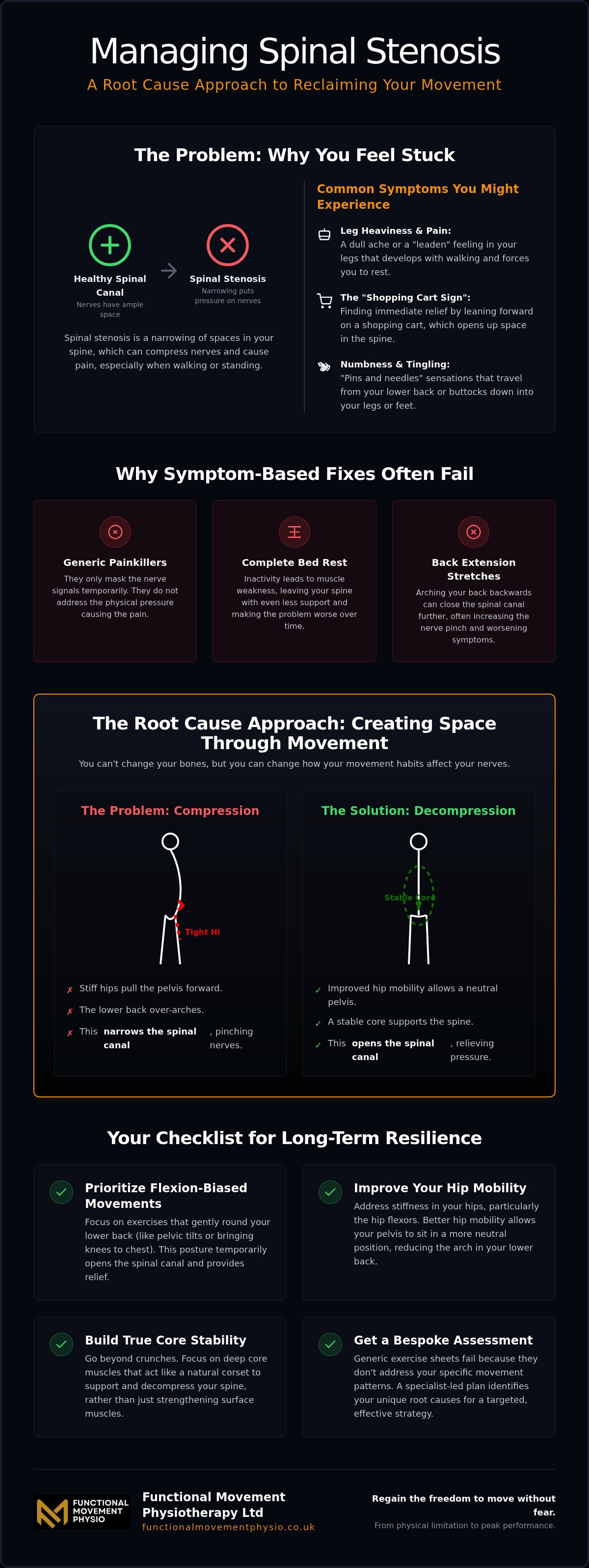
If you've been told you have spinal stenosis, it likely feels like a heavy diagnosis to carry. Essentially, What is Spinal Stenosis? refers to the narrowing of the spaces within your spine. This narrowing can put pressure on the nerves that travel through the column, leading to a specific type of discomfort known as neurogenic claudication. This is why your legs might feel weak, heavy, or painful after standing for just a few minutes.
You probably notice that the pain vanishes almost instantly when you sit down or lean forward. This "stuck" feeling is physically limiting and mentally exhausting. It's easy to look at an MRI report and see terms like "severe narrowing" and assume your active days are over. However, your scan is only one piece of the puzzle. It doesn't account for how you move or how your body can adapt. Understanding the mechanics of your spine is the first step toward finding effective spinal stenosis physio exercises Liverpool residents can use to reclaim their independence.
Common Symptoms You Might Experience
Stenosis doesn't always present as sharp, stabbing pain. Instead, it often manifests as a progressive set of sensations that interfere with your daily routine. You might experience:
- Leg Heaviness: A dull ache or a feeling of "leaden legs" that develops after walking short distances, forcing you to stop and rest.
- The Shopping Cart Sign: You find yourself leaning forward over a trolley or a walker because it creates physical space in your spine and provides immediate relief.
- Numbness and Tingling: Sensations that start in your lower back or buttocks and travel down into your calves or feet, often described as a "pins and needles" feeling.
Why Quick Fixes Usually Fail
When you're in pain, it's tempting to reach for the easiest solution. Many patients spend years searching for the right spinal stenosis physio exercises Liverpool clinics suggest, only to find that generic routines don't target their specific movement blocks. Here is why common approaches often miss the mark:
- Generic Painkillers: These mask the nerve signals but don't address the physical pressure on the canal. They are a temporary bandage, not a long term solution.
- Complete Bed Rest: While it feels better in the short term, inactivity leads to muscle weakness. This leaves your spine with even less support, making the narrowing more problematic.
- Extension Stretching: Many people try to "stretch out" their back by arching backward. In stenosis, this actually closes the spinal canal further, often worsening the nerve pinch.
Focusing purely on the bone narrowing misses the bigger picture. We need to look at how your body manages that space through movement and lifestyle adjustments.
The Root Cause Approach: Creating Space Through Movement
While a diagnosis of stenosis involves structural changes to the bone, it's a mistake to think you're powerless against it. You can't change the shape of your vertebrae without surgery, but you can certainly change the amount of pressure your movement habits place on your nerves. By implementing a tailored plan of spinal stenosis physio exercises Liverpool patients can often avoid the cycle of chronic pain and inactivity. The goal is to move from a state of compression to a state of decompression by addressing how your body carries itself.
Recent research on effective spinal stenosis exercises highlights that success comes from more than just staying active. It requires a specific focus on pelvic positioning and the relationship between your spine and your limbs. When you understand how to "create space" through better alignment, you give your nerves the room they need to function without being pinched during every step you take.
The Hip-Back Connection
Your hips and lower back work as a unit. If your hips are stiff, particularly the hip flexors at the front, they act like a tight bungee cord pulling your pelvis forward. This anterior tilt forces your lower back into an exaggerated arch, which physically narrows the spinal canal even further. By improving hip mobility, you allow your pelvis to sit back into a neutral position, naturally opening up the space for your nerves. The root cause is the functional limit that aggravates the anatomical narrowing.
Core Stability vs. Core Strength
There is a significant difference between having "six-pack" muscles and having a stable spine. Traditional sit-ups or crunches are often the worst choice for stenosis because they increase pressure within the abdomen and can force the spine into aggravating positions. True stability comes from the deep muscles that act as a natural corset, holding your spine in an open, neutral posture while you walk or stand.
This is why Clinical Pilates for back pain in Liverpool is so effective. It prioritises these deep stabilisers over superficial muscle mass. By building core strength to prevent back pain in this specific way, you develop the resilience needed to support your spine throughout the day. If you're tired of guessing which movements are safe, you can book a specialist assessment to find the exact movement blocks holding you back.
Your Checklist for Safe Movement and Exercise
Moving from understanding the root cause to daily management requires a clear set of rules. While general advice often suggests staying active, the specific mechanics of your condition mean that not all movement is equal. When searching for spinal stenosis physio exercises Liverpool patients must prioritise 'flexion-biased' movements. These are positions where your spine is slightly rounded or tucked, which physically opens the spinal canal and gives your nerves more room to breathe. Conversely, you should avoid activities that force your back into a deep arch, as this closes that space and triggers the classic leg pain you're trying to avoid.
Pacing is your most valuable tool for long-term resilience. It's not about how much pain you can tolerate, but how much activity you can perform without a flare-up. By monitoring your symptoms in real-time, you can stay active while ensuring you aren't causing further irritation to the sensitive nerve roots in your lower back.
Daily Activity Do's and Don'ts
Managing stenosis is as much about what you do in the kitchen or at the office as it is about what you do in the gym. Follow these practical guidelines to keep your spine in the 'safe zone' throughout the day:
- Do lean slightly forward if you need to stand for long periods, such as when washing up or waiting in a queue. This creates a small amount of flexion that unloads the nerves.
- Don't push through sharp leg pain, numbness, or a feeling of "giving way" in your limbs. These are clear signals that the nerve is under too much pressure.
- Do take regular 'unloading' breaks. If you've been walking or standing, sit down for a few minutes or perform a gentle knee-to-chest tuck to reset your spinal canal space.
How to Gauge Exercise Intensity
We use a 'Traffic Light' system to help you navigate your recovery without fear. A green light means your symptoms stay the same or actually improve during and after movement. A yellow light indicates a mild, familiar ache that settles quickly once you stop. A red light is a warning: if your leg pain or numbness intensifies, you must stop and adjust your position. You should stop your activity immediately if leg heaviness increases during a walk, as this is a clear sign of nerve compression.
The best guide for your progress is how you feel 24 hours after exercise. If you feel stiffer or more painful the next morning, the intensity or volume was likely too high. To ensure you're following a plan that's truly safe for your back, you can book an initial physiotherapy consultation for a professional movement screen.
Actionable Advice: 4 Key Exercises for Spinal Stenosis
Effective management of your symptoms depends on precision. While generic stretches might provide momentary relief, the following spinal stenosis physio exercises Liverpool residents can practice at home are designed to address the mechanical drivers of your pain. These movements focus on flexion to create the space your nerves require, helping you move from a state of limitation back toward peak performance.
Step-by-Step Guide to Pelvic Tilts
Pelvic tilts are the foundation of spinal control. They teach you how to find your "neutral" and prevent the painful arching that narrows the spinal canal. To perform this correctly:
- Lie on your back with your knees bent and feet flat on the floor.
- Gently flatten your lower back against the floor by tilting your pelvis toward your chin.
- Focus on the sensation of your tailbone "tucking" under.
- Hold this position for 5 seconds while breathing normally, then relax.
Repeat this 10 times. This exercise builds the muscle memory needed to maintain an open spine during daily activities like standing or walking.
The Knee-to-Chest Decompression
Think of this movement as your primary decompression tool. It is a simple yet powerful way to physically widen the spaces between your vertebrae and reduce nerve irritation. While lying on your back, bring one or both knees toward your chest. Hold the position for 30 to 60 seconds to feel a gentle opening in your lower back. This is a key movement used in our specialist physiotherapy in Liverpool to help patients "reset" their symptoms after a long day of activity.
Seated Forward Lean
This is your "reset button" for when symptoms flare up while you are out and about. If you feel leg pain or heaviness starting, find a place to sit and lean your torso forward over your knees. This mimics the relief found when leaning on a shopping cart, providing immediate decompression. It is a practical, sustainable way to manage your capacity without needing to lie down in public.
Building Strength with Modified Bridges
Strength is essential for long term resilience, but traditional bridges can be problematic if you over-arch your back. To modify this for stenosis, focus on squeezing your glutes rather than lifting your hips as high as possible. Keep your ribs tucked down toward your pelvis to avoid entering the painful "extension" zone. If your symptoms frequently travel down the leg, you may need the specific guidance of a sciatica specialist physio Liverpool to ensure your form is protecting the nerve.
Next Steps: Mastering Your Movement in Liverpool
While the techniques mentioned earlier provide a solid foundation, a generic exercise sheet is rarely enough for long term results. Spinal stenosis is a complex condition where structural changes interact with your unique movement habits. This is why a one size fits all approach often falls short. To truly regain your mobility, you need a plan that accounts for your specific biomechanical blocks and lifestyle goals. By refining your routine with professional spinal stenosis physio exercises Liverpool experts can help you move with precision and confidence.
You don't have to manage this condition alone or live in a constant state of anxiety about your next flare up. Our clinic focuses on a partnership between the specialist and the individual, ensuring you understand exactly why your body feels this way. We move beyond symptom management to help you master your own physical capabilities, transitioning from physical limitation to peak performance.
What to Expect from a Specialist Assessment
A professional consultation is more than just a list of movements. It is a deep dive into your body's functional patterns. We perform a thorough analysis of your gait, hip mobility, and spinal movement to see where the pressure is actually coming from. This clarity allows us to create a personalised plan that fits your specific needs, whether that's walking to the local shops or returning to the gym.
You'll leave with a clear understanding of which exercises will help unlock your potential and which activities you should temporarily avoid. This eliminates the guesswork and conflicting advice that often leads to frustration and fear of worsening your condition. Our goal is to provide a clear, actionable path toward long term resilience and sustainable movement.
Beyond the Exercises: Holistic Support
Our Liverpool clinic combines manual therapy with functional rehabilitation to provide a complete recovery experience. If you're struggling with significant nerve irritation, we may integrate medical acupuncture for effective symptom management. This helps settle the nervous system, making it easier for you to engage with your rehab exercises without constant discomfort.
Additionally, we often use sports massage to reduce the compensatory muscle tension that develops when you've been walking in a guarded or stiff way. By addressing these secondary issues, we create a better environment for your spine to heal and adapt. Take the first step toward sustainable movement and book your initial assessment today to start your journey back to purposeful, pain free living.
Reclaim Your Freedom of Movement
Managing spinal stenosis is about more than just avoiding pain; it's about restoring your capacity for a full, purposeful life. You've seen how focusing on the root cause, such as hip mobility and pelvic positioning, can physically create the space your nerves need to function. By shifting your focus toward flexion-biased movements and sustainable pacing, you can begin to walk longer distances without the constant fear of your legs giving way.
Success comes from a clear, evidence-based plan rather than a generic list of stretches. At our specialist Liverpool city centre clinic, we combine expert root cause analysis with personalised movement programmes to ensure your recovery is built for the long term. Using a structured approach to spinal stenosis physio exercises Liverpool residents can trust, you'll gain the tools to master your own physical capabilities and move with confidence once again.
You have the potential to move beyond your current limitations. We're here to provide the clinical expertise and supportive coaching you need to achieve sustainable results and return to the activities you love most.
Frequently Asked Questions
Can physiotherapy actually help with spinal stenosis?
Physiotherapy is highly effective for managing the symptoms of spinal stenosis by addressing the movement patterns that aggravate nerve compression. While we can't change the bony narrowing without surgery, we can change the pressure on your nerves. By improving hip mobility and core stability, you can walk further and stand longer. Our specialist spinal stenosis physio exercises Liverpool clinic focus on these functional improvements to help you regain your independence and avoid long term reliance on painkillers.
What is the best sleeping position for spinal stenosis?
Most people with stenosis find relief in a flexion-biased position that opens the spinal canal. If you sleep on your side, try drawing your knees slightly toward your chest and placing a pillow between them to keep your pelvis neutral. If you prefer sleeping on your back, place a large pillow or bolster under your knees. This slight bend in your hips helps flatten your lower back, reducing the extension that often pinches sensitive nerve roots.
Should I stop walking if my legs feel heavy or painful?
You shouldn't stop walking entirely, but you must avoid pushing through severe leg heaviness or sharp pain. This neurogenic claudication is a sign that your nerves are being compressed. Instead of stopping all activity, use pacing by taking frequent unloading breaks. Sit down or lean forward as soon as symptoms begin to settle the nerves. Over time, performing the right spinal stenosis physio exercises Liverpool specialists recommend will help increase your pain-free walking distance.
Is walking better than cycling for someone with spinal stenosis?
Cycling is often more comfortable than walking for individuals with stenosis because the seated, forward-leaning posture naturally opens the spinal canal. This flexion provides immediate decompression for the nerves. While walking is essential for daily life, it requires more active control of your pelvic position to avoid pain. We often suggest using a stationary bike as a safe way to maintain cardiovascular fitness while you work on the strength needed to walk longer distances comfortably.
How often should I perform these spinal stenosis exercises?
Consistency is the foundation of long term resilience. We typically recommend performing your mobility and decompression exercises, such as pelvic tilts and knee-to-chest tucks, once or twice daily to keep the spinal canal open. Strength-based movements, like modified glute bridges, are usually performed two to three times per week. The exact frequency depends on your current capacity, which is why a professional movement screen at our Liverpool clinic is vital for a sustainable plan.
Can I avoid surgery for spinal stenosis with the right physio?
Many individuals successfully avoid or significantly delay surgery by following a structured conservative management plan. Surgery is often considered when functional mobility is severely limited or if neurological symptoms worsen despite rehab. By focusing on the root cause of your movement blocks, you can improve your quality of life and manage symptoms effectively. Our goal is to help you master your own physical capabilities so that surgery becomes a last resort rather than an immediate necessity.
What exercises should I avoid if I have been diagnosed with stenosis?
You should generally avoid exercises that force your lower back into deep extension or arching, such as Cobra stretches or standing back bends. These positions physically narrow the spinal canal and can pinch nerve roots. Additionally, heavy overhead presses or high-impact activities like running can be problematic if you haven't yet built the necessary core stability. It's essential to replace these aggravating movements with flexion-biased alternatives that support your spine while building functional strength.
How long does it take to see results from physio exercises?
You may feel a reduction in nerve irritation within the first few weeks as you learn to decompress your spine and adjust your daily postures. However, building the deep core stability and hip mobility required for long term results typically takes eight to twelve weeks of consistent effort. Your progress depends on the severity of your symptoms and your commitment to the plan. A bespoke assessment at our Liverpool clinic ensures you're moving in the right direction from day one.

Article by
Stuart Goldfinch
HCPC PH112156
Specialist MSK Physiotherapist
Ex UK SAS Trainer
Graduate Sports Rehabilitator


