

The surgery you're dreading might be a temporary fix for a structural issue that actually starts with how you move. When chronic discomfort forces you to stop running or avoid the gym, it's common to feel trapped between accepting physical limitation or facing the risks and downtime of the operating table. If you're looking for the most effective non-surgical treatment for knee pain Liverpool has to offer, it's essential to look beyond the joint itself and prioritize functional movement over temporary symptom relief.
We agree that the cycle of resting and then relapsing is exhausting, especially when you're managing conflicting medical advice. You deserve to understand exactly why your knee is failing you so you can return to the activities you love without fear. This guide will show you how to resolve chronic pain and avoid unnecessary surgery by identifying the functional root cause of your injury. We'll preview the specific steps needed to transition from pain to peak performance with a clear plan for your long term knee health.
Key Takeaways
- Learn why steroid injections and generic painkillers often provide only temporary relief by masking symptoms without addressing the underlying mechanical flaws.
- Discover how a comprehensive non-surgical treatment for knee pain Liverpool focuses on restoring functional movement to provide a long term alternative to surgery.
- Understand the vital link between your hip and ankle stability and how imbalances in these areas are often the hidden cause of persistent knee strain.
- Explore how advanced interventions like Shockwave Therapy and gait analysis can accelerate recovery for chronic tendon issues and biomechanical errors.
- Gain a clear roadmap for moving from physical limitation back to your peak gym or running performance through a specialist led assessment.
Introduction: Can Knee Pain Be Treated Without Surgery?
Knee pain isn't just a physical sensation; it's a barrier to the life you've built. Whether you're a regular at a Liverpool CrossFit box or you enjoy weekend runs along the Mersey, a nagging ache or a sharp catch in the joint can feel like the beginning of the end for your athletic pursuits. You might have been told that your "bone is rubbing on bone" or that a tear is irreversible. This often leads to the assumption that surgery is the only logical next step. However, for many individuals, the most effective non-surgical treatment for knee pain Liverpool offers is one that addresses why the joint failed in the first place, rather than just attempting to "fix" the damage inside it.
We see patients every day who fear they've lost their mobility forever. This anxiety is often fueled by conflicting medical advice or the belief that a structural change on an MRI scan equals a lifetime of pain. Our approach shifts the focus from the "broken part" to the "working system." By identifying the functional root cause, we help you build a body that can withstand the pressures of high-level activity without the need for invasive procedures. This isn't about masking symptoms; it's about restoring the way you move.
The Reality of Knee Pain in Active Adults
Living with chronic knee pain is exhausting. You've likely tried resting, icing, and perhaps even generic physiotherapy exercises, only to find the pain returns the moment you increase your mileage or weight on the bar. Conditions like meniscus tears, patellofemoral pain (runner's knee), and understanding osteoarthritis are incredibly common, affecting millions across the UK. In fact, musculoskeletal conditions impact over 20 million people nationally. The emotional toll of being sidelined is significant, but it doesn't have to be permanent. The goal of this guide is to provide a roadmap for avoiding the operating theatre by mastering your own physical capabilities.
What is Specialist Non-Surgical Treatment?
True recovery requires more than just a list of leg extensions. Specialist non-surgical treatment for knee pain Liverpool involves a deep dive into your unique biomechanics. We look at how your hips, ankles, and core stability influence the load on your knee joint. By using tools like gait analysis, we identify the hidden imbalances that cause repetitive strain.
This targeted clinical intervention moves beyond generic advice. It's about building a joint that is more resilient than it was before the injury started. We focus on functional restoration, ensuring your body can handle the specific demands of your sport or daily life without relying on temporary fixes. This isn't about a quick fix that fails after a month. It's about a structured journey toward long-term health and peak performance.
The Problem: Why Quick Fixes and Injections Often Fail
Many individuals seeking non-surgical treatment for knee pain Liverpool first turn to quick fixes like steroid injections or high-dose anti-inflammatories. While these can provide immediate relief from acute inflammation, they often create a false sense of security. The danger lies in masking the pain while the underlying mechanical issue persists. If you numb the warning signal without fixing the movement pattern that caused the damage, you're likely to return to the gym and cause further structural harm.
Repeated cortisone injections can actually be counterproductive. Evidence suggests that while they offer short term comfort, they may weaken tendon health and cartilage over time. Relying on these interventions without a plan for functional restoration is a strategy for temporary relief, not long term health. It's a cycle that leaves many athletes and active adults feeling stuck and frustrated.
The Trap of Symptom-Based Treatment
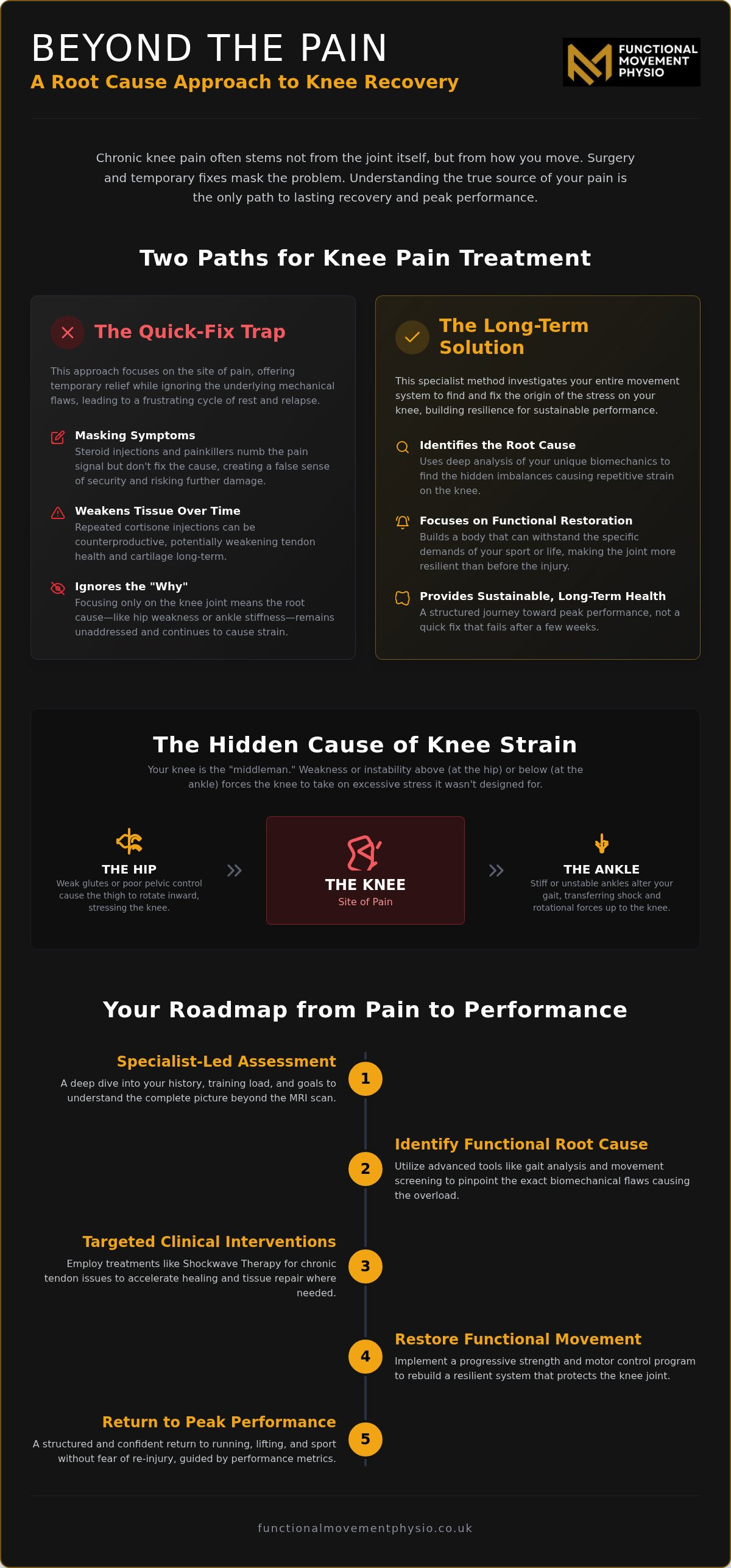
Treating only the site of the pain ignores the global movement system. Your knee is essentially a middleman between the hip and the ankle. If your hip is weak or your ankle is stiff, the knee takes the brunt of the force. This is why general physiotherapy sessions sometimes fail to deliver lasting results. If the therapist only looks at the knee and ignores your overall biomechanics, the root cause remains untouched.
Rest alone rarely solves a mechanical loading problem. While it might settle the initial flare-up, the moment you resume running or lifting, the same stresses will reappear. You can find more information on NHS non-surgical treatments that emphasize active management over passive rest. True recovery requires a proactive approach to strengthen the structures that support the joint.
Why Surgery Should Be the Last Resort
Surgery is often framed as a guaranteed permanent fix, but the reality is more complex. Invasive procedures come with risks, including infection and blood clots, and recovery times can stretch into many months. Even with a successful operation, your final outcome depends heavily on the quality of your rehabilitation. Surgery fixes the structure, but it doesn't automatically fix the movement habits that led to the injury.
If you don't address the movement patterns that caused the issue, even a new joint or a repaired meniscus can eventually fail under the same old stresses. For those who have already undergone a procedure, our Post-Operative Rehabilitation Liverpool guide explains how to maximize your recovery. However, exploring a comprehensive non-surgical treatment for knee pain Liverpool first allows you to build resilience without the trauma of surgery.
If you're tired of temporary fixes and want to identify the true source of your pain, we invite you to schedule an initial consultation to start your recovery journey today.
The Root Cause Approach: Identifying Why Your Knee Actually Hurts
The knee is rarely the original source of its own trouble. It functions as a hinge between your hip and your ankle, making it highly vulnerable to any dysfunction occurring above or below it. When we provide a non-surgical treatment for knee pain Liverpool, we begin by evaluating your entire kinetic chain. If your ankle lacks mobility or your hip lacks stability, your knee joint is forced to compensate, leading to the repetitive strain that eventually feels like a chronic injury.
Our philosophy focuses on understanding your knee's loading capacity. This is the specific amount of stress your joint can safely handle before it begins to break down. By identifying why you've exceeded this capacity, we can create a plan that doesn't just rest the joint, but actually rebuilds its resilience. This comprehensive biomechanical assessment is the foundation of sustainable recovery for active adults.
Beyond the MRI: Functional Assessment
A common misconception is that an MRI scan provides a complete diagnosis. While scans are useful for seeing structural changes, they don't show how your body moves during a run or a heavy lift. Research confirms that many active adults have structural "damage" on scans but experience no pain at all. This is why a functional assessment is critical. We use Gait Analysis Liverpool to observe your foot strike and hip control in real time.
By observing how you load your joints, we can differentiate between a permanent structural issue and a fixable movement error. This evidence-based approach aligns with modern non-surgical treatments for hip and knee pain, which prioritize physical capacity over surgical intervention. We look for hidden imbalances that a static scan simply cannot detect.
Fixing the Movement Pattern
Once we identify these hidden imbalances, the focus shifts to retraining your movement patterns. If your gluteal muscles are weak, your knee may track inward during a stride, putting immense pressure on the meniscus and ligaments. By strengthening the "engine" of the hip, we can effectively offload the knee joint. This allows the irritated tissues to heal while you remain active.
This holistic view is what makes a specialist non-surgical treatment for knee pain Liverpool so effective for long term results. We don't just want to stop the pain; we want to optimize your physical capacity. When your hip and ankle work in harmony, your knee is no longer the victim of poor biomechanics. You gain the resilience needed to return to the gym or the running track with total confidence.
Specialist Non-Surgical Treatments for Knee Recovery in Liverpool
Moving from a state of physical limitation to peak performance requires more than just generic rest or basic stretches. For many active adults, a comprehensive non-surgical treatment for knee pain Liverpool involves integrating advanced clinical technologies with targeted movement therapy. These interventions are designed to accelerate tissue healing and build the structural integrity needed to avoid the operating table. We focus on evidence-based modalities that provide a clear pathway back to the gym or the running track.
Our approach combines specialized tools to address both the symptoms and the mechanical flaws identified in your initial assessment. By utilizing advanced diagnostics and treatment options, we ensure that every intervention serves the ultimate goal: the restoration of full, purposeful movement in your daily life. This isn't about temporary relief; it's about creating a knee joint that is more resilient than it was before your injury began.
Shockwave Therapy for Chronic Knee Pain
For individuals dealing with chronic tendon issues, such as patellar tendinopathy or "jumper's knee," Shockwave Therapy Liverpool offers a powerful, non-invasive alternative to surgery. This technology uses acoustic pressure waves to stimulate metabolic activity in damaged tissues that have stopped healing on their own. It effectively "restarts" the body's natural repair process in non-responsive injuries.
Shockwave therapy is particularly effective because it requires no downtime and carries none of the risks associated with invasive procedures. It's an ideal choice for those who have seen little progress with traditional rest or cortisone injections. By targeting the specific site of tendon degeneration, we can promote faster recovery and reduce localized pain without the trauma of an operation.
Clinical Pilates and Strength Training
Building long term knee health requires a foundation of stability and controlled force. Clinical Pilates Liverpool plays a vital role in this by focusing on the core and hip stability that protects the knee joint. Unlike generic gym classes, our clinical sessions are tailored to your specific biomechanical needs, ensuring that you build strength in a safe and controlled environment.
This targeted strength training ensures that your knee isn't forced to compensate for weaknesses elsewhere in the kinetic chain. As your capacity improves, we transition you from clinical treatment to high-performance movement. This progression is essential for preventing future injury and ensuring that you can return to high-impact activities like running or lifting with total confidence in your physical capabilities.
We also utilize medical acupuncture to manage localized pain and inflammation during the recovery process. By targeting specific trigger points, we can reduce muscle tension and improve blood flow to the joint. This creates an optimal environment for healing, making it easier for you to engage in the strengthening exercises that are essential for your long term progress.
Actionable Advice: Your Roadmap to Sustainable Knee Health
Transitioning from physical limitation back to peak performance isn't a matter of luck. It's the result of a structured, evidence-based plan that prioritizes function over temporary relief. If you've been searching for an effective non-surgical treatment for knee pain Liverpool, your first move must be away from the cycle of "rest and repeat" toward a strategy of proactive resilience. This roadmap provides the structure you need to stop feeling stuck and start making sustainable progress.
We believe in a partnership where you're the master of your own physical capabilities. By understanding the "why" behind your discomfort, you can make informed decisions about your training and daily life. The following steps are designed to move you beyond symptom management and toward long term joint health.
Step 1: Get a Professional Biomechanical Assessment
Expert opinion is vital to break the cycle of recurring pain. Self-diagnosis often leads to unnecessary fear or a reliance on total rest, which can actually weaken the joint further. A specialist assessment looks beyond the site of pain to identify the functional root cause in your kinetic chain. For a deeper look at this process, read our guide on the Conservative Management of Knee Injuries.
During your first visit, don't be afraid to ask direct questions. You should understand how your hip and ankle mobility are influencing your knee load. Ask your therapist for a clear explanation of which specific tissues are irritated and what the exact plan is to bridge the gap between your current pain and your goal of returning to the gym or running.
Step 2: Implement a Progressive Loading Plan
One of the most common mistakes is stopping all activity. We advocate for "relative rest," which means modifying your intensity or volume rather than quitting entirely. Complete inactivity leads to muscle atrophy and reduced joint capacity. A progressive loading plan involves gradually reintroducing weight-bearing activities in a way that challenges the tissue without causing a flare-up.
This progression often starts with isometric holds to build strength without joint movement, eventually moving to slow eccentrics and dynamic movements. If you're an athlete aiming for a high-level comeback, our Return to Sport Assessment Liverpool is an essential resource. It ensures you've met the specific strength and stability benchmarks required for high-impact activities.
Sustainable knee health also requires realistic lifestyle adjustments. Ensure you're prioritizing recovery through quality sleep and adequate nutrition. Check your footwear for excessive wear and consider how your daily work posture might be contributing to stiffness. When you combine these small adjustments with a specialist non-surgical treatment for knee pain Liverpool, you create an environment where long term resilience is the inevitable outcome.
Reclaiming Your Movement Without Surgery
Reclaiming your physical capacity starts with moving beyond the search for a quick fix. By identifying the movement patterns that contribute to joint strain, you can move away from the anxiety of potential surgery and toward a future of sustainable, high-performance activity. Our approach in the heart of Liverpool focuses on building a joint that is more resilient than it was before your injury began.
Choosing a comprehensive non-surgical treatment for knee pain Liverpool means investing in a long term solution rather than a temporary patch. At Functional Movement Physio, we prioritize evidence-based interventions that empower you to understand your own biomechanics and achieve lasting results. We focus on a partnership that transitions you from physical limitation to peak performance, ensuring your recovery is built on a foundation of purposeful movement.
You have the potential to return to the gym or the running track with total confidence. We're here to provide the expert guidance and clinical care needed to help you master your own physical capabilities. Your journey toward a pain free, active life starts with a clear, actionable plan.
Frequently Asked Questions
Can a meniscus tear really heal without surgery?
Many meniscus tears can be successfully managed without an operation. While the inner part of the meniscus has a limited blood supply, the outer "red zone" has a higher healing potential. Even for tears that don't physically knit back together, we can resolve your pain by improving how the joint handles load. Our goal is to strengthen the surrounding musculature to provide the stability the meniscus can no longer offer.
How long does it take to see results from non-surgical knee treatment?
You will typically notice improvements in your pain levels within two to four weeks of starting your plan. However, true structural change and tissue remodeling take longer. A comprehensive non-surgical treatment for knee pain Liverpool usually requires three to six months to achieve peak results. This timeline ensures we aren't just masking your symptoms but are actually building the long term resilience needed for you to return to high impact activities safely.
Is shockwave therapy painful when used on the knee?
Shockwave therapy is generally described as uncomfortable rather than painful. You might feel a deep, pulsing sensation as the acoustic waves target the damaged tendon. The intensity is always adjusted to your tolerance level. Most patients find the sensation manageable, especially since sessions are relatively short. This non-invasive technology is a vital tool for stimulating healing in chronic injuries that haven't responded to traditional rest or generic exercises.
Do I need a GP referral to see a private physiotherapist in Liverpool?
You don't need a GP referral to book an Initial Physiotherapy Consultation at Functional Movement Physio. We are first-contact practitioners, meaning we're qualified to assess, diagnose, and treat your condition directly. If our assessment suggests you need further imaging or a surgical opinion, we can guide you through that process. This direct access allows you to skip long waiting lists and start your recovery journey in Liverpool immediately.
Can I continue running while undergoing non-surgical treatment?
You can often continue running, but your training volume and intensity will likely need modification. We use a concept called "relative rest" to keep you active without overloading the sensitive joint. By using gait analysis, we identify specific technical errors that might be causing flare-ups. This allows us to adjust your running mechanics so you can keep moving while we address the functional root cause of your injury.
What is the success rate of physiotherapy compared to knee surgery?
Clinical studies often show that physiotherapy is just as effective as surgery for common issues like degenerative meniscus tears and osteoarthritis. Choosing a non-surgical treatment for knee pain Liverpool allows you to avoid the risks associated with invasive procedures, such as infection or blood clots. Success depends on your commitment to the rehabilitation plan and addressing the biomechanical imbalances that led to the joint strain in the first place.
Is my knee pain caused by my shoes or my running technique?
While footwear provides support, your running technique and underlying strength are much more significant factors in knee health. A common mistake is buying corrective shoes to fix a pain that actually stems from weak hips or poor foot strike. Our specialist assessments look at your entire movement profile to determine if your shoes are helping or hindering you. Usually, retraining your movement patterns provides more sustainable results than a new pair of trainers.
Will clinical pilates help if I have osteoarthritis in my knee?
Clinical Pilates is exceptionally beneficial for managing knee osteoarthritis. It focuses on low impact strength and core stability, which helps to offload the pressure on the arthritic joint. By building the muscles around the hip and knee, you can improve your mobility and reduce daily discomfort. Our 1:1 sessions are tailored to your specific capacity, ensuring you build resilience without causing a flare-up of your symptoms.
Article by
Stuart Goldfinch
HCPC PH112156
Specialist MSK Physiotherapist
Ex UK SAS Trainer
Graduate Sports Rehabilitator


