

The generic exercise sheet you received at discharge might actually be holding your recovery back. While surgery is often necessary to repair a structural issue, the procedure itself doesn't automatically restore your ability to move with confidence or power. You've likely spent weeks navigating conflicting advice on when to start moving, all while that nagging fear of re-injury keeps you from pushing forward. It's frustrating to feel like you're stuck in a cycle of basic healing when your goal is to get back to the gym or the running track.
Choosing the right specialist post-operative rehabilitation liverpool provides is the difference between simply "getting by" and returning to peak physical performance. You deserve a recovery plan that moves beyond symptom management and addresses the underlying movement flaws that may have contributed to your injury in the first place. This guide will help you navigate your options to find a partner who values long-term resilience over temporary fixes.
We'll examine the essential elements of a high-performance recovery plan, from the importance of functional movement patterns to the role of clinical Pilates and sports massage in your journey back to full, purposeful movement.
Key Takeaways
- Learn why successful surgery is only the structural foundation and why targeted movement retraining is essential to restore your full physical capacity.
- Understand the limitations of generic exercise protocols and how a personalised approach prevents the development of long term compensatory habits.
- Discover the criteria for selecting the best provider for post-operative rehabilitation liverpool by prioritising specialists who identify the root cause of movement dysfunction.
- Identify the critical milestones of a professional recovery plan, moving from early mobilisation to the resumption of high performance activities.
- Find out how a bespoke 1:1 rehabilitation strategy helps you overcome the fear of re-injury and ensures a sustainable return to your peak physical state.
Why Surgery is Only the First Step Toward Your Full Recovery
A successful surgery is a structural win, but it is not a guarantee of a return to your previous lifestyle. The surgeon's role is to repair the physical damage; your role, alongside a specialist, is to retrain your brain and muscles to use that repair effectively. You might have a new ligament or a cleaned-up joint, but your body still remembers the pain and the limitations that led you to the operating table in the first place. This is why a structural fix is only half the battle.
Post-operative rehabilitation is a structured, evidence-based process designed to restore strength, coordination, and confidence. It is a specific branch of healthcare that goes beyond simple rest. To understand the broader scope of these interventions, you can explore the foundational principles of What is Physical Therapy. In the context of post-operative rehabilitation liverpool, this process ensures that your recovery is proactive rather than passive. Relying solely on a surgeon's "all clear" is a common mistake for active individuals. Their "all clear" usually means the tissue has knitted together; it doesn't mean you are ready to sprint, pivot, or lift.
There is a significant difference between tissue healing and functional recovery. Healing is a biological timeline where your body mends the incision and the internal repair. Functional recovery is the process of regaining the capacity to perform complex movements without pain or compensation. If you ignore the latter, you are simply waiting for the next injury to happen because the movement flaws that caused the initial failure remain unaddressed.
The Gap Between Hospital Discharge and the Gym
Standard hospital protocols are designed for basic safety and independent living. They ensure you can navigate your home, use the stairs, and manage daily tasks without assistance. While this is a vital first step, it is not a high-performance plan. If you are a runner or a regular at the gym, you need a bridge between that final hospital checkup and your first training session. Specialist post-operative rehabilitation liverpool services provide this bridge, managing early-stage inflammation while carefully restoring the range of motion required for your specific sport or activity.
Why Tissues Need Controlled Stress to Heal
Your body is incredibly adaptive. It responds to the demands placed upon it through mechanotransduction, a biological process where movement signals your cells to strengthen and repair tissue. Avoiding movement entirely can lead to stiffness and muscle wasting. However, the trap is often "too much, too soon" or "too little, too late." You need a professional to calibrate this stress. A major part of this is restoring proprioception, which is your body's internal sense of where your limbs are in space. Surgery often disrupts these sensory signals, and without retraining them, your movement will remain hesitant and inefficient.
The Problem with Generic Post-Surgical Exercise Sheets
Most patients leave the hospital with a photocopied sheet of basic exercises. While these movements are designed to prevent major complications like blood clots, they are rarely enough to get an active individual back to the gym or the running track. These generic protocols are built for the "average" patient, often ignoring your unique biomechanics, your pre-injury history, and your specific athletic goals. If you want to move beyond basic stability and return to high-level performance, you need a plan that is as specific as your surgery was.
Relying on a standard guide to recovery after surgery is a helpful starting point for general safety, but it doesn't account for the nuances of your recovery. Standard healthcare often defaults to a "wait and see" approach, telling you to rest until the pain subsides. This passivity is frustrating for those used to being proactive. It also relies on the dangerous myth that pain levels are the only measure of success. In reality, you can be pain-free while still moving with significant dysfunction that sets you up for a secondary injury.
Effective post-operative rehabilitation liverpool requires more than just checking boxes on a list. It demands a critical look at how your entire body has adapted to the trauma of surgery. If your rehab specialist isn't looking at how your movement has changed as a whole, they're missing the bigger picture.
The Danger of Compensatory Movement Patterns
Your body is a master of adaptation. When one joint is compromised by surgery, your nervous system "cheats" by shifting the workload to other areas. This is how a knee surgery can quickly manifest as chronic hip or lower back pain. You might think you're getting stronger, but you're actually reinforcing "limp patterns" that bypass the muscles you need to be training. Specialist post-operative rehabilitation liverpool uses detailed gait analysis and movement screening to spot these hidden flaws before they become permanent habits.
Why Quick Fixes Fail the Long-Term Test
Temporary pain relief is not the same as permanent functional change. You can use ice and rest to manage symptoms, but unless you change the way you move, the underlying issue remains. Just "doing the exercises" on your sheet isn't enough if your form is off. Without professional feedback, you might be performing reps that actually reinforce your dysfunction. You can learn more about this by reading our guide on finding the root cause of my running pain. If you're ready to stop guessing and start a plan built for your specific needs, you can book an initial consultation to begin your specialist recovery.
The Root Cause Framework: How to Choose a Liverpool Rehab Specialist
Choosing the right clinic for post-operative rehabilitation liverpool is not just about finding the most convenient location or the flashiest equipment. It is about finding a specialist who looks beyond the surgical scar to understand why your joint failed in the first place. Many clinics focus only on the "what", which is the specific surgery you had. A high-performance mentor focuses on the "why"; they identify the underlying movement patterns that led to the initial injury. If your therapist does not investigate the root cause, you are likely to find yourself back in the same position in the future.
When evaluating your options, prioritise 1:1 sessions over group classes. Group environments often lack the precision required to catch subtle compensatory movements that your brain uses to "cheat" around pain. You need a clinician who integrates manual therapy to manage tissue tension with functional strength training to build long-term resilience. Being based in Liverpool city centre means you have access to a local expertise network that understands the specific demands of your lifestyle, whether you are training for a local race or returning to a high-intensity gym routine.
Essential Questions to Ask Your Prospective Physiotherapist
Before committing to a plan, you should feel empowered to interview your therapist. Ask them directly about their experience with your specific surgical procedure, such as an ACL reconstruction or a rotator cuff repair. You should also ask:
- Do you use video analysis or objective strength testing to track my progress?
- How do you coordinate with my surgeon to ensure we are following their specific post-op constraints?
- What is your approach to identifying the root cause of my original injury?
A clinic that relies on data rather than a gut feeling provides a safer and more predictable path to recovery. It ensures that every step you take is backed by evidence and tailored to your current physical capacity.
The Role of Integrated Care: Massage and Pilates
The gold standard of post-operative care is a multi-modal approach. This means your rehab is not just a list of exercises; it is a holistic plan. Sports massage plays a vital role in managing scar tissue and improving local circulation, which is essential for regaining mobility in the early phases. It helps alleviate the secondary tension that often builds up in muscles surrounding the surgical site.
As you progress, 1:1 Clinical Pilates becomes an invaluable tool. It allows you to restore core stability and fine-tune your movement patterns in a controlled environment. By combining these services, you ensure that every aspect of your physical capacity is being optimised. This integrated strategy is what transitions you from a patient who is healing to an athlete who is performing. If you are ready to start this journey, you can book an initial consultation to discuss your bespoke plan.
This commitment to high-standard, multi-modal care is essential for any family member, including the four-legged ones; pet owners in London can discover Streatham Hill Veterinary Surgery for award-winning, 24-hour animal care that mirrors this professional approach to health and recovery.
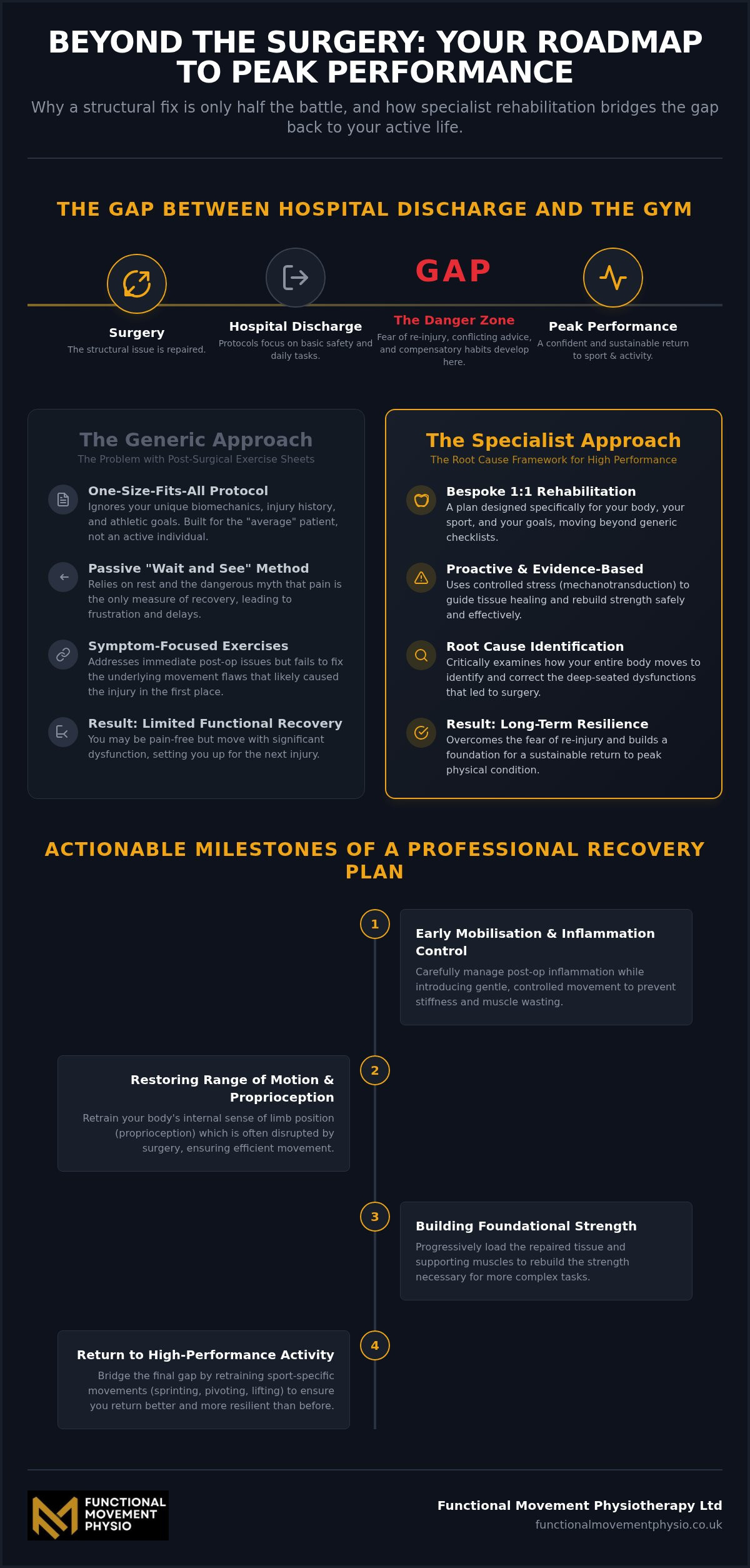
Actionable Milestones: Measuring Your Progress in Liverpool
Recovery following surgery is not a linear process, nor is it a guessing game. It is a series of data-driven phases, each with specific requirements that must be met before moving to the next. High-quality post-operative rehabilitation liverpool ensures you aren't just passing time, but actively hitting benchmarks that guarantee a safe return to your previous activity levels. If your current plan feels aimless, you are likely missing the objective milestones that bridge the gap between "healed" and "high-performing."
Your journey typically follows three distinct stages:
- Phase 1: Protection and Early Mobilisation. The priority here is respecting the surgical repair. We focus on managing swelling and gently restoring basic movement without putting the new tissue at risk.
- Phase 2: Fundamental Movement and Strength. Once the tissue is stable, we begin retraining your brain and muscles to work together. This phase is about restoring the movement patterns you lost while injured.
- Phase 3: Sport-Specific Conditioning. This is the final push. We introduce higher loads, speed, and agility drills tailored to your specific goals, ensuring your body can handle the "chaos" of real-world activity.
A common misconception is that achieving a full range of motion means your rehab is finished. In reality, being able to move a joint through its full range is only the halfway point. Without the strength, power, and coordination to control that movement under load, you remain at a high risk of re-injury. True post-operative rehabilitation liverpool doesn't stop until your operated limb is as strong, if not stronger, than your healthy one.
The Importance of Objective Testing
We move beyond the subjective question of "how do you feel?" and focus on "how do you move?" Feeling good is a poor indicator of readiness for the gym. Instead, we use objective strength benchmarks and video analysis to measure your progress. For example, if you are recovering from a lower-limb procedure, we look at limb symmetry indices to ensure your strength is balanced. You can see how these milestones apply to specific injuries in our runners knee recovery guide, which details the metrics needed for a safe return to impact.
Preparing for the Return to Sport
The final phase of your recovery must mimic the demands of your life in Liverpool. For the growing community of padel and tennis players in the city, this means reintroducing rotational power and lateral speed. For footballers or runners, it involves a graduated return-to-play protocol that tests your capacity for high-impact loading. This stage is also about the psychological transition. We help you move from the mindset of an "injured patient" back to that of a "confident athlete." If you are ready to stop wondering if you're ready and start knowing, you should book an initial consultation to begin your structured recovery plan.
Start Your Recovery at Functional Movement Physio Liverpool
At Functional Movement Physio, we don't believe in a one size fits all approach to healing. Our commitment to post-operative rehabilitation liverpool begins with a deep dive into the root cause of your surgical requirement. Whether you've undergone a joint replacement, a ligament repair, or a spinal procedure, we investigate the movement dysfunctions that may have contributed to your original injury. Our goal isn't just to help you recover; it's to help you master your own physical capabilities so you can avoid future setbacks.
We provide bespoke 1:1 rehab plans tailored specifically to your goals and lifestyle. You won't find generic exercise sheets here. Instead, you'll work with a high performance mentor who understands the unique demands of your sport or daily routine. Our Liverpool city centre location ensures that high quality, specialist care is convenient and accessible, allowing for the consistency required to achieve lasting results. We view our relationship with you as a partnership, guiding you from the initial days of physical limitation back to your peak performance.
What to Expect During Your Initial Consultation
Your journey starts with a comprehensive biomechanical assessment. We look far beyond your surgical scar to understand how your entire body is functioning as a system. This involves analysing your movement patterns, identifying compensatory habits, and testing your current strength levels. It's a thorough process that provides the data we need to build your specific recovery strategy.
By the end of your first session, you'll have a clear, written roadmap for your recovery journey. You won't be left wondering what comes next. We provide immediate actionable advice that you can implement today to start improving today. This structure creates a sense of safety and professional guidance, ensuring you feel supported at every touchpoint.
Your Path Back to Purposeful Movement
Our focus on functional movement patterns is what makes us different from standard clinics. We don't just treat symptoms; we optimise your physical capacity. By integrating tools like Clinical Pilates 1:1 and sports massage into your plan, we ensure that your recovery is holistic and sustainable. We help you move beyond the fear of re-injury by building a foundation of strength and coordination that lasts for years to come.
Stop settling for "good enough" or a life limited by surgical recovery. You have the potential to return to the activities you love with more confidence than before. It's time to transition from basic healing to peak performance. We invite you to book your post-operative assessment and take the first step toward restoring full, purposeful movement in your daily life.
Take the Next Step Toward Peak Physical Performance
Your recovery doesn't end when you leave the hospital; it's where the real work of restoring your physical potential begins. You now understand that structural repair requires functional retraining to prevent future issues and compensatory habits. By choosing a specialist who prioritises objective data over generic protocols, you ensure your return to activity is both safe and sustainable.
Specialist post-operative rehabilitation liverpool at our city centre clinic provides the expertise in sports and functional movement you need to move with purpose again. We focus on our signature root cause approach to identify why your body failed and how to make it more resilient than ever. Stop guessing about your progress and start following a roadmap designed for your specific lifestyle; if you also need to ensure your business finances are in order while you focus on health, you can learn more about the professional support offered by Fair View Accounting Services.
Book your Specialist Post-Operative Assessment in Liverpool today to move beyond basic healing. We're here to help you master your movement and achieve the high-performance results you deserve.
Frequently Asked Questions
When should I start physiotherapy after my surgery?
You should typically start your rehabilitation as soon as your surgeon allows, which is often within the first few days for early stage mobilisation. This initial phase focuses on reducing swelling and maintaining joint health without stressing the repair. Early intervention prevents muscle wasting and joint stiffness, setting a stronger foundation for the more intensive strength work that follows in later weeks of your recovery.
Do I need a referral from my surgeon to start private rehab in Liverpool?
You don't need a formal referral from your surgeon to begin post-operative rehabilitation liverpool at a private clinic. While we often coordinate with consultants to ensure we follow specific surgical constraints, you can self-refer to start your recovery immediately. This direct access allows you to bridge the gap between hospital discharge and your return to activity without waiting for standard healthcare appointments.
How often will I need to attend sessions during my recovery?
The frequency of your sessions depends on your specific stage of recovery and the complexity of your surgery. In the early protection phase, you might attend once or twice a week to manage inflammation and monitor movement. As you progress into the functional strength phase, sessions may become less frequent but more intensive, focusing on high level conditioning and objective performance testing to ensure long term resilience.
Can I do post-operative rehab if my surgery was several months ago?
It is never too late to start a structured rehab program, even if your surgery was several months or even years ago. If you still feel hesitant or experience lingering pain, it is likely because your body has developed compensatory movement patterns. We focus on identifying these root causes and retraining your movement to ensure you can finally move beyond basic healing and return to your peak performance.
What is the difference between NHS physio and private post-operative care?
Private care typically offers more consistent 1:1 time and a focus on high performance rather than just basic safety. While the NHS provides excellent emergency care, their outpatient resources are often stretched, leading to generic exercise sheets and group sessions. Private post-operative rehabilitation liverpool allows for bespoke plans that include video analysis, manual therapy, and sport specific drills tailored to your unique athletic goals.
Will my health insurance cover post-operative rehabilitation at your clinic?
Many private health insurance providers cover physiotherapy when delivered by HCPC registered professionals. You should check the specific terms of your policy regarding post-operative care and whether you need to be referred by a GP or consultant first. We maintain high professional standards to ensure our services are recognised by major insurers, helping you access the specialist support you need for a successful recovery; for those who also require specialized occupational health clearances for their career, you can learn more about Persona Health to see how expert medical assessments support workplace safety.
How do I know if my rehab is actually working?
You will know your rehabilitation is working through objective data rather than just how you feel. We use specific strength benchmarks, range of motion measurements, and functional movement screens to track your progress accurately. If your operated limb is getting closer in strength to your healthy side and you are hitting your phase specific milestones, you are moving in the right direction toward a full recovery.
Is it normal to have pain during my physiotherapy sessions?
Some level of discomfort or "working" pain is normal as you reintroduce movement and load to the surgical site. However, sharp or catching pain is usually a signal that the intensity needs to be adjusted. Our role is to help you navigate this threshold safely. We teach you how to distinguish between beneficial stimulus that promotes tissue repair and harmful stress that could compromise your recovery.
Article by
Stuart Goldfinch
HCPC PH112156
Specialist MSK Physiotherapist
Ex UK SAS Trainer
Graduate Sports Rehabilitator


