

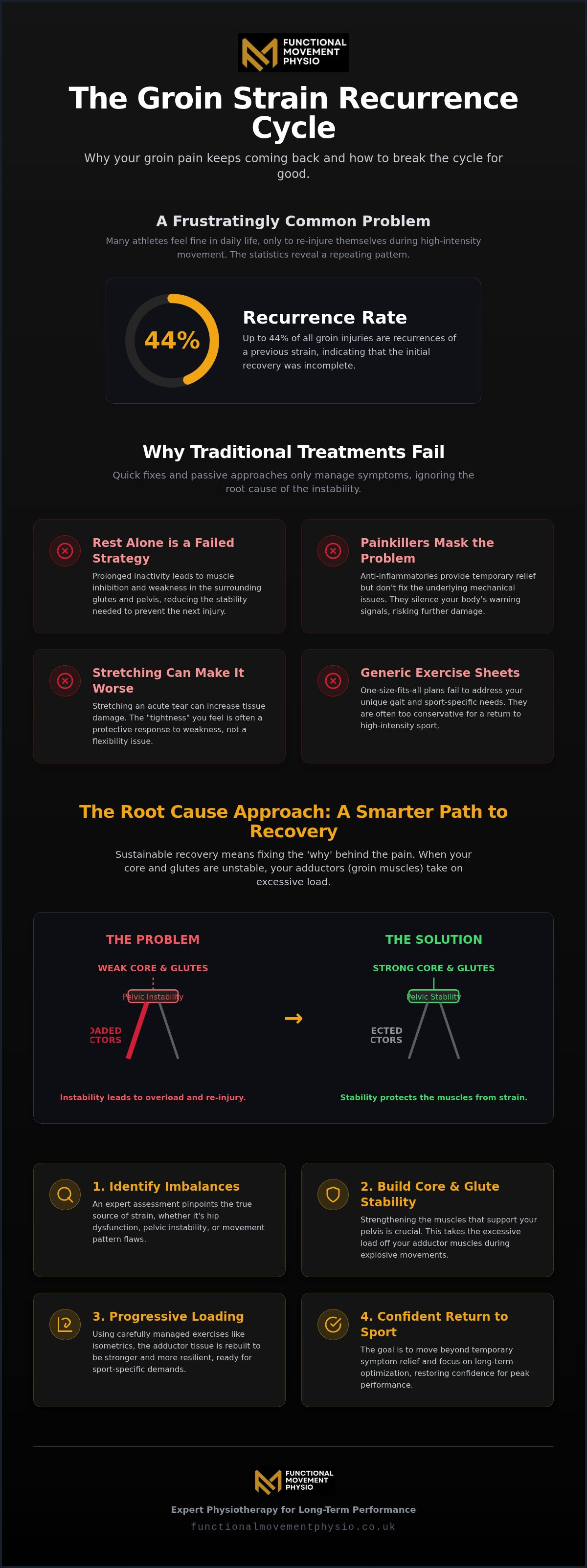
Did you know that up to 44% of groin injuries are actually recurrences of old strains? It is a cycle of frustration that many athletes in the North West know all too well. You rest for a few weeks and feel fine in daily life, but the moment you sprint for a ball or pivot on the padel court, that sharp pull returns. Seeking expert physio for groin strain Liverpool is about more than just managing the immediate ache. It is about understanding why your body is failing to protect that area during high-intensity movement.
You are likely tired of conflicting online advice and the nagging fear that this injury might eventually lead to long term damage or even surgery. We agree that a temporary fix is no fix at all. In this article, you will discover how to identify the root cause of your pain, whether it stems from hip dysfunction or pelvic instability, and how to rebuild functional strength. We will move past symptom management to explore a structured pathway that restores your confidence and gets you back to peak performance without the constant fear of another setback.
Key Takeaways
- Understand why quick fixes like painkillers and generic exercise sheets fail to address the underlying movement issues that cause recurring groin pain.
- Learn how expert physio for groin strain Liverpool identifies imbalances in your hips and pelvis to stop the cycle of injury.
- Discover the role of glute and core stability in protecting your adductor muscles from being overloaded during high intensity sports.
- Explore the benefits of progressive loading and isometrics for building the resilient tissue needed for a sustainable return to activity.
- Gain confidence in your body by shifting your focus from temporary symptom relief to long term physical optimization and performance.
Understanding Groin Pain and Why It Keeps Coming Back
A groin strain is technically a tear or overstretch of the adductor muscles, which are the powerful tissues running along your inner thigh. These muscles are responsible for stabilizing your pelvis and bringing your legs together, making them critical for any movement that involves lateral speed or rotation. For many athletes in the local area, the injury occurs during a high velocity movement, like a sudden sprint or a strike of the ball. You might feel an immediate sharp pull, often described as a "ping," followed by a lingering ache that makes even simple movements feel restricted. Finding specialized physio for groin strain Liverpool is essential because these injuries are notoriously stubborn and prone to coming back if the initial rehab is incomplete.
The adductor group consists of several different muscles that work together to manage the load through your lower body. When one of these is compromised, your body immediately tries to compensate by shifting the workload to other areas. This often leads to a dull, radiating ache that persists long after the initial sharp pain has subsided. Because the groin is a central hub for force transfer between your upper and lower body, an injury here can significantly disrupt your ability to perform even basic athletic tasks with confidence.
The Relentless Cycle of Recurring Groin Strains
It is a frustratingly familiar story for many local footballers and gym-goers. You feel a tweak, you take a few weeks off, and the pain seems to vanish. You assume you are ready to return to the pitch. However, the moment you attempt a high intensity pivot, the injury strikes again. Statistics show that between 32% and 44% of adductor injuries are recurrent. This cycle suggests that while the tissue may have healed enough for daily walking, it has not regained the functional capacity required for competitive sport. In some cases, what feels like a simple muscle pull is actually Athletic pubalgia, a more complex issue involving the soft tissues of the pelvic region that requires a specific, targeted diagnostic approach to resolve.
Why Rest Alone is a Failed Strategy
Rest is often the first advice people receive, but it is rarely the complete solution for long term recovery. While a short period of relative rest can settle acute inflammation, prolonged inactivity leads to muscle inhibition. Your brain essentially "turns off" the injured muscle to protect it, which leads to secondary weakness in the pelvis and glutes. Without a proactive rehab plan, you aren't just losing fitness; you are losing the stability your body needs to prevent the next pull. Relying on rest alone doesn't build the resilient tissue needed to handle the 12% to 16% prevalence of groin injuries seen in sports like football. You need a strategy that builds strength rather than just waiting for the clock to run down, ensuring your body is prepared for the specific demands of your sport.
The Problem with Traditional Groin Strain Treatments
Traditional recovery often starts with a trip to a pharmacy for anti-inflammatories or a quick search for "groin stretches." While these might provide temporary relief, they rarely address the structural instability that caused the injury in the first place. Quick fixes like painkillers only mask the vital signals your body is sending; they don't fix the underlying issue. When you rely on generic exercise sheets, you're following a path that doesn't account for your unique gait, hip mobility, or the specific demands of your lifestyle. These handouts are often too conservative, failing to prepare your tissues for the explosive power required in competitive sports.
Passive treatments like ultrasound or simple rest often fail because they ignore the reality of high-load sports. If you want to return to the intensity of a padel match or a weekend football league, a few minutes of ice and a rest period won't suffice. Fixing the symptom is merely a temporary bandage on a structural problem. Without a comprehensive assessment, you're simply waiting for the next "ping" to happen. If you're tired of temporary fixes that lead back to the treatment table, an Initial Physiotherapy Consultation can help you break this cycle by identifying your specific movement gaps.
Why Stretching Might Be Making Your Groin Worse
It's a common instinct to stretch a muscle that feels tight. However, if you have an acute tear, stretching can actually increase tissue damage and delay healing. That feeling of "tightness" you experience in your inner thigh is often your brain's way of protecting a weak or unstable muscle. By forcing a stretch, you're fighting your body's natural defense mechanism. Instead of more flexibility, your adductors likely need stability and progressive loading to handle force again. Over-stretching an already sensitized area can lead to further irritation of the tendon, making your recovery longer and more complicated than it needs to be.
The Trap of Symptom-Based Management
Many people assume that once the pain is gone, the problem is solved. This is a dangerous trap. Being symptom-free does not mean you are "match fit" or safe to play. Effective physio for groin strain Liverpool must look beyond where it hurts to find out why it happened. If you only treat the inner thigh while ignoring the glutes and core, the adductors will continue to be overloaded. We must assess how your body functions as a complete unit to ensure you aren't just pain-free, but resilient enough for long-term performance. This holistic view is the difference between a temporary fix and a permanent return to the activities you love.
The Root Cause Approach to Groin Rehab in Liverpool
To truly break the cycle of recurring pain, we must look at your body as an integrated machine. When you seek physio for groin strain Liverpool, our focus shifts from the localized pain in your inner thigh to the global mechanics of your movement. We assess how your hips and pelvis move as a single unit, ensuring that no single muscle group is bearing an unfair share of the load. Often, the adductors are simply the victims of a structural "crime" committed elsewhere in your kinetic chain.
Identifying weaknesses in the glutes or core is a critical part of this process. If your glutes aren't providing the necessary lateral stability, your adductors will overwork to compensate, leading to the inevitable strain you feel during a match. Functional movement analysis reveals these hidden compensations that occur every time you step. By using a comprehensive gait analysis in Liverpool, we can see exactly how your foot strike or pelvic tilt might be contributing to your chronic discomfort.
Assessing Hip Mobility and Pelvic Control
Limited hip rotation is one of the most common root causes of chronic groin pain. If your hip joint lacks the range of motion to rotate during a turn or kick, your groin is forced to overstretch to make up the difference. We carefully look for imbalances between your left and right side, as asymmetry is a massive risk factor for future injury. Pelvic stability serves as the essential foundation for all powerful leg movements. Without it, your adductors are left vulnerable and unsupported during high-intensity activity.
Biomechanical Links to the Core and Adductors
The groin and core are deeply interconnected, working together to stabilize the pubic symphysis. This is the joint at the front of your pelvis where significant forces meet during movement. Weakness in your core muscles inevitably leads to increased strain on the adductors, as they struggle to keep the pelvis level. In some cases, groin pain is actually a secondary symptom of an underlying hip joint issue. If we suspect your pain is related to joint mechanics, we may explore hip impingement treatment Liverpool to resolve the actual source of your FAI and protect your soft tissues from further damage.
How to Build a Sustainable Return to Sport
Returning to the field after an injury requires more than just being pain-free. It requires a body that is specifically conditioned for the chaos of competition. Progressive loading is the only evidence-based way to build resilient muscle tissue that can withstand high-speed changes of direction. When you work with a specialist for physio for groin strain Liverpool, your rehab plan follows a logical sequence that gradually increases the intensity of the force your adductors must manage. This structured approach ensures that you aren't just crossing your fingers when you step back onto the pitch, but relying on tested physical capacity.
We often begin with isometrics to settle pain and wake up the muscle fibers without moving the joint, which is a safe way to maintain strength during the early stages of recovery. As you progress, we move into eccentric strengthening. This specific type of training improves the muscle’s length and power by loading it while it is stretching. To support this intense rebuilding phase, many athletes find that incorporating expert sports massage in Liverpool helps manage tissue tension and facilitates better recovery between sessions. This allows you to stay consistent with your rehab without feeling overwhelmed by muscle soreness.
From Isometric Holds to Explosive Movement
Isometrics allow you to load the groin safely, preventing the muscle from wasting away while the initial tear heals. Once you can hold these positions without discomfort, we introduce heavy slow resistance training. This approach is vital because it builds the load-bearing capacity of the tendon, which is often the site of chronic, recurring issues. The final stages of a safe return involve plyometrics and sprinting. These explosive movements ensure your nervous system can coordinate the adductors quickly enough to protect the joint during a real match scenario, bridging the gap between clinical rehab and peak performance.
Padel and Football Specific Drills
Your rehab must eventually mimic the multidirectional nature of your sport. For Liverpool footballers, this means lateral lunges and cutting drills that replicate the stress of a 90-minute game. We don't just want you to run in a straight line; we need to know your pelvis can stay stable when you are shoved off the ball or when you strike a cross. Similarly, for the local padel community, we focus on the high-intensity bursts and quick lateral steps required on the court. We test your readiness through specific performance markers, ensuring you aren't just guessing about your fitness before you commit to a full return.
Specialist Physiotherapy in Liverpool: Your Path to Performance
At Functional Movement Physio, we don't just treat the injury; we help you master your movement. Our clinic provides a focused environment specifically designed for your recovery, moving you away from the anxiety of recurring pulls and toward a state of physical resilience. When you choose our clinic for physio for groin strain Liverpool, you're entering a partnership with a mentor who understands the high stakes of athletic performance. You get a clear roadmap that guides you from the initial frustration of pain back to your first match on the pitch. This is why we're considered a leading provider of expert physiotherapy Liverpool; we focus on resolving root causes rather than merely chasing symptoms.
Our approach is built on the philosophy that movement is the foundation of health. We don't believe in temporary fixes that leave you vulnerable once you return to the gym or the field. Instead, we use evidence-based interventions to rebuild your body’s capacity. This ensures that every step of your recovery is purposeful and leads toward a sustainable return to the activities that define your lifestyle. We empower you with the knowledge to understand your own biomechanics, turning a period of physical limitation into an opportunity for optimization.
Personalised Rehab Plans at Our Liverpool Clinic
Your recovery journey is unique, which is why your plan is built entirely around your specific goals and sport. Whether you're a runner looking to increase your mileage or a footballer aiming for a more explosive turn, we tailor our interventions to suit your needs. We provide the tools you need to manage your own physical capabilities, ensuring you aren't reliant on a therapist for the long term. Long term results are our absolute priority over temporary symptom relief. We look at the data from your initial assessment to create a strategy that addresses your specific imbalances and weaknesses.
Why Local Athletes Trust Our Functional Approach
We speak the language of performance and deeply understand the frustration of being sidelined by an injury that won't stay away. Our team focuses on building resilience so you can play without fear of another setback. By treating the body as an integrated system, we ensure that your adductors are protected by a stable pelvis and strong glutes. Our Liverpool city centre facility is equipped to handle the transition from clinical treatment to high-performance training. If you're ready to stop managing pain and start mastering your movement, we invite you to take the first step toward a lasting recovery.
Experience the difference of a root cause approach. You can book your Initial Physiotherapy Consultation at our Liverpool clinic through our secure online system.
Reclaim Your Performance and Move Without Fear
You don't have to accept recurring pain as a permanent part of your athletic life. By shifting your focus from the immediate pull in your inner thigh to a comprehensive Root Cause Movement Analysis, you can finally break the cycle of injury. Our Specialist Sports Injury Clinic is dedicated to helping you understand your body's mechanics, ensuring your glutes, core, and hips work together to protect your adductors during high intensity activity.
Choosing the right physio for groin strain Liverpool means moving beyond temporary relief and toward sustainable, functional strength. Our Expert Liverpool-based Team provides the structured roadmap you need to transition from physical limitation to peak performance. You deserve to step onto the pitch or court with total confidence in your body's stability and power.
It is time to stop managing symptoms and start mastering your movement. We are ready to help you unlock your full physical potential and get you back to the sports you love with a body that is stronger and more resilient than before.
True physical optimization often extends beyond injury recovery to include overall confidence and well-being; for those interested in exploring specialized men's health services, you can discover FullMast.
Frequently Asked Questions
How long does a groin strain take to heal with physio?
A minor Grade 1 strain typically heals within two to three weeks with the right guidance. More significant tears can take six to twelve weeks to fully resolve. These timelines depend heavily on your adherence to a structured rehab plan. Seeking expert physio for groin strain Liverpool ensures your recovery isn't just about time, but about rebuilding the specific capacity your sport requires.
Can I still run with a mild groin strain?
You should avoid running if it causes any sharp pain or an increase in your symptoms afterward. While it's tempting to push through a mild ache, running on a compromised muscle can lead to chronic compensation patterns. We recommend a period of relative rest followed by a graded return to impact. This ensures your adductors can handle the load without risking a more severe tear.
Is sports massage effective for treating a groin strain?
Sports massage is an excellent tool for managing tissue tension and improving local circulation during your recovery. It can help alleviate the secondary tightness that often develops in the hips and glutes when your groin is injured. However, massage alone won't fix the underlying weakness. It works best when combined with a functional exercise program that addresses the actual root cause of your strain.
What is the difference between a groin strain and a hip issue?
Groin pain is typically related to the adductor muscles, while hip issues often stem from the joint itself. Hip joint problems, such as impingement, often present as deep pinching pain during squats or lunges. Muscular strains usually feel like a sharp pull during explosive movements. A detailed assessment in our clinic helps distinguish between these two distinct but closely related issues.
How do I know if my groin pain is serious?
Your pain is serious if you cannot bear weight on the leg or if you notice significant swelling and bruising. You should also seek professional advice if the pain persists at rest or keeps returning every time you try to increase your activity level. Chronic recurrence is a clear sign that your body is failing to protect the area during movement, requiring a more specialized intervention.
Will I need an MRI for my groin injury in Liverpool?
Most groin injuries are diagnosed through a physical examination and movement testing, so an MRI is rarely the first step. Imaging is typically reserved for complex cases where symptoms aren't improving or if we suspect a condition like athletic pubalgia. Our team will guide you through a thorough clinical assessment first to determine if further imaging is truly necessary for your recovery.
Can clinical pilates help with recurring groin pain?
Clinical Pilates is highly effective for addressing the pelvic instability that often causes recurring groin issues. It focuses on the deep core and glute strength required to offload your adductors during movement. By improving your overall pelvic control, you create a more stable foundation for your legs. This is a vital component of a long term strategy for physio for groin strain Liverpool, helping you move with more confidence.

Article by
Stuart Goldfinch
HCPC PH112156
Specialist MSK Physiotherapist
Ex UK SAS Trainer
Graduate Sports Rehabilitator


