

That sharp, catching sensation in your groin isn't a sign that your athletic career is over; it's a signal that your hip joint is struggling with the way it's being used. If you're searching for hip impingement treatment Liverpool, you've likely grown tired of being told that your bone structure is the sole enemy. It's incredibly frustrating to give up running or football because of stiffness that feels permanent, especially when conventional advice often points straight to the operating theatre.
I agree that the "catching" during deep hip flexion or the ache after a long day at your desk feels like a structural failure that only a surgeon can fix. However, the reality is that many individuals with radiographic signs of femoroacetabular impingement (FAI) can achieve peak performance through targeted movement strategies. You deserve a recovery plan that addresses the root cause of your pain rather than just masking the symptoms with temporary fixes.
This article will show you how a movement-focused approach can help you return to high impact sport without surgery. You'll gain a clear understanding of why your impingement is happening and learn how to build a sustainable plan for pain-free movement. We'll explore the transition from physical limitation to full physical capacity, ensuring you can master your own capabilities once again.
Key Takeaways
- Learn why your hip pain is often a movement strategy failure rather than just a structural bone issue found on an X-ray.
- Discover how an Initial Consultation for hip impingement treatment Liverpool helps differentiate between structural damage and functional "pinching."
- Understand how to use hip dissociation to move your legs independently of your pelvis, reducing joint irritation during sport.
- Find out why modifying specific triggers is more effective for long-term recovery than simply resting and hoping the pain disappears.
- Explore how restoring joint gliding and pelvic stability can help you return to running or football without relying on surgery.
The Frustration of Hip Impingement: Why Just Resting Is Not Working for You
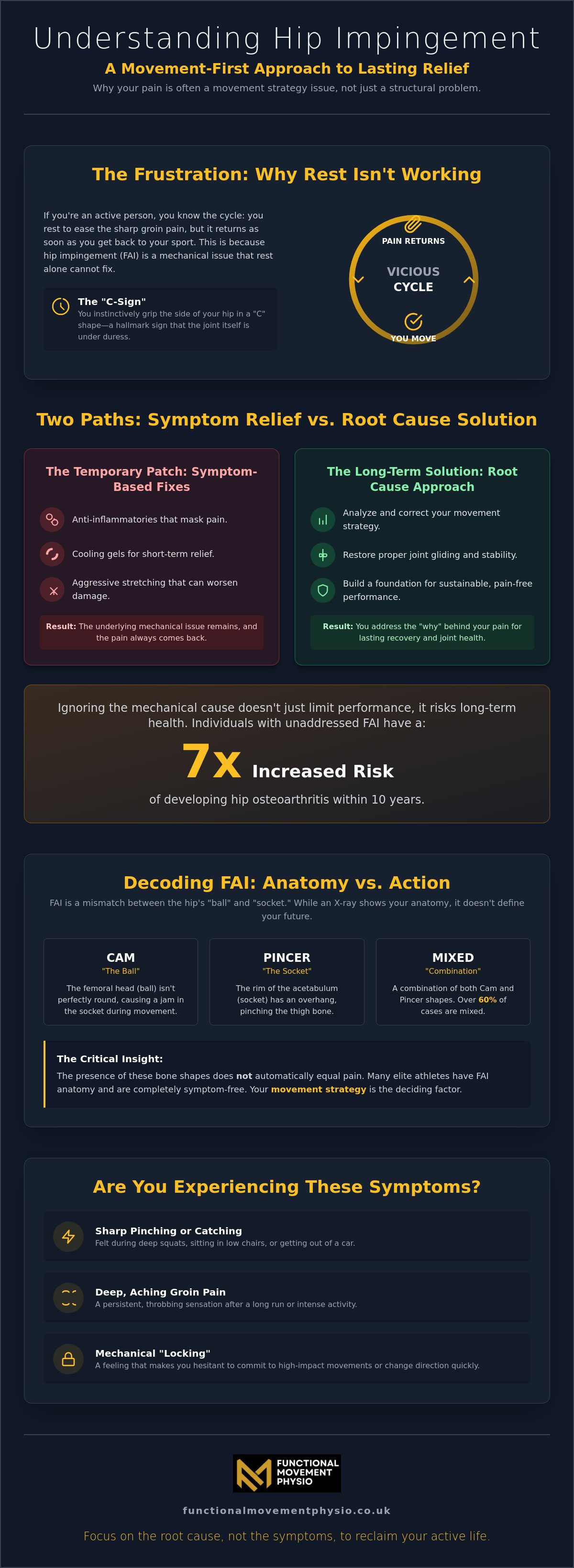
If you've spent weeks resting only to find that your first run back ends in the same sharp groin pain, you're not alone. Many active people in the city seeking hip impingement treatment Liverpool feel like they're going in circles. You stop. The pain settles. You move. The pain returns. This happens because hip impingement, or Femoroacetabular Impingement, is a mechanical issue that rest cannot fix. It's a mismatch between the ball and the socket of your hip joint that causes physical interference during movement, and simply sitting on the sidelines doesn't change that underlying geometry.
You might find yourself instinctively making a "C" shape with your hand, gripping the side of your hip with your thumb behind and fingers in the groin. This "C-sign" is a hallmark of the condition and a clear signal that the joint itself is under duress. While it's tempting to take a "wait and see" approach, this passive strategy often leads to the joint capsule tightening and surrounding muscles guarding the area. Over time, this results in chronic stiffness that makes even daily tasks feel like a struggle. For someone used to being on the move, feeling "stuck" in your own body is incredibly frustrating, but understanding the mechanical nature of the problem is the first step toward a solution for hip impingement treatment Liverpool.
Common Symptoms of FAI in Active Individuals
- Sharp pinching: You feel a sudden, restrictive catch during deep squats, when sitting in a low chair, or while getting out of a car.
- Deep groin ache: A persistent, throbbing sensation that lingers for hours or days after a long run or a competitive game of padel.
- Mechanical sensations: A feeling of the hip "locking" or "catching" that makes you hesitant to commit to high impact movements or sudden changes in direction.
The Problem with Symptom-Based Treatments
Taking anti-inflammatories or using cooling gels might dull the ache, but these interventions only mask the symptoms without addressing the mechanical driver. A dangerous mistake many active individuals make is trying to "stretch out" the pinch. If the impingement is caused by bone-on-bone contact, aggressive stretching can actually accelerate damage to the labrum. Research from 2026 indicates that individuals with FAIS have a nearly sevenfold increased odds of developing hip osteoarthritis within 10 years if the root cause isn't addressed. Ignoring the "catch" today doesn't just limit your current performance; it risks long-term joint health and the potential for early degenerative changes.
Understanding Femoroacetabular Impingement: Cam, Pincer, and the Movement Factor
When you receive a diagnosis of FAI, it's usually categorised into three structural types. Cam impingement occurs when the femoral head, the "ball" of your hip joint, isn't perfectly round. This extra bone causes a jamming effect in the socket during deep movement. Conversely, Pincer impingement involves an overhanging rim of the acetabulum, or the "cup," which strikes the neck of your thigh bone. As Yale Medicine explains FAI, most people actually present with a "Mixed" type, which is a combination of both. In fact, research from August 2021 shows that over 60% of symptomatic patients exhibit this mixed morphology. Understanding these labels is a key part of hip impingement treatment Liverpool, but they only tell half the story.
It's easy to look at an X-ray and feel that your bone shape is a permanent barrier to sport. However, the presence of these shapes doesn't automatically mean you're destined for pain. We see many high-performance athletes who have significant Cam or Pincer shapes but remain completely asymptomatic. This suggests that while your anatomy provides the framework, your movement strategy determines whether that framework becomes painful. If you're ready to look beyond the scan, an Initial Physiotherapy Consultation is the essential first step to seeing how your hip actually functions.
Anatomy vs Function: Why Bone Shape is Not Destiny
Studies frequently show that FAI bone shapes are prevalent in athletes who have no pain at all. This highlights that the labrum, the soft tissue "seal" around your hip joint, often only becomes irritated when the joint isn't controlled properly. Many people with Cam morphology never feel pain because their movement patterns don't force the "bump" into the socket rim. Your pain is often a result of how you move, not just how you're built.
The Role of Pelvic Tilt and Core Stability
Your pelvic position acts as the foundation for your hip joint. If you have an anterior pelvic tilt, where your pelvis tips forward, you effectively "pre-close" the space in your hip joint. This makes a pinch much more likely during simple activities like squatting or sitting. There is a direct connection between your lower back position and hip pinching; often, your hip pain might actually be a mobility issue elsewhere that forces the hip to overwork. By improving core stability and pelvic control, we can often create enough "room" in the joint to eliminate the impingement sensation entirely.
The Root Cause Approach: Why Your Hip Pain Might Be a Movement Strategy Issue
Most diagnoses rely on static imaging, but your hip isn't static. It's a dynamic joint designed for high performance. While an X-ray might show a Cam or Pincer shape, it doesn't explain why you only feel pain during the 40th minute of a football match or at the bottom of a heavy squat. This is why our hip impingement treatment Liverpool focuses on how you move in the real world. We look for "Functional Impingement," where the pinch is caused by a lack of muscular control rather than just a bony block.
When your glutes are weak or your hip flexors are excessively tight, the femoral head doesn't stay perfectly centred in the socket. This poor "joint centration" means the ball of the hip shifts slightly forward or upward during movement, creating that familiar catching sensation. As noted in the NIH's overview of Femoroacetabular Impingement diagnosis and treatment, a successful plan must account for these biomechanical nuances. For runners, this often manifests as a subtle collapse in form under fatigue, which is why we prioritise a comprehensive gait analysis to see how your hip handles load over time.
Identifying Your Specific Movement Triggers
We don't just poke the area that hurts. Instead, we assess your squat, lunge, and single-leg balance to see exactly where your movement strategy breaks down. Often, the root cause isn't even in the hip. If your foot mechanics are poor, your leg might collapse into excessive internal rotation, forcing the hip into a compromised position. By identifying these triggers, we can stop "rubbing the sore spot" and start fixing the movement that's causing the friction. This is the cornerstone of effective hip impingement treatment Liverpool.
The Connection Between Hip and Spine
Your hip and lower back are intrinsically linked. If your lumbar spine is stiff or lacks stability, your pelvis won't provide the stable base your hip needs to rotate freely. This is why we always check your lower back during a hip assessment. To address this, we often use Clinical Pilates to help you retrain pelvic control and rebuild confidence in your body. Studios like The Pilates Circle focus on these exact principles, using specialized classes to build the strength and balance necessary for such recovery. It's about moving past the fear of movement that often accompanies FAI and mastering your own physical capabilities through a structured, evidence-based recovery path.
Practical Steps to Manage Hip Impingement and Return to Sport
Resolving hip pain isn't a passive process. It requires a deliberate shift from simply resting to actively managing how you load your joint. If you're looking for hip impingement treatment Liverpool, your recovery should follow a clear, progressive path that respects your joint's current tolerance while building the capacity for future performance. We move away from the "wait and see" model toward a structured, four-step strategy for long-term health.
- Step 1: Modify Triggers. The first priority is to quieten the irritation. If a specific movement, like a deep squat or a long run along the Liverpool waterfront, triggers that sharp pinch, you must temporarily modify it. This isn't about avoiding movement forever; it's about giving the labrum and joint capsule a chance to settle.
- Step 2: Improve Hip Dissociation. You need to learn how to move your leg independently of your pelvis. Many athletes "cheat" by tilting their pelvis to gain range, which actually drives the impingement. Mastering hip dissociation allows you to maintain a stable core while your leg rotates freely.
- Step 3: Strengthen Deep Rotators. Strength is your best form of joint support. By targeting the deep gluteals and rotators, you improve joint centration. This ensures the ball of the hip stays exactly where it should be during high-load activity.
- Step 4: Reintroduce Sport-Specific Demands. Once the foundation is solid, we gradually reintroduce sprinting, pivoting, and jumping. We monitor your response carefully to ensure your hip can handle the dynamic forces of your chosen sport.
What to Avoid: Common Mistakes in Hip Rehab
Stop the aggressive "pigeon stretches." If you feel a pinch in the groin during a stretch, you're likely compressing the very structures you're trying to help. Deep "ass-to-grass" squats and generic "hip opening" yoga flows can also be counterproductive for FAI sufferers. These movements often force the joint into a bony block, causing further inflammation rather than relief. Focus on range of motion that feels "clean" and free of catching.
Building a Sustainable Movement Foundation
Quality of movement always trumps quantity. Precision is the key to ensuring your hip joint isn't being overloaded by poor mechanics. This is where Clinical Pilates plays a vital role, helping you build the precision and pelvic control needed for long-term hip health. We use a "pain traffic light" system to guide you. Green is safe, amber means proceed with caution, and red means stop. This system empowers you to manage your own recovery with confidence. If you're ready to stop guessing and start a structured recovery, book an Initial Physiotherapy Consultation today to get a clear path forward.
Specialist Hip Impingement Treatment in Liverpool: Our Functional Recovery Process
Your journey to resolving FAI begins with an Initial Physiotherapy Consultation at our Liverpool clinic. This session is designed to bridge the gap between your clinical diagnosis and your physical goals. At Functional Movement Physio, we combine over 20 years of clinical experience with a deep understanding of sports biomechanics to provide effective hip impingement treatment Liverpool. We use this time to map out exactly why your hip is catching and create a clear, evidence-based roadmap for your return to peak performance.
During your treatment, we often employ manual therapy techniques to restore natural joint gliding. When FAI causes pain, your muscles often "guard" the joint, creating a cycle of stiffness and further impingement. By manually addressing these restrictions, we can reduce this protective tension and improve the functional space within the joint. This clinical intervention is then paired with a tailored strength and conditioning plan designed specifically for the demands of your lifestyle in Merseyside, ensuring your recovery is both fast and sustainable.
Expert Care for Liverpool’s Active Community
We work closely with Liverpool’s runners, Sunday league footballers, and the growing community of padel players at local clubs. Our "Root Cause" philosophy differs from standard care because we don't just focus on the area of pain. While general advice often provides generic exercises for symptom management, we look at the biomechanical drivers unique to you. Whether you're navigating the hills of Sefton Park or sprinting on a pitch, your hip impingement treatment Liverpool is built around your specific environment. You can easily book your assessment at our Liverpool city centre location to start this process.
Your Path to Pain-Free Performance
The transition from physical limitation to full return to sport is a logical, step-by-step progression. We guide you from the initial diagnosis through to the achievement of sustainable results that focus on long-term joint preservation. This journey isn't just about fixing a "pinch" but about optimization and physical capacity. Our goal is to ensure you don't just get better, but that you stay better by mastering your own physical capabilities and avoiding the need for surgery or temporary fixes.
We are committed to helping you achieve full, purposeful movement in your daily life without the constant fear of a "catch" or "pinch" holding you back. Ready to start? Book your appointment here to begin your recovery journey and get back to the sports you love.
Take Control of Your Hip Health Today
Understanding that your anatomy isn't your destiny is the most powerful step in your recovery. While bone shape provides the framework, your movement strategy determines your performance. By focusing on the root cause of your pain, you can move away from the frustration of catching sensations and return to the high-impact activities you love. We've shown how identifying functional triggers and rebuilding pelvic stability creates a sustainable path back to sport without the need for surgery.
Our team of specialist sports injury experts is dedicated to this root-cause focused approach. With 300+ 5-star reviews from local patients, we have a proven track record of helping people master their own physical capabilities. If you're ready to stop managing symptoms and start resolving the underlying issue, seeking expert hip impingement treatment Liverpool is your next logical step. You don't have to stay stuck in a cycle of stiffness and rest.
Book Your Hip Assessment in Liverpool Today
We're here to partner with you on this journey toward pain-free movement. Let's work together to unlock your full potential and get you back to peak performance on the field, the court, or the track.
Frequently Asked Questions
Is physiotherapy effective for hip impingement?
Physiotherapy is highly effective and is recommended as the first line of treatment before considering surgery. It works by improving joint mechanics and muscle control to reduce friction within the socket. Research shows that many patients avoid surgery entirely by following a structured plan for hip impingement treatment Liverpool. We focus on optimizing your movement patterns to ensure the joint functions without the sharp "pinch" that causes pain.
How do I know if my hip pain is impingement or a labral tear?
It's often both; impingement is a leading cause of labral tears in active individuals. While a tear involves the cartilage "seal" of the joint, impingement refers to the mechanical friction causing that damage. A specialist assessment is the only way to differentiate between the two. We look for specific clinical signs like the "C-sign" and restricted internal rotation to determine which structure is driving your symptoms.
Can I keep running with hip impingement?
Yes, you can usually keep running if you modify your training volume and address the underlying mechanics. Simply stopping often leads to joint stiffness, but running through sharp pain can cause further irritation. We use gait analysis to identify if your running style is aggravating the joint. The goal is to keep you active while building the strength needed to support the hip throughout your stride.
What is the best exercise for hip impingement?
There is no single "best" exercise because the root cause varies for everyone. However, improving hip dissociation and gluteal strength is generally essential for recovery. Exercises that teach you to move your leg without tilting your pelvis help create more space in the joint. We prescribe specific movements based on your Initial Physiotherapy Consultation to ensure you aren't accidentally compressing the joint during your workout.
How many physio sessions will I need for FAI?
Most patients see significant improvement within 6 to 12 weeks of consistent, movement-focused treatment. The exact number of sessions depends on how long you've had the pain and your specific athletic goals. A typical plan involves an initial assessment followed by regular check-ins to progress your strength and mobility. We focus on giving you the tools to manage your own recovery for long-term results.
Do I always need an MRI to diagnose hip impingement?
No, an MRI is not always necessary for a clear diagnosis. We can often identify FAI through a thorough clinical examination and a detailed movement assessment. While scans show bone shape, they don't show how you move under load. We use imaging only when symptoms don't respond to conservative care or if we suspect a significant labral tear that requires a surgical review.
Can Clinical Pilates help with my hip pain?
Clinical Pilates is an excellent tool for managing hip impingement because it focuses on pelvic stability and deep core control. By strengthening the muscles that support the hip, you can reduce the "shifting" of the joint that causes the pinch. It's a low-impact way to build precision; for example, those in the US can access this type of specialized support through reformer pilates fairfield county ct to help manage high-performance demands without overloading sensitive joint structures during recovery.
Is surgery the only way to fix a Cam or Pincer deformity?
Surgery can change the bone shape, but it's not the only way to resolve the pain associated with it. Many people have Cam or Pincer shapes and feel no pain because their movement strategies are efficient. By improving your biomechanics through hip impingement treatment Liverpool, you can often live a high-performance, pain-free life without ever needing to go under the knife or face long surgical recovery times.

Article by
Stuart Goldfinch
HCPC PH112156
Specialist MSK Physiotherapist
Ex UK SAS Trainer
Graduate Sports Rehabilitator


