

A hamstring strain can make walking, bending, running or exercising uncomfortable. When pain settles, it’s natural to wonder whether your leg is ready for activity again. But feeling less pain doesn’t automatically mean your hamstring has rebuilt the strength and capacity your usual activities require.
Your symptoms are one part of the picture. How the pain started, which movements bring it on and how your leg responds to activity can help guide your next steps. Recovery isn’t about pushing through pain or resting indefinitely. It’s about adjusting activity and progressing at a pace that suits your current function.
This article explains common hamstring strain symptoms, when an assessment may help and how to approach a gradual return to movement. You’ll also learn why considering your movement and activity demands, not just the sore area, can support a more confident return to the activities that matter to you.
Key Takeaways
- A hamstring strain affects muscle fibres at the back of your thigh, but symptoms alone don’t show the full picture.
- How the pain started, changes in your activity and your movement goals can help identify relevant contributors.
- Adjust aggravating activity, find movement you can manage, then build strength and function progressively.
- Notice how your leg responds during activity and afterwards to help guide your next steps.
- An initial physiotherapy consultation can help clarify the injury and shape a plan around your needs and valued activities.
The Problem: What a Hamstring Strain Can Feel Like
Pain that interrupts a run, sport or even a brisk walk can make ordinary movement feel uncertain. A hamstring strain affects muscle fibres at the back of your thigh. It may happen during activity, but the way it feels doesn’t, on its own, tell you how extensive the injury is.
You might notice discomfort when bending forwards, climbing stairs or pushing off to accelerate. The location and intensity of symptoms vary, so don’t use pain alone to decide whether the injury is minor or severe.
This video shows one example of hamstring rehabilitation and a return-to-sport progression:
A strain affects muscle fibres, and the tendon connecting muscle to bone may also be involved. A sprain is different: it affects a ligament, the tissue that connects bones at a joint. For a broader overview of causes, grades and symptoms, read this summary of a hamstring strain. Neither a label nor a symptom list can replace an assessment of how your leg is functioning.
Common hamstring strain symptoms and movement changes
You may feel pain or tenderness at the back of your thigh, along with weakness, swelling or restricted movement. Brisk walking might be uncomfortable, or you may notice symptoms when hinging at the hips, stretching your leg or trying to accelerate. You might also change the way you walk or move to avoid discomfort.
Symptoms can affect everyday tasks as well as training, and they vary from person to person. Their presence or intensity can’t reliably establish the extent of the injury. Notice which movements are affected and how your leg responds instead of trying to grade the injury yourself.
When should you seek an assessment?
Arrange an assessment if pain is severe, worsening, persistent or limiting your usual activities. A physiotherapist can ask how the symptoms began, assess relevant movements and help clarify what may be contributing to the problem. That gives you a more useful starting point than guessing based on pain alone.
Seek prompt medical attention if you have concerning symptoms such as significant numbness or are unable to use the leg. These signs need timely attention. Don’t try to manage them by pushing through or simply waiting for symptoms to settle.
Symptoms alone can’t give you a reliable recovery timetable. Your next steps depend on your symptoms, movement and activity needs. An assessment can help you understand what’s happening and plan a safer route back to meaningful movement.
Root Cause Approach: Why Did the Hamstring Become Overloaded?
The painful area shows where you feel symptoms, but not necessarily why they began. A hamstring strain may follow a sudden sprint, build during repeated training or appear after a change in activity. The circumstances matter, but they don’t prove a single cause. Your training history, movement demands and previous symptoms help form a more complete picture.
Think of capacity as your body’s ability to meet the demands you place on it. If those demands rise faster than your hamstring is prepared for, the muscle may struggle to keep up. That isn’t a sign you’ve done something wrong. It’s useful information for planning your return to activity.
How training load and activity demands may contribute
A change in running speed, weekly distance, hill work or strength training can alter the demands on your legs. For example, adding faster intervals while also increasing your usual running volume gives your body more to adapt to at once. A busy period with repeated hard sessions may also matter if recovery between them changes.
These are possible contributing factors, not automatic explanations. The same training change may affect people differently, and an injury can occur without an obvious increase in workload. An assessment considers what changed around the time your symptoms started rather than assuming one session or movement caused the problem.
What a functional physiotherapy assessment can examine
A clinician may ask when the pain began, what you were doing, how symptoms have changed and whether you’ve had similar problems before. Your goals matter too. Returning to everyday walking, gym sessions or sprinting places different demands on your leg, so your plan should reflect what you need to do.
The assessment may include checks of strength, mobility and functional movement. You might be asked to move your leg, hinge at the hips or perform a task related to your usual activity. The clinician observes how your body responds to build a picture of your current ability. No single movement or symptom tells the whole story.
These findings can guide an individual rehabilitation plan, including which demands to address and how to build capacity progressively. At Functional Movement Physio in Liverpool, assessment focuses on functional movement and factors that may contribute to your pain, not just the sore area.
If you’re unsure what may be driving your symptoms or how they relate to your activity, an initial physiotherapy consultation can help clarify the picture and inform your next steps.
Hamstring Strain Recovery: Rest, Rehab, and the Return to Activity
Pain easing is encouraging, but it doesn’t automatically mean your hamstring is ready for running, sport or your usual training. Symptoms can settle before your strength and function are ready for those demands. Recovery needs to consider both how your leg feels and what it can do.
There’s no single timetable or exercise plan that suits everyone. Your starting point, symptoms and goals all matter. The aim is to rebuild capacity progressively so you’re prepared for the activities you want to return to, rather than relying on pain reduction alone.
Why complete rest is not the whole rehabilitation plan
Reducing or temporarily adapting activities that aggravate your leg can help manage symptoms. That’s different from avoiding all movement indefinitely. Rest alone doesn’t show whether your hamstring can meet everyday or sporting demands, and it doesn’t provide a plan for rebuilding that ability.
A tailored approach can help you stay active in ways that suit your current function while limiting activities that clearly worsen symptoms. This isn’t a reason to push through increasing pain. If your symptoms or movement deteriorate, the activity or loading may need to be adjusted. The right balance depends on your assessment and how your leg responds.
What progressive hamstring rehabilitation can involve
Rehabilitation may include strengthening work that increases the demands on your hamstring as your ability develops. The exercises, level of effort and pace of progression should reflect your symptoms and assessment, not a standard programme copied from someone else. The purpose is to build capacity that transfers to your everyday and sporting needs.
Progression involves more than checking whether one exercise feels comfortable. Your physiotherapist can consider how well you control the movement, how your leg responds during and after activity, and whether you’re ready for the next demand. For a runner, that may eventually mean preparing for faster movement. For a gym-goer, it may mean rebuilding confidence with relevant lifting patterns. These are individual decisions, not automatic steps on a fixed schedule.
If a new level of loading brings a sustained increase in symptoms or makes normal movement harder, that’s useful feedback. It may mean the plan needs adjusting, not that you’ve failed or must stop all activity. As your strength and function change, your rehabilitation can change with them.
Returning to full activity means matching your current capacity to the task, then building further where needed. A physiotherapist can shape that progression around your goals and adapt it as your response becomes clearer. For personalised guidance, you can book an initial physiotherapy consultation.
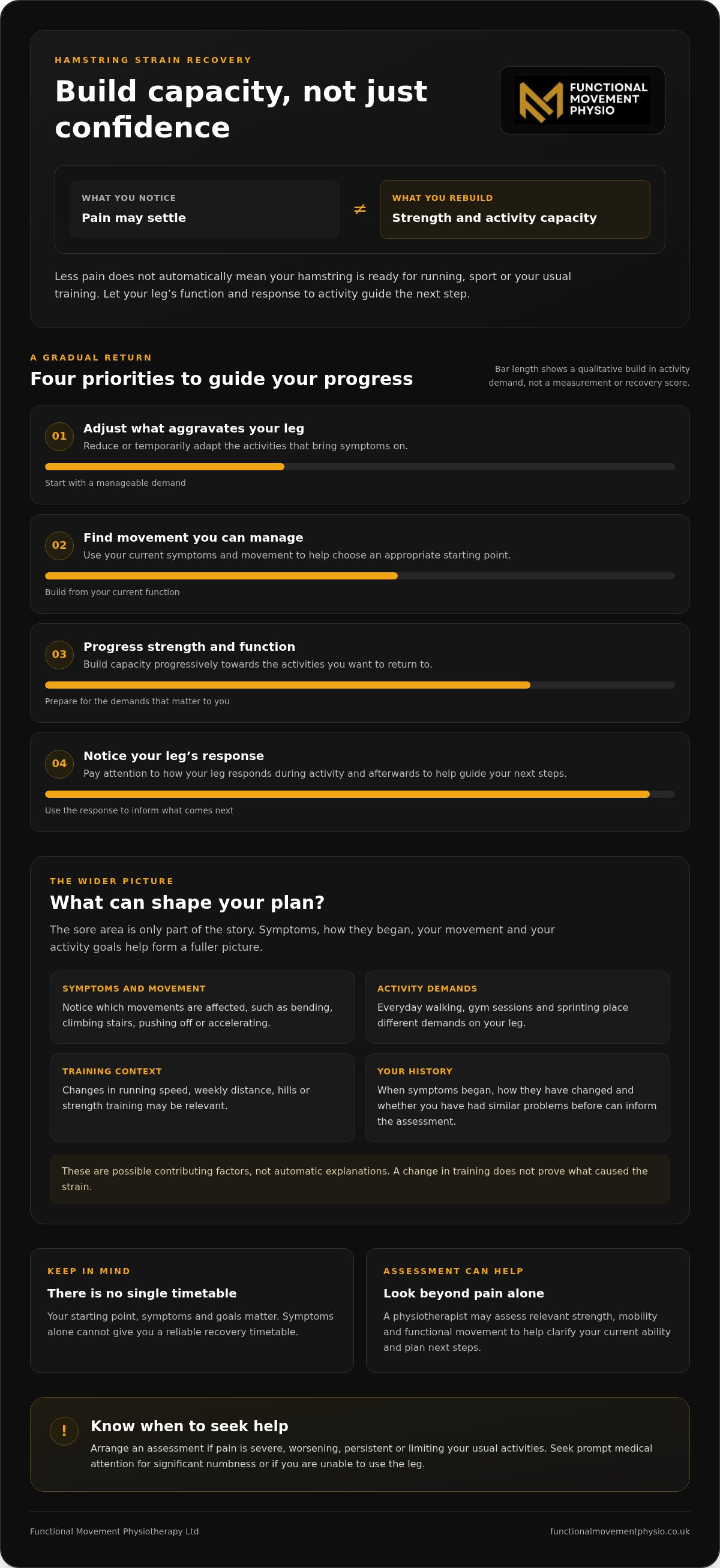
Practical Steps to Rebuild Hamstring Strength and Confidence
A steady return is more useful than guessing or jumping straight back to your usual training. Let your symptoms, movement and activity goals guide each step. Find a level your leg can manage, then build towards the demands you want to meet.
- Adjust aggravating activity. Temporarily reduce or adapt movements that make symptoms difficult to manage. You may still be able to stay active with other tasks that feel more comfortable.
- Establish tolerable movement. Choose movements suited to how your leg feels and functions now. Notice whether you can perform them with control rather than forcing a movement that feels difficult.
- Build strength and function. Gradually increase the challenge in a way that prepares you for your usual activities. The right exercises depend on your assessment and goals.
How to progress movement without guessing
Make changes gradually. Adjust one factor at a time, such as walking distance, effort during a strength exercise or running pace. Avoid a sudden jump in load or intensity just because one session felt comfortable.
Track how your leg responds during activity and afterwards. Consider whether movement felt controlled, whether symptoms changed and whether everyday function was affected later. There’s no single pain score that suits everyone. If symptoms become difficult to manage or your function worsens, reduce or adapt the activity and seek guidance.
Preparing to return to running or sport
Comfortable daily movement is a useful step, but running and sport ask more of your hamstring. Depending on your activity, preparation may need to address quicker acceleration, longer strides, hills, repeated efforts or changes of direction. Build towards the demands that matter to you rather than testing everything at once.
Readiness depends on your function and intended activity, not a calendar date alone. If confidence remains low or your performance is limited, guided progression can help you decide what to work on next. Sports physiotherapy in Liverpool can focus rehabilitation on the movements and demands relevant to your return.
Use your response to make informed adjustments. Don’t treat it as a reason to push through worsening symptoms or stop all movement. A physiotherapist can help adapt your plan as your strength, control and activity tolerance change.
Hamstring Strain Physiotherapy in Liverpool: Your Next Step
Recovering well means more than waiting for pain to ease. You need to understand the injury, consider what may have contributed to it and progressively rebuild the strength and function your daily life, running or sport requires. A plan focused only on symptoms can miss the demands you need to manage when you return to activity.
At Functional Movement Physio in Liverpool, care looks beyond the painful area to consider how you move and what may be affecting your recovery. This root-cause approach shapes rehabilitation around your needs and valued activities, rather than relying on symptom relief alone.
What to expect from an initial physiotherapy consultation
Your initial physiotherapy consultation starts with a conversation about how the hamstring strain began, what currently feels difficult and how symptoms affect your everyday movement or training. You can discuss your usual activities and what you want to return to, whether that’s comfortable walking, gym sessions, running or sport.
Your physiotherapist can then assess relevant movement and function, including how your leg responds to appropriate strength or mobility checks. The aim is to understand your starting point and identify factors that may be influencing your symptoms. You don’t need to arrive with a self-diagnosis or a list of exercises to try.
The assessment findings help guide an individual rehabilitation plan. As your strength, movement and activity tolerance change, your plan can be adjusted to reflect your progress. You don’t need to force a standard routine or assume one test tells the whole story. Sports physiotherapy in Liverpool can connect your rehabilitation with the movement demands of your goals.
Take the next step towards purposeful movement
It’s understandable to feel unsure about what’s safe, especially if symptoms have returned before or conflicting advice has left you uncertain. An assessment gives you the chance to explain what you’re experiencing and work through practical next steps with a physiotherapist. You can begin with questions, not a perfect account of what happened.
The focus is on helping you move towards meaningful activity with a plan informed by your symptoms, movement and goals. Progress may need adjustment, and your rehabilitation should respond to how you’re functioning rather than follow an assumed timetable. Building capacity progressively can help you work towards a more confident return to the activities that matter to you.
Move Forward With Confidence
It can be tempting to wait until you feel completely certain before changing your routine. But confidence often grows through informed steps, not by testing your hamstring strain against every activity on your own. You don’t need all the answers before seeking guidance, and you don’t need to prove your readiness by pushing through discomfort.
Take a measured approach. The right support can help you make sense of what your body is telling you, decide what to focus on next and keep your longer-term goals in view. Whether you want to move more comfortably through the day or return to a sport you value, progress is most useful when it reflects your needs and adapts as your ability changes.
Choose a next step that replaces guesswork with a clearer direction. An initial consultation gives you space to discuss what’s concerning you and consider a practical way forward. Rebuilding trust in movement takes time, but you can approach it with a plan that fits your life.
Keep moving towards the activities that make you feel like yourself. A purposeful next step can help you build confidence along the way.
Frequently Asked Questions
What does a hamstring strain feel like?
You may feel an ache, sharp discomfort or tenderness at the back of your thigh, especially when using the leg. Getting up from a chair may feel manageable, for example, while taking a longer stride brings on pain. Some people also notice weakness or stiffness. These sensations can have other explanations, so pay attention to which movements affect you and whether your everyday function is changing.
How can you tell if a hamstring strain is serious?
Symptoms alone can’t reliably show how extensive an injury is. Seek prompt medical attention if you have significant numbness or cannot use your leg. Arrange an assessment if pain is severe, getting worse or making normal activities difficult. A clinician can consider how the problem started and assess your movement instead of estimating severity from how sore the area feels.
Should you rest or walk with a hamstring strain?
Reduce activities that aggravate your symptoms, but you don’t necessarily need to avoid all movement. If walking feels manageable and doesn’t noticeably worsen your symptoms or affect your movement, gentle everyday walking may be appropriate. Shorten your route or slow your pace if needed. If you’re limping, symptoms are escalating or walking feels difficult, don’t force it. An assessment can help you decide what activity suits your current function.
Can you run with a hamstring strain?
Don’t use running to test whether the injury has healed. If you’re changing your stride, struggling to accelerate or finding that symptoms increase during or after a run, pause running and get advice on your next step. Your return should reflect your ability to manage the demands of running, not just whether discomfort has eased. A physiotherapist can help you plan a gradual progression towards your usual pace and distance.
How long does a hamstring strain take to recover?
Recovery time varies, so symptoms alone can’t predict a precise date. The extent of the injury, your starting function and the demands you want to return to all matter. A comfortable walk doesn’t necessarily mean you’re ready for sprinting or sport. An assessment can help clarify your needs, while your response to progressively increased activity provides useful information about how recovery is developing.
Can a hamstring strain happen without a sudden pull?
Yes. Symptoms can develop during one sudden movement, but they may also build gradually as repeated activity places demands on the hamstring. You might first notice discomfort after a run or training session, then find it returning during similar activity. A clear moment of injury isn’t required for your symptoms to deserve attention. Consider what has changed in your activity and seek an assessment if the problem persists or limits you.
When should you see a physiotherapist for a hamstring strain in Liverpool?
Consider seeing a physiotherapist if pain persists, worsens, returns as you resume activity or leaves you unsure how to progress. At a Liverpool consultation, you can discuss how symptoms began, which movements are limited and what you want to return to. Your physiotherapist can assess relevant movement and use the findings to shape a personalised plan. Book an initial physiotherapy consultation for support with your next steps.

Article by
Stuart Goldfinch
HCPC PH112156
Specialist MSK Physiotherapist
Ex UK SAS Trainer
Graduate Sports Rehabilitator


