

A calendar can’t tell you whether your knee is ready for the next challenge. During knee surgery recovery, pay attention to how your knee moves and responds to activity, alongside the milestones set by your surgical team.
It’s understandable to wonder whether pain, swelling or a slow return to normal routines means you’re falling behind. Recovery differs depending on the procedure, your starting strength and health, and how your knee responds as activity increases. Pushing too quickly can set you back, but avoiding movement altogether can make it harder to rebuild confidence and capacity.
This practical, stage-by-stage guide explains what can shape recovery after procedures such as knee replacement or ACL reconstruction, and why timelines aren’t identical for everyone. You’ll learn how to track useful functional signs, balance activity with rest, and understand how tailored physiotherapy can build strength, control and confidence for everyday movement and sport. Rehabilitation should complement, not replace, your surgeon’s instructions. The aim is steady, purposeful progress towards the activities that matter to you, rather than rushing to meet an arbitrary date.
Key Takeaways
- Knee surgery recovery varies with the procedure, your starting point and the activities you want to return to.
- Use changes in movement, strength and confidence to understand progress, while following your surgical team’s guidance.
- Build a steady routine around prescribed rehabilitation, track your function and review progress with your clinical team.
- Tailored physiotherapy can complement post-operative instructions and help you progress towards the demands of everyday life or sport.
Knee Surgery Recovery: Why Your Operation and Starting Point Matter
It’s understandable to feel uncertain about pain, mobility and when familiar routines will feel manageable again after surgery. You may be following your instructions carefully and still wonder whether a difficult day means something is wrong, or whether you should be doing more. That uncertainty is frustrating, especially when advice from other people doesn’t match your experience.
Knee surgery recovery is the process of restoring movement and function under clinical guidance. The aim is not simply to reduce symptoms. It’s to understand what is affecting your movement and build towards the activities that matter to you.
The Problem: Why progress can feel unclear
Pain can draw your attention, but it doesn’t tell the whole story of how your knee is functioning. You might feel less discomfort yet still find a task difficult, or notice a change in symptoms that leaves you unsure how to respond. Focusing only on how the knee feels can overlook other useful signs, including movement, strength and confidence.
A quick fix or generic exercise list may not address why a particular activity remains challenging. Without considering your operation, current abilities and goals together, it’s difficult to know what to prioritise. Your surgical team’s guidance sets the clinical boundaries for recovery. An individual assessment can help make rehabilitation more relevant to you and the tasks you want to regain.
How recovery can differ after knee operations
A knee replacement and an ACL reconstruction address different problems, so their rehabilitation priorities differ. After a replacement, rehabilitation may focus on restoring movement and function for daily tasks. Following ACL reconstruction, it may also need to prepare the knee for more physically demanding activities. Your operation and surgeon’s instructions shape which priorities apply and when they’re appropriate.
Even knee replacements aren’t all the same. The NHS notes that recovery after a partial replacement may be shorter than after a total replacement. For a general overview of replacement procedures, see this Knee replacement surgery overview. Your surgical advice, not a general comparison, should guide your plan.
Why a single recovery timeline can mislead
Time since surgery provides context, but it can’t show by itself whether you’re ready for a specific task. Everyday routines and sport place different demands on your knee. Your rehabilitation priorities may also depend on what you could do before surgery and what you hope to regain.
Recovery varies because your operation, starting function and activity goals are different. Use general timelines as background, not as a personal deadline or proof of readiness. If you’re unsure what a change in symptoms or function means, discuss it with your surgical team rather than relying on someone else’s experience.
A Root-Cause Approach to Knee Surgery Recovery
A useful rehabilitation plan does more than respond to pain on the day. It considers your operation, how your knee currently moves and what you need to do in daily life or sport. Physiotherapy should work alongside your surgeon’s instructions, not replace or overrule them. Those instructions set the boundaries; assessment and rehabilitation help guide progress within them.
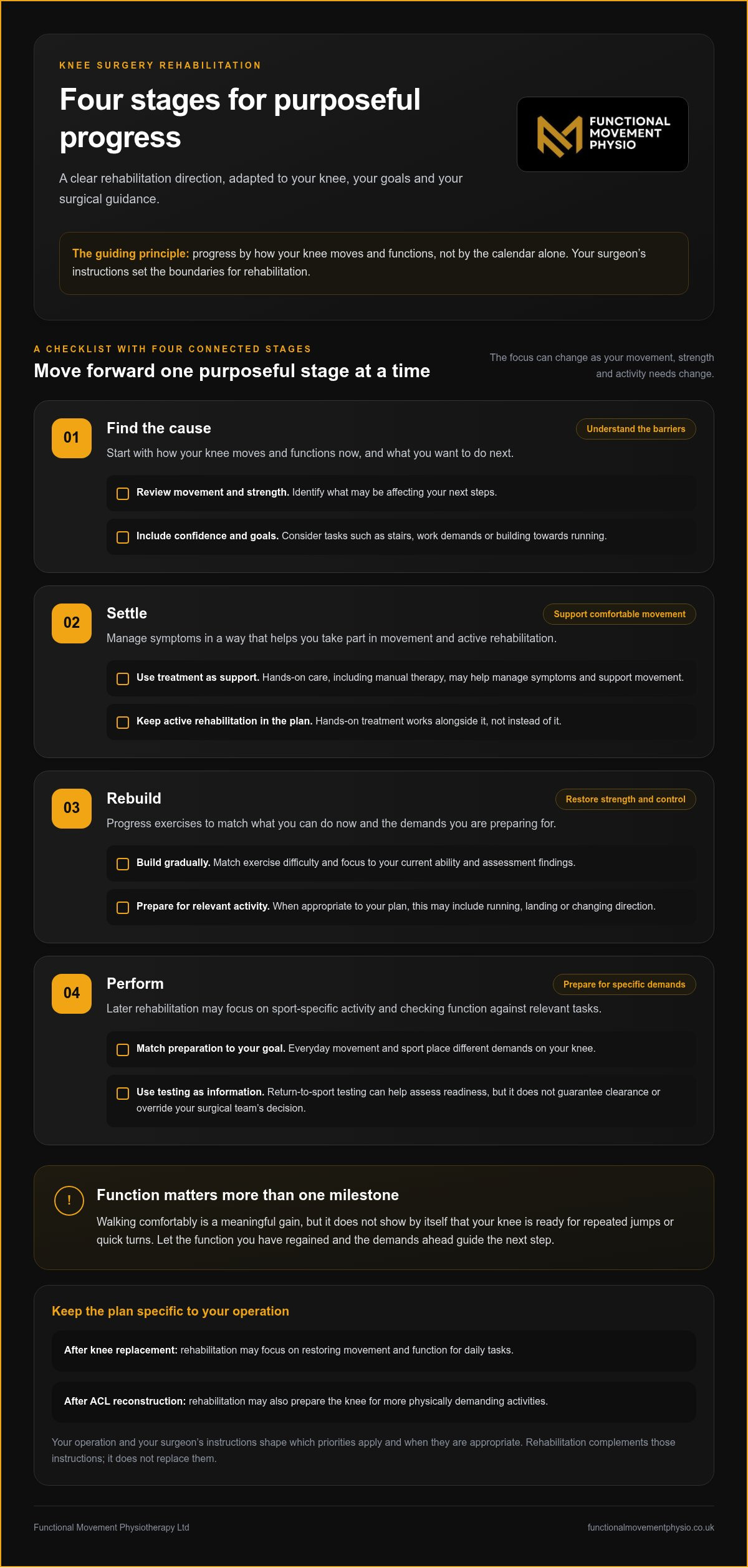
At Functional Movement Physio, rehabilitation follows four connected stages: find the cause, settle, rebuild and perform. This gives your care a clear direction while allowing the focus to reflect your needs. Settling symptoms can help you engage with movement, but lasting progress also involves rebuilding the strength and control needed for your activities.
What an individual assessment should clarify
An assessment looks at your current movement and strength, your confidence using the knee, and the activities you want to regain. That could mean feeling more secure on stairs, managing work demands or building towards running. The aim is to connect what your knee can do now with practical rehabilitation priorities, rather than give you a generic exercise list. Gait analysis and a posture screen are included in your first visit, if clinically justified.
How rehabilitation can progress from settling to rebuilding
Each stage has a distinct purpose, and the sequence gives your rehabilitation a clear direction. Your physiotherapist adapts the plan to your needs and surgical guidance:
- Find the cause: Assess how your knee is moving and functioning, and identify the barriers affecting your next steps.
- Settle: Hands-on treatment, including manual therapy, can help manage symptoms and support movement. It works alongside active rehabilitation, not instead of it.
- Rebuild: Progress strength and control with exercises matched to your current ability. If your goal is sport, rehabilitation can build towards relevant actions such as running, landing or changing direction when appropriate to your plan.
- Perform: Later rehabilitation may include sport-specific work and return-to-sport testing. Testing helps assess readiness against relevant tasks; it doesn’t guarantee clearance or override your surgical team’s decision.
For example, walking comfortably may be an important gain, but it doesn’t show by itself that your knee is ready for repeated jumps or quick turns. Your next step should match the function you’ve regained and the demands you’re preparing for. Your physiotherapist can use assessment findings to adjust exercise difficulty and focus while keeping your surgeon’s restrictions central.
If you’re unsure how to turn your post-operative guidance into a progressive plan, you can book an appointment for physiotherapy support. The goal is to rebuild purposeful movement with a plan shaped around your operation, current function and meaningful activities.
How to Judge Knee Surgery Recovery by Function, Not Just Time
A date on the calendar can be useful context, but it can’t tell you whether your knee is ready for a particular task. You might manage everyday movement more confidently while still needing to build strength for a more demanding activity. Progress is clearer when you consider what your knee can do, how it responds and what you’re aiming to return to.
Keep your surgical team’s instructions at the centre of your decisions. They know the details of your operation and remain the authority on restrictions and procedure-specific guidance. A physiotherapist can help you understand changes in movement and strength within those boundaries, but neither a progress log nor a general timeline replaces clinical advice.
Which progress markers can help structure a conversation
Notice practical changes in everyday movement and confidence. For example, record how comfortable you feel standing from a chair, walking on level ground or using stairs, if these activities are permitted in your plan. Note what feels easier, what remains difficult and how your knee responds afterwards. This is useful self-observation, not a diagnosis or a formal measure of readiness.
Bring these observations to your appointments. Your physiotherapist can assess movement and strength, then relate rehabilitation to your goals, whether that’s managing daily routines, returning to the gym or preparing for a sport. Formal assessment and return-to-sport testing involve clinical judgement and specific tasks. They’re different from deciding for yourself that you feel ready.
Question: What activities or movements am I currently allowed to do? Discuss with: Your surgeon or surgical team.
Question: What changes in movement, strength or confidence should I track? Discuss with: Your physiotherapist, within the surgical guidance.
Question: What needs assessing before I progress towards training or sport? Discuss with: Your physiotherapist and, where relevant, your surgical team.
Why returning to sport needs more than a date
Sport places varied demands on your knee. Returning to steady gym exercises is not the same as running, landing or changing direction at speed. Your progression should reflect the movements and intensity involved in your activity, as well as your current function and surgical restrictions. A single date can’t account for those differences.
At FM Physio, return-to-sport testing sits within the later perform stage of rehabilitation. It can help assess how you manage relevant tasks as you progress, but it doesn’t guarantee clearance or replace decisions made by your surgical team. Results should be understood in the context of your operation, rehabilitation and sport-specific goals.
A calendar date records time since surgery, but it doesn’t measure your movement, strength, confidence or ability to meet the demands of your chosen activity. In knee surgery recovery, use time as one part of the picture, then discuss functional progress with the clinicians guiding your care.
Practical Ways to Support Steady Progress After Knee Surgery
Rehabilitation can feel difficult to manage when you’re keen to return to normal but unsure how much activity is appropriate. A clear routine can help you stay consistent without guessing, adding exercises or rushing back to training. Use your surgical team’s guidance as the foundation for each step.
Build a realistic routine around your recovery plan
Keep your approach simple and repeatable. Follow the exercise plan provided by your care team and attend the rehabilitation appointments arranged for you. Don’t add movements, increase effort or change the schedule based on someone else’s recovery. Your operation and clinical guidance determine what’s appropriate for you.
A brief record can make appointments more useful. Note changes in everyday tasks, such as walking, getting up from a chair or managing stairs if these are permitted. Record what feels easier or remains challenging, and write down questions as they occur. This gives you and your clinician a clearer picture than relying on memory alone.
Rehabilitation priorities can change as your function changes. A task that once needed attention may become easier, while a new goal may need different preparation. Review your plan with your treating clinician so your exercises and activity remain relevant to your progress and the demands you want to meet.
Respond to setbacks without guessing
Progress isn’t always perfectly smooth. If symptoms change, an activity becomes difficult or you’re unsure whether to continue, speak with your surgeon or treating clinician. Don’t assume all discomfort is expected, but don’t decide on your own that a temporary change means you’ve caused damage. Your clinical team can interpret what’s happening in the context of your operation and recovery.
An individual reassessment can help clarify the next step. Your clinician may review how you’re moving, which activities affect your knee and how your current function compares with your goals. That conversation can help determine whether to maintain the plan, adjust a rehabilitation priority or seek further clinical advice. Avoid changing prescribed activity or treatment without guidance.
For a practical check-in, work through this sequence with your care team:
- Follow surgical guidance: Keep the restrictions and recommendations from your surgical team central.
- Attend planned rehabilitation: Use appointments to review your progress and understand your next steps.
- Track function: Record changes in permitted daily activities, confidence and any concerns.
- Review and adjust: Discuss your notes with your clinician before changing your activity or exercise plan.
Consistency is more useful than trying to make up for a difficult day with extra training. Sustainable knee surgery recovery means building capacity in a way that respects your current function and clinical guidance. You don’t need to prove readiness by pushing through uncertainty. Ask for support, understand the reason behind your next step, and progress towards meaningful movement with care.
Knee Surgery Rehabilitation in Liverpool: Your Next Step with FM Physio
After surgery, you may know the restrictions set by your surgical team but still feel unsure how to turn them into a practical plan. FM Physio provides post-operative rehabilitation for active people at its Liverpool city-centre clinic. Physiotherapy complements your surgeon’s guidance by assessing your current function and helping you progress towards the movement and activities that matter to you.
What to expect from a first visit in Liverpool
Your first visit can cover the operation you’ve had, your current movement and strength, and what you want to regain. You can discuss challenges with everyday activities as well as longer-term goals, such as returning to training. Gait analysis and a posture screen are included in your first visit, if clinically justified. The clinic is in Liverpool city centre’s Baltic Triangle, giving you a local setting for rehabilitation.
This assessment helps shape priorities around your situation rather than relying on a generic exercise list. Your surgical team’s instructions remain central, and your physiotherapist can use them alongside assessment findings to guide rehabilitation. Raise any restriction or instruction that affects your planned activity so that your programme stays within the guidance you’ve been given.
Connect rehabilitation to the activities you want back
Rehabilitation can progress from addressing symptoms and supporting comfortable movement towards rebuilding strength and preparing for more demanding activity. The right emphasis depends on your operation, current function and goals. FM Physio sessions are hands-on, with manual therapy provided in every session as part of a broader approach that includes progressive rehabilitation.
If your goal is to return to sport, strength and exercise can be developed towards relevant sporting demands as your plan allows. Later progression may include return-to-sport testing, which helps assess function but does not guarantee clearance. For broader support with activity-related goals, FM Physio also provides sports physiotherapy in Liverpool. Rehabilitation should build your capacity steadily, not pressure you to resume training before your clinical guidance allows.
FM Physio’s find the cause, settle, rebuild and perform approach keeps the focus on more than short-term symptom management. It aims to understand the factors affecting your movement, support progress and develop the function needed for meaningful activities. Your plan can be reviewed as your abilities and priorities change, while staying aligned with your surgical team’s instructions.
No GP referral is needed, so you can book directly. If you’re ready to discuss post-operative rehabilitation in Liverpool, take the next step at a pace guided by your needs and clinical advice.
Take Your Next Step Towards Confident Movement
Your next step doesn’t have to be a return to full training. It can be a clearer plan for what to work on now, shaped around your operation, your surgeon’s guidance and the activities you want to regain. With a considered approach, knee surgery recovery can move towards meaningful everyday movement and, where appropriate, the demands of sport without relying on guesswork.
FM Physio’s team includes five HCPC-registered specialist physiotherapists, and the clinic has more than 300 five-star Google reviews. Most patients achieve pain-free function within around 8 sessions and leave noticeably stronger. This describes typical progress, not a guaranteed outcome. No GP referral is needed, and you can book directly.
Keep following your surgical team’s advice, take progress one purposeful step at a time, and give yourself room to build confidence as well as capacity. A more confident return to the movements that matter can start with a conversation.
Frequently Asked Questions
How long does knee surgery recovery take?
Knee surgery recovery varies with the procedure and your individual circumstances. The NHS says recovery after knee replacement may take several months or longer, but this isn’t a prediction of your personal progress. Your operation and the demands of your usual activities affect what rehabilitation involves. Ask your surgical team what to expect for your procedure, and use their advice rather than comparing your progress with someone else’s.
Is recovery different after a partial and total knee replacement?
Yes. The NHS notes that recovery after a partial knee replacement may be shorter than after a total knee replacement. That general difference can provide context, but it doesn’t determine your individual plan or readiness for a particular activity. Your surgical team’s advice should guide rehabilitation, including how to approach tasks such as longer walks or returning to work. Discuss any uncertainty with them before changing your activity.
Can physiotherapy help after knee surgery?
Yes. Physiotherapy can help you work towards better movement, strength and activity goals through rehabilitation guided by your needs and clinical advice. Your plan might address a difficulty with everyday tasks before progressing towards gym training, if appropriate. Physiotherapy should complement your surgeon’s instructions, not replace them, and it can’t promise a particular result. Your physiotherapist can help you understand how your current function relates to your goals.
Do I need a GP referral to book knee rehabilitation with FM Physio?
No GP referral is needed, and you can book directly with FM Physio in Liverpool. At your first visit, you can discuss your operation, guidance or restrictions from your surgical team, and what you hope to return to. Bringing relevant details and questions can help focus the conversation on your priorities. Your rehabilitation can then be considered alongside the advice you’ve received from your surgical team.
When should I ask my surgeon or clinician about a concern during recovery?
Ask your surgeon or treating clinician whenever you’re concerned or unsure how to interpret a change during recovery. You don’t need to decide alone whether a symptom is expected or whether to alter your activities. Explain what has changed, when you noticed it and how it affects your usual permitted tasks. Your clinical team can advise in light of your procedure and circumstances, which general guidance cannot assess.
Can I return to running or sport as soon as my knee feels better?
No. Feeling better is encouraging, but it doesn’t show on its own that your knee is ready for running or sport. These activities can involve demands beyond everyday movement, such as repeated impact or quick changes of direction. Follow your surgical team’s guidance and progress according to your function and professional assessment. Discuss your specific sport and training demands with your physiotherapist before planning a return.
Article by
Stuart Goldfinch
HCPC PH112156
Specialist MSK Physiotherapist
Ex UK SAS Trainer
Graduate Sports Rehabilitator


