

Stiffness and weakness after a wrist fracture can make it hard to know whether to move more or protect your wrist. After time in a cast or splint, you may feel unsure which movements are safe and whether exercise could set you back. Wrist fracture rehabilitation should follow the guidance for your fracture and progress according to how your wrist responds.
You don’t need to guess your way back to strength. Rehabilitation usually moves from restoring appropriate movement towards rebuilding the capacity you need for everyday tasks, work and training. The right pace is individual, so your exercises should match your stage of recovery rather than follow a one-size-fits-all timeline.
This guide explains how movement and strengthening may progress, how to approach activity safely, and why a personalised assessment considers more than pain alone. With a clear plan, you can build confidence in your wrist and work towards the activities that matter to you.
- Wrist fracture rehabilitation should follow clinical guidance and progress at a pace suited to your fracture and recovery.
- Build towards everyday tasks in stages, moving from appropriate wrist movement to strength and function-led practice.
- Exercise lists aren’t one-size-fits-all. A movement that’s suitable at one stage may not be right for yours.
- Follow your treating clinician’s instructions, monitor how your wrist responds, and don’t force movement or progress against their advice.
- An individual assessment can connect your current wrist function with the activities you want to return to.
The problem after a wrist fracture: stiffness, weakness, and uncertainty
After a wrist fracture, simple tasks can feel unexpectedly difficult. Turning a door handle, lifting a mug or gripping a bag may reveal stiffness or weakness. It can also be hard to know whether movement will help or whether you risk doing too much.
Wrist fracture rehabilitation is a gradual return to movement and function, guided by your fracture care. It takes account of how your fracture is being managed and the advice you’ve received from your fracture clinic or treating clinician. The aim is to restore useful movement and capacity safely, not to push through symptoms or follow a standard plan regardless of your circumstances.
There isn’t one timeline or set of exercises that suits everyone. The type and severity of the fracture, its treatment and your clinician’s instructions all affect what’s appropriate and when. Rehabilitation supports fracture treatment; it doesn’t replace it. Follow your treating clinician’s guidance before starting or changing exercises.
Wrist fractures can involve different parts of the joint and surrounding bone. A distal radius fracture, for example, affects the larger of the two forearm bones near the wrist. Knowing the broad injury type can help explain why individual clinical guidance matters, but it can’t tell you which movements are right for your wrist.
Why the wrist can feel stiff or weak after immobilisation
When your wrist is kept still during treatment, you use it less. Reduced use can affect how freely it moves and how much strength you can call on when gripping or lifting. Turning a key, opening a jar or carrying shopping may feel awkward. These difficulties can be frustrating, but they don’t all have the same cause or indicate the same stage of healing.
How your wrist feels also depends on the fracture and its management. Stiffness or weakness alone can’t confirm whether the bone has healed or whether a particular exercise is safe. A suitable plan starts with your clinical guidance and considers your symptoms and function.
When to pause and seek clinical advice
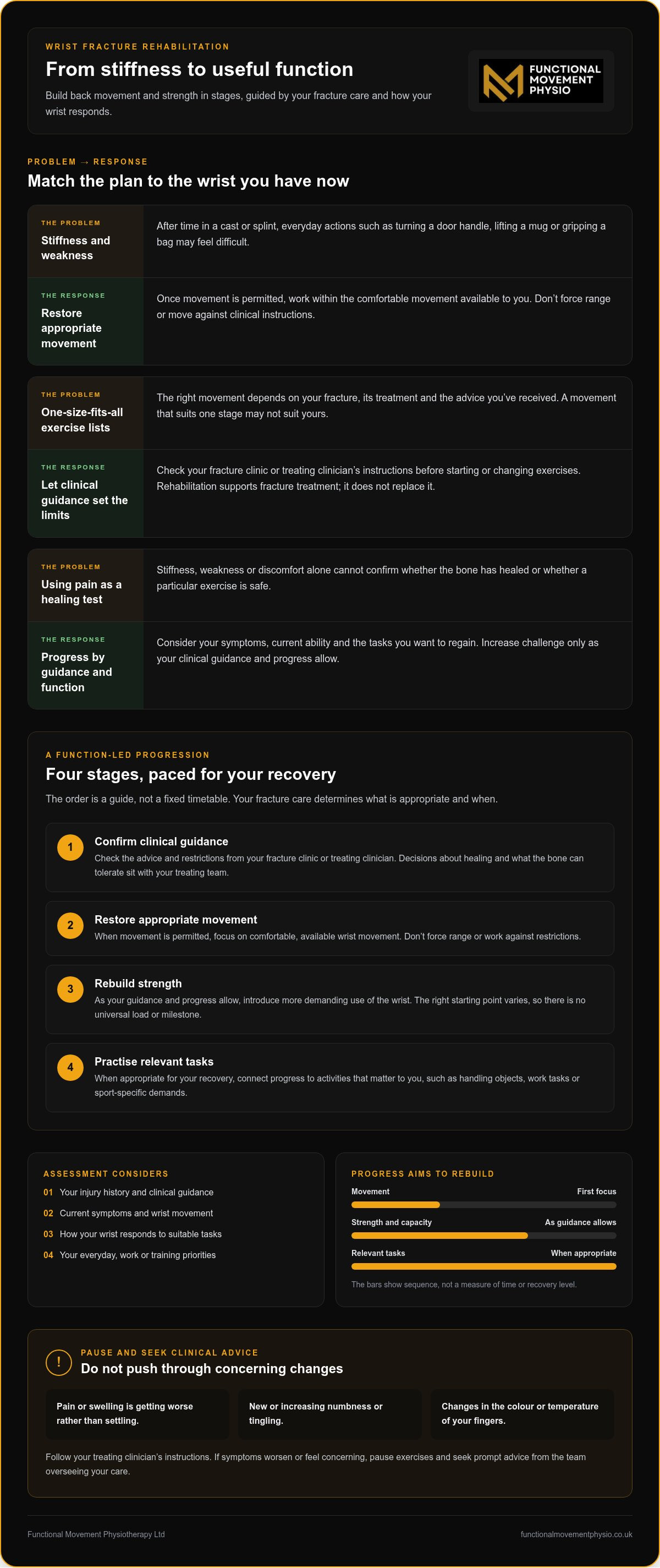
Follow your fracture clinic or treating clinician’s instructions first, including any restrictions on movement or use. If symptoms worsen or something feels concerning, pause exercises and seek prompt advice from the team overseeing your care. Don’t use discomfort during exercise as a test of whether the fracture has healed.
- Seek advice if pain or swelling is getting worse rather than settling.
- Get prompt clinical guidance about new or increasing numbness, tingling, or changes in the colour or temperature of your fingers.
- Don’t restart, add or intensify exercises against your treating clinician’s instructions.
If you’re unsure whether a symptom needs urgent attention, contact your fracture clinic or treating clinician for guidance. The safest next step respects your fracture care and gives you clarity, rather than asking you to guess based on how an exercise feels.
The root-cause approach: how wrist fracture rehabilitation progresses
A structured plan doesn’t start with a list of exercises. It starts by understanding what your fracture care allows, what your wrist can comfortably do now, and which activities you need to regain. Wrist fracture rehabilitation then builds from that starting point, addressing movement and capacity rather than focusing on discomfort alone.
Function-led wrist rehabilitation matches each step to your clinical guidance, current ability and the tasks you want to return to. The sequence is straightforward, but the pace and specific choices depend on your fracture and an individual assessment.
- Confirm clinical guidance. Check the advice and restrictions from your fracture clinic or treating clinician. Decisions about fracture healing and what the bone can tolerate sit with the treating team.
- Restore appropriate movement. Once movement is permitted, rehabilitation can focus on the wrist’s comfortable, available movement. Don’t force range or work against instructions that limit movement.
- Rebuild strength. As your clinician’s guidance and your progress allow, rehabilitation can introduce more demanding use of the wrist. The right starting point varies, so there’s no universal load or milestone.
- Practise relevant tasks. Progress can connect to activities that matter to you, such as handling objects, work tasks or sport-specific demands, when appropriate for your recovery.
Assessment links symptoms to movement and daily demands
An assessment considers your injury history, current symptoms and the clinical guidance you’ve received. It can also look at how your wrist moves and responds to suitable functional tasks. This helps identify whether your main limitation is movement, strength, confidence using the wrist, or a combination, without assuming every symptom has the same cause.
Your goals shape the plan. You might want to manage everyday tasks more comfortably, meet the demands of your job or return to training. Discussing those priorities connects rehabilitation to useful outcomes while keeping your fracture care and clinical instructions central.
Progression moves from movement towards capacity
Appropriate movement generally comes before more demanding strengthening, but this isn’t a fixed timetable. As your ability changes, your clinician can guide you on increasing the challenge. That might mean moving from comfortable motion towards tasks requiring more control or effort, depending on your stage of recovery and the advice you’ve been given.
Progress shouldn’t rely on a set number of repetitions, a standard weight or a date on the calendar. Your symptoms, movement, daily demands and treating clinician’s guidance all help inform the next step. If you’re unsure how those factors apply to your wrist, an individual physiotherapy assessment can help clarify a suitable functional plan.
There are two related but different questions to consider: your treating team guides decisions about fracture healing and restrictions, while rehabilitation focuses on restoring function within those boundaries. Keeping both in view helps you move forward with purpose, without mistaking a generic exercise plan for advice tailored to your recovery.
Wrist fracture rehabilitation compared: generic exercises versus individual progression
An exercise sheet can introduce possible movements, but it can’t account for every fracture, treatment plan or stage of recovery. The useful question isn’t simply, “Which exercises are available?” It’s, “Which movement is appropriate for me now, and how does it support what I need to do?”
Exercise choice should reflect your clinical guidance and current function, not just a routine written for someone else.
| Approach | Personalisation | Progression and relevance |
|---|---|---|
| Generic exercise list | Offers examples, but may not account for your fracture or instructions. | May not explain when to change an exercise or how it connects to your goals. |
| Clinician-guided movement | Movement choices are considered alongside fracture care and current symptoms. | Helps keep activity within the guidance for your recovery. |
| Function-led progression | Considers what you can do now and what you want to return to. | Builds towards relevant daily, work or sport tasks as appropriate. |
What exercise sheets can and cannot tell you
Exercise resources can help you understand the kinds of movement that may be used in wrist rehabilitation. For example, MyHealth Alberta describes wrist bending forwards and backwards, turning the palm up and down, and stretches. These examples show possible movement categories, not a prescription for every person or every stage. Follow a clinician’s advice about which exercises are right for you.
Why the same movement may not suit everyone
Exercise choices may differ according to the fracture, how it was treated, your stage of healing and your symptoms. A movement’s purpose matters too: one may explore comfortable motion, while another places a different demand on the wrist. Copying a routine without understanding its purpose can leave you unsure whether it fits your situation.
A list can’t assess your wrist or decide whether you’re ready to progress. That doesn’t make examples useless; it means they need context. Follow your treating clinician’s instructions, and don’t assume an exercise is suitable simply because it appears in a general guide. An exercise also shouldn’t be treated as a way to speed bone healing or prevent complications.
In wrist fracture rehabilitation, the aim is to choose movements that fit your current ability and build towards meaningful function within your clinical guidance. If you’re uncertain how to connect your instructions with everyday or sporting goals, an individual physiotherapy assessment can help you understand your movement and plan appropriate next steps.
Practical steps for rebuilding wrist movement and strength safely
Clear instructions make it easier to act without guessing. In wrist fracture rehabilitation, start with your treating clinician’s advice, not an exercise routine found online. Use that guidance to decide what movement is appropriate, notice how your wrist responds and know when you need a review.
Your fracture clinic or treating clinician’s guidance takes priority over online exercise examples.
How to approach movement and exercise guidance
Before beginning or changing exercises, make sure you understand what your treating clinician has advised about movement and using your wrist. Choose only movements they have recommended or approved for your fracture and current stage of recovery. Don’t force a movement to reach a particular range, add resistance or increase the challenge against their instructions.
This checklist can help you follow your plan:
- Follow your clinical instructions. Keep any restrictions in mind and ask the team overseeing your care if the guidance is unclear.
- Use suitable movements. Stick to exercises selected or approved for your situation rather than combining routines from different sources.
- Notice the response. Pay attention to changes during and after activity, including symptoms that are worsening or concerning.
- Review your progress. If you’re unsure whether to continue or change an exercise, pause and seek appropriate clinical advice.
Exercise discomfort can’t tell you whether the bone has healed. Don’t use it as a reason to test your limits or override your clinician’s instructions. If symptoms worsen or you become concerned, stop the activity and seek advice from the team responsible for your fracture care.
Track function before returning to training
Set practical goals that reflect your day, not just a general idea of “getting stronger”. Depending on your clinician’s guidance, you might note how your wrist manages a suitable grip, carrying a light everyday item or a task linked to work. If you’re returning to sport, discuss the movements and demands involved before trying them.
Increase the demand in manageable steps rather than testing your full capacity all at once. A task that feels straightforward without load may feel different when it involves carrying, sustained gripping or a sport-specific movement. Your clinician can help you decide which activities are appropriate and whether it’s time to make them more demanding.
Keep a brief record of the tasks you’ve tried, how your wrist responded and any difficulties that remain. This gives you and your physiotherapist useful information to discuss instead of relying on a single high-effort test. If limitations persist, review your plan before deciding how to return to training.
A personalised assessment can connect your symptoms and movement with the demands of everyday life or sport, while respecting your fracture care. That gives you a clearer basis for your next steps.
Wrist fracture rehabilitation in Liverpool: personalised support at Functional Movement Physio
Getting back to everyday tasks, work or training after a wrist fracture takes more than picking exercises from a list. At Functional Movement Physio in Liverpool city centre, a hands-on assessment considers your symptoms, movement and activity goals, then uses those findings to shape a personalised approach to rehabilitation. Your fracture clinic’s instructions remain central, so your plan works within the guidance you’ve been given.
Recovery is individual. The focus is on understanding what is limiting your function and building towards purposeful movement, rather than addressing discomfort in isolation. Your goals might include managing daily tasks more comfortably or preparing to return to sport, depending on your clinical advice and progress.
What to expect from an initial physiotherapy assessment
Your physiotherapist will discuss your injury history, current symptoms and relevant guidance from your treating team. They’ll consider how your wrist moves and manages appropriate tasks, connecting those findings with what you want to do. This helps identify your current limitations and inform a plan suited to your situation, without assuming a standard wrist-fracture protocol or outcome.
Functional Movement Physio’s sports physiotherapy approach considers how symptoms affect movement and activity. If your fracture was treated surgically, rehabilitation can also take account of the instructions related to that treatment. Your physiotherapist can help you work towards relevant activities while keeping your treating clinician’s guidance in view.
The initial physiotherapy assessment lasts 45 minutes and costs £75. Gait analysis and a posture screen are included in your first visit if clinically justified. The assessment gives you time to discuss what is difficult, what you hope to return to and how an individual plan may support your next steps.
Book support for your return to movement
Functional Movement Physio is based in Liverpool city centre. You don’t need a GP referral to book directly. Bring any instructions you’ve received from your fracture clinic or treating clinician, and share the tasks or activities you’re working towards. This gives your physiotherapist useful context to consider your symptoms, movement and goals together.
Wrist fracture rehabilitation should respect the treatment and advice guiding your recovery. Physiotherapy can help you understand your current function and plan a considered route back to the activities that matter, with progress shaped around your individual needs rather than a fixed timetable.
Take your next step towards confident movement
You don’t have to work out your return to activity alone. If uncertainty is keeping you from using your wrist with confidence, an individual assessment can help you decide what to focus on next, in line with the guidance for your fracture.
At Functional Movement Physio, five HCPC-registered specialist physiotherapists support people to build movement and function around their individual needs. Wrist fracture rehabilitation isn’t about rushing to meet a target. It’s about making considered progress towards the activities that matter to you, with a plan shaped by your symptoms, current ability and goals.
Choose a manageable next step. Bring your questions, explain what you’re finding difficult and identify what you hope to return to. A clearer direction can help you move forward with purpose and confidence.
Your recovery is individual. Steady, informed progress can help you reconnect with the movement that matters in everyday life.
Frequently Asked Questions
How long does wrist fracture rehabilitation take?
There’s no single timeframe for wrist fracture rehabilitation. Your recovery depends on the fracture, its treatment, healing and your starting function. Your fracture clinic or treating clinician should guide when activity can progress. A physiotherapist can assess how your wrist is moving and adapt your plan as your needs change. If progress stalls or you’re concerned about a setback, seek clinical advice.
When can I start exercises after a wrist fracture?
Start exercises only when your fracture clinic or treating clinician says movement is appropriate. The right time depends on your injury and how it’s being managed, so an exercise sheet can’t confirm that your wrist is ready. Ask which movements are suitable now and what changes should prompt you to pause. Clarify whether the advice applies to wrist movement only or also to gripping and lifting.
Can I return to the gym after a wrist fracture?
You can return to gym training when your healing stage, wrist function and the demands of each exercise have been considered with your treating clinician. Being able to move your wrist doesn’t automatically mean it’s ready for heavy loading. Discuss specific activities, such as holding a bar, using a cable machine or supporting your weight through your hand. If these remain difficult, get individual advice before building your training.
Is pain normal during wrist fracture rehabilitation?
Some discomfort or stiffness may occur during recovery, but pain alone can’t show whether the bone has healed or an exercise is appropriate. Follow your treating clinician’s instructions, and don’t force a movement that makes symptoms worse. If pain is increasing, feels unusual or concerns you, pause the activity and seek medical advice. Note which movement brought it on so you can describe the situation clearly.
What should I do if my wrist becomes more swollen or painful?
Stop the activity that has aggravated your wrist and follow the advice from your fracture clinic or treating clinician. If swelling or pain is worsening, feels unusual or worries you, contact an appropriate healthcare professional promptly. Don’t try to diagnose the cause or push through to test your wrist. For severe or urgent symptoms, use the appropriate urgent medical service in your area.
What can I expect from an initial physiotherapy assessment at Functional Movement Physio?
Your physiotherapist can discuss your symptoms, wrist movement and the activities you want to return to. If you’ve recently fractured your wrist, bring any instructions from your fracture clinic or treating clinician, along with questions about how they relate to your daily tasks or training. The 45-minute initial assessment costs £75 and can help clarify your current needs and appropriate next steps while keeping your fracture care guidance in view.

Article by
Stuart Goldfinch
HCPC PH112156
Specialist MSK Physiotherapist
Ex UK SAS Trainer
Graduate Sports Rehabilitator


