

What if recurring tightness needs more than another short-term fix? Myofascial release uses gentle, sustained pressure to work with the connective tissue around your muscles. It may ease discomfort or help you move more freely, but hands-on treatment alone may not address why symptoms keep returning.
If stretching, massage or rest has helped briefly before the discomfort crept back, your frustration makes sense. And if you’re worried that exercise will aggravate things, it can be hard to know what to try next. The aim isn’t to push through pain or rely on treatment indefinitely. It’s to understand what your symptoms respond to and build your confidence in movement.
This article explains what myofascial release involves, what it may realistically help with and why results vary. You’ll also learn how hands-on care can fit into an assessment-led physiotherapy plan alongside practical, movement-specific rehabilitation. The focus is on identifying factors that may contribute to your symptoms, then gradually rebuilding your capacity for daily activities, running or training. In Liverpool, that means making treatment a step towards meaningful progress, not just temporary relief.
Key Takeaways
- Recurring tenderness or restricted movement doesn’t identify one specific cause, so look beyond the sore area when symptoms keep returning.
- Myofascial release may offer short-term changes in comfort or movement, but those changes don’t prove the underlying issue is resolved.
- After hands-on treatment, try comfortable movement and reassess how well you can do a meaningful task.
- An assessment-led physiotherapy plan can consider your symptoms, movement, history and goals to guide the next steps.
- Build progress around activities you want to return to, adjusting your approach if movement worsens your symptoms.
The Problem: Why Tightness and Pain Can Keep Coming Back
You stretch a tight calf, book a massage or take a few days off, and the discomfort eases. Then you return to running or the gym, and it comes back. That cycle can leave you wondering whether to keep treating the same spot or change something else.
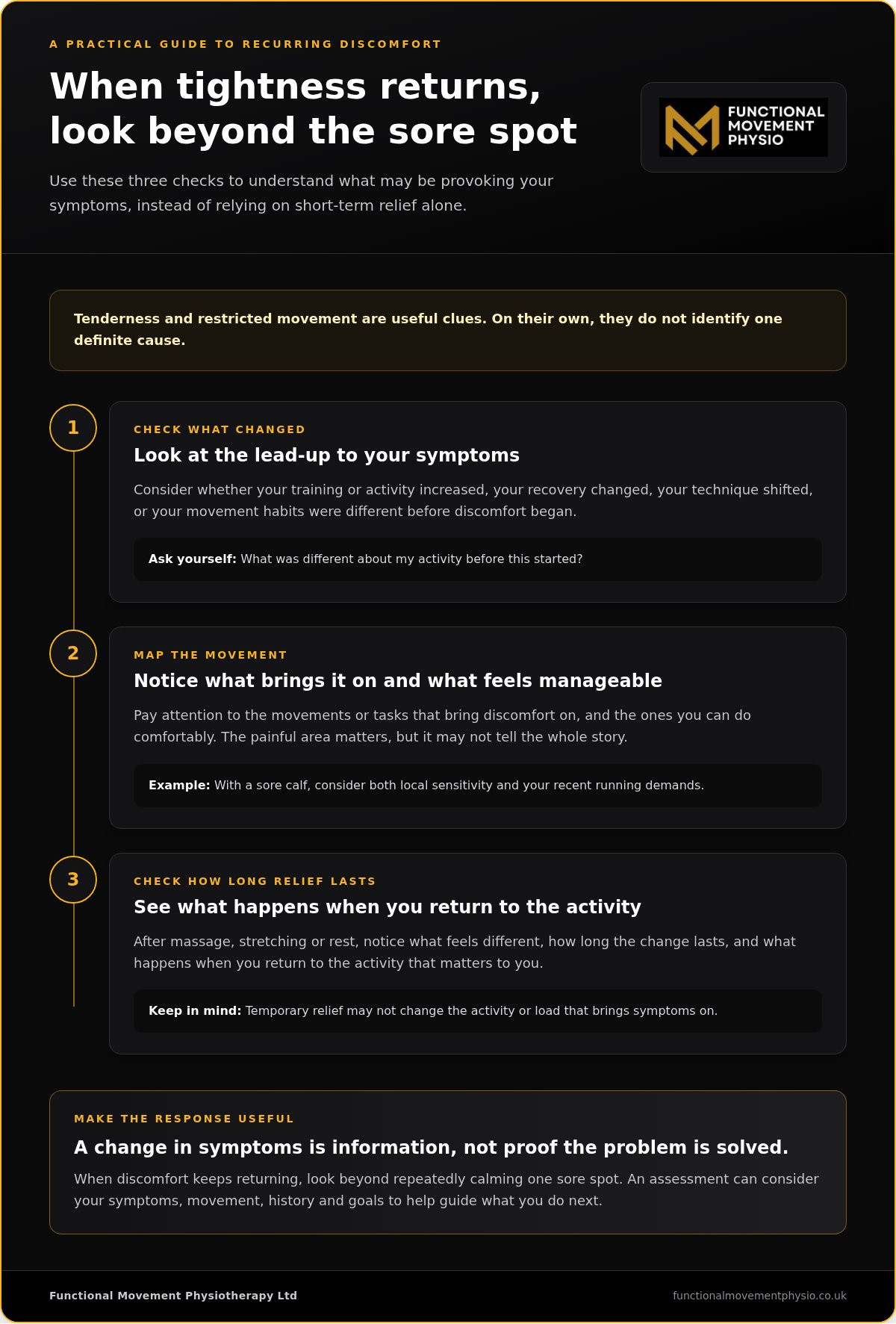
A symptom tells you what you feel; it doesn’t, on its own, explain why you feel it. Tenderness and restricted movement are useful clues, but they don’t point to one definite cause. Focusing only on the sore area can overlook how your recent activity, training load or movement habits may be contributing.
Why does tightness not always identify the source of pain?
A tight or tender muscle can draw your attention, but sensation is information, not a diagnosis. Similar feelings can arise in different situations, and more than one factor may be involved. Symptoms may relate to a recent increase in training, reduced recovery, a change in technique or how much movement your body is currently used to.
That doesn’t mean the painful area is irrelevant. It means treating it as the whole explanation can be misleading. A runner with a sore calf, for instance, may need to consider both local sensitivity and recent running demands. One muscle, or a supposed restriction in fascia, cannot be assumed to explain every case.
The term myofascial release overview describes a hands-on approach directed at soft tissues, but a technique’s name doesn’t establish what is driving your symptoms. The useful question is whether assessment and your response to treatment help clarify what you can change to move more comfortably.
When can a quick fix fall short?
A massage, stretch or period of rest may change how you feel for a while. That can help, especially if discomfort has made normal movement difficult. But temporary relief may not change the activity or load that brings symptoms on. If your calf settles after massage but hurts again during your next training session, the relief hasn’t necessarily addressed why that run was difficult to tolerate.
Use short-term changes as information, not proof that the problem has been solved. Notice what feels different, how long the change lasts and what happens when you return to the activity that matters to you.
When discomfort keeps returning, useful questions include:
- Did your training or activity increase or change before symptoms began?
- Which movements or tasks bring the discomfort on, and which feel manageable?
- Does the relief last beyond the treatment or rest period?
Your answers can shift the focus from repeatedly calming one sore spot to understanding what may be provoking it. That gives you a clearer starting point for managing activity and building back towards purposeful movement.
What Is Myofascial Release and How Is It Intended to Help?
Myofascial release is a hands-on approach that uses pressure or movement directed at soft tissues, including muscles and the connective tissue around them. Its intended aim is to ease sensitivity or support more comfortable movement, not to prove that a particular tissue restriction caused your symptoms.
Fascia is connective tissue that surrounds and links structures in the body, including muscles. Think of it as part of the body’s network of supporting tissue. It’s one part of a complex system, not a single layer that can explain every ache or limited movement.
A physiotherapist may consider the technique when touch or movement feels uncomfortable, or when manual therapy could help you move more easily as part of a wider plan. The response is personal. Pressure may feel gentle or more noticeable, but treatment shouldn’t rely on force or promises that tissue is being permanently reshaped.
What happens during a myofascial release technique?
A physiotherapist may apply sustained pressure to an area or use pressure while guiding a movement. The approach can be adapted to your comfort, symptoms and assessment findings. For example, they might work around a sensitive area and then ask you to try a relevant movement, such as turning your head or bending your knee.
The treatment area and technique can vary. You should be able to give feedback about what you feel, so pressure and positioning can be adjusted. The goal is to see whether the approach supports a useful change in comfort or movement, not to force a response or claim that tissue has been broken apart.
How is myofascial release different from general massage?
Myofascial release is usually described by its focus on soft tissues and the way pressure or movement is applied. General massage can use a broader range of techniques, shaped by your needs and activity goals. The methods aren’t mutually exclusive, and either may be used within a physiotherapy plan when appropriate.
Sports massage can also focus on soft-tissue comfort and recovery goals, particularly alongside training and sport. The best fit depends on your symptoms, what you want to get back to and how your body responds. A technique should support your progress, not replace understanding what may be contributing to the problem.
If ongoing discomfort is limiting your training or daily movement, an initial physiotherapy consultation at Functional Movement Physio in Liverpool can help assess your symptoms, movement and goals. Hands-on treatment may be one option, alongside practical steps that build confidence in the activities that matter to you.
Does Myofascial Release Work, and What Can It Realistically Change?
Myofascial release may help some people feel less discomfort or move more comfortably in the short term. That response can be useful, but it doesn’t automatically show that the cause of your symptoms has changed or that the improvement will last. The practical test is whether you can do more of what matters to you, and whether that progress continues.
Research findings are not uniform. Studies have examined different conditions and treatment approaches, so results for one group or technique may not apply to everyone. Evidence summaries report possible benefits for pain and mobility, while also noting mixed findings and a need for stronger, more consistent research. Claims about lasting functional improvement should therefore be made cautiously.
What does the evidence say about myofascial release?
The available evidence suggests potential, not a guaranteed result. Research into short-term pain or movement changes doesn’t necessarily show that people return to sport or daily activities more reliably over time. Those are different outcomes and should be considered separately. Assess your response in the context of your symptoms, activity and goals, rather than judging it by the pressure applied or how the treated area feels immediately afterwards.
For example, a runner might notice that their ankle feels easier to move after treatment. That’s worth noting, but a more meaningful measure is whether they can gradually manage planned running without a symptom flare that disrupts recovery. Treatment response varies, so track function as well as comfort.
| Possible immediate response | What it does not establish | Useful next step |
|---|---|---|
| Less tenderness or easier movement | That a specific tissue restriction caused the problem | Try a relevant, comfortable task and note how it feels |
| Temporary relief after treatment | That the change will last or support full recovery on its own | Review activity demands and build movement progressively |
Does myofascial release break up fascia or adhesions?
It’s common to hear that hands-on pressure “breaks up” fascia or adhesions. That description shouldn’t be treated as an established explanation for why symptoms change. Feeling looser or less sensitive after treatment doesn’t prove that tissue has been physically broken apart or permanently reshaped. The precise mechanisms behind any response require careful clinical evidence review.
Keep the focus on what you can observe: your comfort, movement and ability to take part in daily life or training. If a hands-on technique helps, it may have a place in your plan. Judge lasting progress by how your function develops, not by an assumed change beneath the skin.
How to Use Myofascial Release Alongside Practical Movement
Hands-on treatment is most useful when it helps you take a practical next step. Rather than judging progress only by how the treated area feels, connect any change to a movement or task you care about. Try this simple sequence:
- Notice the response: Before treatment or self-massage, note your symptoms and how a relevant movement feels.
- Use comfortable movement: Try an easy version of an activity, such as walking, bending or a gentle bodyweight movement.
- Reassess function: Notice whether the task feels easier, unchanged or more uncomfortable, and whether that response lasts into normal activity.
This isn’t a test you need to pass. It’s a way to gather useful information and decide whether to continue, adjust or pause. If your goal is to return to running, for example, a comfortable walk may be a sensible check before you consider a run. Progress the activity in a manageable way instead of trying to prove you’re ready by pushing through a flare-up.
Can you try self-release techniques at home?
Gentle self-massage or mobility work is optional. You don’t need a particular tool, routine or treatment schedule to make progress. If you choose to try it, use manageable pressure and keep the movement comfortable. Stop if symptoms significantly worsen or if you notice a response that concerns you. Self-treatment should support movement, not become something you feel you must do before you can function.
How can you tell whether an approach is helping?
Choose a task that matters to you and track how it feels alongside your symptoms. You might note how comfortably you manage a usual walk, a gym movement or part of a training session. Compare these observations over time instead of relying only on tenderness when you press the area. There’s no fixed recovery timeline that applies to everyone.
If symptoms persist, change or limit an activity you value, an individual assessment can help put your response in context. A physiotherapy movement plan can take account of your symptoms, activity demands and goals, then guide suitable next steps. Myofascial release may be one part of that plan, while movement helps you practise the function you want to regain.
Keep your approach flexible. If a technique makes movement more comfortable, use that opportunity for a tolerable activity. If it doesn’t help or makes symptoms worse, you don’t have to repeat it. The aim is steady progress towards meaningful movement, not a perfect response to every treatment.
A Root-Cause Physiotherapy Approach to Myofascial Release
An initial physiotherapy consultation looks beyond the tender area. Your physiotherapist considers your symptoms, movement, relevant health and activity history, and what you want to get back to doing. This helps build a clearer picture of factors that may be influencing your discomfort, without assuming in advance that one muscle or tissue is responsible.
Manual therapy may be included if it suits your presentation, but it isn’t a guaranteed or standalone solution. The purpose is to support a wider plan, not replace it. If myofascial release is considered, its value should be judged by how it fits your needs and whether it helps you work towards meaningful activity.
What might an assessment-led plan consider?
Your physiotherapist may ask when symptoms appear, what eases or aggravates them, and how they affect work, daily tasks or sport. They’ll also assess movement and physical capacity relevant to your concerns. The aim is to understand your situation, rather than assume one cause or apply the same treatment to everyone.
For a runner, that might mean discussing which parts of training feel difficult and looking at movements relevant to running. For someone with discomfort during everyday tasks, the assessment may focus on movements and demands that affect their routine. The details depend on your symptoms and goals.
You and your physiotherapist can agree practical goals, such as returning to a particular training activity, managing a workday more comfortably or moving with greater confidence. Your plan may then combine:
- Clear guidance about your symptoms and the factors being considered.
- Hands-on treatment when appropriate, as one part of care.
- Relevant movement or exercise, progressed in line with your response and goals.
This connects treatment with the activity you want to resume. Your response can guide adjustments: if a movement is manageable, your plan may build on it; if it aggravates symptoms, your physiotherapist can review the approach and consider what needs to change. Progress is individual, so your plan should reflect how you respond rather than promise a fixed result.
When is it worth booking a physiotherapy appointment?
Consider an assessment if recurring symptoms are limiting activities you value, or if you’re unsure how to move forward without making things worse. You don’t need to arrive with a diagnosis or know which treatment you need. Your physiotherapist can consider your presentation and discuss suitable options with you.
If symptoms are holding back your training, sport or daily life, an initial physiotherapy consultation in Liverpool can help you work towards a clear, personalised plan. The focus is on understanding what may be contributing to the problem and building purposeful movement at a manageable pace.
Take the Next Step Towards Confident Movement
You don’t need to wait until every symptom has disappeared before thinking about your next step. Start with a movement goal that matters to you, whether that’s building back towards a run, returning to the gym or managing everyday tasks with less hesitation. A clear goal gives you something practical to work towards and a way to recognise progress beyond how one sore area feels.
Myofascial release may have a place in your care, but the next step should be guided by your needs and the activities you want to resume. If recurring symptoms are keeping you stuck, an initial physiotherapy consultation can help you explore a sensible way forward, with care focused on meaningful movement rather than a quick fix.
You can move forward at a pace that feels manageable. Each useful step can help you rebuild confidence in what your body can do.
Frequently Asked Questions
What is myofascial release?
Myofascial release is a hands-on technique that applies pressure or movement to soft tissues, including muscles and the connective tissue around them. A physiotherapist may adapt the approach to your comfort and the movement being assessed. For example, they might work around a sensitive shoulder while considering how it moves during a task such as reaching overhead. The technique is one possible part of care, not a diagnosis by itself.
Does myofascial release actually work?
Myofascial release may help some people experience temporary changes in pain or movement, but results vary and it isn’t a guaranteed fix. Whether it’s useful depends on your response and what you’re aiming to do. If turning your neck feels easier after treatment, check whether that helps with a real task, such as driving or working at a desk. Lasting progress depends on more than the immediate treatment response.
Is myofascial release supposed to hurt?
No. You may notice pressure or tenderness, but treatment shouldn’t require you to tolerate severe pain. Tell your physiotherapist if the sensation feels sharp, uncomfortable or worrying so they can adjust or stop. Your response can also change during a session. Don’t judge effectiveness by how intense the pressure feels. A comfortable approach that lets you move more confidently is more useful than enduring discomfort for its own sake.
Can you do myofascial release on yourself at home?
You can try gentle self-massage or comfortable mobility if it feels appropriate, but self-release isn’t essential and won’t suit everyone. Keep pressure manageable and avoid pressing directly on a painful area if that makes symptoms worse. For example, if gentle rubbing around a tight-feeling thigh increases discomfort rather than easing it, stop and choose comfortable movement instead. Seek individual guidance if you’re unsure what’s safe for your symptoms.
How long do the effects of myofascial release last?
There’s no reliable duration that applies to everyone. Some people notice a short-lived change, while others may not feel a clear difference. Your activity, symptoms and the reason for treatment can all affect what happens next. Rather than expecting relief to last a set number of hours or days, note whether a useful change carries over into an activity you care about, and whether it remains manageable afterwards.
How often should you have myofascial release?
There isn’t one schedule that suits every person or problem. How often hands-on treatment is used should depend on your assessment, how you respond and what else your plan involves. Repeating treatment automatically may not address what is contributing to your symptoms. Review whether each session supports a practical step, such as moving more comfortably or progressing an activity, and adjust the plan with your physiotherapist as needed.
Can myofascial release help with running or gym-related pain?
It may help some runners or gym-goers feel more comfortable, but the right approach depends on what brings your pain on. A runner might notice symptoms after hills, while a gym-goer may feel discomfort during a particular lift. At Functional Movement Physiotherapy in Liverpool, an assessment can consider those activity demands and your movement, then guide suitable options. The aim is to build towards training with greater confidence, not just soothe symptoms between sessions.
If recurring tightness or pain is limiting your running, training or daily movement, book an initial physiotherapy consultation in Liverpool to explore a plan focused on the factors contributing to your symptoms and the activities you want to return to.

Article by
Stuart Goldfinch
HCPC PH112156
Specialist MSK Physiotherapist
Ex UK SAS Trainer
Graduate Sports Rehabilitator


