

Chasing 180 steps per minute could change your stride without addressing why you’re in pain. If you’re considering improving running cadence to prevent injury, it’s understandable to want a clear number or quick adjustment. But cadence is personal, and changing it isn’t a guaranteed fix.
Your step rate can influence how you run, but it’s only one part of the picture. Your pace, strength, training load and movement patterns may also contribute to discomfort. A higher cadence won’t automatically prevent injury, and forcing a new rhythm could feel awkward or change the demands on your body.
This guide explains what cadence can and can’t tell you, why there’s no single ideal steps-per-minute target, and how to test a small adjustment without overhauling your running form. You’ll also learn when recurring pain deserves an individual assessment. The aim is to find an approach that suits you, considers possible contributors to pain and supports a sustainable return to running.
Key Takeaways
- Cadence is your number of steps per minute, but there’s no single ideal target for every runner.
- Improving running cadence to prevent injury isn’t a guaranteed fix. Consider it one part of understanding your running and any pain.
- Notice your comfortable running rhythm before making changes, then test a small adjustment and reassess how it feels.
- A watch, metronome or recording can help you observe your rhythm, but you don’t need to force a particular number.
- If pain keeps returning or gets worse, an individual runner assessment can explore your symptoms, training history and movement patterns together.
The problem with treating running cadence as an injury-prevention shortcut
Conflicting advice can make running feel harder than it needs to be. You might be told to take shorter steps, aim for a particular number of steps per minute or change your foot strike, all while trying not to aggravate pain. It’s reasonable to wonder whether cadence is the missing piece, but one number can’t explain every running injury.
Cadence is the number of steps you take per minute; stride length is the distance you cover with each step. They’re related to how you run, but they aren’t the same measure. This Cadence in sports reference gives a general introduction to the term.
This video offers another perspective on cadence and running form:
What running cadence measures, and what it does not
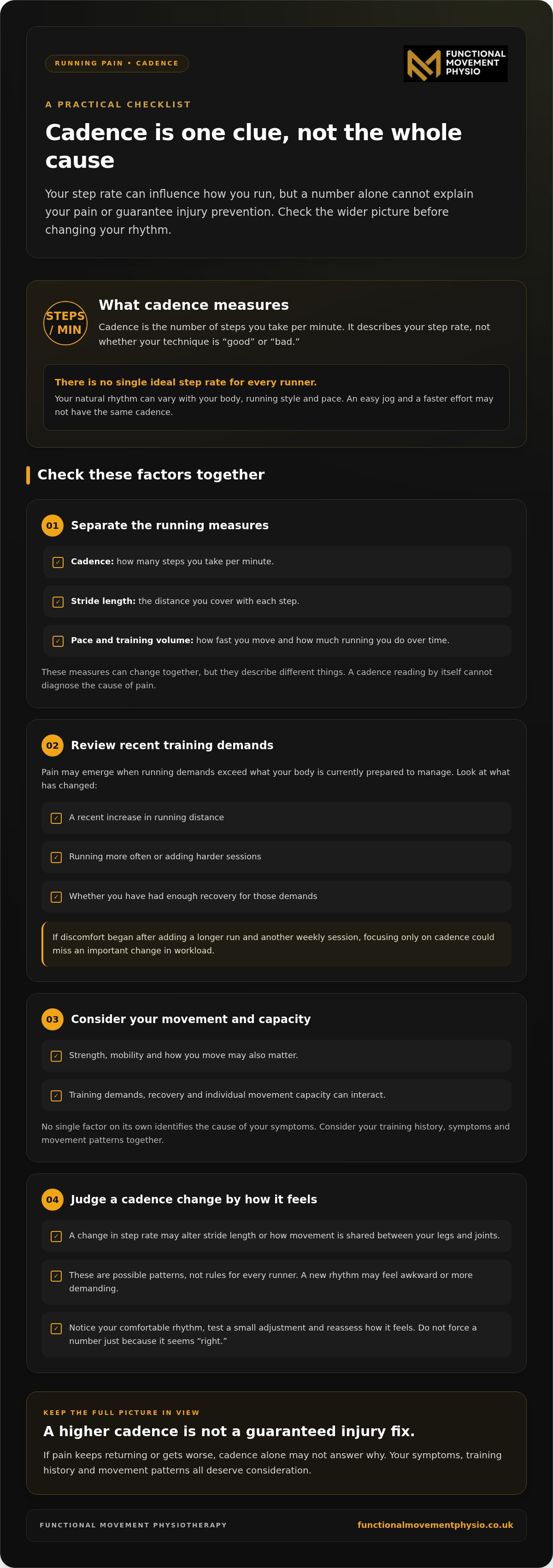
Cadence is your step rate, usually counted as steps per minute. It isn’t a score of good or bad technique, and there’s no single target that suits every runner. Pace is how fast you’re moving; stride length is how far you travel with each step; training volume is how much running you do over time.
These measures can change together, but they describe different things. For example, you may naturally take more steps per minute when running faster than during an easy jog. That doesn’t mean you need to speed up to change your cadence. Your natural rhythm also depends on your body and how you move.
Why a cadence number cannot diagnose your pain
A cadence reading describes one part of your running, but it can’t identify the cause of pain. Symptoms may relate to several factors, including recent changes in training and whether your body has built up capacity for those demands. A lower cadence or longer stride alone doesn’t prove that either caused an injury.
If generic online form advice has left you unsure, you’re not alone. Changing your stride because a number seems “wrong” may distract you from more relevant factors. Improving running cadence to prevent injury is best approached as an individual question, not a guaranteed shortcut. A running gait analysis can consider your movement alongside your symptoms and running history, rather than treating cadence as the whole answer.
How cadence fits into the root causes of running pain
Cadence can influence how you organise your stride, but it’s only one part of a changing, whole-body activity. A shift in step rate may alter stride length or how movement is shared between your legs and joints. How that feels depends on you, your pace and the context of the change.
A systematic review of running cadence examines how cadence changes relate to biomechanical measures such as impact forces. These findings can help explain how running mechanics may change, but a change in a measured force is not proof that an injury will be prevented. Research findings need careful interpretation, and individual responses vary.
How step rate may change running mechanics
Taking more steps over the same period may mean each step covers less ground, while a lower step rate may accompany a longer stride. These are possible patterns, not rules for every runner. A change that feels comfortable for one runner may feel unnatural or more demanding for another, depending on their usual rhythm and pace.
That’s why a cadence target shouldn’t be treated as a prescription. If you’re exploring improving running cadence to prevent injury, consider how a change affects your movement and symptoms instead of assuming a particular number will produce a specific result.
What else may contribute to running pain
Pain can emerge when the demands of running exceed what your body is currently prepared to manage. A recent increase in distance, running more often, harder sessions or limited recovery may all be relevant. Strength, mobility and how you move may also matter, although none of these factors alone can diagnose the cause of your symptoms.
No single running metric can identify every cause of pain because symptoms may reflect several interacting factors, including training demands, recovery and individual movement capacity.
For example, if discomfort began after adding a longer run and another weekly session, focusing only on cadence could miss an important change in overall workload. Equally, changing your training may not answer every question about strength or movement. Looking at these factors together shifts the focus from chasing a number to understanding what may be contributing to your pain.
If recurring symptoms are affecting your running, an individual assessment can consider your training history, symptoms and movement patterns together. You can book an appointment to discuss a tailored way forward.
Does increasing running cadence prevent injury? Myths and practical limits
No. Increasing your cadence is not a guaranteed way to prevent injury. It may be worth exploring as one part of your running, but it can’t replace considering symptoms, training demands, recovery and physical capacity together.
Advice to aim for one fixed step rate can make you feel that your natural rhythm is wrong. A number on its own doesn’t tell you whether your running is comfortable, sustainable or contributing to pain. A gradual, individual experiment is more useful than forcing a target presented as ideal for everyone.
Is there one ideal running cadence for everyone?
There isn’t one number that automatically suits every runner. Body size, running pace, experience and individual running style all affect your natural step rate. Even your own cadence can vary between an easy jog and a faster effort.
Focus on movement that feels comfortable and sustainable, rather than chasing a number. If you’re considering improving running cadence to prevent injury, treat it as a question to explore, not a rule you must follow.
| Reasonable guidance | Unsupported certainty |
|---|---|
| Cadence is one factor to consider alongside symptoms and training. | A particular step rate prevents injury for every runner. |
| Test a change gradually if there’s a clear reason to do so. | Changing cadence will definitely resolve existing pain. |
| Notice how your movement and symptoms respond. | A single cadence reading can identify the cause of pain. |
When a cadence adjustment may be worth exploring
A change may be worth testing if you have a specific reason, such as wanting to see how a different rhythm affects your stride. First consider your training and symptoms together. Have you recently changed your distance, frequency or intensity? Are you recovering well? What happens to your symptoms during and after a run?
If you have knee pain, don’t assume cadence is the cause or the cure. Runner’s knee can have contributing factors that need to be considered in context. Our guide to runner’s knee pain can help you understand the issue, while an individual assessment can explore your symptoms, training history and movement together.
Cadence is one possible tool for adjusting your running, not a cure or a guarantee against injury. The aim is to understand what may be contributing to your pain and find changes that support sustainable running, not simply to make a number look right.
How to experiment with running cadence gradually and safely
If you want to test a cadence change, keep the experiment simple. Observe your usual rhythm first, make one small adjustment during an easy run, then review how your body responds. You don’t need to change every run or force yourself to run faster.
Set a baseline before changing your stride
Choose a familiar, comfortable run and notice your natural step rate without trying to alter it. You can count your steps over a timed interval, or use a watch, metronome or recording if helpful. These are optional tools, not requirements.
Note how the run feels, including any symptoms and your sense of effort. Consider your recent training too: a harder session or a change in distance may affect how you feel. Your baseline is personal information, not a score you need to improve.
Make a small adjustment and review your response
If you have a clear reason to experiment, change just one thing. During part of an easy run, try a slightly quicker rhythm while keeping your pace and route familiar. Let the adjustment feel natural. If you’re counting or following a cue, use it as a reminder, not a demand to hit a particular number.
Pay attention while you run and afterwards. Does your movement still feel relaxed? Do your symptoms stay the same, settle or increase? Notice how you feel later, too. If pain worsens or your stride feels strained, stop the experiment or return to your usual rhythm. Don’t push through a change that feels wrong.
Keep the rest of your training consistent while you assess your response. Changing cadence, pace and distance at the same time makes it harder to work out what affected how you felt. If the adjustment feels comfortable, consider whether it has a useful place in your running. There’s no need to keep it if it doesn’t suit you.
A cadence experiment can offer useful feedback, but it won’t identify every contributor to pain. A tailored Liverpool gait analysis can consider your running movement alongside your symptoms and training history, helping you focus on what’s relevant to your body.
When to seek help with running cadence and recurring pain in Liverpool
If pain keeps returning, is getting worse, or is stopping you from running as you normally would, an individual clinical assessment can help you understand what may be contributing. You don’t need to keep changing your stride based on online advice when you’re unsure what’s driving your symptoms.
Cadence may be relevant, but it’s only one part of the picture. A useful assessment considers your symptoms alongside your running history, recent training changes and movement patterns. That broader view can help distinguish a potentially useful adjustment from a change that simply adds another demand.
What a runner assessment can help clarify
A runner assessment at Functional Movement Physio includes biomechanical analysis and video gait analysis. This allows your running movement to be considered alongside what you’re experiencing, rather than judging your form by one number or focusing on cadence in isolation.
Where relevant, findings can inform an individual strength and conditioning plan. The aim is to address factors that matter to your movement and running goals, not just respond to pain temporarily. Read more about gait analysis for runners and how movement can be assessed in context.
Choose a sustainable next step for your running
While you work out what’s going on, avoid abrupt changes to your running form. A gradual return to comfortable running, shaped around your symptoms and goals, is a more considered step than forcing a new cadence or pushing through worsening pain.
Advice about improving running cadence to prevent injury should fit your circumstances. An assessment can help clarify whether cadence is worth exploring, what other factors may need attention and how to build towards running sustainably. The goal is to help you return to meaningful activity with a clearer plan.
If recurring running pain is leaving you uncertain about your next step, book an appointment with our Liverpool physiotherapy team.
Take your next step towards comfortable running
Improving running cadence to prevent injury isn’t about chasing a universal number. Cadence is one part of your running, and a gradual, comfortable experiment is more useful than forcing a change that doesn’t suit you.
If you try an adjustment, notice how you feel during and after your run. If pain persists, returns or worsens, look beyond cadence to understand what may be contributing. Your training, recovery, movement and strength all matter.
At Functional Movement Physio in Liverpool, a runner’s assessment includes biomechanical and video analysis, with a tailored strength and conditioning plan based on relevant findings. This personalised approach can help you make sense of recurring pain and plan a sustainable return to running.
You don’t have to figure it out by chasing conflicting advice. With a clearer understanding and a plan that fits you, you can build towards running with greater confidence.
Frequently Asked Questions
Can increasing running cadence prevent injuries?
Increasing cadence may be one factor to consider, but it can’t guarantee injury prevention or replace understanding your individual situation. A change in step rate may alter how you run, but pain can also relate to training demands, recovery and physical capacity. If you’re improving running cadence to prevent injury, treat it as a possible adjustment to explore, not a cure or substitute for considering the wider picture.
What is a good running cadence for a beginner?
There’s no single cadence that every beginner should aim for. Cadence means the number of steps you take per minute, and it can vary with your pace, experience and natural running style. Rather than chasing a universal target, notice what feels comfortable during an easy run. If your running is pain-free and sustainable, you don’t need to change your step rate simply because someone else has a different number.
How do I calculate my running cadence?
You can count every step you take during a timed minute of running to estimate your cadence. Choose a familiar, comfortable pace and count without deliberately changing your rhythm. Alternatively, a running watch may display your step rate. The result is a snapshot of your personal baseline, not a grade or diagnosis. Your cadence can vary with pace and effort, so compare similar runs if you’re observing it over time.
Should I increase my cadence if my knees hurt?
Don’t assume cadence is the cause of your knee pain or that increasing it will resolve the problem. Knee symptoms can have several contributing factors, including changes in training, recovery and movement. If you have a clear reason to test a cadence adjustment, try it gradually during an easy run and monitor how you feel. Seek an individual assessment if pain persists, keeps returning or worsens.
How quickly should I change my running cadence?
There’s no fixed deadline for changing your cadence. Start by noticing your usual rhythm, then, if there’s a reason to experiment, make a small adjustment during part of an easy run. Keep other training changes steady so you can judge your response. Check how your symptoms and effort feel during the run and afterwards. If the change feels strained or symptoms worsen, pause or return to your usual rhythm.
Can changing my running stride cause pain?
A change to your stride can feel unfamiliar and may alter how running feels for you. That doesn’t mean it will necessarily cause an injury, but forcing a new rhythm or changing several things at once can make it harder to judge your response. Keep any experiment gradual and manageable. If movement feels strained or pain increases, stop or modify the change rather than pushing through it.
When should I see a physiotherapist about running pain?
Consider an individual physiotherapy assessment if pain keeps returning, is getting worse or limits your running. These symptoms don’t identify a specific cause on their own, but they’re a reason to look beyond cadence and consider your training history, symptoms and movement together. In Liverpool, a runner’s assessment includes biomechanical and video analysis, helping clarify relevant factors and guide a tailored plan for returning to activity.

Article by
Stuart Goldfinch
HCPC PH112156
Specialist MSK Physiotherapist
Ex UK SAS Trainer
Graduate Sports Rehabilitator


