

If recurring discomfort is disrupting your runs, a running gait analysis Liverpool search may be about more than finding different shoes or changing your stride. You may want to understand what could be contributing to the problem and what practical steps might help. A Liverpool running assessment can consider how you move alongside your symptoms, training and goals.
Online advice can be conflicting, and a movement pattern on its own does not explain every runner’s discomfort. Video observations are most useful when discussed in context: when symptoms occur, what has changed in your training, and what you want to return to doing.
At Functional Movement Physio in Liverpool, video analysis is part of an individual Runner’s Assessment. It is not an automatic instruction to change your technique or simply a shoe-fitting exercise. This article explains how to prepare, what the assessment includes, and how findings can inform a tailored strength and conditioning plan.
Key Takeaways
- Recurring pain can involve factors beyond the area where you feel it, so a quick fix may not answer the whole question.
- A running gait analysis Liverpool assessment can connect movement observations with your symptoms, training and goals.
- Before attending, think about when discomfort occurs, how your training has changed and what activities you want to return to.
- Ask how each observation relates to your situation instead of assuming you need to change your running form.
- A tailored strength and conditioning plan can turn relevant findings into practical next steps.
The Problem: When Running Pain Keeps Returning
It can be discouraging when a few days’ rest settles your running pain, only for it to return as you build up your training. You may have tried changing shoes, stretching more or following advice online, but still be unsure what is contributing to the discomfort.
Pain gives you useful information, but its location does not identify every factor involved. Knee discomfort, for example, does not automatically mean the knee is the only area to consider. Training changes, recovery, strength and movement may all be relevant, and no single factor explains every runner’s symptoms.
This video explores running cadence, one aspect of running form that may come up in online advice:
Why symptom-only fixes may not answer the whole question
Rest or another quick fix may ease symptoms, but relief alone does not explain why discomfort returns when you run. To explore possible contributors, consider the wider picture: recent changes to your training, how you recover, your strength and how you move.
This does not mean you need to stop running or change everything at once. It means looking for an explanation that fits your experience rather than treating one possible factor as the answer.
Advice to shorten your stride or change your foot strike may sound convincing, but another runner’s approach may not suit your symptoms, goals or training demands. A Liverpool running gait assessment can put movement observations into context. Gait analysis is the study of movement, but an observation by itself does not identify every cause of pain.
Is running gait analysis just a shoe-fitting exercise?
No. Gait analysis can involve observing how you move while running, not just considering your shoes. Footwear may be worth discussing, but movement observations are more useful when considered alongside your running history, symptoms and goals. They are not a judgement of your form or an automatic instruction to change it.
At Functional Movement Physio in Liverpool, video analysis is included in a comprehensive Runner’s Assessment. Findings inform individual next steps. Read more about the clinic’s gait analysis service in Liverpool to explore the assessment.
The Root Cause Approach: What Running Gait Analysis Can Show
Running gait analysis is a structured observation of how you move while running, used to guide questions and inform practical next steps. It can help a practitioner notice movement patterns, but it cannot identify every cause of pain on its own or guarantee a diagnosis.
At Functional Movement Physio, video analysis is part of a comprehensive Runner’s Assessment. The aim is not to label your running style as right or wrong. Instead, observations are considered alongside your symptoms, running history, training demands and goals, to explore what may be relevant to you.
Which aspects of running movement may be observed?
A practitioner may observe how your legs and arms move, how your body responds as you run, and whether movement patterns change during the assessment. Video analysis can make movement easier to review and discuss. The clinic confirms that video analysis is included, but practical details such as the camera setup, running surface and assessment duration are not specified. Contact the clinic if you want to check what the session involves before attending.
The aim is to make observations useful, not to collect information for its own sake. You can ask how the assessment is carried out and what to expect when arranging your Runner’s Assessment.
How symptoms and running context shape the assessment
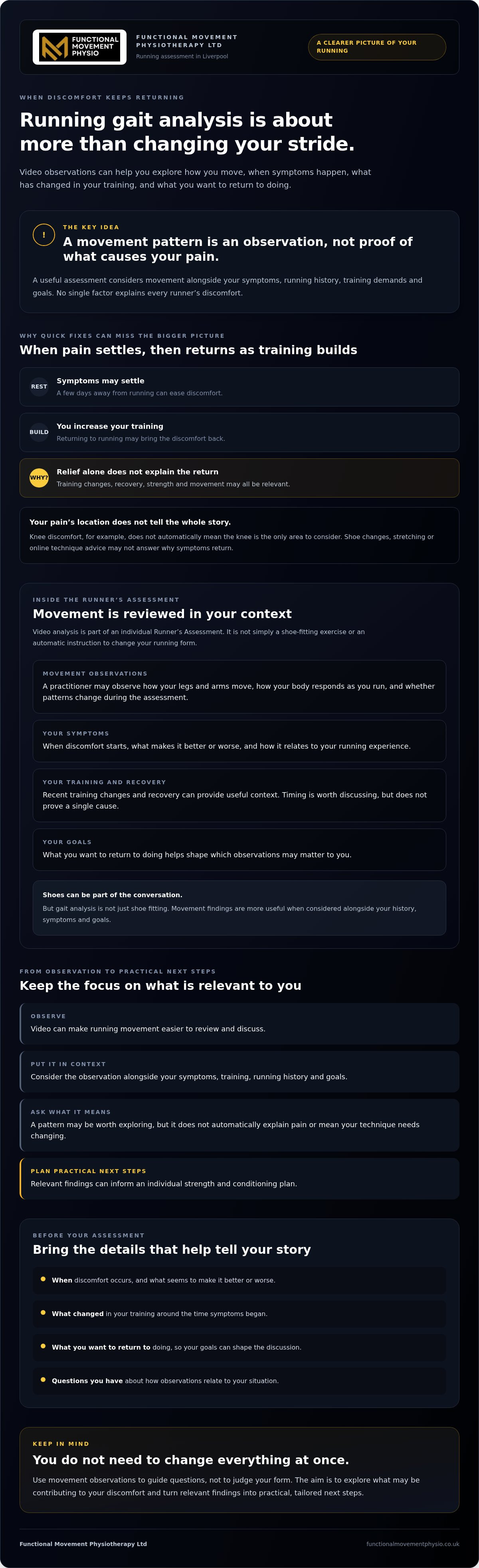
A visible movement pattern is an observation, not proof that it causes pain. Its relevance depends on the wider picture: when symptoms start, what makes them better or worse, how your training has changed and what you want to get back to doing. A pattern may be worth exploring, but it needs to make sense alongside your experience.
For example, if discomfort began after a change in training, the timing is useful context to discuss. It does not prove that the change is the sole cause. Analysis can help shape further questions and practical next steps, rather than prompting an automatic change to your technique.
If you are considering running gait analysis Liverpool, explore Functional Movement Physio’s gait analysis service in Liverpool to learn about its Runner’s Assessment. You can also book an appointment to discuss whether the assessment fits your concerns and goals.
What to Expect from Running Gait Analysis in Liverpool
Knowing what an assessment involves can help you prepare. A useful running assessment connects your experience and goals with movement observations, rather than focusing only on your feet or shoes. Check practical details with the clinic when arranging your Runner’s Assessment, especially if you are unsure what to bring or wear.
Before the running assessment
Start by thinking about what you want help with. Be ready to describe where you feel discomfort, when it appears, what activities you currently do and what you hope to return to. You do not need a perfect training log or a particular running distance or pace. A few clear examples can help explain what matters to you.
If you are unsure what to wear or whether to bring particular running shoes, ask the clinic beforehand rather than assuming specific clothing or footwear is required.
During and after the movement assessment
The assessment considers your symptoms and running goals alongside observations of how you move. Video analysis can help you and the practitioner review movement patterns, but those observations need to be interpreted in context. They are not a judgement of your running style, nor do they automatically mean you need to change your technique.
Functional Movement Physio’s Runner’s Assessment includes a discussion of your running needs, video analysis and a tailored strength and conditioning plan. This can help turn relevant findings into practical next steps, rather than generic exercises or a one-size-fits-all correction.
After reviewing the observations, ask which findings relate to your symptoms and goals, and what the suggested plan is intended to address. If something is unclear, ask for a straightforward explanation. You should leave with a better understanding of how to move forward, not just a list of technical terms.
If your concern involves a wider sports injury, you can also read about sports physiotherapy in Liverpool. For details about running gait analysis in Liverpool, check with the clinic what the session involves and what to bring.
How to Use Your Gait Analysis Findings in a Sustainable Plan
An assessment is most useful when it helps you decide what to do next. Ask which observations matter to your symptoms and goals, and how they relate to your running demands. Findings are most useful when interpreted alongside your experience, not treated as a verdict on your running style.
Turn observations into realistic next steps
A tailored strength and conditioning plan can translate relevant findings into practical work. Before starting an exercise or changing how you run, make sure you understand its purpose. Is it intended to build strength, support a movement goal or help you manage your training? Knowing the reason helps you focus on relevant changes instead of adding adjustments at random.
Your plan should be individual. Pay attention to how your body responds and whether the plan supports activities that matter to you, such as returning to regular training or working towards a running goal. If an exercise or adjustment is unclear, ask how it relates to your assessment and what to do if your symptoms change.
Avoid copying a running style you have seen online or trying to correct every movement at once. Your plan should reflect your assessment, current capacity and goals. Discuss changes and review your response without assuming a particular timeframe or outcome.
When recurring running pain needs wider assessment
If discomfort keeps returning, persists or limits an activity you value, consider seeking individual guidance rather than relying only on self-directed fixes. Gait analysis may form one part of a broader clinical assessment. The useful question is not simply “What does my running look like?” but “How do these observations fit with my symptoms, activity and goals?”
For runners searching for running gait analysis Liverpool, Functional Movement Physio’s Runner’s Assessment includes video analysis and a tailored strength and conditioning plan. Read about the clinic’s gait analysis service in Liverpool and discuss whether an assessment is relevant to your situation.
Running Gait Analysis in Liverpool: Your Next Step
If recurring discomfort is making you question every step, an individual Runner’s Assessment may help you make sense of what you are experiencing. It can be useful if you want to understand how you move while running and whether those observations relate to your symptoms, training or goals.
The aim is not to judge your form or promise a diagnosis or recovery. It is to explore possible contributors and identify practical next steps. At Functional Movement Physio, the Runner’s Assessment includes video analysis and a tailored strength and conditioning plan. It is a specific assessment, not simply a shoe-fitting service or a promise that one change will resolve every problem.
Questions to ask before booking
Before arranging an assessment, make sure you understand what it involves and how findings may be used. You could ask:
- What does the Runner’s Assessment include?
- How will observations be connected to my symptoms and running goals?
- What should I bring or wear?
Be ready to explain when your symptoms occur, what activities they affect and what you have already tried. For example, mention if discomfort returns as you increase your running, or if you have changed footwear or training in response. This context can help the practitioner understand what you want support with. Confirm appointment details directly with the clinic.
Choose an assessment that leads to useful action
A helpful assessment should leave you with clear explanations and next steps that make sense for your circumstances. You should be able to ask why an observation matters, how an exercise relates to your goals and what to consider as you return to activity. The focus is on exploring possible contributors to pain, not labelling your movement as faulty or prescribing a change without context.
If you are considering running gait analysis Liverpool, look for an approach that connects movement observations with your experience and supports realistic progress. Individual responses and outcomes vary, so ask how the assessment findings may guide your next steps.
Take the Next Step Towards More Confident Running
Recurring running discomfort deserves more than guesswork. Gait analysis can offer useful observations, but those findings matter most when considered alongside your symptoms, training and personal goals. They are not a judgement of your running form or a guaranteed diagnosis.
Functional Movement Physio offers a Runner’s Assessment in Liverpool that includes video analysis and a tailored strength and conditioning plan. The assessment can help turn relevant observations into practical next steps based on your needs.
Bring your questions, explain what you have already tried and be clear about the activities you want to return to. A thoughtful assessment can help you understand possible contributors to discomfort and make a more informed plan for moving forward.
With clearer guidance, you can work towards a sustainable return to the running that matters to you.
Frequently Asked Questions
What happens during a running gait analysis?
The assessment considers your concerns and running goals alongside observed movement, rather than treating a video as a diagnosis. Functional Movement Physiotherapy’s Runner’s Assessment includes video analysis and a tailored strength and conditioning plan. Ask the clinic about the exact process and practical details. Observations can guide discussion about what may be relevant to you, but they do not automatically prove the cause of pain.
Can gait analysis identify the cause of running pain?
Gait analysis can provide useful information, but one movement observation should not automatically be treated as the cause of your pain. Your symptoms, running history, usual activities and goals help put observations into context. Think of analysis as one part of understanding your situation. It can guide further discussion, but it cannot promise a diagnosis or resolve every running problem.
Is running gait analysis only about choosing running shoes?
No. Gait analysis can involve observing how you move while running, rather than focusing only on shoe selection. Footwear may be relevant to discuss, but it should not replace consideration of your symptoms, running habits and goals. There is no one shoe type or running style that is right for everyone. An individual assessment keeps the discussion focused on what may matter in your circumstances.
How should I prepare for a running gait analysis in Liverpool?
Be ready to describe your symptoms, running habits and what you hope to achieve. It may help to note when discomfort occurs and what you have already tried. Bring any questions you want answered. Ask the clinic whether particular clothing or footwear would be useful rather than assuming there are specific requirements. The clinic can also confirm appointment details and what to expect.
Can gait analysis help if I do not have an injury?
You may want movement insight without an active injury, for example to understand your running or discuss a performance goal. Whether an assessment is suitable depends on your needs and the service offered. Functional Movement Physiotherapy provides Runner’s Assessments in Liverpool, but no assessment can promise performance gains. Contact the clinic to explain what you hope to learn and ask whether the assessment fits your aims.
What happens after a running gait analysis?
Next steps should reflect your assessment findings, symptoms and goals, rather than follow a fixed plan for every runner. Functional Movement Physiotherapy’s Runner’s Assessment includes a tailored strength and conditioning plan. Ask how each recommendation relates to your situation and what it is intended to address. Your response can guide decisions over time, but there is no guaranteed outcome or set recovery timeline that applies to everyone.

Article by
Stuart Goldfinch
HCPC PH112156
Specialist MSK Physiotherapist
Ex UK SAS Trainer
Graduate Sports Rehabilitator


