

If pain or stiffness is making running, training or everyday tasks harder, it can be difficult to know which exercise is right for you. With clinical Pilates in Liverpool, the useful question is not simply whether Pilates is suitable, but whether the exercises can be matched to your movement needs, current capacity and goals.
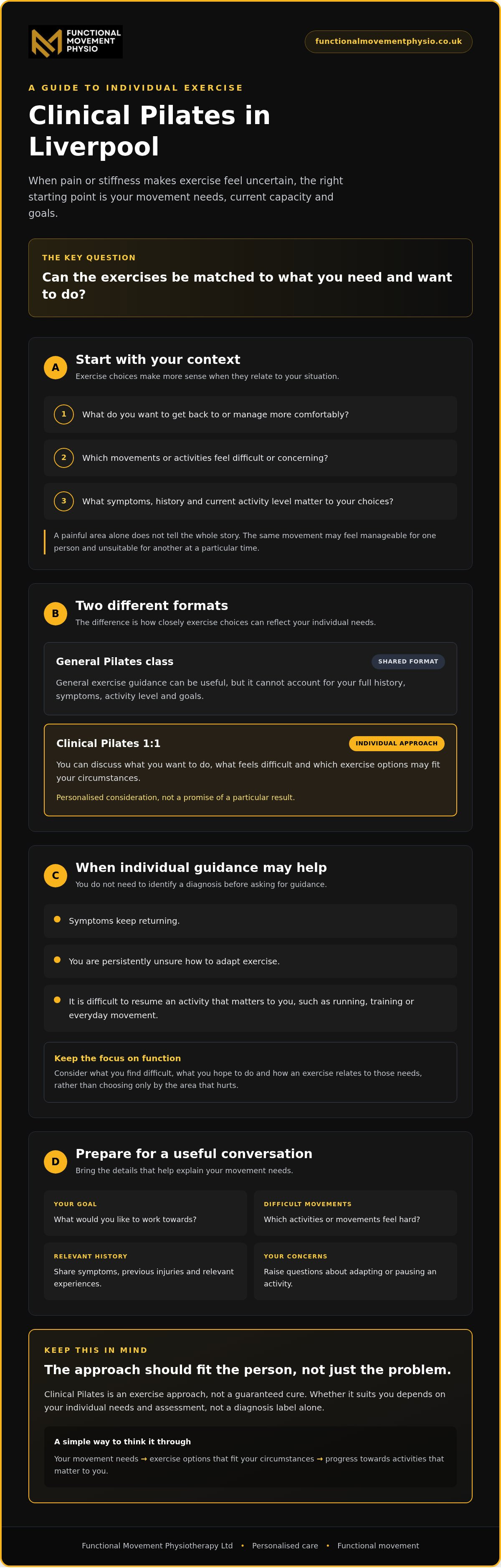
A general Pilates class and one-to-one Clinical Pilates are different formats. In an individual session, you can discuss what you want to do, what feels difficult and what exercise options may fit your circumstances. That does not mean Pilates is right for everyone or guarantees a particular result. It gives you an opportunity to consider your needs before deciding how to move forward.
This article explains what one-to-one Clinical Pilates may involve, how it compares with a general class, and what to consider when choosing an approach in Liverpool. It also covers practical ways to prepare for a conversation with a Liverpool clinic.
Key Takeaways
- Generic exercise advice may not reflect your history, symptoms or current capacity. Note which movements and activities feel difficult for you.
- Clinical Pilates 1:1 lets exercise choices be considered in relation to your movement needs and personal goals.
- Whether clinical pilates liverpool suits you depends on your individual needs and assessment, not a diagnosis label alone.
- Before a session, think about what you want to work towards, share relevant history and raise concerns about movement.
- Functional Movement Physio focuses on personalised care, functional movement and factors that may contribute to difficulty.
The Problem: When Pain Makes Exercise Feel Uncertain
You want to keep moving, but recurring pain or stiffness can make each exercise feel like a risk. Advice to “keep active” may seem to conflict with instructions to rest, leaving you unsure whether to continue, modify an activity or pause it. That uncertainty can make it harder to return to running, training or everyday movement with confidence.
General exercise guidance can be useful, but it cannot account for your full history, current symptoms, activity level and goals. A movement that feels manageable for one person may not suit someone else at a particular time. Rather than choosing an exercise based only on the area that hurts, consider what you find difficult, what you hope to do and how the exercise relates to those needs. For background, you can read about the Pilates method.
This video provides a further perspective on Clinical Pilates and back pain:
Why the same exercise advice does not suit everyone
Your needs depend on more than the name of a painful area. Your goals, symptoms, usual activity and previous injuries all help shape what feels appropriate. A desk worker hoping to move more comfortably during the day may need a different starting point from a runner working towards regular training.
That does not mean sitting, running or a particular posture is automatically the cause of pain. It means context matters. When considering an exercise, ask whether it relates to an activity you want to manage, whether you can do it in a way that feels suitable, and whether you know how to raise concerns if it does not feel right.
Exercise works best when it matches the person, not just the problem.
When it may be time to seek individual guidance
Consider seeking professional guidance if symptoms keep returning, you are persistently unsure how to adapt exercise, or you are finding it difficult to resume an activity that matters to you. You do not need to identify a diagnosis before asking for help. An assessment can explore your history, the movements you find difficult and what you want to work towards.
If you are searching for clinical Pilates in Liverpool, an individual approach gives you an opportunity to discuss those concerns and consider exercise options. Functional Movement Physio offers Clinical Pilates in Liverpool, with a focus on personalised care and functional movement. If you are unsure whether to adapt or pause an activity, raise that concern as part of a professional assessment.
What Clinical Pilates in Liverpool Involves
Clinical Pilates is Pilates-informed exercise considered in relation to your needs, symptoms and movement goals. Rather than following the same routine as everyone else, exercise choices can take your circumstances into account. At Functional Movement Physio, the service is Clinical Pilates 1:1, an individual approach that connects exercise choices with your goals and movement needs.
It is an exercise approach, not a guaranteed cure or a substitute for appropriate assessment. Pilates-based exercises may be adapted for different needs, as explored in this research on gentle strength training for rehabilitation. The practical question is whether an exercise fits your situation and how it relates to the factors affecting your movement, rather than focusing only on symptoms.
How an individual session can be tailored
An individual session can give you space to discuss what you want to do, what feels difficult and any relevant symptoms or previous experiences. You might want to build confidence with everyday movement, work towards returning to training or find an appropriate starting point after a change in your health.
Exercise selection should reflect those needs. You can explain which movements concern you, what you have already tried and what you hope to achieve. The approach can then be considered in light of your goals and how you respond. If you are considering clinical Pilates in Liverpool, you can read about Clinical Pilates in Liverpool at the clinic.
Clinical Pilates and general Pilates: what is the difference?
A general Pilates class typically offers a planned session for a group. Individual Clinical Pilates 1:1 focuses on considering Pilates-informed exercise in relation to one person’s needs and movement goals. Neither format is automatically right for everyone. The main difference is the degree of individual focus, not a promise that one approach will produce a particular result.
When comparing the options, think about whether you want a shared class routine or an individual conversation about your history, goals and concerns. If you are unsure whether one-to-one support is relevant, consider what you hope to change and what currently gets in the way. You can book an appointment to discuss your options with Functional Movement Physio.
Who May Consider Clinical Pilates, and What Should You Compare?
You might consider an individual Pilates approach if you want to feel more confident moving, build strength in a considered way or work towards an activity you have changed or paused. Your goal could be returning to running, managing gym exercises more comfortably or feeling steadier with everyday tasks. Start with what matters to you, rather than a label attached to your symptoms.
Suitability depends on your individual needs and assessment. A diagnosis alone does not determine which exercises are appropriate, and Clinical Pilates should not be assumed to treat a particular condition. An assessment can explore your history, current movement and goals, then consider whether Pilates-informed exercise is suitable or whether another form of support should come first.
Questions to ask before choosing a Pilates option
Compare how well the format can respond to your needs, rather than judging by the word “Pilates” alone. A group class may offer a shared routine, while individual support can give you time to discuss your circumstances and consider how exercises relate to your goals. Neither format is automatically better for everyone.
- How will my symptoms, relevant history and activity goals be considered?
- What should I do if an exercise feels uncomfortable or difficult?
- Is the session individual or group-based?
Clear answers help you decide whether the approach feels relevant and whether you understand how exercise choices will be made. You can also ask what practical details you need to know before arranging a session.
When Pilates may need to sit alongside physiotherapy
If pain keeps returning, your movement feels limited or you are unsure what is driving the difficulty, an assessment may help clarify contributing factors and exercise options. Physiotherapy and Pilates-informed exercise can be considered together, depending on your needs. This means looking beyond the area that feels uncomfortable and discussing how your movement goals may shape the approach.
Functional Movement Physio offers Clinical Pilates 1:1 in Liverpool as part of its personalised, functional movement approach. If you are weighing up clinical Pilates in Liverpool, consider whether you want individual attention, how your goals will guide exercise choices and how your needs will be reviewed. You can learn more about the Clinical Pilates service in Liverpool or book an appointment to discuss your options.
How to Approach Clinical Pilates Safely and Sustainably
A clear conversation can help you move from uncertainty to a plan that reflects your needs. Before starting, think about what you want to work towards and what has made exercise difficult so far. You do not need to arrive with a diagnosis or a perfect explanation. Specific examples can make it easier to discuss what may be useful.
What to discuss at your first appointment
Prepare a short account of your symptoms, relevant injury or health history, and the activities you would like to resume. For example, you could mention that running feels uncomfortable after a certain point, or that a gym movement leaves you unsure how to continue. Share any exercise advice that has conflicted or made you hesitant, too.
Ask how your needs will be assessed and how exercises will be selected. If you are concerned about a movement, say so. You can ask how the approach might be adjusted if an exercise feels unsuitable or your symptoms change. Open communication keeps the focus on your goals and movement needs, rather than simply pushing through discomfort.
How to build progress without chasing a quick fix
Sustainable progress is not about forcing an immediate change in symptoms. It involves finding an appropriate level of movement, understanding how it relates to your goals and reviewing the approach as your needs change. If an exercise does not feel right, raise it with the clinician so they can consider whether it needs adapting or reviewing.
Progression should reflect your response and goals, not a fixed timetable.
Keep the conversation active. If returning to a valued activity is your aim, explain what it involves and what currently gets in the way. If your symptoms, confidence or everyday demands change, share that as well. Exercise choices may need to be reviewed as your needs evolve. This is different from following a generic programme without considering how it applies to you.
If you are exploring clinical Pilates in Liverpool, use your appointment to discuss a suitable next step and how exercises could relate to your goals. Functional Movement Physio’s approach centres on personalised care and functional movement, with attention to factors that may contribute to difficulty.
Explore Clinical Pilates in Liverpool and Choose Your Next Step
Individual Clinical Pilates 1:1 may be worth discussing if pain, stiffness or reduced confidence is affecting how you move, or if you are working towards returning to an activity that matters to you. You do not need to know in advance whether Pilates is the right fit. A conversation can help clarify your goals, concerns and possible next steps.
Functional Movement Physio is a Liverpool clinic offering Clinical Pilates 1:1 alongside physiotherapy and rehabilitation. Its approach focuses on personalised care, functional movement and factors that may contribute to difficulty, rather than addressing symptoms in isolation. This does not guarantee a particular treatment or outcome. The aim is to understand your needs and consider suitable options with you.
What to expect from a personalised conversation
You can explain what you would like to do more comfortably, which movements or activities feel challenging, and what you are worried might make things worse. You may want to return to training, build confidence with everyday movement or understand how to exercise around ongoing symptoms. Share relevant history and any advice you have found confusing, too.
You can ask how your movement needs will be considered, how exercises could relate to your goals, or what to do if a movement feels unsuitable. The discussion can help you understand whether individual Clinical Pilates 1:1 appears relevant and what other support, if any, may be appropriate. It does not commit you to a specific treatment plan.
You can find more information about the Clinical Pilates service in Liverpool before deciding whether you would like to discuss it. Reading about the service may help you prepare questions. An individual conversation is the opportunity to explore how your own needs and goals could shape a next step.
Book a Liverpool appointment when you are ready
If you are considering clinical Pilates in Liverpool, you do not need to have everything figured out first. Bring your questions and describe what you hope to get back to. An appointment can help you discuss your movement needs and whether the service may suit you, without assuming a particular result.
Take the Next Step Towards Confident Movement
Clinical Pilates may be worth discussing if pain, stiffness or uncertainty is getting in the way of activities you value. Rather than choosing exercises based only on a diagnosis label or generic routine, consider your movement needs, history and goals. Individual Clinical Pilates 1:1 can connect exercise choices with what you want to work towards, though it cannot guarantee a particular result.
If you are exploring clinical Pilates in Liverpool, Functional Movement Physiotherapy offers individual sessions in Liverpool as part of a personalised approach focused on functional movement and factors that may contribute to difficulty. Use an appointment to explain what feels challenging, what you hope to resume and any concerns you have about exercise. You can discuss whether the service fits your needs and consider appropriate next steps.
You do not need to have all the answers before starting the conversation. A clearer understanding of your needs can be a practical first step towards moving with greater confidence.
Frequently Asked Questions
What is clinical Pilates, and how is it different from regular Pilates?
Clinical Pilates uses Pilates-informed exercises considered in relation to an individual’s needs and movement goals. A general Pilates class usually follows a shared routine, while individual Clinical Pilates 1:1 allows exercise choices to be considered alongside your history, symptoms and activities. It is an exercise approach, not a guaranteed cure. The difference is the individual focus, not a promise of a particular result.
Can clinical Pilates help if exercise makes my pain feel worse?
If exercise increases your pain or makes you unsure how to move, do not assume you need to push through or stop all activity. Your response may be a reason to review the exercise, how it is being done and whether it suits your current needs. Tell a clinician which movement affected you and what happened. An individual assessment can help clarify suitable options without promising a specific outcome.
Is clinical Pilates suitable for beginners?
Limited Pilates experience does not automatically rule it out. Suitability depends on your needs, goals and movement capacity, not simply whether you have attended a class before. In an individual session, you can explain what feels unfamiliar or concerning, and exercise choices can be considered in that context. If you are unsure, ask how the approach could fit your starting point before deciding whether it is right for you.
How does a one-to-one clinical Pilates session work?
A one-to-one session focuses on your needs rather than a shared group routine. You can discuss your goals, relevant symptoms, activity history and movements you find difficult. Exercise choices can then be considered in relation to your needs and reviewed as appropriate. At Functional Movement Physio, Clinical Pilates 1:1 is offered as part of a personalised approach to functional movement. Ask the clinic about practical session details when arranging an appointment.
Can clinical Pilates support a return to sport or everyday activity?
It may be one way to work towards movement goals, such as building confidence with everyday tasks or progressing towards sport. Exercises should relate to what you want to resume and the factors affecting your movement. Clinical Pilates cannot guarantee a return to a particular activity or timeframe. If you are considering clinical Pilates in Liverpool, discuss your sport or daily demands so suitability and possible next steps can be considered individually.
Do I need a physiotherapy assessment before starting clinical Pilates?
Whether a separate physiotherapy assessment is needed depends on your circumstances and the clinic’s process, so check directly rather than assuming. An assessment can explore your relevant history, movement needs and goals, and whether Pilates-informed exercise is suitable. Be ready to explain what feels difficult and any concerns about exercise. Functional Movement Physio offers physiotherapy and Clinical Pilates 1:1, but confirm how to begin when you enquire.
Where can I find clinical Pilates in Liverpool?
Functional Movement Physio is a Liverpool clinic offering Clinical Pilates 1:1. Its approach emphasises personalised care, functional movement and individual goals. If you are comparing options, ask how the service considers your needs and what practical details you should know before booking. You can find information about Clinical Pilates in Liverpool and decide whether you would like to discuss your movement goals with the clinic.

Article by
Stuart Goldfinch
HCPC PH112156
Specialist MSK Physiotherapist
Ex UK SAS Trainer
Graduate Sports Rehabilitator


