

Complete rest is often the worst thing you can do for an aching tendon. If you've spent weeks resting and icing to calm morning stiffness, only to feel that familiar ache flare up the second you lace up your trainers or pick up a barbell, you aren't alone. It feels deeply frustrating when taking time off completely fails to solve the problem. The truth is that chronic tendinopathy isn't an acute inflammatory issue waiting to settle with passive rest; it is a clear sign that your tendon has lost the capacity to handle your everyday physical demands.
When you stop moving entirely, that tissue capacity drops even further. You don't need prolonged rest; you need the right mechanical stimulus to rebuild. In this guide, you will learn the true biological mechanisms behind persistent tendon pain and discover how targeted progressive loading safely restores strength and elasticity. We will walk through a clear, staged exercise blueprint that tackles the root cause of your symptoms so you can eliminate flare-ups and return to running, gym training, and purposeful daily movement with total confidence.
Key Takeaways
- Understand why chronic tendinopathy is a breakdown in tissue load capacity rather than simple inflammation, explaining why passive rest fails to solve the problem.
- Discover how prolonged inactivity weakens tendon fibers and why specific mechanical loading is necessary to stimulate true cellular repair.
- Learn the staged exercise progression, from pain-calming isometric holds to heavy slow resistance, that safely rebuilds tendon resilience.
- Identify the biomechanical faults and training errors across your kinetic chain that trigger recurring flare-ups during running or lifting.
- Explore how targeted clinical therapies, including Shockwave Therapy, can help stimulate stubborn tissue alongside an active rehabilitation plan.
What Is Tendinopathy: Why Tendon Pain Persists Beyond Inflammation
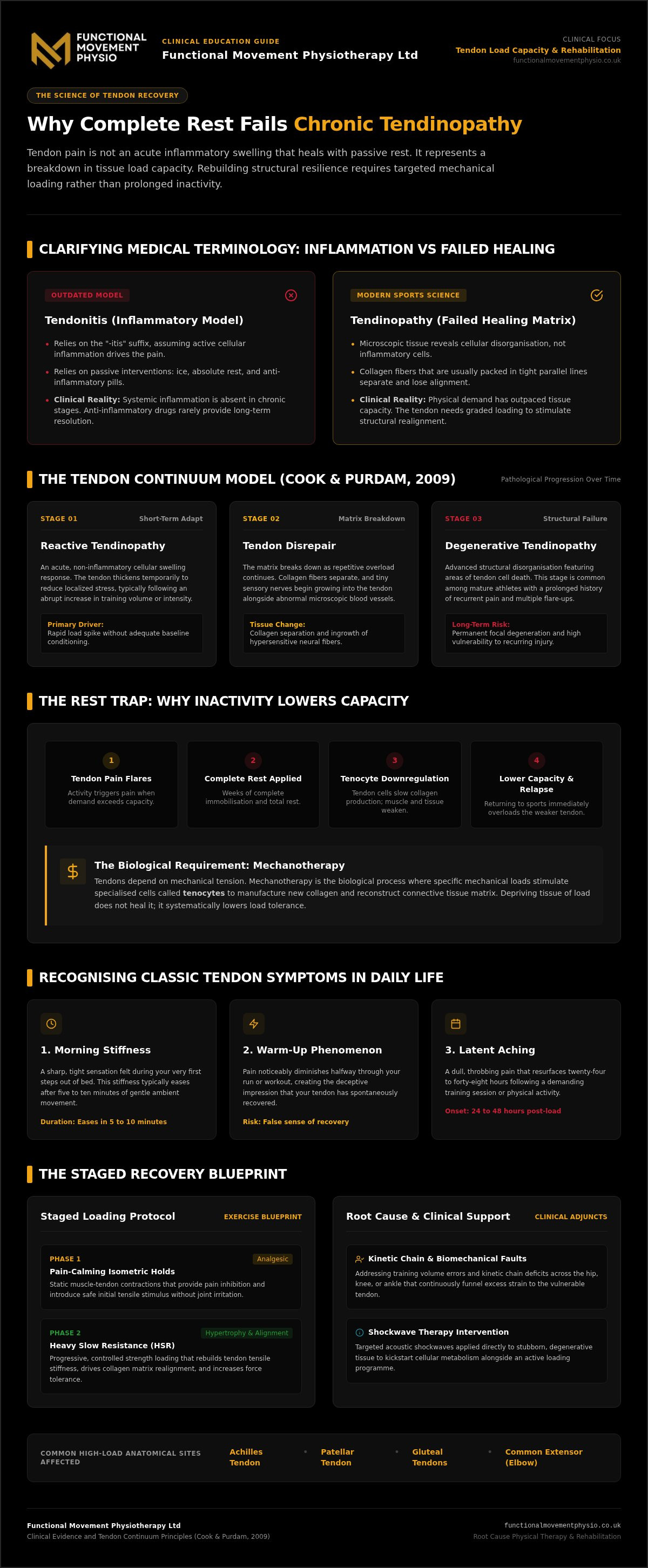
For decades, tendon pain was viewed as simple swelling that needed ice, anti-inflammatory pills, and rest. Modern sports science shows a very different reality. Clinicians now define tendinopathy not as an inflammatory disease, but as a failed healing response within the tendon matrix. When physical demand outpaces tissue recovery, the tendon enters a state of structural overload where normal tissue maintenance breaks down.
This condition frequently affects high-load areas, including your Achilles, patellar, gluteal, and common extensor tendons in the elbow. Rather than an inflammatory flare, the core issue is that your tendon cells struggle to adapt to the volume of stress placed upon them.
To better understand how tendon pain develops and why traditional advice falls short, watch this helpful video:
Tendonitis vs Tendinopathy: Clarifying the Medical Terminology
The traditional label of tendonitis relies on the "-itis" suffix, which implies that active cellular inflammation drives the pain. While an acute overload can create short-term swelling, chronic issues reveal something else. Under a microscope, long-standing painful tendons show cellular disorganisation rather than inflammatory cells. Healthy collagen fibers, which usually lie tightly packed in parallel lines, separate and lose their alignment. Because systemic inflammation is absent in chronic stages, anti-inflammatory tablets rarely provide long-term relief.
The Three Stages of the Tendon Continuum
In 2009, researchers Jill Cook and Craig Purdam introduced the tendon continuum model to describe how tissue responds to load:
- Reactive Tendinopathy: An acute, non-inflammatory cellular swelling response. The tendon thickens temporarily to reduce stress, usually after an abrupt jump in training intensity or volume.
- Tendon Disrepair: The matrix starts breaking down as repetitive overload continues. Collagen separates, and tiny sensory nerves begin growing into the tendon alongside abnormal microscopic blood vessels.
- Degenerative Tendinopathy: Advanced structural disorganisation where areas of tendon cell death occur. This stage commonly affects mature athletes with a history of recurrent pain.
Recognising the Classic Symptoms in Daily Life
Tendon problems display a very predictable clinical behaviour. You will likely recognize these three signature signs:
- Morning Stiffness: That sharp, tight sensation during your first steps out of bed, which eases after five to ten minutes of gentle movement.
- The Warm-Up Phenomenon: Pain that diminishes halfway through your run or workout, creating the false impression that your tendon has recovered.
- Latent Aching: A dull, throbbing pain that resurfaces twenty-four to forty-eight hours after a demanding training session.
The Problem with Complete Rest and Quick Fixes for Tendon Pain
Resting an irritated tendon feels like common sense. When your Achilles or knee aches, stepping away from running or lifting seems sensible. Yet, complete immobilisation often accelerates the underlying issue. Tendons require a cellular process called mechanotherapy: the physiological mechanism where mechanical load stimulates specialized cells, called tenocytes, to produce collagen and repair connective tissue. Depriving a tendon of load does not heal it; it weakens it.
This reality creates a classic cycle of frustration. You rest for six weeks, the ache quietly subsides, and you assume the tissue has recovered. The moment you return to your sport, the pain returns immediately. Your tendon did not heal during that period off; it simply lost even more tolerance to everyday force.
Why Total Rest Lowers Your Tendon Load Capacity
Without regular tension, your tenocytes slow down collagen production. Inactivity causes the surrounding musculature to atrophy, leaving your tendon with less muscular shock absorption. While your pain might settle because you have stopped testing the tendon, its structural threshold has dropped even lower. When you reintroduce normal running or lifting volumes, an underprepared tendon is forced to take the strain, sparking another painful flare-up.
The Dangers of Relying on Cortisone and Passive Fixes
Passive treatments like ice packs, deep friction rubs, and painkillers may temporarily dull pain signals, but they fail to alter the tendon structure. Masking discomfort creates a false sense of security, encouraging you to push through workouts before your tissues can handle the strain.
Cortisone injections carry even greater risks. While they provide short-term symptom relief, a comprehensive systematic review of tendinopathy treatments found that corticosteroid injections often lead to poor long-term outcomes, with higher recurrence rates and an increased risk of cellular damage. Breaking free from this cycle requires active tissue remodeling rather than temporary pain relief. If you feel stuck between resting and reinjury, you can book an initial assessment to uncover exactly where your movement patterns are failing.
The Root Cause Approach: Assessing Load Capacity and Biomechanics
Your tendon did not start hurting for no reason. At its core, tendinopathy represents a basic mathematical mismatch: the applied mechanical load exceeded the tissue's capacity to tolerate that stress. When you look only at the sore tendon, you miss why that capacity was overwhelmed in the first place. Resolving chronic pain requires looking up and down the kinetic chain to uncover what forced that specific tissue to take on more work than it could handle.
Identifying the root cause means evaluating training patterns, joint mechanics, and functional strength as connected parts of one system. Treating the tender spot without fixing these underlying deficits almost guarantees the issue returns.
Training Errors: Too Much, Too Soon, Without Adequate Recovery
Most tendon issues trace back to training mistakes. Sudden spikes in running mileage, introducing explosive sprint drills, or rapidly adding weight to a barbell can easily surpass your tendon's remodeling capacity. Tendons need time to respond. Unlike muscles, which adapt relatively quickly, tendon collagen takes roughly 48 to 72 hours to complete its metabolic repair cycle after heavy loading. Compounding high-stress sessions without adequate recovery drains tissue reserves, tipping healthy fibers into overload.
Kinetic Chain Dysfunctions That Overload Your Tendons
Weakness or stiffness elsewhere in the body forces your tendons to compensate. When your gluteal muscles do not fire efficiently during hip extension, the patellar or Achilles tendon often absorbs excessive braking forces. Similarly, stiff ankles transfer extra mechanical strain directly into the calf complex and plantar tissues. An objective gait analysis in Liverpool allows clinicians to spot cadence issues, overstriding, and foot-strike asymmetries before they manifest as chronic pain.
Differentiating True Root Causes from Innocent Bystanders
Scans often mislead runners and lifters. Magnetic resonance imaging (MRI) and ultrasound scans frequently reveal tendon thickening, partial tears, or degenerative changes in completely pain-free athletes. You treat the individual, not the picture. Instead of panicking over radiological findings, a functional assessment focuses on active movement, joint mobility, and dynamic load tolerance to fix the true physical limitations driving your symptoms.
Practical Rehabilitation: Progressive Loading Strategies for Long-Term Recovery
Rehabilitating tendinopathy requires a structured, staged approach. Tendons adapt specifically to the mechanical demands placed on them, meaning rehabilitation must systematically progress through distinct loading thresholds. Moving too quickly into explosive work invites flare-ups, while staying with gentle exercises fails to stimulate structural change.
Phase 1 and 2: Isometric Relief and Heavy Slow Resistance
Phase one focuses on calming irritability through isometric holds: static muscle contractions without joint motion. Holding a heavy, static load for 30 to 45 seconds triggers cortical inhibition, temporarily dulling local pain signaling without compressing vulnerable insertion points. It gives you immediate pain relief while maintaining muscle activation.
Once baseline symptoms settle, phase two introduces heavy slow resistance (HSR). Slow, controlled repetitions (taking three to four seconds both up and down) place high mechanical tension across the tendon. This specific stimulus signals tenocytes to produce durable type 1 collagen and increases tendon stiffness. Throughout this phase, mild discomfort is acceptable. A pain rating up to 3 or 4 on a 10-point scale is safe, provided symptoms settle back to baseline within 24 hours.
Phase 3 and 4: Stored Energy Loading and Sport-Specific Return
Lifting heavy builds raw strength, but running and jumping require tendons to act like stiff elastic springs. Phase three introduces energy-storage drills such as skipping, bounding, and landing mechanics. These exercises train the tendon to absorb and release force rapidly.
Phase four bridges the gap back to performance through gradual run-walk intervals, agility drills, and sport-specific patterns. Integrating core control and dynamic hip stability through clinical pilates in Liverpool reinforces movement efficiency, ensuring force distributes cleanly across your entire kinetic chain.
Debunking the Tendon Stretching Myth
Aggressive static stretching often makes tendon pain worse. When you pull a sore Achilles, patellar, or proximal hamstring into a deep stretch, you press the tendon firmly against adjacent bone. This compressive force irritates reactive tissue and delays remodeling. Replace sustained static stretching with controlled dynamic mobility and load management. Resting the tendon in neutral angles protects reactive insertion points while you rebuild capacity.
Clinical Interventions and Next Steps: Restoring Full Function in Liverpool
When chronic tendinopathy stalls your training, structured home exercises sometimes need an extra biological boost. Long-standing tendon pain often reaches a plateau where the tissue remains stuck in a failed healing cycle. In these situations, combining advanced clinical therapies with targeted movement re-education creates the ideal cellular environment for recovery, helping you bridge the gap between stubborn symptoms and peak athletic performance.
Instead of turning to invasive surgeries or enduring endless waiting lists for passive advice, modern clinical modalities deliver targeted mechanical stimulation directly to the affected tissue.
Extracorporeal Shockwave Therapy (ESWT) for Chronic Tendons
Extracorporeal Shockwave Therapy delivers focused acoustic sound waves straight into the stubborn matrix. These high-energy pulses produce microscopic interstitial physical effects that stimulate metabolic cellular repair and promote local revascularisation, encouraging new blood flow into poorly vascularised areas. Clinical evidence supports ESWT for persistent Achilles, patellar, and gluteal tendon issues, particularly when standard rehabilitation has stalled.
Using shockwave therapy in Liverpool allows our team to restart this natural repair process, desensitising irritated local nerves while you continue progressive loading exercises.
Targeted Manual Therapy and Movement Re-Education
Hands-on clinical treatment works in tandem with active loading to address the surrounding tissues. Tight, overworked muscles create excessive sustained tension across tendon attachments. Skilled soft tissue therapy and joint mobilisation ease muscle hypertonicity in the calf, quadriceps, or gluteal complex, immediately reducing strain on the insertion point.
At our clinic, specialist sports physiotherapy in Liverpool integrates these manual techniques with regular, objective strength testing every four weeks to ensure your muscular output steadily matches your athletic goals.
Your Roadmap to Pain-Free Movement: Booking Your Consultation
Lasting recovery requires an exact understanding of why your tendon broke down. During your Initial Physiotherapy Consultation, we carry out a comprehensive biomechanical evaluation to identify the true root cause of your pain. Here is what to expect during your assessment:
- Kinetic Chain Assessment: Objective strength dynamometry to measure muscle force output and uncover asymmetries.
- Dynamic Movement Analysis: High-definition video evaluation to review your running gait, jump mechanics, or lifting form.
- A Structured Action Plan: A clear, phased rehabilitation roadmap tailored to your specific sports and daily movement goals.
Take Control of Your Recovery and Move Without Fear
Living with tendon pain can make you feel like your body is broken, but tendons are remarkably adaptable tissues when given the correct stimulus. Lasting relief from tendinopathy doesn't come from waiting on the sidelines for pain to vanish. True recovery requires identifying the root cause of tissue overload, correcting biomechanical faults along your kinetic chain, and following a structured progressive loading plan to restore genuine capacity.
Whether you're struggling through recurring morning stiffness or feel frustrated by failed passive treatments, you can break the rest-and-reinjury cycle. Combining targeted strength work with clinical therapies like Extracorporeal Shockwave Therapy provides the cellular kickstart stubborn tissue needs to rebuild.
Step away from temporary fixes and take the first step toward lasting, resilient movement.
Frequently Asked Questions
Can tendinopathy heal completely on its own with enough rest?
No, complete rest will not resolve tendinopathy. Tendons require mechanical tension to trigger collagen remodelling and cell activity. While resting may temporarily quieten your pain receptors, the tendon's tensile load capacity drops even lower. When you return to normal running or lifting, the deconditioned tissue will quickly become overloaded again. Healing requires progressive, active exercise rather than passive time off.
Is it safe to exercise when experiencing mild tendon pain?
Yes, exercising with mild tendon discomfort is safe and often necessary for rehabilitation. Pain rated up to 3 or 4 out of 10 during or immediately after exercise is acceptable, as long as it settles within 24 hours. If your pain flares up significantly the following morning or alters your natural movement mechanics, the applied load was too high and should be reduced for the next session.
What is the difference between tendonitis, tendinosis, and tendinopathy?
Tendonitis implies an active inflammatory response, whereas tendinosis describes cellular matrix disorganisation without inflammatory markers. Tendinopathy is the accurate umbrella medical term that encompasses the entire spectrum of tendon pain, swelling, and impaired performance. Research demonstrates that chronic tendon problems rarely feature systemic inflammatory cells, which is why treatments focusing purely on anti-inflammatories fail to produce lasting structural recovery.
Why does stretching often make my tendon pain feel worse?
Stretching often aggravates tendon pain because it introduces aggressive compressive force against the bone. Pulling a tight muscle taut pinches the tendon's insertional fibres against underlying joint structures, irritating already sensitive tissue. Instead of deep static stretches, you should prioritize active isometric holds and eccentric strengthening. These techniques relieve muscular tension while promoting collagen synthesis without inflicting unwanted joint compression.
How many shockwave therapy sessions are typically needed for tendon recovery?
Most individuals require three to five Shockwave Therapy sessions delivered at weekly intervals. Each clinical session delivers targeted acoustic waves directly to the stubborn tendon, kickstarting cellular metabolism and stimulating local blood vessel formation. At our Liverpool clinic, we combine this shockwave treatment protocol alongside an active, progressive strengthening programme to ensure long-term mechanical resilience rather than just temporary symptom relief.
Can a gait analysis identify why my running tendon pain keeps returning?
Yes, an objective gait analysis pinpoints the exact biomechanical faults overloading your tendon during running. Evaluating your cadence, step rate, and ground contact dynamics reveals issues like overstriding or excessive pelvic drop. At our Liverpool clinic, our specialist Runner's Assessment uses video analysis to uncover kinetic chain breakdowns, helping us correct movement errors that repeatedly stress your Achilles or patellar tendons.
How long does it take for a chronic tendon to rebuild full strength?
True tendon adaptation usually takes between three to six months of consistent progressive loading. Tendons have a lower metabolic rate and blood supply compared to skeletal muscle, so collagen synthesis and matrix stiffening happen gradually. While pain often improves within four to six weeks of targeted exercise, completing the full rehabilitation phases ensures your tendon can safely handle high-impact sporting demands without future flare-ups.

Article by
Stuart Goldfinch
HCPC PH112156
Specialist MSK Physiotherapist
Ex UK SAS Trainer
Graduate Sports Rehabilitator


