

Your recurring back pain isn't actually a back problem; it's a symptom of a movement deficit you haven't addressed yet. It's incredibly frustrating to feel like you're making progress, only for that familiar sharp twinge to return the moment you increase the load. You might have been told by a general practitioner to simply stop lifting or received conflicting advice that leaves you feeling fearful that your best days under the bar are behind you.
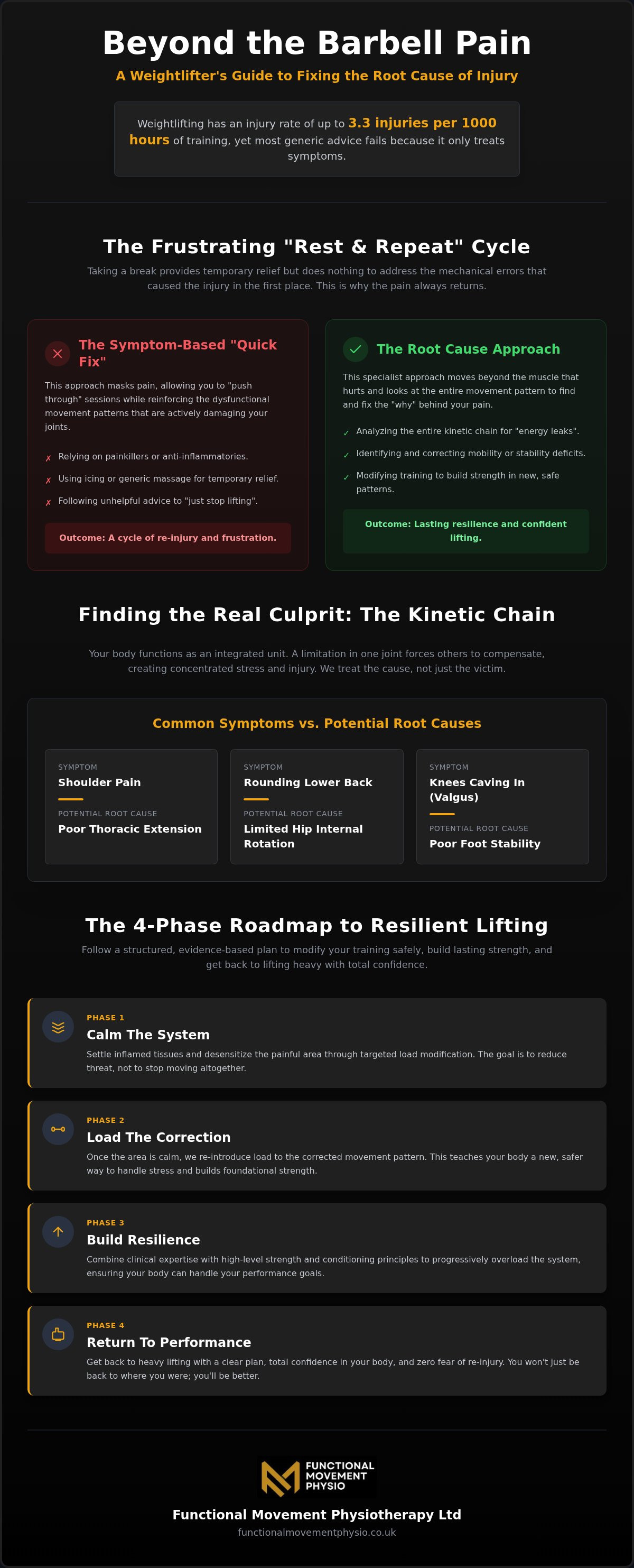
We understand that weightlifting carries a specific injury incidence of up to 3.3 injuries per 1000 hours of training, yet most generic advice fails to account for the unique biomechanics of a heavy snatch or deadlift. This guide to physio for weightlifters Liverpool will show you how to identify the mechanical root cause of your injuries rather than just masking the symptoms. You don't have to choose between your performance and your long term health.
We'll provide a specialist roadmap to help you understand why your injury happened and how to modify your training to build lasting resilience. You will learn how a structured, evidence based approach can get you back to heavy lifting with total confidence and zero fear of re-injury.
Key Takeaways
- Understand why the "rest and repeat" cycle fails and why temporary breaks rarely address the underlying mechanical issues causing your pain.
- Discover how hidden mobility deficits in your kinetic chain, such as restricted ankles, force other joints to compensate under heavy loads.
- Learn how specialist physio for weightlifters Liverpool uses video analysis and movement screening to identify subtle shifts in your center of mass.
- Follow the "Calm, Load, Build, Return" roadmap to modify your training safely instead of stopping physical activity altogether.
- Gain a clear plan for achieving long term resilience by combining clinical expertise with high level strength and conditioning.
Why Your Weightlifting Injury Keeps Coming Back
The "rest and repeat" cycle is one of the most soul-destroying experiences for any athlete. You feel a twinge in your lower back or a sharp pinch in your shoulder during a heavy set, so you take a week off. The pain subsides, you feel optimistic, and you head back to the gym. But the moment you load the bar to 80% of your previous max, the pain returns with frustrating precision. This happens because rest alone is not a rehabilitation strategy; it is merely a pause button.
Taking time away from the platform might settle inflamed tissues, but it does nothing to address the mechanical errors that caused the irritation in the first place. Symptom-based treatments like icing, general rubbing, or generic sports massage often provide temporary relief by desensitising the area. However, they fail to account for the complex demands of the snatch, clean and jerk, or heavy compound lifts. Seeking specialist physio for weightlifters Liverpool means moving beyond the muscle that hurts and looking at the movement patterns that are failing you.
The Failure of Quick Fixes
Relying on painkillers or anti-inflammatories to get through a session is a dangerous game. These substances mask the vital feedback your nervous system provides, often leading you to ignore technique flaws that are actively damaging your joints. When you "push through" sharp, localised pain during heavy sets, you aren't building mental toughness; you're reinforcing a dysfunctional movement pattern that will eventually lead to a forced layoff.
Generic medical advice often falls short because it doesn't respect the fundamental principles of strength training that govern your life. A doctor telling you to "just stop lifting" is unhelpful and ignores the fact that for many, lifting is a non-negotiable part of their identity and health. You don't need to stop; you need to move better. Effective physio for weightlifters Liverpool focuses on how your body handles load, ensuring your mechanics match your ambitions.
Identifying the Real Issue
It's vital to distinguish between "good" training soreness, known as DOMS, and "bad" injury pain. While soreness is a natural byproduct of adaptation, sharp or radiating pain that lingers long after your session is a red flag. Being stuck on the sidelines doesn't just affect your physical totals; it has a significant psychological impact, leading to anxiety about your long-term capability and a loss of the community found in the gym.
You need a specialist who understands the specific requirements of the squat, bench, and deadlift. We look for the "why" behind the pain. For example:
- Does your shoulder hurt because of poor thoracic extension?
- Is your back rounding because of limited hip internal rotation?
- Are your knees caving because of poor foot stability?
Our Liverpool city centre clinic is designed for active individuals who refuse to settle for "just okay." We provide the clarity you need to stop guessing and start training with a purpose again.
The Root Cause Approach to Lifting Injuries
To lift heavy, your body functions as a single, integrated unit known as the kinetic chain. In a snatch or a deadlift, force is generated from the floor and must be transferred through your joints to the bar. Any disruption in this chain creates an energy leak. These leaks don't just lower your maximum numbers; they create concentrated stress on specific tissues that aren't designed to handle high loads. This is why a "sore shoulder" is often a symptom of a problem elsewhere in the chain.
Consider the squat. If you lack sufficient ankle mobility, your body will still attempt to reach the required depth. To do this, your pelvis often tilts or your heels lift, forcing your lower back to compensate for the stiff ankles. This is a classic example of why we look at your bracing and breathing patterns before we even touch your sore joints. Proper intra-abdominal pressure is the foundation of every heavy triple, acting as a natural weight belt from the inside out.
According to Weightlifting safety measures published by USA Weightlifting, understanding these biomechanical principles is essential for preventing common injuries. Without this root cause perspective, you are simply treating the victim (your back) rather than the criminal (your ankles). Finding a specialist who provides physio for weightlifters Liverpool ensures you aren't just chasing pain but fixing the movement flaw that started it.
Mobility vs Stability Deficits
We follow a joint-by-joint approach to identify whether you have a mobility or stability deficit. Certain joints, like the ankles, hips, and thoracic spine, require significant ranges of motion to execute lifts safely. Others, such as the knees and lumbar spine, require stability to protect the surrounding structures. Bracing for a heavy triple is vastly different from generic core strength; it is an active, reflexive skill that secures your spine under load. If you aren't sure where your specific leak is, you can book a movement assessment to find out.
Biomechanical Compensation Patterns
Compensation is the body's way of finding the path of least resistance. When a primary mover is weak or restricted, your nervous system will recruit secondary muscles to finish the rep. While this might help you complete a set today, the long-term cost is a technical breakdown that leads to chronic pain. Identifying these patterns is a core part of our physio for weightlifters Liverpool services, ensuring you build resilience rather than just masking a problem. We help you identify when your body is "cheating" to finish a rep, allowing you to correct the form before it turns into a significant injury.
Assessing Your Squat and Pull Mechanics
A standard form check from a well-meaning gym partner usually focuses on whether you hit depth or locked out. However, a specialist assessment for physio for weightlifters Liverpool goes much deeper. We use professional movement screening to analyze how your joints interact under load. This often involves high-speed video analysis to spot subtle shifts in your center of mass that are invisible to the naked eye. If your weight shifts forward onto your toes during a heavy clean, it isn't just a technique error; it's a diagnostic clue about your injury risk.
Your "sticking point" is the specific part of a lift where the bar slows down or your form begins to degrade. This isn't just a sign of weakness; it's often the exact moment where your body's compensation patterns take over. By identifying these specific breakdown points, we can predict which tissues are under the most stress before they actually fail. This level of detail is what separates a clinical assessment from a generic gym tutorial.
The Squat Assessment
During the squat, we look closely at "butt wink," which is a rounding of the lower back at the bottom of the movement. This posterior pelvic tilt can place significant stress on your intervertebral discs when repeated under high intensity. We also evaluate knee cave, technically known as valgus, which often indicates a lack of hip stability and can lead to meniscus or ligament irritation over time. Finally, your torso angle tells us a lot about your hip anatomy; a forced upright position in someone with specific hip structures can lead to painful impingement and long term joint wear.
The Deadlift and Pull Assessment
In the pull, we often see an early hip rise where the hips move up significantly faster than the shoulders. This shift removes the legs from the movement and places an enormous, sudden load on the lumbar spine. We also check if you are "packing your lats" effectively. Engaging the large muscles of your back creates a rigid frame that protects both your shoulders and your spine. Finally, we monitor your foot pressure throughout the pull. If you lose contact with the floor or shift your balance mid-lift, you lose the stable base needed to transfer force safely, which is a primary focus in our physio for weightlifters Liverpool sessions.
This detailed screening is the difference between guessing why you hurt and having a definitive plan to fix it. Our Liverpool city centre clinic provides the technical environment needed to analyze these high-performance movements accurately, ensuring you can return to the platform with total confidence in your mechanics.
How to Modify Your Training Without Stopping
Total rest is often the worst prescription for a weightlifting injury. While it might reduce immediate inflammation, it leads to tissue deconditioning and a loss of technical proficiency. The goal of specialist physio for weightlifters Liverpool isn't to keep you away from the gym, but to find your "entry point" where you can train without aggravating the injury. This approach keeps your nervous system engaged and maintains your strength levels while the affected tissues heal. Movement is medicine, provided the dosage is correct.
We focus on load management rather than avoidance. By adjusting the volume, intensity, or range of motion, you can continue to stimulate adaptation without causing further damage. This proactive mindset shifts the focus from what you can't do to what you can do, which is vital for maintaining your mental health and athletic identity during the recovery process.
The 4-Step Recovery Roadmap
We use a structured "Calm, Load, Build, Return" framework to guide your recovery with precision.
- Step 1: Calm the area using targeted manual therapy or sports massage to reduce protective muscle guarding and desensitise painful tissues.
- Step 2: Load the tissues through isometrics (holding a static position) or controlled eccentrics (the lowering phase) to rebuild strength safely.
- Step 3: Build capacity by adding specific accessory exercises that address the root cause mobility or stability deficits identified in your assessment.
- Step 4: Return to full training using a structured, percentage-based plan that gradually reintroduces high-intensity compound lifts and explosive movements.
Practical Training Modifications
Adapting your lifts allows you to stay active while you recover. If deep squats irritate your knee, switching to a high box squat can manage the load while keeping your movement patterns sharp. We often implement tempo work and pauses at the bottom of a lift to rebuild movement quality without needing high weights. This slow, controlled movement improves your proprioception and gives your tendons the time they need to adapt to tension. Integrating Clinical Pilates Liverpool is another effective way to build a resilient core that supports heavy bracing, ensuring your spine remains stable as you transition back to compound movements.
Using RPE (Rate of Perceived Exertion) is critical during this phase. Instead of sticking to rigid percentages that might be too heavy for an injured joint, you adjust the weight based on how you feel that day. This prevents overtraining and ensures you stay within a safe threshold for recovery. If you're tired of being told to just "take a break," you can book an initial consultation to get a tailored modification plan that keeps you under the bar safely.
Specialist Physio for Weightlifters in Liverpool
Our Liverpool city centre clinic is specifically designed to meet the needs of those who live and breathe the gym. We understand that for a weightlifter, "taking it easy" isn't a viable long term strategy. That's why we've built a high performance environment that bridges the gap between traditional clinical care and elite strength and conditioning. When you choose physio for weightlifters Liverpool at our facility, you aren't just getting a standard medical appointment; you're entering a partnership focused on unlocking your physical potential.
We don't believe in the cold, detached nature of traditional healthcare. Instead, we offer a sophisticated blend of clinical authority and empathetic encouragement. Our approach combines hands on manual therapy with evidence based rehabilitation to ensure you don't just get out of pain, but you stay out of pain. Your recovery plan is built around the achievement of sustainable results rather than just masking symptoms for a few days.
Our Liverpool Specialist Services
Every journey starts with an Initial Physiotherapy Consultation. This isn't a generic checkup; we look at your entire lifting history, your current programming, and your long term goals to find the root cause of your discomfort. We also understand the importance of maintenance. Regular Sports Massage in Liverpool is a vital tool for aiding recovery between heavy sessions, helping to manage muscle tension before it turns into a mechanical issue.
We also believe in collaborative care. If you're working with a coach, we speak their language. We can coordinate with them to ensure your training modifications align with your program, keeping you in the gym and moving toward your next PB. This "no fluff" approach ensures every minute you spend in our clinic is a direct investment in your performance.
Take the First Step to Pain-Free Lifting
Don't let a small niggle become a long term injury that forces you off the platform. It's a fact that 39% of Britons have received care from a physiotherapist at some point, and 83% of those people found it helpful. Professional intervention is a standard part of high level athletic management. When you come for your first session, bring your gym clothes and be ready to move. We'll get straight to work identifying the mobility or stability deficits that are holding you back.
It's time to stop guessing and start following a specialist roadmap. You can book your specialist assessment at Functional Movement Physio today. We're here to help you move beyond physical limitations and return to the heavy lifting you love with total confidence.
Return to the Platform with Total Confidence
Lifting heavy is a lifestyle that demands more than just temporary pain relief. You've learned that recurring injuries are often the result of hidden mobility leaks and compensation patterns rather than the muscle that actually hurts. By shifting your focus from masking symptoms to identifying the root cause, you can build a body that is resilient enough to handle high intensity training without the constant fear of a setback.
Our specialist clinic in Liverpool City Centre is built for athletes who refuse to settle for the sidelines. We provide expert physio for weightlifters Liverpool by combining clinical movement assessments with high level strength and conditioning principles. You don't have to stop lifting; you just need a professional roadmap that prioritises functional movement and long term recovery, which can be further supported by the metabolic health and longevity insights found at emagene.life.
It is time to stop guessing and start training with a clear purpose. Book your weightlifting physio assessment in Liverpool today to secure your path back to peak performance. We're ready to partner with you to ensure your next PB is built on a foundation of sustainable, pain-free movement.
Frequently Asked Questions
Can I keep training if I have a lifting injury?
You can almost always continue training by modifying your movements rather than stopping entirely. Total rest is often counterproductive because it leads to tissue deconditioning and can increase the fear of returning to the bar. We help you identify an entry point where you can maintain your strength and technical skills without aggravating the injured area.
Do I need to see a physio for a minor back tweak?
A minor tweak is often an early warning sign that your movement mechanics are failing under load. While the immediate pain might fade, the underlying compensation pattern usually remains, which increases the risk of a more significant injury later. Seeking specialist physio for weightlifters Liverpool ensures you address the root cause before a small niggle turns into a forced layoff.
How many sessions will I need to get back to heavy lifting?
Recovery timelines are individual, but a typical course of sports physiotherapy for lifting injuries often spans between 6 and 8 sessions. This allows us to move through the essential phases of calming the tissue, rebuilding capacity, and returning to high intensity training. Our focus is on long term resilience so you don't find yourself back in the clinic with the same issue next month.
Why does my shoulder hurt only during the bench press?
Shoulder pain that only appears during the bench press is frequently caused by a lack of thoracic mobility or poor scapular stability. If you cannot create a stable platform with your upper back, your shoulder joint is forced to compensate, leading to irritation. We analyse your setup and bar path to find the specific mechanical leak that is causing the discomfort.
Will a sports massage help my weightlifting recovery?
Sports massage is an effective tool for managing muscle tension and improving local blood flow between heavy training sessions. It helps desensitise the nervous system and can reduce protective muscle guarding that often follows a hard workout. However, it works best when used alongside movement correction to ensure you are fixing the mechanical issues that caused the tension.
What is the difference between a physio and a sports therapist for lifters?
Physiotherapists are clinical experts with a wider scope of practice, focusing on the complex relationship between your nervous system, joints, and muscles. While sports therapists often focus on soft tissue and immediate injury management, our approach prioritises identifying the biomechanical root cause. This ensures your recovery is sustainable and fully integrated into your long term strength goals.
Do you work with CrossFit athletes in Liverpool?
We work extensively with CrossFit athletes in our Liverpool city centre clinic. CrossFit requires a unique blend of high volume olympic lifting, gymnastics, and metabolic conditioning, all of which demand exceptional movement quality. We understand the specific stresses of a WOD and how to keep you competitive while managing your injury risk.
Can you help with hip pain during deep squats?
Hip pain during deep squats is a common issue we resolve by looking at your ankle mobility and pelvic control. If your ankles are stiff, your hips are often forced into a position that causes impingement or strain at the bottom of the rep. Specialist physio for weightlifters Liverpool involves a detailed screen of your squat mechanics to find exactly where your kinetic chain is breaking down.

Article by
Stuart Goldfinch
HCPC PH112156
Specialist MSK Physiotherapist
Ex UK SAS Trainer
Graduate Sports Rehabilitator


