

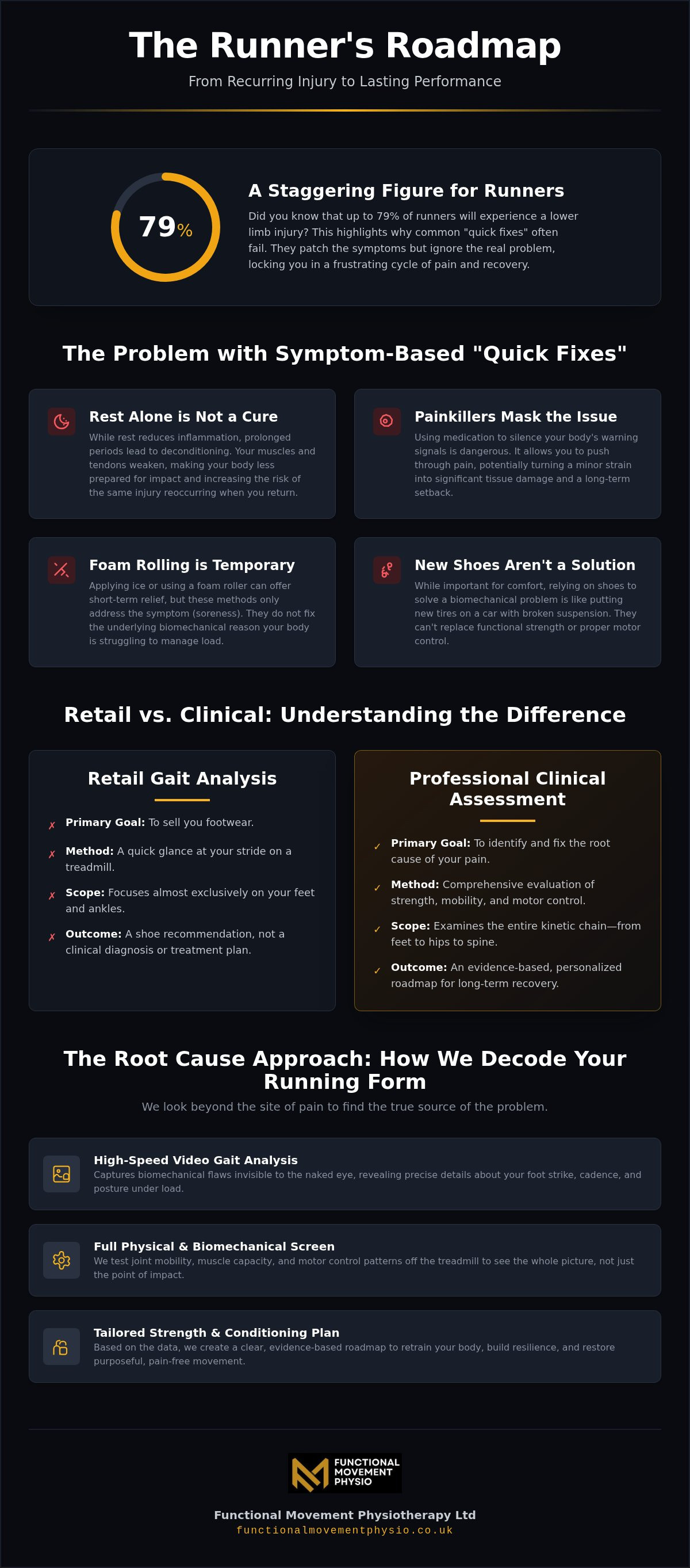
Did you know that up to 79% of runners will experience a lower limb injury at some point? It is a staggering figure that highlights why simply buying a more expensive pair of shoes or resting for a week rarely solves the underlying problem. You might be dealing with recurring knee pain or shin splints that just won't quit, or perhaps you're frustrated that your race times have plateaued despite training harder. It is exhausting to feel like you're constantly fighting your own body just to stay on the pavement.
We understand that you want more than just a temporary fix. You want to run without the nagging fear of long term joint damage. This guide shows you how a professional runners assessment moves beyond symptom management to identify the precise biomechanical flaws holding you back. You will discover how to stop guessing and start moving with the quiet confidence of a runner who knows their body is built for the long term.
We will explore how video gait analysis and expert strength testing provide the movement blueprint you need to return to your Liverpool running club and hit your next personal best. By focusing on the root cause of your pain, we can create a tailored strength plan that transforms your physical capacity and restores purposeful movement to your daily life.
Key Takeaways
- Learn why a professional runners assessment is a vital clinical diagnostic tool for your movement rather than just a retail tool for selecting shoes.
- Discover why common quick fixes like rest and foam rolling fail to provide long term relief when they only address symptoms instead of the root cause.
- Understand how video gait analysis captures high speed biomechanical flaws that are invisible to the naked eye.
- Receive a clear, evidence-based roadmap to retrain your body and return to your local Liverpool running club with confidence.
What is a Runners Assessment and Why Do You Need One?
A runners assessment is a comprehensive clinical evaluation designed to map every facet of your movement. It isn't a simple shoe fitting or a quick glance at your stride. Instead, it is a detailed investigation into your running biomechanics, focusing on how your joints, muscles, and nervous system work together under load. While retail stores might look at your feet, a clinical assessment explores your joint mobility, muscle strength, and motor control to find the real reason you are in pain.
Generic advice often fails because it treats every runner the same. If you have Achilles tendonitis or runners knee, simply resting or buying "supportive" shoes won't address the mechanical stress causing the injury. Research shows that 30% to 50% of recreational runners experience at least one injury every year. This high rate of injury often stems from ignoring your unique movement blueprint. Without understanding this individual map, you are just guessing at a solution rather than fixing the underlying problem.
The Difference Between Gait Analysis and a Clinical Assessment
It's vital to distinguish between what you find in a sports shop and what happens in a clinic. Retail gait analysis is primarily a tool used to help you choose footwear. While helpful for comfort, it cannot diagnose an injury or identify a clinical pathology. A shoe can cushion your strike, but it cannot fix a hip stability issue or a lack of ankle dorsiflexion. A clinical runners assessment involves a full physical screen. We test your range of motion and muscle capacity off the treadmill before we even watch you run. This ensures we see the whole picture, not just the point of impact.
Signs You Should Book a Professional Assessment
You might feel like your pain isn't "bad enough" for a professional look, but waiting often leads to longer recovery times. If you experience pain that disappears when you rest only to return the moment you lace up your shoes, your mechanics are likely at fault. Other signs include unexplained performance plateaus or feeling like your legs are consistently heavy despite proper recovery. If you are training for a major event like the Liverpool Marathon, an assessment acts as a preventative strategy. It helps you stay injury-free so you can reach the start line in peak condition and move with purposeful confidence.
The Problem With Quick Fixes and Symptom-Based Treatments
Many runners fall into a frustrating cycle of injury, rest, and relapse. You might have spent weeks using a foam roller, applying ice, or taking anti-inflammatory medication, only to find the pain returns the moment you hit the three-mile mark. These approaches fail because they focus entirely on the symptom. While these tools can provide temporary relief, they don't address why your body is struggling to manage the load of running in the first place.
In the clinic, we often find that pain is a liar. The site of your discomfort is rarely the actual source of the problem. For example, persistent knee pain is frequently the result of poor gluteal control or restricted ankle mobility elsewhere in the kinetic chain. If you only treat the knee, you are ignoring the mechanical driver of the stress. A high-quality medically-based running analysis looks beyond the area that hurts to find these hidden imbalances and provides the clarity needed for a permanent fix.
There is also a common myth that "better" shoes will fix your injuries. While the right trainers are important for comfort, they cannot replace functional strength or proper motor control. Relying on footwear to solve a biomechanical issue is like putting a new set of tyres on a car with a broken suspension. Similarly, using painkillers to mask symptoms can lead to more significant tissue damage. By silencing your body's warning system, you risk turning a minor strain into a long-term setback that keeps you off the road for months.
Why Rest Alone Rarely Fixes a Running Injury
Rest is often the first piece of advice runners receive, but it is rarely the complete solution. While a period of reduced activity helps settle acute inflammation, it does not improve your physical capacity. Prolonged rest can actually lead to deconditioning. Your muscles and tendons become weaker and less resilient to impact. When you eventually return to your normal routine, your body is less prepared than it was before, which often triggers the same injury. True recovery requires a transition from physical limitation to peak performance through active, targeted loading.
The Downside of Conflicting Online Advice
Searching for exercises online will give you thousands of results, many of which are contradictory. What works for one person might be harmful to you. For instance, over-stretching a sensitised tendon can actually increase your pain and delay healing. You don't need a generic YouTube routine; you need a personalised plan based on your specific biomechanical flaws. If you are ready to stop guessing and start moving with confidence, you can book a runners assessment to identify exactly what your body needs to stay resilient and pain-free.
The Root Cause Approach: How We Decode Your Running Form
Our approach to a runners assessment is built on a single, powerful philosophy: identifying the mechanical source of your stress. We don't just manage your symptoms; we decode your movement to find exactly why an injury occurred. This is about more than just getting you back to the start line. It is about unlocking your full physical potential and ensuring you can push your limits without fear of a relapse. By creating a personalised movement blueprint, our local Liverpool team helps you master your own physical capabilities.
For runners who are looking for this level of evidence-based clinical care in Singapore, you can learn more about Benchmark Physio, a premium clinic in Bukit Timah specialising in advanced movement analysis.
Step 1: The Subjective History and Injury Timeline
We begin by understanding your unique context. We look at your training load, previous injuries, and your long term goals. It's essential to see the full picture, including your lifestyle and stress levels, as these factors directly impact your recovery and resilience. You can read more about our clinical philosophy on finding the root cause of my running pain to understand how we piece this puzzle together. This initial conversation ensures that your plan isn't just evidence-based, but also realistic for your life.
Step 2: The Physical Screen and Strength Testing
Next, we move to a physical screen. This is where we identify "energy leaks" where your power is wasted during the gait cycle. We check for hip impingements, ankle mobility, and core stability. We use specific tests for muscle groups like the gluteus medius and calf complex to see if they have the capacity to handle the demands of your specific running style. If your glutes aren't firing correctly, your knee or ankle often pays the price. This stage tells us why your form looks the way it does before we even step onto the treadmill.
Step 3: High-Speed Video Gait Analysis
The final phase is high-speed video gait analysis. The human eye cannot capture the fine details of a stride at high speeds, but our technology can. We analyse your foot strike, knee drive, and pelvic tilt under load. Crucially, we watch how your form breaks down as you begin to fatigue. This is often where the root cause reveals itself, as your body defaults to its most ingrained habits. We then translate this complex data into simple, actionable visual feedback. You won't just be told what is wrong; you will see it for yourself on the screen, making the path to improvement clear and achievable.
Actionable Advice: Transforming Your Running for the Long Term
Once you have completed your runners assessment, the focus shifts from diagnosis to implementation. You now have a movement blueprint that identifies exactly where your body is under-performing. The transition from physical limitation to peak performance requires a shift in how you view your training. It isn't just about the miles you log; it is about how your body handles the load of every step. Sustainable results come from small, deliberate changes to your mechanics and physical capacity.
Strength work is a fundamental pillar of running, not an optional extra. To move with quiet confidence, you must build a body that can withstand the repetitive impact of the road. This requires a proactive approach to health management where you master your own physical capabilities. By retraining your brain and body to move more efficiently, you can unlock potential you didn't know you had and return to your local Liverpool events stronger than before.
Implementing Targeted Strength and Conditioning
Many runners rely on high-rep, low-weight circuits, but true resilience often requires heavy slow resistance training. This specific type of loading is vital for tendon health, as it stimulates the tissue to adapt to higher demands. You need to build the "brakes" of your system to manage impact forces that can reach up to three times your body weight. If you are currently struggling with joint discomfort, our Runner's Knee Pain? A Liverpool Physio's Guide provides deeper insights into specific recovery strategies.
- Single-Leg Stability: Since running is a series of single-leg hops, your strength plan must include exercises like split squats and single-leg deadlifts to mimic these specific demands.
- Posterior Chain Power: Target the calf complex and glutes to ensure they can drive you forward without overloading your smaller joints.
Gait Retraining: Cues and Techniques
Retraining your gait is about subtle adjustments rather than a complete overhaul. We use simple cues to change your mechanics without overwhelming your focus. For example, increasing your cadence by just 5% to 10% can significantly reduce the heavy landing forces on your knees and hips. You might also focus on maintaining a "tall" posture to naturally engage your core and prevent the pelvic drop that often leads to injury. Practice these changes in short, controlled intervals during easy runs to allow your nervous system to adapt without fatigue.
Ready to build your own tailored strength plan? Book your runners assessment today and start your journey back to pain-free movement.
Book Your Specialist Runners Assessment in Liverpool Today
Moving from the frustration of recurring pain to a clear, evidence-based recovery plan is a transformative journey. You no longer have to rely on guesswork or conflicting online advice that fails to address your specific needs. A professional runners assessment provides the clinical clarity required to stop chasing symptoms and start fixing the mechanical drivers of your discomfort. By identifying your unique movement blueprint, we ensure your return to running is both sustainable and high-performing.
Our team is dedicated to helping you master your own physical capabilities. We understand the anxiety that comes with a persistent injury and the fear that it might lead to long term joint damage. Our goal is to alleviate that stress by providing a structured path forward. Whether you are aiming for a sub-20 minute parkrun, training with the Pipman team (פיפמן) for your next triathlon, or simply want to complete your first couch-to-5k without knee pain, we are here to support your progress with expert guidance and quiet confidence.
Our Liverpool Clinic: Expert Care for Local Runners
We are proud to serve the vibrant running community in the heart of Liverpool. Our clinic is designed to be an accessible hub for anyone looking to improve their movement and resolve chronic issues. We work with a diverse range of individuals, from beginners just starting their fitness journey to elite club runners training for the Liverpool Marathon. Every runner receives the same high level of clinical scrutiny and personal attention. You can learn more about our philosophy on Expert Physiotherapy Liverpool to see how we help our patients achieve long-term wellness.
Your Next Steps to Pain-Free Running
Preparing for your first session is straightforward. We want to see how you move in your natural environment, so please bring your current running shoes and your usual training kit. This allows us to conduct a thorough analysis of your footwear and your biomechanics under load. During the assessment, we will discuss your specific goals and training history. Whether you are planning for a local event or a major international race, we tailor the evaluation to the distances and intensities you intend to run.
Don't let a small niggle or a persistent ache become a season-ending injury. Proactive health management is the foundation of a long and successful running career. By addressing your biomechanical flaws now, you protect your joints and unlock your true athletic potential. Take the first step toward purposeful, pain-free movement today. You can Book your appointment at Functional Movement Physio and secure your path back to the activities you love.
Take Control of Your Running Future
Running shouldn't be a constant battle against recurring pain. By choosing a professional runners assessment, you are investing in a clinical diagnostic process that looks far beyond your footwear. You now understand that true recovery comes from identifying the mechanical drivers of stress through expert biomechanical video analysis and physical screening. This evidence-based approach ensures you aren't just resting; you are actively building the resilience needed for long term health.
Our specialist sports injury clinic in Liverpool is dedicated to providing you with a tailored strength and conditioning plan that matches your specific movement blueprint. It is time to stop the cycle of frustration and start moving with the quiet confidence of a runner who understands their own body. Whether you are aiming for a personal best or a pain-free morning run, we are here to help you unlock your full physical potential and restore purposeful movement to your life.
Book your Runners Assessment in Liverpool today and take the first step toward sustainable performance. We look forward to partnering with you to get you back on the road with total confidence.
Frequently Asked Questions
How long does a specialist runners assessment take?
A specialist runners assessment is a comprehensive session that typically lasts between 60 and 90 minutes. This duration allows sufficient time for a detailed subjective history, a physical screen of your joint mobility, and high speed video analysis on the treadmill. We ensure the process is never rushed; giving us the space to identify the precise biomechanical flaws that are contributing to your pain or performance plateau.
Do I need to be an elite athlete to have a running assessment?
You do not need to be an elite athlete to benefit from a professional evaluation. We work with everyone from couch-to-5k beginners to experienced club runners. If you are a human who runs, you have a unique movement blueprint that deserves expert attention. Our goal is to help you move with confidence and achieve sustainable results, regardless of your current pace or experience level.
Should I book an assessment if I am currently in pain?
You should book an assessment if you are currently experiencing pain. Evaluating your gait while you are symptomatic often provides the most accurate data regarding your movement compensations. By identifying the root cause of the stress while it is active, we can create a more effective path back to pain-free running and prevent the risk of long term tissue damage or a chronic setback.
What is the difference between this and a shoe shop gait analysis?
The primary difference is that a clinical runners assessment is a medical diagnostic tool rather than a retail sales tool. While a shoe shop focuses on matching your foot strike to a specific trainer, we examine your entire kinetic chain. We look at hip stability, core control, and muscle capacity to find the clinical source of your injury, which no shoe can fix on its own.
Can a runners assessment help me run faster?
A professional assessment is one of the most effective ways to improve your speed and efficiency. By identifying energy leaks where your power is being wasted through poor mechanics, we can help you refine your form. This transition from physical limitation to peak performance allows you to run more economically, meaning you can maintain higher speeds for longer periods with significantly less effort.
What should I bring to my running assessment appointment?
You should bring your usual running kit and the shoes you wear most frequently for training. It is also helpful to bring any orthotics or previous injury reports if you have them. Seeing your footwear allows us to analyze wear patterns, which provides valuable clues about your foot strike and how your body distributes pressure and manages impact during the gait cycle.
Will I get a specific exercise plan after the session?
You will receive a fully tailored strength and conditioning plan following your session. This isn't a generic list of exercises; it is a specific set of interventions designed to address the weaknesses or imbalances identified during your physical screen. These plans focus on building the physical capacity your body needs to handle your specific training load and achieve your personal running goals.
Can you help with shin splints during the assessment?
We frequently help runners resolve shin splints by identifying the mechanical cause of the bone or muscle stress. Shin pain is often a symptom of poor shock absorption or an over-reliance on certain muscle groups. During the assessment, we look at factors like your cadence and foot strike to reduce the load on your lower legs, helping you return to activity without fear.

Article by
Stuart Goldfinch
HCPC PH112156
Specialist MSK Physiotherapist
Ex UK SAS Trainer
Graduate Sports Rehabilitator


