

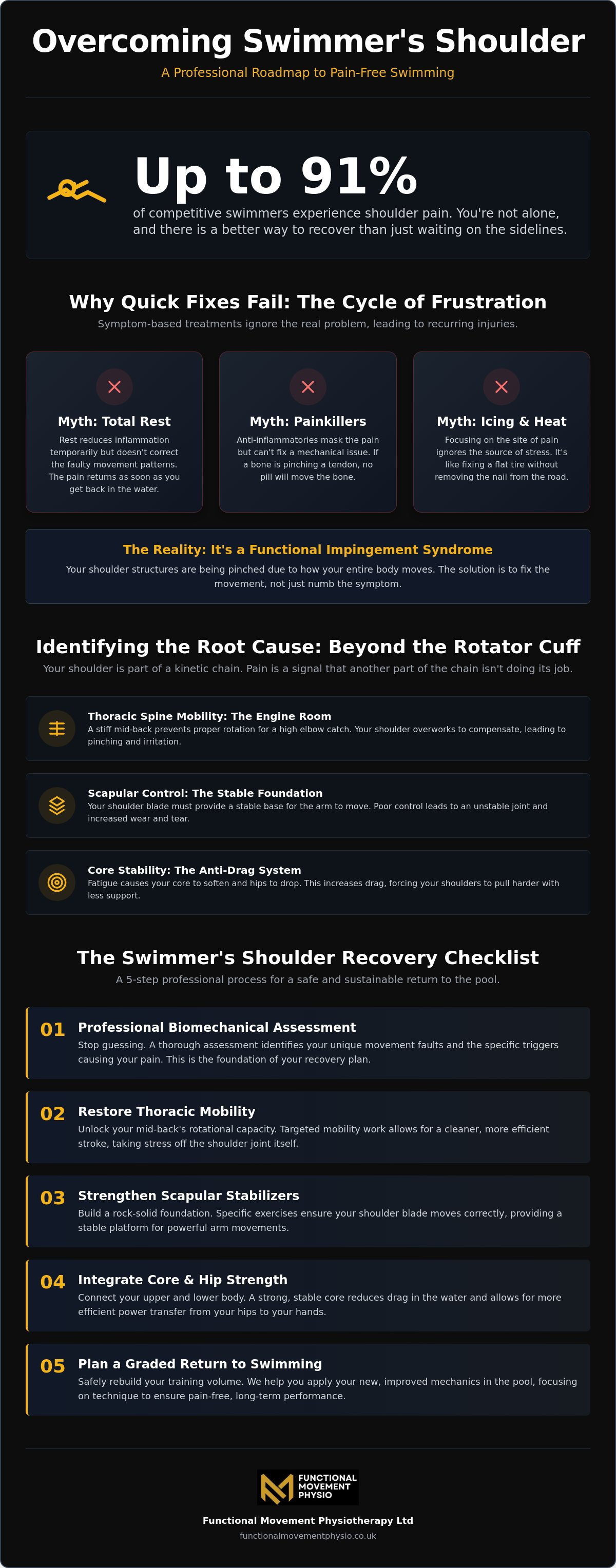
Did you know that up to 91% of competitive swimmers experience shoulder pain at some point in their career? If you're currently wincing during the catch phase or feeling a deep ache throughout the pull-through, you are certainly not alone. It's incredibly frustrating to be told that rest is the only solution, particularly when you have gala dates on the calendar and a genuine fear of losing your hard-earned fitness. Seeking expert physio for swimmers shoulder Liverpool is the first step toward moving past temporary fixes and addressing the functional breakdowns that are actually holding you back.
You deserve a recovery plan that respects your dedication to the sport rather than one that simply keeps you on the sidelines. We believe that shoulder issues are rarely just about the joint itself; they are often the result of complex biomechanical imbalances that require a professional eye to untangle. This article provides a clear, evidence-based roadmap to help you identify the root cause of your discomfort. You will gain access to a professional recovery checklist designed to restore pain-free overhead movement and improve your stroke efficiency, ensuring you return to the water with more power and resilience than before.
Key Takeaways
- Understand why total rest often leads to recurring injury and how to address the functional root cause instead of just the symptoms.
- Discover the critical link between thoracic spine mobility and shoulder health to unlock a cleaner, more efficient swimming stroke.
- Follow our professional five point checklist for physio for swimmers shoulder Liverpool to ensure a safe and sustainable return to training.
- Learn how to utilize local facilities and biomechanical assessments to transition from rehabilitation to peak pool performance.
- Shift your focus from temporary pain relief to long term movement optimization that protects your shoulders for the entire season.
Why Quick Fixes for Swimmers Shoulder Often Fail
Swimmer's shoulder is rarely a simple case of a single torn muscle. Instead, it is a complex functional impingement syndrome. This means that the structures within your shoulder joint are being physically pinched or irritated during specific phases of your stroke. Many people label this as simple tendonitis, but it often involves Shoulder impingement syndrome, where the subacromial space becomes compromised. Elite swimmers can perform over 2,500 shoulder revolutions per day. At that volume, even a tiny mechanical error becomes a major problem that rest alone cannot fix.
The most common mistake is relying on total rest. While taking a week off might reduce the immediate swelling, it does nothing to improve your biomechanics. When you return to your training sessions, your body still uses the same faulty movement patterns that caused the irritation in the first place. This leads to a frustrating cycle where you feel fine on land but experience sharp pain the moment you start your pull-through. Anti-inflammatory medications face a similar limitation. They are excellent at masking chemical inflammation, but they cannot fix a mechanical movement issue. If your humerus is rubbing against your acromion because of poor scapular control, no amount of ibuprofen will reposition the bone.
The Problem with Symptom-Based Treatment
Treating the site of the pain while ignoring the source of the stress is a recipe for long term failure. You might spend weeks icing your shoulder or using heat packs, but these interventions only address the symptoms. They don't account for why that specific tendon is being overloaded. For instance, rubbing a sore supraspinatus tendon won't fix a poor catch phase or a lack of thoracic rotation. If your mid-back is stiff, your shoulder has to overwork to compensate. This is why seeking expert physio for swimmers shoulder Liverpool is vital. We look at how your entire body moves as a unit rather than just focusing on the spot that hurts.
The Frustration of Conflicting Advice
You have likely heard a dozen different theories on how to fix your shoulder. Some tell you to stretch more, while others suggest heavy lifting. The reality is that stretching an already unstable or impinged joint can often make the irritation worse. Similarly, strengthening a joint that is in a poor physical position only reinforces bad habits and increases wear and tear. You don't need generic exercises; you need a clear, professional roadmap that identifies your specific movement triggers. We help you break the rest and repeat cycle by providing a strategy that focuses on sustainable, long term results. If you are ready to stop guessing and start a targeted recovery, you can book an appointment to begin your assessment.
Identifying the Root Cause: Beyond the Rotator Cuff
To truly resolve your pain, we must look beyond the rotator cuff. While the site of irritation is usually the shoulder joint, the source of the mechanical stress often lies elsewhere in your kinetic chain. Effective physio for swimmers shoulder Liverpool involves a deep dive into how your spine, shoulder blade, and core work together to create a streamlined position. When one part of this system fails, the shoulder pays the price. Identifying these specific breakdowns is the only way to move from temporary relief to a permanent return to the pool.
Thoracic Mobility and the High Elbow Catch
Your thoracic spine, or mid-back, is the engine room for rotation. In freestyle and backstroke, you need significant spinal rotation to achieve a high elbow catch without overtaxing the shoulder joint. If your mid-back is stiff, your body will try to find that extra range of motion by tilting the shoulder blade forward or crossing the midline during entry. This directly reduces the subacromial space and leads to the pinching sensation you feel. Research regarding the Prevention and Treatment of Swimmer's Shoulder highlights that addressing these biomechanical limitations is essential for long term recovery.
Scapular Control: The Foundation of the Stroke
Your shoulder blade acts as the stable foundation for every pull-through. If the muscles that control it, such as the serratus anterior, are weak or poorly timed, the scapula will wing or move out of position. This lack of stability forces the smaller rotator cuff muscles to work twice as hard to keep the joint centered. This imbalance between the strong pulling muscles at the front and the stabilisers at the back is a primary driver of chronic irritation. Restoring this balance is a core component of our approach to physio for swimmers shoulder Liverpool. By assessing these patterns during an Initial Physiotherapy Consultation, we can pinpoint exactly where your movement is breaking down and provide a clear path forward.
The Swimmers Shoulder Recovery Checklist: 5 Essentials
Moving from pain to performance requires more than just a few stretches. You need a structured framework that addresses every link in your movement chain. This checklist serves as your roadmap for effective physio for swimmers shoulder Liverpool, ensuring that no aspect of your recovery is left to chance. By following these five essentials, you can systematically rebuild your capacity and return to the pool with confidence. Our approach focuses on long term resilience rather than the temporary relief offered by quick fixes.
Step 1: The Functional Assessment
Recovery begins with a deep dive into your specific movement triggers. A specialist physiotherapist liverpool doesn't just look at where it hurts; they analyze your entire stroke mechanics on land and simulate the stresses of the pool. It's vital to test movement under fatigue because many technique breakdowns only appear once your primary movers begin to tire. We identify whether your pain stems from entry, the catch phase, or the exit to create a truly bespoke plan. This clinical clarity is what differentiates a professional approach to Swimmer's Shoulder from generic advice found online.
Step 2: Mobility and Stability Integration
Once we understand your triggers, we focus on unlocking the rotation needed for a clean stroke. Thoracic and rib cage mobilization exercises are essential to ensure your shoulder doesn't have to overcompensate for a stiff mid-back. We often integrate Clinical Pilates Liverpool into this phase to develop the deep core-to-shoulder power necessary for an efficient freestyle. For those dealing with high levels of tissue sensitivity, we may utilize medical acupuncture or manual therapy to desensitize painful areas, allowing you to move through your rehab exercises without constant irritation.
The final three essentials focus on building a robust foundation and managing your transition back to full training. We implement scapular stability drills to ensure your shoulder blade provides a stable base for the arm, followed by rotator cuff conditioning that builds functional strength for the water. Finally, we guide you through a graduated return to pool protocol. We don't just send you back to full sets. Instead, we carefully manage your volume and intensity, starting with technical drills before progressing to high-intensity training. This controlled exposure is the key to avoiding the common "flare-up" cycle and ensuring your recovery is sustainable.
Optimising Your Return to the Pool in Liverpool
Returning to full training is the most critical phase of your recovery. It's where many swimmers fail by doing too much, too soon. To ensure your progress is sustainable, you must bridge the gap between clinical rehab and the high-volume demands of a competitive squad. If you're a member of the City of Liverpool Swimming Club or a regular at the Liverpool Aquatics Centre, you have access to world-class facilities that are perfect for this transition. Seeking professional physio for swimmers shoulder Liverpool allows you to navigate this stage with a data-driven plan rather than guesswork.
Effective communication with your coach is vital during this period. They need to understand your current limitations so they can adapt sets to focus on technique rather than just mileage. Instead of pushing through sharp pain, we recommend using a "Traffic Light" system to monitor your shoulder's response to the water. Green means you have minimal discomfort that settles quickly; amber suggests a manageable ache that requires a reduction in intensity; red signifies sharp pain or a breakdown in stroke mechanics that requires you to stop immediately. This proactive approach keeps you in the water while protecting your long-term health.
Local Liverpool Resources for Swimmers
Consistency is key to a successful return. Utilizing the 50-meter lanes at the Liverpool Aquatics Centre provides the space needed for focused technical drills without the constant interruptions of a busy public session. Between heavy training blocks, many of our athletes find that a Sports Massage (60 Minutes) is an essential tool for managing muscle tension and promoting recovery. For those who prefer the open water, connecting with local groups at Salthouse Dock can provide a structured environment for transitioning back to outdoor conditions once your land-based strength is established.
Monitoring Progress and Avoiding Relapse
You must distinguish between external volume, which is the total distance you swim, and internal load, which is how much stress your shoulder actually absorbs. A session that felt easy two weeks ago might feel taxing today if your sleep or nutrition has slipped. Watch for warning signs like increased morning stiffness or a loss of "feel" for the water, as these often precede a flare-up. Your shoulder pain must return to its pre-swim baseline level within 24 hours of your session to ensure the training load was appropriate for your current stage of recovery. If you're struggling to find the right balance between rest and training, you can book an appointment for a tailored return-to-play strategy.
Specialist Shoulder Rehabilitation at Functional Movement Physio
Choosing the right partner for your recovery is the difference between a temporary fix and a permanent solution. At Functional Movement Physio, we specialize in untangling the complex biomechanical issues that lead to persistent swimming injuries. Our approach is built on the philosophy that your body is an integrated system; a shoulder problem is often a symptom of movement inefficiency elsewhere. By providing expert physio for swimmers shoulder Liverpool, we ensure that every athlete receives a personalized strategy that accounts for their specific stroke mechanics and performance goals.
Your rehabilitation plan at our clinic is never static. It evolves as you regain strength and mobility, transitioning from corrective drills to functional loading that mimics the high intensity of a competitive gala. This progression ensures that your tissues are prepared for the specific stresses of your stroke, whether you are a sprinter or a long distance specialist. We are committed to helping you achieve sustainable results that protect your athletic longevity and keep you in the pool for years to come.
Why Choose Our Liverpool Clinic?
Our reputation is built on a track record of success with athletes who have felt stuck or frustrated by generic advice. With over 300 5-star reviews, our sports injury clinic Liverpool city centre location offers the expertise required to resolve deep seated movement patterns. We combine 20 years of clinical experience with a modern understanding of functional movement to ensure your recovery is both efficient and thorough. We don't just treat the site of your pain; we help you master your own physical capabilities so you can return to the activities you love without hesitation.
Book Your Initial Consultation
The first step toward a pain-free stroke is a comprehensive evaluation. During your Initial Physiotherapy Consultation, we will perform a detailed biomechanical analysis to identify your specific movement triggers and provide a clear, professional roadmap for your recovery. You'll leave this first session with a deep understanding of your condition and a realistic plan for your return to training. If you're ready to stop managing symptoms and start fixing the root cause, you can Book your Initial Physiotherapy Consultation today. We look forward to helping you achieve lasting results and a stronger, more resilient shoulder.
Take Control of Your Recovery Today
Your journey back to the pool starts with a shift in perspective. As we have explored, moving past the "rest and repeat" cycle requires a commitment to identifying the functional root causes of your discomfort. Whether it is improving your thoracic rotation or building scapular stability, addressing these mechanical triggers is essential for long term stroke efficiency and pain-free movement. You don't have to settle for temporary relief or the constant fear of missing your next gala date.
With over 20 years of specialist experience in elite sports rehabilitation, we provide a structured, evidence-based approach to physio for swimmers shoulder Liverpool. We are here to partner with you, moving beyond simple symptom management to optimize your physical capacity. It's time to stop guessing and start following a professional roadmap designed to get you back to the activities you love with complete confidence.
Book your expert shoulder assessment at our Liverpool clinic and take the first definitive step toward reaching your peak performance. We look forward to helping you master your movement and return to the water stronger than ever.
Frequently Asked Questions
Is it okay to swim with a sore shoulder?
You shouldn't push through sharp or pinching pain, as this usually indicates active mechanical impingement. If the ache is mild and disappears within 24 hours of your session, you might be able to continue with a modified workload. However, continuing to swim with a faulty movement pattern only deepens the injury. We recommend a professional assessment to determine if your current stroke is causing structural damage.
How long does it take to recover from swimmers shoulder with physio?
Most swimmers see significant improvement within 6 to 12 weeks of starting a structured rehabilitation plan. Recovery time depends on the severity of the tissue irritation and how consistently you follow your corrective exercises. Seeking expert physio for swimmers shoulder Liverpool ensures that you're targeting the root cause rather than just resting, which significantly reduces the risk of the pain returning once you increase your yardage.
Will I need an MRI for my shoulder pain?
You rarely need an MRI for swimmer's shoulder, as most cases are functional movement issues rather than structural tears. A thorough clinical examination can usually identify the biomechanical triggers, such as poor scapular control or restricted thoracic mobility. We only suggest imaging if your symptoms don't respond to conservative treatment as expected or if we suspect a more significant internal injury that requires a surgical consultation.
Can I do specific exercises at home to help my swimming shoulder?
Targeted home exercises are a vital part of your recovery, but they must be specific to your individual needs. Generic stretches often fail because they don't address your unique movement imbalances. We provide tailored drills focusing on thoracic rotation and rotator cuff resilience that you can perform between pool sessions. These exercises bridge the gap between your clinic visits and your return to full intensity training.
What is the most common cause of shoulder pain in swimmers?
The most common cause is subacromial impingement, where the tendons are pinched due to a combination of high volume and faulty mechanics. This often stems from a lack of mid-back mobility or weak shoulder blade stabilizers. When these areas don't function correctly, the shoulder joint overcompensates, leading to the chronic irritation often managed by physio for swimmers shoulder Liverpool. Addressing these functional gaps is the key to long term relief.
Do I need to stop swimming completely while I recover?
Total rest is rarely the answer and can often lead to further weakness and frustration. We usually prefer a modified training schedule that keeps you in the water while avoiding the specific movements that trigger your pain. This might involve using a pull buoy to rest your kick-related rotation or temporarily avoiding certain strokes like butterfly. Maintaining your feel for the water is important for a successful and sustainable return to performance.

Article by
Stuart Goldfinch
HCPC PH112156
Specialist MSK Physiotherapist
Ex UK SAS Trainer
Graduate Sports Rehabilitator


