

The standard advice to just rest your leg is often the biggest obstacle to your recovery. If you've been struggling with persistent swelling at the front of the knee or sharp pain when climbing stairs, you've likely found that a few weeks off only provides a temporary reprieve. When searching for effective bursitis knee treatment liverpool, you need more than a cold pack and a chair. You need to understand exactly why that small sac of fluid is protesting in the first place.
It's frustrating to feel stuck in a cycle of quick fixes that never actually fix anything. You want to return to your running routine or gym sessions without the constant anxiety of a flare-up or the threat of long-term medication. We promise to show you how a movement-first approach can provide a permanent solution by addressing your unique biomechanics. In this guide, we'll explain the true cause of your inflammation and how to transition from physical limitation back to your peak performance.
Key Takeaways
- Understand why traditional rest and ice often fail to provide a long term solution for persistent knee inflammation.
- Discover how identifying underlying biomechanical issues, such as hip weakness, can resolve the friction causing your knee pain.
- Learn a practical framework for load management that allows you to stay active while your body heals.
- Explore how our specialist bursitis knee treatment liverpool integrates advanced tools like shockwave therapy for faster recovery.
- Gain clarity on the steps needed to return to running and gym activities with a focus on sustainable physical optimization.
Understanding Knee Bursitis: Why Your Knee is Inflamed
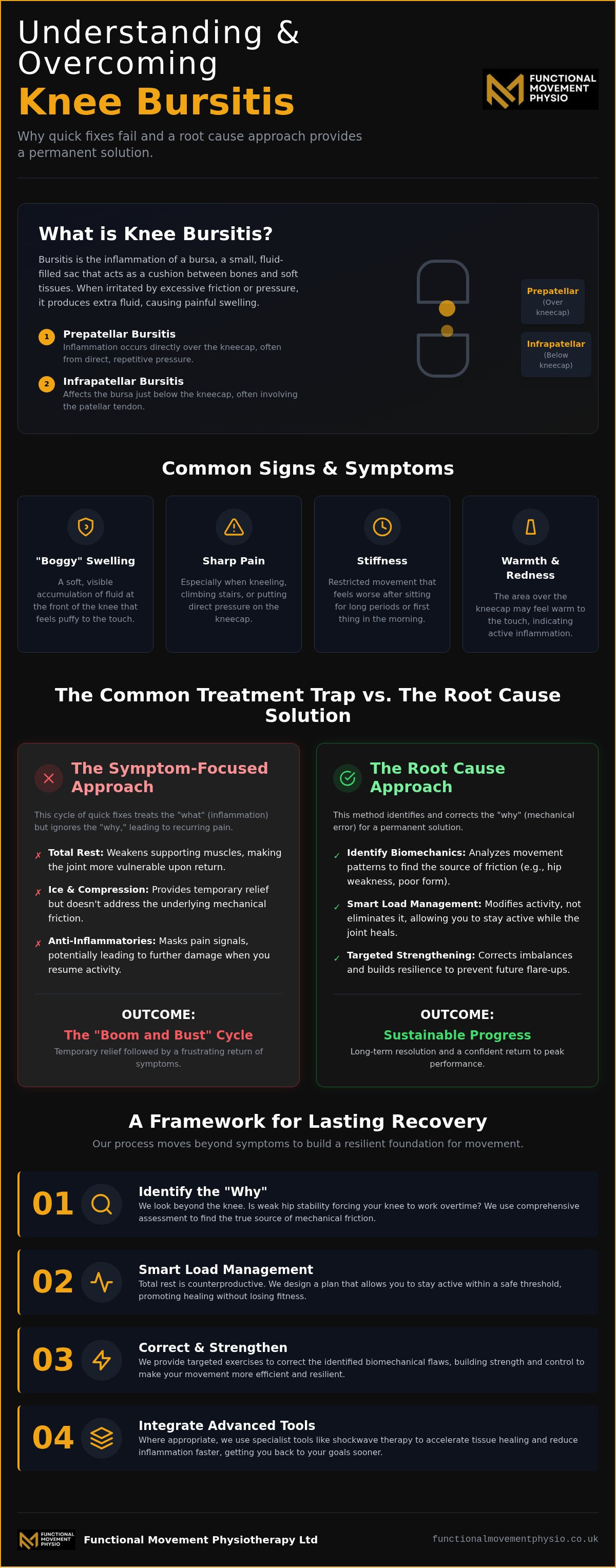
Knee pain often feels like a mystery, especially when it presents as a stubborn, localized swelling that won't shift. If you're a runner training in Sefton Park or a regular at a city centre gym, you might have noticed a "boggy" sensation at the front of your joint. This is often the first sign that you need specialized bursitis knee treatment liverpool. To understand the condition, we first need to look at the anatomy. What is Bursitis? It's the inflammation of the bursae, which are small, fluid-filled sacs that act as cushions between your bones and soft tissues. When these sacs become irritated, they produce extra fluid, leading to the characteristic swelling that can make daily movement a struggle.
In the knee, we most commonly see two types of this condition. Prepatellar bursitis occurs right over the kneecap and is frequently linked to direct pressure or repetitive friction. Infrapatellar bursitis affects the sacs just below the kneecap, often involving the patellar tendon. Both conditions can stop you in your tracks, making it difficult to maintain your training volume or even walk comfortably to the office.
To better understand this concept and how it affects your joint health, watch this helpful video:
Common Signs You Are Dealing with Bursitis
The symptoms of bursitis are usually quite distinct from other knee injuries like ligament tears or meniscus issues. You might notice visible swelling that feels soft or "boggy" when you press on it. This isn't just a minor puffiness; it's a clear accumulation of fluid at the front of the joint. Other common indicators include:
- Sharp pain when kneeling or putting any direct pressure on the front of the knee.
- Stiffness and restricted movement that feels significantly worse after you've been sitting for a long time or when you first wake up in the morning.
- A localized warmth or redness over the kneecap, indicating active inflammation.
Fundamentally, bursitis is a protective response to excessive friction. Your body is trying to cushion the joint against perceived stress, but the resulting inflammation creates its own set of problems. Without the right bursitis knee treatment liverpool, this protective response can become a chronic cycle of pain and limitation.
Why Traditional Diagnosis Often Stops Too Early
Many local athletes and gym-goers often misinterpret bursitis as simple bruising or a "knock" that will eventually go away. While a standard medical diagnosis might correctly identify the inflammation, it often stops there. Identifying the inflammation tells you the "what," but it fails to explain the "why." Your bursa doesn't just inflame for no reason; it's reacting to a mechanical error in how you move.
The bursa's primary role is to reduce friction. If your knee biomechanics are slightly off, the bursa is forced to work overtime, leading to the very irritation you're feeling now. This is why simply resting or taking anti-inflammatories rarely provides a permanent fix. At our clinic, we believe sports physiotherapy must look beyond the swelling to find the root cause of that friction. If you don't address the movement error, the bursitis will likely return the moment you try to return to your peak performance levels.
The Problem: Why Quick Fixes and Total Rest Often Fail
When you first notice that telltale swelling, your first instinct is likely to reach for an ice pack or a packet of ibuprofen. The standard RICE protocol (Rest, Ice, Compression, Elevation) is the foundation of most first aid, but for chronic knee inflammation, it's often insufficient. While these methods might dampen the immediate fire of inflammation, they do nothing to address the mechanical friction that caused the bursa to flare up. You might find that the swelling goes down after a few days on the sofa, only to return the moment you attempt your first run or leg day session.
This creates a frustrating "boom and bust" cycle. You rest until the pain feels manageable, you return to activity, and the joint protests again. Relying solely on anti-inflammatory medications can even be counterproductive; they mask the pain signals that your body uses to prevent further damage. If you're looking for effective bursitis knee treatment liverpool, you have to move beyond temporary symptom suppression and look at how your body handles physical load.
The Myth of Total Rest for Knee Pain
Total inactivity is rarely the answer for active individuals. When you stop moving entirely, your muscles begin to atrophy surprisingly quickly. The muscles surrounding your knee, particularly the quadriceps and glutes, provide the stability your joint needs to function without excessive friction. By "waiting for it to go away" through total rest, you might actually be weakening the very structures required to protect the bursa.
Effective recovery is about managing load rather than avoiding it. We focus on finding the "sweet spot" where you can maintain your fitness without aggravating the injury. If you feel like you've tried everything and are still stuck, it might be time to book a specialist assessment to break the cycle of recurring pain.
The Danger of Masking Symptoms with Injections
It's tempting to seek out the "quick fix" of a steroid injection. While these can provide dramatic short term relief, they often act as a trap for the unwary. Research into Knee Bursitis Diagnosis and Treatment shows that while injections reduce inflammation, they don't fix poor patellar tracking or hip instability.
Overusing steroid injections can actually weaken the local tendons and soft tissues over time. More importantly, because the pain is gone, you might return to high intensity activity before your biomechanics are ready. This leads to a high recurrence rate and leaves you vulnerable to more significant injuries down the line. True bursitis knee treatment liverpool should prioritize building a resilient joint over simply silencing the pain for a few weeks.
The Root Cause Approach: Fixing Your Knee Biomechanics
Your knee is often the victim of mechanical issues happening elsewhere in your leg. It's a hinge joint sandwiched between the hip and the ankle; if either of those joints fails to provide adequate stability or mobility, the knee joint takes the strain. This is why standard treatments often fail to provide a permanent solution. While NHS guidance on treating bursitis is useful for initial self-care and managing acute swelling, a movement-first approach to bursitis knee treatment liverpool looks at the entire lower limb system. We use the principle of regional interdependence to find the real source of the friction that is irritating your bursa.
When we look at the knee, we aren't just looking at the site of the pain. We're looking at how your body distributes force during your daily activities. If you're a runner or a regular gym-goer, small imbalances in your movement patterns are magnified over thousands of repetitions. Identifying these errors is the only way to stop the inflammation from returning every time you increase your training load.
How Hip Stability Protects Your Knee
The gluteus medius is your knee's best friend. This muscle is responsible for controlling the alignment of your leg during single-leg movements, such as running, jumping, or simply climbing the stairs. When this muscle is weak or doesn't fire correctly, your thigh bone tends to rotate and drift inward. This pattern, known as "valgus collapse," creates a grinding effect on the bursae at the front of the joint.
We don't just want to stop the pain; we want to optimize your hip function so your knee can glide smoothly. By building core and hip stability, we create a protective environment for the joint. This focus on biomechanics is what leads to sustainable results and prevents the recurring frustration of being sidelined by the same injury every few months.
Ankle Mobility and Foot Strike Patterns
Your feet and ankles are the foundation of every movement you make. If you have restricted ankle mobility, your knee is forced to bend further or rotate awkwardly to compensate for the lack of range. This extra work leads to increased stress on the knee bursae. Similarly, overpronation, where the foot rolls inward excessively, can pull the entire leg out of alignment with every step you take.
Using a specialist gait analysis liverpool allows us to see these hidden movement flaws in real-time. By capturing your mechanics on video, we can identify whether your foot strike or ankle stiffness is the true culprit behind your knee inflammation. This data-driven approach ensures we are treating the actual cause of the friction rather than just chasing the symptoms of the swelling.
Actionable Advice: Realistic Steps for Sustainable Progress
Recovery is not a passive process. If you have been told to stop all activity and wait for the inflammation to subside, you have been given a recipe for muscle weakness and joint instability. True bursitis knee treatment liverpool focuses on finding the right balance between protecting the irritated bursa and maintaining the physical capacity of your leg. Movement is the foundation of health; the goal is to modify your activity so you can keep training without making the issue worse.
One of the biggest hurdles is the fear of movement. It's essential to distinguish between "safe" discomfort and "bad" pain. A mild ache during exercise that doesn't exceed a 3/10 on a pain scale and settles quickly afterward is often a sign that you are loading the joint appropriately. If the pain is sharp, escalating, or causes increased swelling the next morning, you've likely overstepped your current capacity. Learning to listen to these signals allows you to stay active while your body heals.
Immediate Load Management Strategies
You don't always need to quit the gym to recover. Instead, look at modifying your volume and intensity. If a five-mile run causes your knee to flare up, try a two-mile run on a softer surface or switch to a low-impact alternative like cycling for a week. This keeps your cardiovascular system primed while reducing the repetitive friction on the bursa.
Practical changes in your daily life also make a significant difference. If your job involves kneeling, use high-quality knee pads or a foam mat to distribute pressure away from the joint. At the gym, avoid exercises that place direct, heavy pressure on the front of the kneecap until the acute sensitivity has settled. Small adjustments to your routine often provide the breathing room your body needs to start the repair process.
Foundational Strengthening Exercises
Once the initial irritation has calmed, we begin building resilience through targeted exercise. We start with isometrics, such as quad sets or glute squeezes. These exercises allow you to contract the muscle forcefully without moving the joint, which helps maintain muscle tone without aggravating the bursa. As you progress, we move toward eccentric loading, where the muscle lengthens under tension, to build long-term durability in the tendons and surrounding tissues.
Building a stable foundation is key to preventing recurrence. Many of our clients find that clinical pilates liverpool is an excellent way to develop the core and hip stability required for better knee alignment. By strengthening the glutes and improving your body's ability to control movement, you take the workload off the knee joint and allow the bursa to function as it was intended.
Bursitis Knee Treatment in Liverpool: Our Specialist Process
Resolving the root cause of your pain requires a structured, evidence-based pathway. Your journey begins with a comprehensive Initial Physiotherapy Consultation at our Liverpool city centre clinic. During this first session, we don't just look at the swelling; we perform a detailed biomechanical screen to identify why your movement patterns are overloading the bursa. This deep dive is the foundation of effective bursitis knee treatment liverpool, ensuring we aren't just chasing symptoms but building a plan for permanent relief.
We believe in a partnership between the therapist and the individual. You aren't just a patient receiving a treatment; you're an active participant in your own recovery. By understanding the "why" behind your pain, you gain the confidence to push through the rehabilitation process and return to the activities you love without the fear of a setback.
Advanced Modalities for Faster Healing
While we focus on movement, we also utilize advanced technology to accelerate your recovery. Shockwave Therapy is a powerful tool for chronic cases where the bursa or surrounding tendons have become thickened and resistant to standard care. Much like we use shockwave therapy for Achilles tendonitis, the same principles apply to chronic knee issues by using high-energy sound waves to stimulate a biological healing response in the localized tissue.
We often combine this with medical acupuncture liverpool to help manage acute sensitivity and improve blood flow to the area. These modalities aren't just about temporary relief; they create the optimal environment for you to engage fully with your functional movement drills. By combining manual therapy with specific loading exercises, we bridge the gap between initial pain relief and the resumption of high-performance activity.
Your Roadmap to Long-Term Results
Once the initial pain is controlled, we shift the focus toward optimization and physical capacity. We use Clinical Pilates 1:1 sessions to reinforce healthy movement patterns and build the core and hip stability identified during your assessment. This isn't a one-size-fits-all approach. Your therapist works as a mentor to develop a bespoke strength and conditioning plan tailored to your specific goals, whether that's running a marathon or returning to heavy lifting in the gym.
Regular reassessments ensure you are meeting your recovery milestones and allow us to fine-tune your program as your strength grows. The ultimate goal is the restoration of full, purposeful movement in your daily life. If you're ready to stop the cycle of recurring pain and start mastering your physical capabilities, we invite you to book an appointment at book appointment.
Master Your Movement and Resolve Your Knee Pain
You don't have to accept a cycle of recurring swelling and frustration as your new normal. By shifting your focus from temporary symptom relief to a comprehensive movement-first strategy, you can reclaim your ability to run, train, and move without restriction. Effective bursitis knee treatment liverpool is about more than just managing inflammation; it's about identifying the specific biomechanical errors, such as hip instability or restricted ankle mobility, that caused the issue in the first place.
Our specialist sports injury clinic provides the clinical expertise and empathetic support you need to transition from physical limitation back to peak performance. Through expert root cause analysis and a personalised recovery roadmap, we ensure you have the tools to build long-term joint resilience. We don't just treat the injury; we help you master your own physical capabilities so you can stay active for the long term. Whether we are integrating advanced shockwave therapy or refining your core stability with clinical Pilates, our goal remains the restoration of full, purposeful movement in your daily life.
Take the first step toward a future of pain-free activity and sustainable results. We look forward to partnering with you on your journey to recovery.
Frequently Asked Questions
Can I continue running with knee bursitis?
You can often continue running, provided you modify your volume and intensity to stay within a manageable pain threshold. Total rest can lead to muscle weakness, which often worsens the underlying biomechanical issue. We use a pain monitoring scale to help you find the "sweet spot" where you can maintain fitness without aggravating the bursa. If your pain is sharp or causes increased swelling the next day, it's a sign to reduce your mileage.
How long does it take for knee bursitis to heal with physiotherapy?
Most clients see significant improvement within 6 to 12 weeks of starting a structured rehabilitation programme. While acute swelling might settle in a few days, building the necessary hip and core stability to prevent recurrence takes longer. This timeframe allows us to address the root cause of the friction through targeted exercises. Your specific recovery speed depends on the chronic nature of the condition and how consistently you follow your bespoke movement plan.
Is a steroid injection necessary for knee bursitis treatment?
Steroid injections are rarely necessary and are often considered a temporary fix rather than a permanent solution. While they can reduce immediate inflammation, they fail to address the movement errors that caused the irritation. Over-reliance on injections can also weaken local soft tissues. We prioritise evidence-based bursitis knee treatment liverpool that focuses on improving your biomechanics. This approach ensures long term recovery by fixing the actual cause of the friction rather than just silencing the pain.
What is the difference between runner's knee and knee bursitis?
The main difference lies in the specific structures involved. Runner's knee, or patellofemoral pain syndrome, typically involves irritation of the cartilage behind the kneecap. Knee bursitis is specifically the inflammation of the fluid-filled sacs that cushion the joint. While both can cause pain at the front of the knee, bursitis often presents with more visible, localized swelling. A professional assessment is essential to distinguish between the two, as their rehabilitation strategies differ significantly.
How do I know if my knee pain is bursitis or a meniscus tear?
Bursitis usually presents as a visible, "boggy" swelling at the front of the joint, whereas a meniscus tear often causes deep-seated pain and internal swelling. Meniscus injuries frequently involve mechanical symptoms like clicking, locking, or the knee "giving way" during twisting movements. If your pain is mostly triggered by direct pressure or kneeling, it's more likely to be bursitis. We use specialist clinical testing during your consultation to provide a clear, accurate diagnosis.
Will knee bursitis go away on its own with rest?
While acute inflammation might subside with total rest, the underlying cause rarely disappears on its own. If you don't address the hip weakness or ankle stiffness that caused the friction, the swelling will likely return once you resume normal activity. This is why many active individuals experience a "boom and bust" cycle of recurring pain. Effective bursitis knee treatment liverpool focuses on proactive management and movement optimization to ensure the condition doesn't become a chronic limitation.
What should I wear to my first physiotherapy appointment in Liverpool?
You should wear loose, comfortable clothing that allows us to see your knee and move your joint easily. A pair of shorts is ideal for the physical examination. If you're a runner, please bring the trainers you use most frequently, as this helps us during your biomechanical assessment. Being prepared in the right gear ensures we can perform a thorough evaluation of your movement patterns during your initial consultation at our Liverpool city centre clinic.
How many sessions of shockwave therapy will I need for my knee?
Most clients require between three and six sessions of shockwave therapy to achieve optimal results for chronic bursitis. These sessions are typically spaced one week apart to allow the biological healing process to take effect. We use shockwave therapy as an adjunct to your movement plan, helping to kickstart recovery in tissues that have become resistant to traditional treatments. Your therapist will monitor your progress at each session to determine the exact number of treatments required.
Article by
Stuart Goldfinch
HCPC PH112156
Specialist MSK Physiotherapist
Ex UK SAS Trainer
Graduate Sports Rehabilitator


