

Being told you're "cleared" to play based on a calendar date or the absence of pain is one of the biggest risks an athlete can take. Most people assume that once the swelling is gone and they can jog without a limp, the hard work is over; however, this is exactly where the gap between rehabilitation and performance becomes a dangerous territory. If you're searching for a return to sport assessment Liverpool, you deserve more than a generic evaluation. You need objective data that proves your body is truly ready for the unpredictable demands of your sport.
You probably know the feeling of wanting to push harder but being held back by a nagging fear of re-injury or conflicting advice from coaches and GPs. It's normal to feel stuck when your standard physio sessions end but you still don't feel ready for high-impact movements. This article outlines the essential markers you must hit to reclaim your spot on the pitch or in the gym with total certainty. We'll explore the specific strength symmetries, movement quality tests, and psychological readiness scores that form the ultimate comeback checklist, ensuring your return is permanent rather than a temporary fix.
Key Takeaways
- Learn why being pain-free is not the same as being game-ready and how objective data ensures your structural integrity is truly restored.
- Discover how a return to sport assessment Liverpool identifies hidden "energy leaks" in your movement that could lead to future injuries.
- Understand the importance of the 90 percent symmetry rule for limb strength and how it protects your joints during high-impact loading.
- Find out how testing your body under "chaotic" and reactive conditions prepares you for the unpredictable demands of your sport.
- Gain a clear, evidence-based plan for the final stage of your recovery to move beyond symptom management and back to peak performance.
The Sideline Trap: Why Pain-Free Does Not Mean You Are Game-Ready
The most dangerous moment in your recovery isn't the day you get injured; it's the day you stop feeling pain. Most athletes assume that the absence of symptoms equals a green light to return to full intensity. This is a common misconception that leads to the high re-injury rates we see in amateur and professional sports. A professional return to sport assessment Liverpool is a comprehensive, data-driven evaluation that measures your physical and mental readiness through objective markers rather than just how you feel during a light jog.
Pain is often the first thing to disappear during sports physiotherapy Liverpool, but structural integrity and neuromuscular control take much longer to restore. Rushing back to the pitch because you "feel fine" often results in secondary injuries or chronic compensation patterns. When one muscle group hasn't fully regained its power, your brain subconsciously shifts the load to other joints, frequently leading to issues in the opposite limb or the lower back. Without objective testing, you're essentially guessing with your long-term health.
The Gap Between Clinical Rehab and High-Intensity Sport
There is a massive difference between performing a controlled lunge in a quiet clinic and reacting to an opponent's movement on a wet football pitch. Traditional rehabilitation often focuses on linear movements, but sport is inherently chaotic. You need to know that your graft, joint, or muscle can handle sudden deceleration and lateral cutting. Bridging this gap requires a formal Movement assessment to identify "energy leaks" where your form breaks down under fatigue. If you haven't tested your body in a way that mimics the "chaos" of your sport, you aren't truly ready to return.
Why Liverpool Athletes Need a Professional Clearance
Whether you are playing football at Sefton Park, competing in a local rugby league, or joining the growing community of padel players in the city, the physical demands are high. A formal assessment protects your athletic career by ensuring you meet specific clinical standards before you face high-impact forces. Beyond the physical benefits, there is a significant psychological advantage. Knowing you have passed a rigorous battery of tests eliminates the "fear of the first tackle" and allows you to play with total confidence. This peace of mind is the final piece of the puzzle that helps you move from physical limitation back to peak performance.
The Root Cause Approach: Objective Data Over Guesswork
Relying on how you feel is a subjective gamble that often leads back to the treatment table. To bridge the gap between basic recovery and high performance, we move beyond symptom management to identify exactly why an injury occurred in the first place. A professional return to sport assessment Liverpool focuses on identifying the root cause of your physical limitations by using objective data to measure your readiness. We don't just ask if it hurts; we measure if your body can handle the specific forces required by your sport.
This approach involves looking for "energy leaks" in your movement. These are subtle points of failure where your body compensates for a weakness by overloading a different joint or muscle. If these leaks aren't plugged, you're simply waiting for the next injury to happen. By using a structured framework similar to the CDC's Return to Play Progression, we ensure every step of your comeback is backed by physical evidence rather than optimistic guesswork.
Biomechanical Movement Analysis in Liverpool
We observe how your entire kinetic chain functions under load to ensure you aren't hiding a lingering weakness. For runners, this often involves a detailed gait analysis Liverpool to spot overstriding or hip drops that contribute to recurring pain. By recording and analysing your movement patterns, we can see exactly how your body reacts when you are tired or under pressure. Identifying these compensations early allows us to refine your technique and build a more resilient foundation for your return to training.
Measuring Power and Force Absorption
Being strong enough to perform a heavy squat in the gym doesn't always mean you are strong enough to land a jump or change direction at speed. True athletic readiness requires the ability to absorb force rapidly and decelerate your own body weight without losing control. During your assessment, we measure the symmetry between your injured and healthy limb, aiming for at least 90 percent symmetry in strength and power output. If one leg is significantly weaker than the other, your risk of a secondary injury sky-rockets during the chaotic moments of a match.
We use these objective markers to create a clear roadmap for your final stage of recovery, ensuring you don't favour one side or put unnecessary stress on healing tissues. If you want to stop guessing and start measuring your progress, you can book your initial assessment to get a clear picture of your current physical capacity.
The Essential Checklist: 5 Pillars of a Successful Return to Sport Assessment
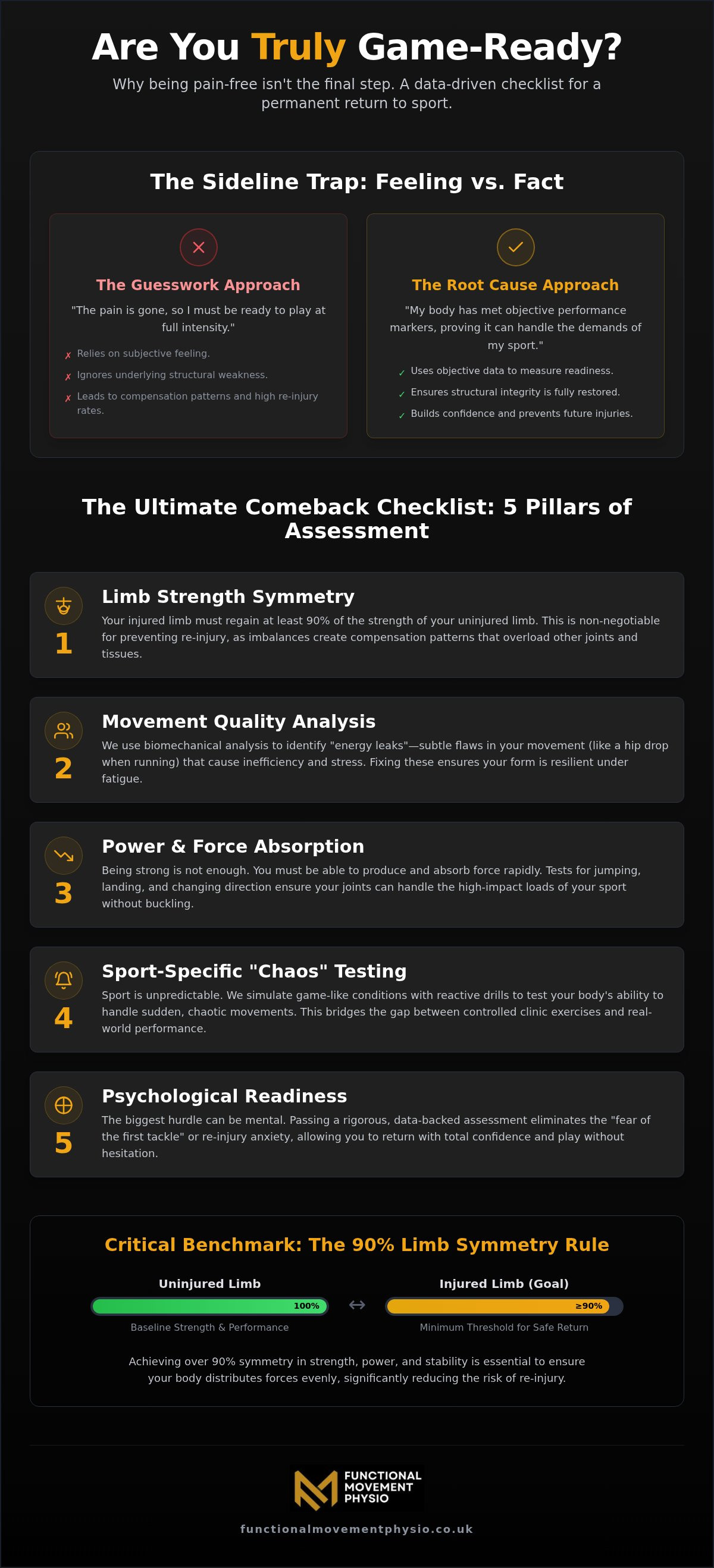
A successful return to sport assessment Liverpool isn't a single test; it's a rigorous battery of evaluations designed to ensure your body can handle the specific demands of your game. We move away from time-based recovery where you simply wait six months to play again. Instead, we follow a criterion-based return to sport protocol. This means you only progress when you have met specific physical and mental milestones. Our framework is built on five essential pillars:
- Pillar 1: Symmetrical Strength: Achieving at least 90 percent symmetry in muscle power between your injured and healthy limbs.
- Pillar 2: Force Absorption: Demonstrating safe landing mechanics and the ability to decelerate rapidly without joint collapse.
- Pillar 3: Reactive Agility: Moving efficiently in response to external cues rather than just performing rehearsed drills.
- Pillar 4: Sport-Specific Conditioning: Ensuring your cardiovascular and muscular endurance can meet the metabolic demands of a full match.
- Pillar 5: Psychological Readiness: Measuring your mental confidence to ensure you aren't hesitating during high-stakes movements.
Physical Performance and Strength Markers
We use specific functional tests to provide objective proof of your readiness. One of the most reliable indicators is the single-leg hop for distance or the triple hop test. These movements require a combination of explosive power, balance, and eccentric control. For athletic populations, the "90 percent rule" is our gold standard; if your injured leg cannot produce at least 90 percent of the force of your healthy leg, you aren't ready for the pitch. This level of detail is a core part of our sports physiotherapy Liverpool, where we bridge the gap between basic movement and elite performance.
Psychological Readiness: The Mental Game
Your brain often tries to protect an old injury long after the physical tissue has technically healed. This protective mechanism leads to hesitation, which is a primary risk factor for a new injury. During your assessment, we use validated scales like the ACL-RSI (Anterior Cruciate Ligament Return to Sport after Injury) questionnaire to quantify your confidence levels. If you're physically strong but mentally hesitant, you're more likely to move awkwardly or "pull out" of a tackle, putting yourself at risk. We address this mental barrier directly to ensure you return to your sport with total confidence in your body's capabilities.
Testing Under Pressure: Reactive Drills and Sport-Specific Chaos
Most sports injuries do not occur during a slow, controlled warm-up or a pre-planned drill. They happen in a split second when you are forced to react to a bobbling ball, a sudden change in an opponent's direction, or a teammate's shout. This is the "chaos" of sport. If your return to sport assessment Liverpool only involves predictable movements, it is failing to prepare you for the reality of competition. True readiness requires testing your body under neuro-cognitive load, where your brain must process external information while your limbs execute high-intensity movements.
Modern injury rehabilitation has moved beyond simple physical benchmarks. We now understand that re-injury risk increases when the brain is distracted. By introducing reactive elements into your assessment, we can see if your mechanics hold up when you aren't thinking about them. We want to ensure that your knee or ankle stability is automatic, allowing you to focus entirely on the game rather than worrying about your injury.
From the Clinic to the Pitch
The transition from a controlled clinical environment to the high-stakes atmosphere of a match is often where athletes feel most vulnerable. We simulate the specific demands of your sport, whether that involves the lateral cutting required in padel, the explosive jumping of basketball, or the unpredictable tackling in rugby. There is a fundamental difference between a pre-planned cone drill and a reactive drill where you must change direction based on a visual cue. As you increase your training load to meet these demands, incorporating sports massage Liverpool can be a vital tool for managing muscle tension and supporting your recovery between these high-intensity sessions.
The Role of Fatigue in Movement Quality
Many injuries occur in the final minutes of a match when fatigue begins to set in. As you tire, your central nervous system's ability to control your joints decreases, and your biomechanics often begin to break down. This is why we don't just test you when you are fresh. We observe your movement patterns when you are under metabolic stress to see if your "energy leaks" reappear. If you can move perfectly for ten minutes but lose control in the 80th minute, you aren't yet game-ready. We help you develop a sustainable conditioning plan that ensures your movement quality remains high from the first whistle to the last. This objective approach removes the guesswork and provides the confidence you need to push your limits safely.
Start Your Comeback: Booking Your Assessment in Liverpool
You have put in the hours of rehabilitation and survived the frustration of the sidelines. Now, you need the objective proof that your body is ready for the demands of high-level competition. A professional return to sport assessment Liverpool is the final bridge between clinical recovery and peak performance. It is the moment we move away from "hoping" you are ready and start "knowing" you are ready. This assessment provides the data required to silence the fear of re-injury and allow you to move with total freedom.
The results of your evaluation don't just tell you if you can play; they form the blueprint for your final stage of training. By identifying any lingering "energy leaks" or subtle strength imbalances, we can create a targeted plan to plug those gaps. This ensures that when you do return to the pitch, court, or gym, you aren't just back to your old self, you're more resilient than before. We focus on long-term results and sustainable movement, ensuring your comeback isn't cut short by a preventable setback.
What to Expect During Your Initial Consultation
Your journey begins with a comprehensive Initial Physiotherapy Consultation specifically tailored to your athletic goals. We conduct a thorough review of your injury history, your previous surgery details if applicable, and your current training load. This is followed by a battery of physical tests designed for your specific sport. You can expect:
- Biomechanical Screening: Analysing how you move under load to spot any hidden compensations.
- Strength and Power Testing: Measuring limb symmetry to ensure you meet the 90 percent readiness rule.
- Reactive Chaos Drills: Assessing how your body responds to unpredictable, sport-specific movements.
- The Traffic Light Report: A clear "green, amber, or red" light for play, accompanied by a detailed report of your results.
Take the Final Step Toward Peak Performance
Stop letting conflicting advice or the fear of a recurring injury keep you in the "gap" between physio and performance. You deserve a clear, evidence-based plan that addresses the root cause of your physical limitations. Our approach is designed for the modern athlete who values data, precision, and proactive health management. Whether you are a runner aiming for a PB or a footballer returning from an ACL reconstruction, we provide the expert guidance you need to master your physical capabilities.
Take the guesswork out of your recovery and secure your future on the pitch. You can book your return to sport assessment Liverpool today at Functional Movement Physio to start your journey back to purposeful, pain-free movement.
Secure Your Spot Back on the Pitch
Returning to sport after an injury shouldn't be a matter of luck or guesswork. By focusing on objective biomechanical movement analysis and hitting specific strength markers, you ensure your body is truly ready for the chaos of competition. You've already put in the hard work of initial recovery; now you need the proof that your foundations are solid. Whether you're recovering from surgery or a recurring strain, our specialist post-operative rehabilitation expertise provides the structure you need for sustainable long-term results.
You've worked too hard on your comeback to risk a premature return based on pain levels alone. Booking your return to sport assessment Liverpool gives you the data-backed confidence to play at full intensity without the constant fear of re-injury holding you back. It's the final, essential step in moving from physical limitation to peak performance.
It's time to stop feeling stuck in the gap between physio and performance. Take control of your recovery and start moving with purpose again. We're here to help you unlock your full potential and ensure you stay on the field where you belong.
Frequently Asked Questions
What is a return to sport assessment and why do I need one?
A return to sport assessment Liverpool is a data-driven evaluation used to determine if your body and mind are ready for the high-intensity demands of competition. It moves beyond simply being pain-free by measuring objective markers like strength symmetry and reactive agility. You need this assessment to bridge the gap between basic rehabilitation and full-speed play, significantly reducing the risk of a secondary injury that could sideline you for even longer.
How long does a typical return to sport assessment take in your Liverpool clinic?
A comprehensive assessment in our clinic typically takes 60 minutes. This time allows us to conduct a thorough review of your injury history, perform a battery of physical tests, and analyse your movement patterns under load. We ensure the session is never rushed, giving us enough space to discuss your results in detail and provide you with a clear, actionable plan for your final stage of recovery.
Do I need a referral from my GP or surgeon for an assessment?
You don't need a referral from a GP or surgeon to book an appointment with us. While we frequently collaborate with local specialists to ensure a smooth recovery process, you can self-refer directly to our clinic. If you've already had surgery, bringing any operation notes or specific protocols from your surgeon can be helpful, but it isn't a requirement to start your evaluation.
Can I have an assessment if I am still feeling a small amount of pain?
You can still undergo an assessment if you have minor discomfort, as the evaluation helps determine if that pain is a sign of structural weakness or a normal part of the recovery process. We observe how pain affects your biomechanics during high-impact movements. If the pain causes a breakdown in your form, we'll identify the root cause and adjust your rehabilitation plan to address it before you return to play.
What specific tests are included in an ACL return to sport assessment?
An ACL-specific evaluation includes a mix of strength, power, and psychological markers. We use a variety of single-leg hop tests to measure limb symmetry, aiming for a score of at least 90 percent compared to your healthy side. We also incorporate reactive drills to test your knee stability during unpredictable movements and use the ACL-RSI scale to quantify your mental confidence before you step back onto the pitch.
What happens if I do not pass the assessment checklist?
If you don't hit the required markers, we don't view it as a failure but as a roadmap for your final progress. We'll identify the specific energy leaks or strength deficits that are holding you back and build a targeted bridge rehab plan. This ensures you aren't guessing about your readiness, providing a clear set of goals to work toward so you can pass your next assessment with total certainty.
Is the assessment covered by private health insurance?
Most major UK private health insurance providers cover our physiotherapy services, provided your policy includes outpatient care. As HCPC-registered practitioners, our assessments meet the professional standards required by insurers like Bupa, AXA, and Vitality. We recommend contacting your provider before your session to confirm your level of coverage and to see if you need an authorisation code to process your claim.
How soon after surgery can I book a return to sport assessment?
The timing depends on your specific surgical procedure and your surgeon's individual protocol. Generally, a full return to sport assessment Liverpool is conducted during the final phase of your rehabilitation, often when you're ready to transition from linear running to multidirectional drills. For major procedures like an ACL reconstruction, this typically occurs between six and nine months post-op, once you've built a solid foundation of baseline strength.

Article by
Stuart Goldfinch
HCPC PH112156
Specialist MSK Physiotherapist
Ex UK SAS Trainer
Graduate Sports Rehabilitator


