

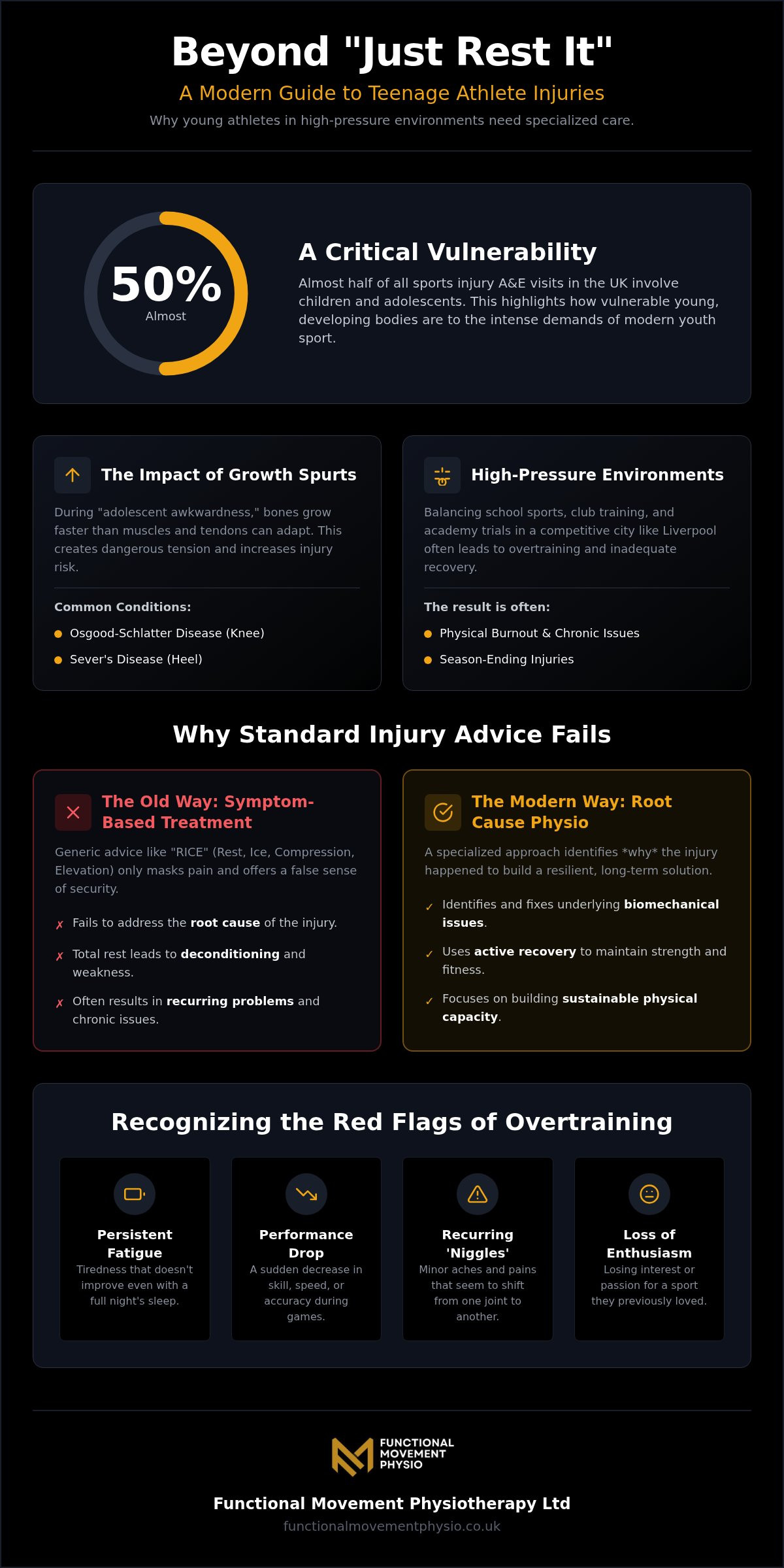
Did you know that almost 50% of all sports injury A&E visits in the UK involve children and adolescents? It is a startling figure that highlights just how vulnerable young bodies are during periods of intense training and rapid development. If you are a parent or coach, you have likely felt the frustration of receiving generic advice like "just rest it" or felt the anxiety of a potential growth plate injury. Finding specialized physio for teenage athletes Liverpool is often the difference between a recurring problem and a successful, sustainable career in sport.
You want your child to excel, but conflicting advice from coaches and GPs often leaves you feeling stuck and uncertain. We understand that teenage athletes are not just small adults; their recovery must account for skeletal maturity and unique developmental biomechanics. In this article, you will learn how to manage growth spurts and training loads to keep your young athlete performing at their best. We will explore the link between rapid growth and injury risk, providing a clear roadmap for a safe return to the sport they love while focusing on long term performance sustainability.
Key Takeaways
- Understand why the high density of sports academies in Liverpool requires a specialized approach to managing youth training loads and school sport pressures.
- Learn why generic "rest and ice" protocols fail to address the underlying biomechanical issues that cause recurring injuries in growing bodies.
- Discover how specialized physio for teenage athletes Liverpool identifies the root cause of pain by assessing movement patterns in the hips and ankles.
- Gain practical strategies for distinguishing between normal training soreness and injury-related pain to prevent long term physical setbacks.
- Focus on building sustainable physical capacity through dynamic stability and structured recovery to ensure your athlete achieves their full potential.
The Unique Challenges Facing Teenage Athletes in Liverpool
Liverpool is a city defined by its sporting heritage. From the elite football academies at Kirkby and Finch Farm to high-level swimming and rugby clubs, the competition for young talent is fierce. If you are a parent of a young athlete, you know that this environment demands more than just talent; it requires physical resilience. However, the pressure to perform often leads to a "powering through" mentality. Ignoring minor aches during puberty doesn't show toughness. Instead, it often creates chronic adult issues that could have been avoided with specialist physio for teenage athletes Liverpool.
The stakes are high when balancing school sport, club training, and representative trials. When a teenager tries to meet all these demands simultaneously, their body rarely has the time it needs to recover. This is not just about tired muscles. It is about a developing nervous system and skeleton trying to keep up with adult-level training volumes. Without a clear strategy, the risk of burnout or a season-ending injury increases significantly.
The Impact of Growth Spurts on Performance
During puberty, your child's body undergoes rapid changes that can temporarily decrease coordination. This is often called "adolescent awkwardness." It happens because bones frequently grow faster than the muscles and tendons can stretch to keep up. This discrepancy creates significant tension at the points where tendons attach to the bone, making teenagers particularly susceptible to common sports injuries like Osgood-Schlatter disease or Sever's disease.
Identifying the period of peak height velocity is crucial for safe performance. This is the window where the risk of injury is highest due to altered biomechanics and reduced bone density. Early intervention ensures that we manage this tension before it leads to a structural setback. Our approach focuses on maintaining flexibility and core stability, often utilizing clinical pilates liverpool to help the body adapt to its new proportions safely.
Liverpool Youth Sport: A High-Load Environment
The transition from primary to secondary school is a significant "load spike" for many young athletes. Suddenly, they are balancing school matches, club training, and academy sessions. In a high-performance city like Liverpool, the temptation to say yes to every opportunity is high. This often leads to overtraining, where the body simply cannot recover fast enough between sessions. Finding the right physio for teenage athletes Liverpool provides a necessary buffer against these pressures.
You should look out for signs of burnout before a major injury occurs. These include:
- Persistent fatigue that doesn't improve with a full night's sleep.
- A sudden drop in performance or technical skill during matches.
- Recurring "niggles" that seem to shift from one joint to another.
- Loss of enthusiasm for a sport they previously loved.
Managing this load is not about stopping activity. It's about intelligent distribution. We provide the mentorship needed to help you and your child understand when to push and when to prioritize recovery to ensure long term success.
Why Standard Injury Advice Often Fails Young Athletes
Standard advice for sports injuries often centers on the "RICE" protocol: rest, ice, compression, and elevation. While these steps might reduce immediate swelling, they do nothing to address why the injury occurred in the first place. For a developing teenager, this generic approach is particularly ineffective. If your child is experiencing persistent pain, simply masking the symptoms with ice or painkillers creates a false sense of security. It allows them to return to the pitch or pool while the underlying mechanical failure remains unaddressed. This is a primary reason why seeking specialized physio for teenage athletes Liverpool is essential for long-term health.
You may find yourself caught between conflicting, outdated advice from school PE teachers, well-meaning coaches, and general practitioners. While a coach might suggest "running it off" and a GP might suggest six weeks of total rest, neither provides a proactive plan for recovery. Total rest often leads to deconditioning, meaning the athlete returns to sport even less prepared for the physical demands than they were before the injury. We focus on active recovery that keeps the athlete moving while protecting the injured tissue.
The Problem with Symptom-Based Treatment
Treating the site of pain rather than the source of the issue is a common pitfall in youth sports medicine. If a young runner has knee pain, the issue often stems from poor hip stability or restricted ankle mobility. Focusing only on the knee provides temporary relief, but as soon as the training load increases, the pain returns. This cycle of recurring "niggles" is incredibly frustrating and takes a significant psychological toll. Being "stuck" on the sidelines while teammates progress can lead to anxiety and a loss of identity for a dedicated young athlete. We believe in finding the root cause to break this cycle for good.
Common Mistakes in Youth Injury Management
One of the biggest mistakes is returning to full training too quickly after a growth-related flare-up. Conditions like Osgood-Schlatter require a phased return to sport, not a sudden jump back into competitive matches. We also see many athletes relying on painkillers to get through a weekend tournament. This is dangerous because it turns off the body's natural warning system, leading to more severe tissue damage. If you are tired of temporary fixes and want a clear, evidence-based path forward, booking an initial physiotherapy consultation can help identify the true cause of your child's discomfort.
Recovery isn't just about what happens in the clinic. Many families overlook the role of sleep and nutrition in teenage recovery. A teenager's body is already under massive metabolic stress from growing; adding high-intensity sport without adequate fuel and rest is a recipe for injury. As their body proportions change, their technique must also evolve. A squat or running gait that worked six months ago might now be putting undue stress on their joints. We help athletes recalibrate their movements to match their changing biomechanical profile.
The Root Cause Approach to Youth Sports Physio
The core of our philosophy is that symptoms are merely indicators of a deeper mechanical failure. When you bring your child for physio for teenage athletes Liverpool, we don't simply treat the area that hurts. Instead, we perform a systematic assessment of movement patterns to find the primary driver of pain. For example, persistent knee pain in a young footballer is rarely just a knee problem. By looking at the hip's ability to control rotation or the ankle's flexibility, we can identify why the knee is being overloaded. This approach ensures that we aren't just providing a temporary fix but are building a foundation for long term health.
You need to understand that the body is a kinetic chain. If one link is restricted or weak, another link must work harder to compensate. In developing athletes, these compensations often happen because their bodies are changing so rapidly. We use gait analysis to identify these inefficiencies in developing runners and field athletes. By seeing exactly how the foot hits the ground and how the pelvis responds, we can pinpoint the exact moment a movement pattern breaks down. This level of detail is what separates a high-performance mentor from a general practitioner.
Assessing Developmental Biomechanics
Developmental biomechanics is the study of movement during skeletal maturation. It is vital to evaluate how a teenager moves during their specific sport, whether that is the explosive sprint of a winger or the repetitive stroke of a swimmer. Rapid limb growth often creates muscle imbalances where the lever arms of the body change faster than the brain can recalibrate control. We look for these discrepancies to ensure the athlete isn't compensating in ways that lead to injury. Our goal is to help them master their own physical capabilities during this transition.
Managing Growth Plate Injuries
Many parents are told that Severs disease or Osgood-Schlatter are simply "growing pains" that will go away with time. This is a myth that keeps athletes on the sidelines for longer than necessary. These are mechanical issues where a tendon is pulling too hard on a sensitive growth plate. While rest provides temporary relief, the pain will return as soon as the athlete starts running again unless we change the underlying mechanics. It's about how the muscle pulls on the bone, not just the fact that the bone is growing.
We use specialist sports physiotherapy to offload these sensitive areas. This involves specific loading strategies and manual therapy to reduce the tension on the growth plate. By refining an athlete's technique and improving their dynamic stability, we can often keep them active while they grow. This proactive management prevents the frustration of "resting and repeating" and focuses on the achievement of sustainable results.
How to Manage Load and Recovery: A Step-by-Step Guide
You need a structured approach to bridge the gap between high-intensity training and physical maturity. Educating your child on the difference between "good" sore, which is normal muscle adaptation, and "bad" pain, which indicates joint or growth plate irritation, is the first step. We help you implement a structured warm-up focused on dynamic stability to prepare the nervous system for the demands of sport. This is where clinical pilates plays a vital role. It builds a resilient core that supports the spine and pelvis during rapid growth. Effective recovery requires clear communication between you, the coach, and your specialist in physio for teenage athletes Liverpool.
Step 1: Implementing a Training Diary
Managing the total volume of activity is essential to prevent overload. You should track training hours across school PE, club sessions, and representative matches to see the full picture of your child's physical stress. Monitoring morning resting heart rate and general fatigue levels provides an early warning system for overtraining. During peak growth spurt phases, we often recommend adjusting intensity to prioritize quality of movement over sheer quantity. This ensures the body has the resources it needs to grow and perform simultaneously.
Step 2: Sport-Specific Strength and Conditioning
Generic stretches are rarely enough to protect a developing body from the rigors of competitive sport. We focus on functional strength, specifically landing mechanics and change-of-direction stability to reduce the risk of acute ligament tears. Integrating a sports massage is also a highly effective way to aid recovery between high-intensity sessions. It helps reduce muscle tension and improves circulation, allowing the athlete to back up sessions without accumulating excessive fatigue. This proactive maintenance is a hallmark of high-quality physio for teenage athletes Liverpool.
Step 3: Graduated Return to Play
Returning to sport should never be based on a calendar date or a "wait and see" approach. We use the 24-hour rule to guide progression. If pain increases or persists for more than 24 hours after a training session, the load was too high and needs adjustment. Our criteria-based progression ensures the athlete meets specific strength, balance, and agility benchmarks before they are cleared for full match play. The goal is to ensure they return to the field stronger and more resilient than they were before the injury occurred.
Building a Resilient Future at Functional Movement Physio
Our commitment to young athletes goes beyond simple injury recovery. We see ourselves as high-performance mentors, guiding the next generation of Liverpool's talent through the most physically demanding years of their lives. When you seek out physio for teenage athletes Liverpool, you aren't just looking for a quick fix for a sprained ankle or a sore knee. You are looking for a partnership that prioritizes long-term physical capacity over temporary relief. We focus on building a foundation of movement that will serve your child well into their adult sporting life.
A multidisciplinary approach is essential for a developing body. By combining specialist biomechanical analysis with interventions like clinical pilates liverpool and recovery-focused sports massage, we address the athlete's needs from every angle. This holistic strategy ensures that we don't just fix the current issue; we optimize the entire system for peak performance. We want to see your child return to the field with more confidence and a deeper understanding of their own physical capabilities.
Your First Visit: What to Expect
Your journey begins with an Initial Physiotherapy Consultation. This isn't a rushed session where we just poke at the site of pain. It is a comprehensive assessment of movement, strength, and growth history. We take the time to understand the specific demands of your child's sport and their current training load across school and club levels. You will receive a clear, jargon-free explanation of the root cause of the issue, not just a label for the symptoms.
We then build a collaborative plan that keeps the athlete involved in their sport whenever possible. We know that total rest is rarely the answer and can be psychologically damaging for a dedicated teenager. Our goal is to find the "optimal load"—the amount of activity that allows for healing while maintaining fitness and skill. This proactive approach keeps the athlete engaged and motivated throughout their recovery process.
Sustainable Results for Liverpool Athletes
Solving teenage movement problems today is the best way to prevent chronic adult issues tomorrow. Many of the persistent back, hip, and knee problems we see in older athletes can be traced back to unaddressed growth-related imbalances during puberty. By intervening now, we ensure that your child’s skeletal maturation doesn't become a liability. We empower the athlete with the knowledge to manage their own body, teaching them how to recognize early warning signs of overload before they become injuries.
Our philosophy is rooted in the belief that movement is the foundation of health. For more context on how we approach recovery, you can read our guide on Finding the Best Physiotherapist in Liverpool. We are here to help your young athlete master their physical potential and enjoy a long, successful sporting career.
If you are ready to move past temporary fixes and focus on long-term performance, book an appointment at book appointment
Secure Your Athlete's Sporting Future
Helping your young athlete navigate the complexities of growth and elite sport requires more than just patience. It demands a proactive strategy that moves beyond the limitations of standard rest protocols. By prioritizing root cause analysis and understanding the unique biomechanical shifts of puberty, you can transform a period of physical vulnerability into an opportunity for performance optimization. We focus on building sustainable movement patterns that protect the growing skeleton while enhancing physical capacity.
Our team are specialists in functional movement and root cause analysis, providing evidence-based recovery plans that are trusted by active individuals across Liverpool. Whether it is managing a growth plate flare-up or refining a running gait, we are committed to helping your child master their own physical capabilities. Investing in specialized physio for teenage athletes Liverpool today is the most effective way to ensure a resilient, injury-free future on the field, court, or in the pool.
We look forward to helping your child achieve their full potential and return to the activities they love with confidence.
Frequently Asked Questions
Is it normal for my teenage athlete to have constant knee pain during a growth spurt?
Constant knee pain is never normal; it's a sign of mechanical overload. While common during growth spurts, persistent discomfort often points to conditions like Osgood-Schlatter where the tendon pulls on a sensitive growth plate. Ignoring these symptoms can lead to chronic issues. Seeking specialized physio for teenage athletes Liverpool ensures we identify whether the pain is a simple strain or a more complex developmental issue.
How long does it take for a teenager to recover from a sports injury?
Recovery times are highly individual and depend on the injury type. A simple muscle strain might take two to four weeks, while complex growth plate issues require management over several months. We don't use fixed timelines; instead, we use a criteria-based approach. Your child progresses to the next stage of training only when they demonstrate the required strength and stability to do so safely.
Can my child continue to play sport while receiving physiotherapy?
Yes, we rarely advocate for total rest. Most athletes can continue to play if we modify their training volume and intensity. Our goal is to find the "optimal load" that keeps them active without worsening the tissue damage. By integrating specific exercises into their routine, physio for teenage athletes Liverpool helps them stay on the pitch while we fix the underlying movement dysfunction.
What is the difference between growing pains and a sports injury?
Growing pains are typically vague aches that occur in both legs, often at night, and don't limit physical activity. In contrast, a sports injury usually causes localized pain that worsens during or after exercise. If the pain is linked to a specific movement or results in swelling and limping, it requires a professional evaluation to identify the mechanical root cause of the problem.
Does my child need a GP referral for youth sports physio in Liverpool?
No, you don't need a GP referral to see us. We are primary contact practitioners, meaning you can book an Initial Physiotherapy Consultation directly. This allows your child to start an evidence-based recovery plan without the delays often found in the traditional referral system. Getting an expert assessment early is the most effective way to prevent a minor niggle from becoming a season-ending injury.
How can clinical pilates help a developing athlete?
Clinical Pilates helps a developing athlete by improving core stability and body awareness. As limbs grow rapidly, the brain sometimes struggles to control the new body proportions. Pilates provides a structured way to recalibrate these movement patterns. It focuses on functional strength and dynamic control, which are essential for preventing injuries and maintaining athletic performance during the "adolescent awkwardness" phase of puberty.
What are the signs that my teenage athlete is overtraining?
Overtraining signs include persistent fatigue, a sudden drop in performance, and recurring minor injuries. You might also notice your child losing interest in their sport or having trouble sleeping. These symptoms suggest that their training load has exceeded their body's ability to recover. Identifying these red flags early allows us to adjust their training diary and prevent a more significant physical breakdown from occurring.
Is sports massage safe for teenagers?
Yes, sports massage is safe and highly effective for teenagers. It helps reduce muscle tightness and improves circulation, which is essential for athletes balancing club and school sports. We provide both 30 and 60-minute sessions to help manage the physical stress of high-load training. It's a proactive way to support their recovery and keep their muscles functioning at peak capacity during rapid growth phases.

Article by
Stuart Goldfinch
HCPC PH112156
Specialist MSK Physiotherapist
Ex UK SAS Trainer
Graduate Sports Rehabilitator


