

What if the MRI scan showing a meniscus tear doesn't mean you're destined for the operating table? It's natural to feel a sense of dread when you see those results, especially if you're an active runner or gym-goer who fears long-term disability. If you've been searching for meniscus tear physiotherapy Liverpool, you've likely grown frustrated with generic rest advice that doesn't address why your knee failed in the first place.
We believe that recovery shouldn't be about just waiting for pain to fade; it's about active rebuilding. In this guide, you'll learn how to recover from meniscus and ligament injuries using a root cause approach that avoids surgery and builds long-term knee resilience. We'll provide a clear, evidence-based roadmap to help you return to the gym or the track pain-free, ensuring you understand exactly how to master your own physical capabilities for a sustainable future.
Key Takeaways
- Understand why modern sports medicine prioritises a structured non-surgical pathway over immediate surgery for sustainable joint health.
- Discover how meniscus tear physiotherapy Liverpool moves beyond outdated rest protocols to prevent muscle atrophy and speed up your recovery.
- Learn to identify the root cause of your injury by looking at the kinetic chain, including how hip and ankle function affects knee stress.
- Explore the four essential pillars of a modern rehabilitation programme designed to build long-term resilience and functional strength.
- Gain a clear, evidence-based roadmap to return to running or the gym without the fear of your injury recurring.
What is Conservative Management of Knee Injuries?
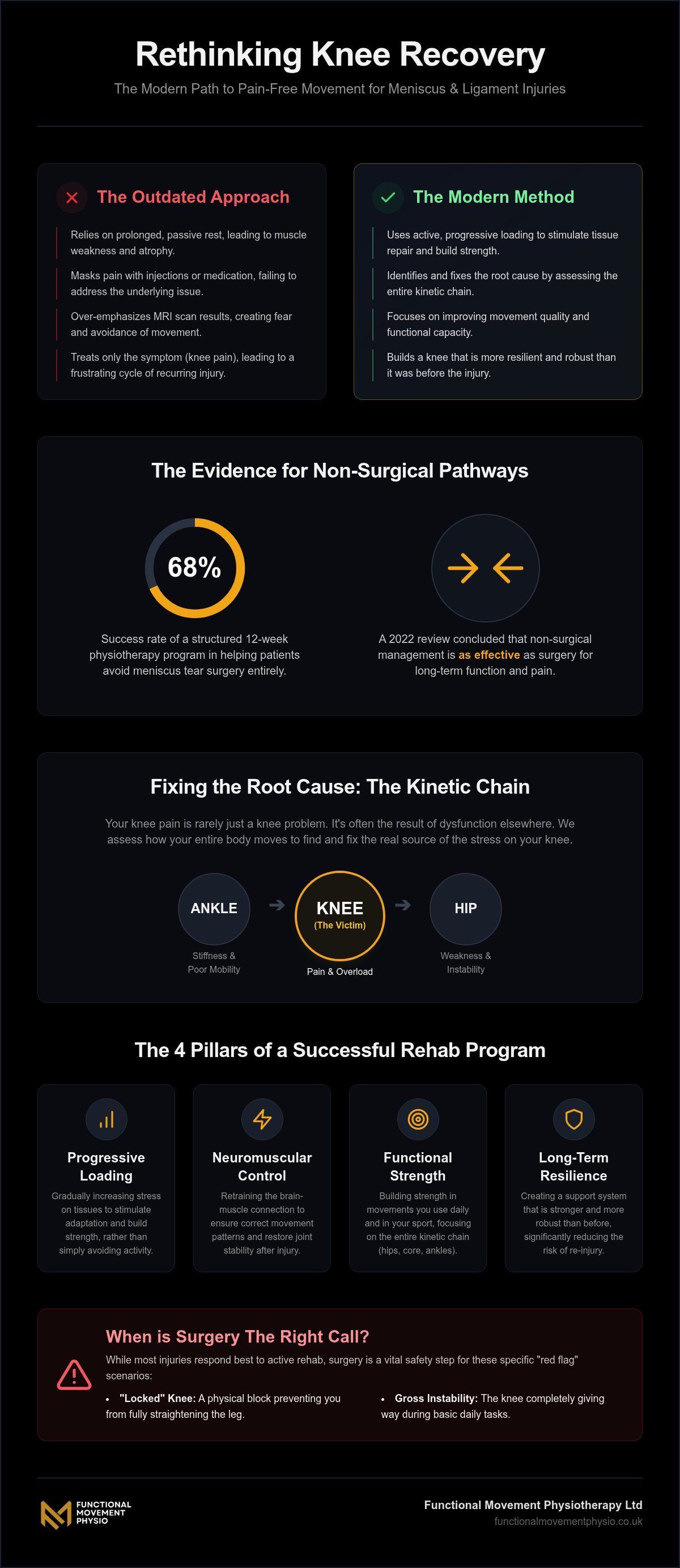
Conservative management is often misunderstood as a passive waiting game. In reality, it's a high-performance strategy that uses a structured non-surgical pathway to restore full joint function. In 2026, modern sports medicine has moved away from the "surgery first" mindset. We now prioritise physiotherapy because it addresses the underlying mechanics of your movement rather than just the structural damage seen on an MRI. This approach is particularly effective for meniscus tears, ligament strains, and chronic patellar issues.
The difference between traditional rest and active conservative rehabilitation is significant. While old-fashioned advice tells you to sit on the sofa and wait for the pain to fade, our approach involves progressive loading. We use specific exercises to stimulate tissue repair and maintain muscle volume. This is why meniscus tear physiotherapy Liverpool services are evolving; we focus on building a knee that is more resilient than it was before the injury happened. We don't just want you walking; we want you back in the gym or out on the trails with total confidence.
When is surgery actually necessary?
Safety is the foundation of any good recovery plan. Surgery remains a vital safety step in specific "red flag" scenarios. If your knee is physically "locked" and you cannot straighten it, or if you experience total joint instability where the knee gives way during basic daily tasks, a surgical consult is necessary. However, these cases are the minority. Most meniscus and ligament injuries don't require a knife to heal. Understanding this distinction helps alleviate the fear of long-term disability and allows you to focus on the work of rehabilitation.
The evidence for non-surgical pathways
The data supporting non-operative care is compelling. A 2022 systematic review concluded that non-surgical management for meniscus tears is as effective as arthroscopic surgery regarding long-term function and pain. Research indicates that a structured 12 week physiotherapy program can have a 68% success rate in helping patients avoid surgery entirely. For those who want to understand the mechanical nature of these injuries, this comprehensive guide to meniscus tears explains how different tear types behave.
Your body is designed to adapt. Controlled loading through specialist exercises encourages blood flow to the "red zone" of the meniscus, where healing is most likely. Setting your recovery roadmap begins with an Initial Physiotherapy Consultation. This session moves beyond the MRI results to look at how you move, identifying the root cause of your pain so we can create a sustainable path back to peak performance.
Why Traditional Rest and Ice Often Fails Your Recovery
The RICE protocol (Rest, Ice, Compression, Elevation) has been the standard for decades, but modern sports clinics are moving away from this passive approach. While ice can help with immediate discomfort, excessive rest often causes more harm than good. When you stop moving, your brain can "switch off" the muscles surrounding the knee, a process known as arthrogenic muscle inhibition. This leads to rapid muscle atrophy, leaving your joint even more vulnerable when you eventually try to resume activity.
If you're seeking meniscus tear physiotherapy Liverpool, you've likely found that "just resting it" hasn't worked. Quick fixes like corticosteroid injections or high doses of anti-inflammatories often mask the problem rather than solving it. These interventions can provide a false sense of security, encouraging you to return to high-impact activities before your knee has the functional strength to support them. Masking pain with medication prevents true healing by silencing the body's natural warning signals and disrupting the inflammatory phase necessary for tissue repair.
The limitation of imaging and scans
It's a common misconception that an MRI scan provides a complete map of your pain. Research indicates that many high-level athletes without any symptoms have "abnormal" findings, including meniscus tears, on their scans. If we treat only the image rather than the person, we risk performing unnecessary procedures. This "scan-focused" approach often creates fear-avoidance behaviour, where you stop moving naturally because you're worried about what the report says. This fear is a significant barrier that actually slows down your physical recovery and movement.
Why symptom-based treatment fails long-term
Relying on treatments that only target the site of pain often leads to a frustrating cycle of recurring injury. You might feel better for a few days after resting, but as soon as you return to running or the gym, the ache returns. This happens because your body has likely developed compensation patterns, overworking the hip or ankle to protect the knee. A successful non-surgical treatment plan must look at these biomechanical links to ensure long-term success.
If you're tired of temporary fixes and want to understand why your knee keeps flaring up, it's time for a different approach. Booking an Initial Physiotherapy Consultation allows us to evaluate your movement as a whole, helping you move past the symptoms and toward peak performance.
Fixing the Root Cause: The Kinetic Chain Approach
The knee is often described as a slave to the joints above and below it. While you feel the pain in the knee joint, the dysfunction frequently originates in the hip or the ankle. Effective meniscus tear physiotherapy Liverpool relies on this whole-body perspective because the knee is caught in the middle of these two powerful levers. If your glutes are weak, your thigh bone can rotate inwards during movement, creating valgus stress. This position, where the knee caved in, places excessive pressure on the medial meniscus and can lead to structural failure over time.
Similarly, limited ankle mobility can destroy your squat form or running gait. If your ankle cannot flex properly, your body finds that range of motion elsewhere, often by forcing the knee into a compromised, twisting position. This evidence-based treatment for meniscal tears highlights that addressing these biomechanical flaws is just as critical as treating the damaged tissue itself. Identifying these movement dysfunctions is the only way to prevent a cycle of reinjury once you return to high-intensity training.
The relationship between hip and knee stability
Controlling hip rotation is your primary defence against ligament and meniscus damage. When you land from a jump or change direction on a pitch, your hip muscles must stabilise the entire leg to keep the knee tracking correctly. A collapse in your foot arch can also send a ripple effect up the chain, causing the knee to twist under load. This is why we look at your whole body during a Runner’s Knee assessment, ensuring that every link in your kinetic chain is pulling its weight and protecting the joint.
Biomechanical retraining for Liverpool athletes
We use Gait Analysis in Liverpool to identify hidden movement flaws in real-time. By watching how you run or lift, we can spot the exact millisecond where your form breaks down. Small adjustments, such as increasing your running cadence or improving your foot strike, can significantly offload the knee joint and reduce internal stress.
Proprioception, which is your body's ability to sense its position in space, is the final piece of the rehabilitation puzzle. After an injury, this internal GPS is often damaged, leading to a feeling of instability. Retraining your balance ensures that your muscles react instinctively to uneven ground, providing the dynamic stability needed for a safe and confident return to peak performance.
Practical Steps for a Successful Knee Rehab Programme
Successful recovery from a knee injury is a deliberate, phased process. Unlike rigid 12-week protocols that ignore individual progress, a modern programme adapts to your body's specific response to load. When searching for meniscus tear physiotherapy Liverpool, you need a plan that balances protection with performance. This begins by managing swelling through active movement rather than static rest. Low-impact activities, like cycling or swimming, can actually flush out joint fluid more effectively than sitting on the sofa.
The four essential pillars of our conservative management programme include load management, strength capacity building, biomechanical retraining, and plyometric progression. We don't just want to stop the pain; we want to increase the threshold at which your knee can handle stress. Progressive loading is the gradual increase of stress to promote tissue adaptation. By carefully increasing the demands on your meniscus and ligaments, we stimulate the tissue to become stronger and more resilient.
Building a foundation of strength
Your quadriceps and hamstrings act as the primary shock absorbers for the knee joint. Building capacity in these muscles is your best insurance policy against future flare-ups. If direct loading is too painful, we start with isometric exercises. These involve tensing the muscle without moving the joint, which provides a safe way to maintain strength while the tissue is still sensitive.
Core stability also plays a vital role in how your knee tracks during movement. Integrating Clinical Pilates in Liverpool allows us to refine your control and balance. This ensures that your trunk and hips provide a stable base, reducing the rotational forces that often lead to meniscus damage.
Confidence and return to sport
Readiness isn't a guessing game. We use objective data, such as single-leg hop tests and strength symmetry assessments, to ensure your injured leg is within 10% of your healthy side's capacity. Beyond the physical metrics, the psychological aspect of trusting your knee is paramount. Fear of reinjury can change your movement patterns, making you stiffer and more prone to issues.
Gradual exposure to sport-specific movements, such as cutting, pivoting, and sprinting, helps bridge the gap between clinical rehab and the intensity of the gym or the pitch. This structured approach is why meniscus tear physiotherapy Liverpool specialists focus on long-term resilience rather than just short-term relief. Research indicates that a dedicated physiotherapy programme can help 68% of patients avoid surgery entirely.
Specialist Knee Rehabilitation in Liverpool
At Functional Movement Physio, we act as high-performance mentors for local athletes and active individuals who refuse to let a knee injury dictate their lifestyle. Our clinic provides the specialist meniscus tear physiotherapy Liverpool residents need to move beyond physical limitation and back to peak performance. By focusing on the root cause of your pain, we ensure that your recovery is sustainable and your joint becomes more resilient than it was before the injury.
We combine expert manual therapy with advanced rehabilitation technology to provide a comprehensive care package. This dual approach allows us to settle acute symptoms quickly while building the physical capacity you need for your sport. Your recovery isn't just about healing a tear; it's about mastering your own physical capabilities and reclaiming the activities that give your life purpose. We view our role as a partnership, guiding you through the complexities of knee health with quiet confidence and evidence-based expertise.
Advanced tools for non-surgical recovery
We use a curated mix of clinical interventions to support your non-surgical journey. For instance, Shockwave Therapy in Liverpool is highly effective for chronic patellar issues that haven't responded to traditional exercise alone. This technology triggers a biological healing response in stubborn tissues, helping to resolve long-standing pain and speed up the return to high-impact activities. It's a non-invasive way to stimulate repair in areas with poor blood supply.
To bridge the gap during the early, more sensitive stages of your rehab, Medical Acupuncture can be used to manage pain and desensitise the nervous system. This isn't a standalone fix, but a strategic tool that allows you to engage with your tailored strength plan more comfortably. Building muscle volume and improving control is your ultimate defence against joint degeneration. Our plans are designed to fit into your lifestyle while delivering results you can see and feel in the gym.
Start your recovery today
Your first visit to our Liverpool clinic marks the beginning of a structured, logical progression toward your goals. We perform a thorough biomechanical assessment to understand the unique demands you place on your body, whether you're a competitive runner or a weekend hiker. This allows us to create a personalised roadmap that moves you through the phases of healing, from initial protection to full, purposeful movement in daily life.
We believe in transparency and evidence-based care. While we aim to help you avoid surgery, we also recognise when an operation is the most appropriate path forward for your specific injury. For those who do require a surgical intervention, our Post-Operative Rehabilitation Liverpool guide provides a detailed look at how we support specialist recovery after a procedure. Whatever your path, we're here to ensure you reach your physical potential with confidence and clarity.
Reclaiming Your Peak Performance
A meniscus tear doesn't have to be the end of your running career or gym progress. By shifting the focus from passive rest to active rebuilding, you can address the movement dysfunctions that caused the injury in the first place. Our specialist sports injury clinic uses expert biomechanical analysis to look beyond the knee joint, identifying the hip or ankle issues that are often the real culprits.
Choosing meniscus tear physiotherapy Liverpool means you're opting for a personalised long-term recovery plan rather than a temporary fix. You've learned that progressive loading and kinetic chain stability are the keys to avoiding surgery and building lasting resilience. It's time to stop feeling stuck and start moving with confidence again.
Your journey to a pain-free, active life is within reach. We're here to partner with you as you master your physical capabilities and return to the activities you love.
Frequently Asked Questions
Can a meniscus tear actually heal without surgery?
Yes, many meniscus tears heal or become asymptomatic through structured conservative management. Tears in the outer third of the meniscus have a better blood supply and a higher potential for natural repair. Even if the tear remains visible on a scan, specialist physiotherapy helps you build the strength needed to offload the joint and move pain-free.
How long does conservative management of a knee injury take?
A typical structured programme for meniscus tear physiotherapy Liverpool takes approximately 12 weeks to achieve sustainable results. This timeframe allows for the initial inflammatory phase to settle and provides enough time for muscle hypertrophy and biomechanical retraining. You'll progress from basic stability to high-level performance in a phased, logical manner that respects your body's healing rate.
Is walking good for a knee injury or should I rest completely?
Gentle, controlled walking is usually beneficial because it encourages blood flow and helps manage joint swelling. Complete rest is often counterproductive as it leads to rapid muscle wasting and joint stiffness. We'll guide you on the exact volume of walking that is safe for your specific injury level, ensuring you stay active without overstressing the tissue.
What is the success rate of physiotherapy versus knee surgery?
Research indicates that a 12-week physiotherapy programme has a 68% success rate in helping patients avoid surgery entirely. Systematic reviews also show that non-surgical management is as effective as arthroscopic surgery for long-term function and pain. Most patients can achieve peak performance through meniscus tear physiotherapy Liverpool without the risks associated with an operation.
Can I still go to the gym while undergoing conservative management?
You don't need to stop training, but you must adapt your routine to protect the healing tissue. We encourage you to maintain upper body strength and perform modified lower body exercises that don't aggravate your symptoms. This proactive approach keeps you mentally engaged and physically prepared for a full return to your normal gym routine.
How do I know if my knee injury is serious enough for surgery?
Surgery is typically reserved for "locked" knees where you cannot physically straighten the leg or cases involving total joint instability. If your knee frequently gives way during basic daily activities, a surgical consult is a vital safety step. For the majority of other cases, a root cause approach through physiotherapy remains the recommended first line of treatment.
What exercises should I avoid with a meniscus tear?
You should initially avoid deep weighted squats, sharp pivoting, and high-impact jumping until your knee has sufficient dynamic stability. These movements can place excessive twisting force on the meniscus while it is still sensitive and healing. We'll gradually reintroduce these activities as your strength and control improve, ensuring your return to sport is safe and permanent.
Does conservative management work for older adults with knee pain?
Absolutely, conservative management is highly effective for older adults, especially those dealing with degenerative tears. Modern clinical guidelines prioritise physiotherapy as the first line of treatment for this demographic. It focuses on optimising joint capacity and maintaining independence, helping you master your own physical capabilities without the long recovery time required for surgery.

Article by
Stuart Goldfinch
HCPC PH112156
Specialist MSK Physiotherapist
Ex UK SAS Trainer
Graduate Sports Rehabilitator


