

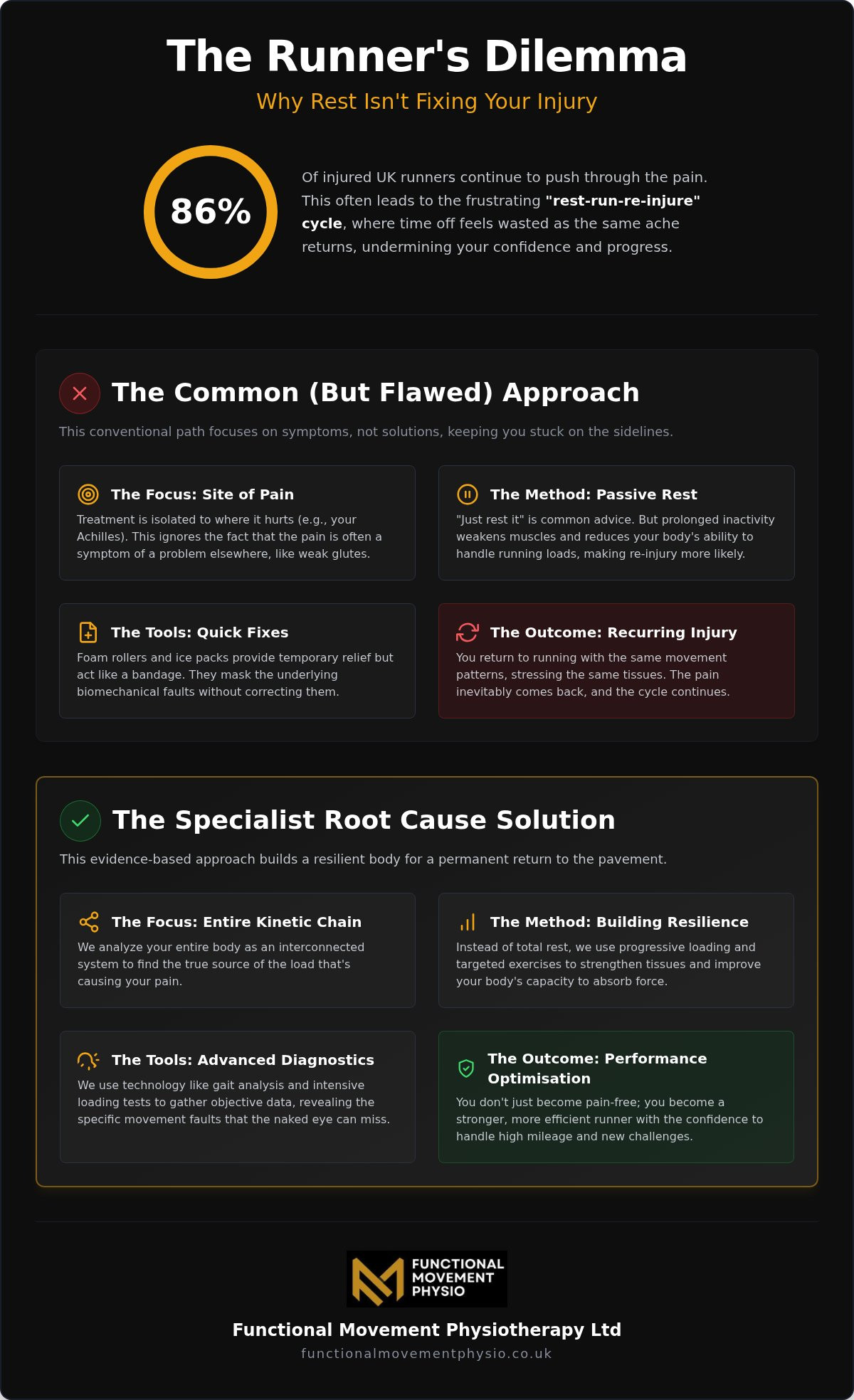
86% of UK runners currently dealing with an injury continue to push through the pain, often unknowingly worsening the underlying issue. You probably know the frustration of the rest-run-repeat cycle, where a few weeks of rest feels like a wasted effort the moment you return to the pavement and that familiar ache reappears. It is exhausting to navigate conflicting online advice while worrying that every mile might be causing long-term damage to your joints.
At our running injury clinic liverpool, we understand that you want more than just a temporary reprieve from symptoms. You deserve a clear diagnosis that explains exactly why your pain keeps returning. This guide will show you how a root cause approach identifies biomechanical inefficiencies, allowing you to keep training safely while you recover. We will outline a path that moves you beyond simple rest toward a future where you can handle high mileage with total confidence in your body’s resilience.
Key Takeaways
- Understand why rest alone fails to fix injuries and how addressing underlying movement faults prevents the cycle of recurring pain.
- Discover how a specialist running injury clinic liverpool uses advanced diagnostic tools to meet the unique demands of high-volume training.
- Learn how gait analysis uncovers the root cause of your discomfort by identifying biomechanical links between different areas of your body.
- Move beyond generic advice with a progressive rehabilitation plan that is tailored to your individual load tolerance and performance goals.
- Gain the confidence to return to the pavement permanently by focusing on functional movement patterns rather than temporary symptom relief.
Why Resting Your Running Injury Is Not a Long Term Solution
You have likely been told to "just rest" after experiencing pain during a run. While stepping back from high mileage can allow acute inflammation to settle, it rarely addresses the fundamental reason the pain started in the first place. Rest is passive; it doesn't teach your body how to handle the specific loads required for running. When you eventually lace up your trainers and return with the exact same movement patterns, the stress on your tissues remains unchanged. This is why so many runners find themselves stuck in a cycle of recovery and re-injury.
Prolonged inactivity can actually work against you. During periods of total rest, your muscle strength and motor control often diminish. This means you return to the pavement with less physical capacity than when you stopped. At our running injury clinic liverpool, we focus on building tissue resilience. True recovery isn't about the absence of pain while sitting on a sofa; it's about your body's ability to absorb force and maintain stability over long distances.
The Failure of the Quick Fix
Many athletes reach for a foam roller or an ice pack the moment they feel a niggle. While these tools can offer temporary relief, they are often just masking deeper issues. Relying on these quick fixes without a plan for long-term correction can lead to compensatory injuries. If your knee hurts, you might change your stride to protect it, which then places excessive strain on your hip or lower back. This shift in load often leads to common running injuries that seem unrelated but stem from the same original movement fault. Our goal is to move you away from simple pain management and toward performance optimisation.
Why Symptom Based Treatment Keeps You Sidelined
General physiotherapy often focuses on the site of the pain. If your Achilles hurts, the treatment stays on the Achilles. However, a specialist running injury clinic liverpool looks at the entire kinetic chain. We define the kinetic chain as the interrelated system of joints and muscles that must work in harmony to produce movement. A weakness in your glutes might be forcing your foot to over-pronate, causing that tendon pain. By looking at how you move as a whole rather than just where it hurts, we identify the root cause that general clinics might miss. This comprehensive approach ensures that once you return to your training plan, you have the structural integrity to stay there.
What Sets a Specialist Running Injury Clinic in Liverpool Apart?
A general clinic might treat a sprained ankle the same whether you tripped on a curb or rolled it at mile 20 of a marathon. A specialist running injury clinic liverpool recognizes that the forces involved in high-volume training require a different level of scrutiny. We don't just look for the absence of injury; we look for the presence of physical capacity. Our team speaks your language, understanding the subtle difference between a recovery run and a tempo session, as well as the specific psychological stress of a marathon taper. We focus on getting you back to your specific goals, whether that is a parkrun PB or a first ultra-marathon finish.
Our facility is built specifically for active bodies. We prioritize long-term results over a high frequency of low-value sessions that only offer temporary relief. This means you spend less time on the treatment table and more time on the road. We believe in a partnership where we provide the clinical expertise and you provide the commitment to your tailored recovery plan. This collaboration is what transforms a frustrated, injured runner into a resilient athlete who understands their own physical capabilities.
Beyond Generalist Physiotherapy
A standard visit often focuses on manual therapy to reduce immediate pain. In contrast, a specialist sports physiotherapy Liverpool session involves intensive loading tests. We need to see how your tissues respond to the actual impact of running. With over 20 years of clinical experience, our HCPC registered staff understands that treating high-mileage athletes requires a proactive, evidence-based strategy. We focus on functional movement patterns to ensure your body is structurally sound before we increase your training volume. This level of specialization is the difference between a temporary fix and a permanent return to the pavement.
The Role of Advanced Technology in Diagnosis
Humans cannot see everything in real-time, no matter how experienced they are. This is why a comprehensive gait analysis is the gold standard for any runner who is stuck in a cycle of injury. We use specialist technology and slow-motion video to capture the minute details of your stride that the naked eye misses. Research suggests that Preventing running injuries relies heavily on identifying these biomechanical faults and training errors before they become chronic. By quantifying your movement, we can track your progress with objective data rather than guesswork, ensuring your return to running is permanent and safe.
If you are ready to stop guessing and start a structured recovery, you can schedule a specialist consultation with our team today.
Understanding the Root Cause Through Gait Analysis and Biomechanics
Biomechanics is the study of how your muscles, bones, and joints work in unison to produce movement. When you run, this system must absorb and redistribute forces that are several times your body weight with every single step. If one part of this system is inefficient, the load doesn't disappear; it simply moves somewhere else. At our running injury clinic liverpool, we recognize that a fault in your hip stability can easily manifest as pain in your opposite ankle. This is the reality of the kinetic chain, where the site of your pain is rarely the actual source of the problem.
By analyzing your movement, we can identify overstriding, heavy landings, and inefficient energy leaks that force your body to work harder than necessary. Fixing these faults does more than just stop the ache. It reduces the cumulative stress on your joints and significantly improves your running economy. You'll find that when your body moves as a cohesive unit, you can maintain faster paces with less effort and a much lower risk of recurring issues.
How Video Gait Analysis Identifies Inefficiency
We use high-definition cameras to record your form on a treadmill from multiple angles, allowing us to review your stride in slow motion. This process uncovers subtle faults that are invisible to the naked eye at full speed. We look for "medial collapse", where the knee rolls inward upon landing, and "pelvic drop", where the hips tilt excessively due to poor core control. These patterns are primary drivers of chronic pain. This objective data is a core component of our gait analysis liverpool service, providing the clarity needed to build a precise recovery plan. Understanding these mechanics is the first step toward preventing injury and ensuring your return to the pavement is permanent.
The Link Between Hip Stability and Foot Strike
It is common to assume that foot pain requires a foot-focused fix, but your landing mechanics are often dictated by your hips. If your glutes lack the strength to stabilize your pelvis, your leg may rotate internally, causing a chain reaction that forces your foot to over-pronate. This misalignment is a frequent cause of runners knee and persistent shin splints. We focus on improving your core control and hip mobility to ensure your foundation is solid. When your hips are stable, your feet can land in a neutral, efficient position, resolving many lower limb issues without ever needing to treat the foot itself. This holistic view of the body is what allows us to deliver sustainable results for high-mileage athletes.
Building a Sustainable Path Back to the Start Line
Recovery is not a linear process, and it certainly shouldn't be a period of total stagnation. At our running injury clinic liverpool, we view rehabilitation as a bridge that connects clinical treatment to high-performance training. This transition must be progressive, moving you from isolated strength work to functional movements that mirror the exact demands of your stride. Consistency in your strength program is just as critical as consistency in your weekly mileage. One provides the engine, while the other ensures the chassis can handle the torque.
You have likely heard of the "10 percent rule" for increasing volume, but this generic advice often fails because it ignores individual load tolerance. Your body doesn't follow a mathematical formula; it responds to the specific stress placed upon it. We teach you to monitor "pain latency", which is how your body feels 24 hours after a run. If you feel fine during the activity but wake up with increased stiffness or pain the next morning, it is a clear sign that you've exceeded your current capacity. Tuning into these signals allows for a much more precise and safe progression.
Targeted Strength and Conditioning for Runners
Runners often shy away from heavy weights, fearing bulk, but lifting heavy is essential for improving tendon resilience. Your tendons act like springs. They need to be strong enough to store and release energy efficiently without breaking down. We focus heavily on single leg exercises because running is essentially a series of thousands of single leg hops. If you can't stabilize your weight on one limb in the gym, you can't expect to do it for ten miles on the road. Integrating clinical pilates liverpool into your routine can further enhance this by improving core stability and pelvic control, ensuring your form remains crisp even when fatigue sets in.
Managing Load Without Stopping Completely
Total rest is rarely the answer. We use a "Traffic Light System" to help you manage discomfort. Green means you're good to go. Amber suggests you can proceed but shouldn't increase intensity or volume. Red means you must stop and reassess. While you're in the rehab phase, cross training through cycling or swimming maintains your cardiovascular fitness without the high impact forces of running. As your symptoms settle and your strength improves, we provide a structured plan to safely reintroduce speed work and hills, ensuring your return to the start line is both permanent and powerful.
Choosing Functional Movement Physio for Your Recovery
Choosing the right running injury clinic liverpool means finding a team that prioritises your return to purposeful movement as much as you do. At Functional Movement Physio, we have created a dedicated environment in Liverpool City Centre for individuals who value high performance and long term health. We don't just provide short term symptom relief; we provide the clinical education and structural support needed for a permanent recovery. Every plan we develop is tailored to your specific running goals, whether you are preparing for a local 5k or a multi-day ultra marathon.
We believe in a partnership between the expert and the athlete. Our HCPC and CSP registered specialists bring over 20 years of clinical experience to every consultation, ensuring your care is rooted in evidence and practical application. We focus on physical activity as the foundation of health, framing our interventions as a way to unlock your full potential rather than just managing a limitation. This modern, person-centric approach is designed to help you master your own physical capabilities and stay on the road for years to come.
Our Specialist Runners Assessment Package
The gold standard for any runner stuck in a cycle of injury is our specialist Runners Assessment package. This comprehensive 1:1 consultation includes high definition video analysis and the creation of a bespoke strength plan tailored to your unique biomechanical profile. By identifying hidden movement faults before they become chronic issues, this package saves you significant time and money by preventing the need for endless follow-up appointments. It provides the clarity you need to stop guessing about your pain and start a structured, successful path toward pain free running.
Evidence Based Treatments for Faster Recovery
We utilise advanced clinical tools to accelerate your healing process and ensure your tissues can handle the loads of high mileage. For persistent, chronic issues that have failed to respond to traditional methods, we offer shockwave therapy liverpool to stimulate the body's natural repair mechanisms. This is often integrated with sports massage liverpool to manage soft tissue tension and support the overall rehabilitation process. Our commitment remains finding and fixing the root cause of your pain, allowing you to return to the activities that give your life purpose.
Take the first step toward a permanent recovery by booking your appointment at book appointment.
Reclaim Your Miles with Lasting Confidence
Transitioning from physical limitation to peak performance requires more than just waiting for pain to fade. You now understand that identifying the root cause through detailed gait analysis is the only way to break the cycle of recurring injury. By focusing on tissue resilience and functional movement patterns, you can move beyond simple symptom management and unlock your true physical potential.
Our running injury clinic liverpool provides the elite-level tools and clinical expertise needed to rebuild your confidence. With over 300 5-star reviews from local athletes and a team of HCPC and CSP Registered Specialists, we are committed to your long-term success. Our Liverpool City Centre location offers 8am to 8pm availability to ensure your recovery fits seamlessly into your lifestyle.
You don't have to settle for a rest-run-repeat cycle or live in fear of long-term damage. It's time to master your movement and return to the pavement with a body that is stronger, more efficient, and ready for high mileage.
Achieving long-term success on the road requires a commitment to a structured plan, a principle that applies to professional infrastructure development as well; to learn how experts manage complex planning requirements, check out ML Traffic Engineers UK.
Frequently Asked Questions
How is a running assessment different from a gait analysis in a shoe shop?
A shoe shop gait analysis is designed to sell trainers, whereas a clinical assessment at our running injury clinic liverpool is designed to diagnose movement faults. We don't just look at your foot strike; we evaluate your entire kinetic chain, including hip stability and core control. Our HCPC registered specialists use medical-grade video analysis to identify why you are in pain, rather than simply suggesting a shoe to mask the symptoms.
Do I have to stop running while I am undergoing treatment for an injury?
You rarely need to stop running completely. We prioritize load management, which involves adjusting your intensity and volume rather than enforcing total rest. Using our "Traffic Light System," we help you understand which sensations are safe to run through and which require a step back. This proactive approach maintains your cardiovascular fitness and mental well-being while we systematically build your body’s resilience to handle higher mileage again.
How many sessions will I need before I see an improvement in my running?
Most patients notice a significant change in their symptoms and movement quality within three to five sessions. However, the exact number depends on the severity of your injury and your specific goals. We focus on sustainable, long-term results rather than temporary fixes. Your progress is monitored using objective data from our gait analysis technology, ensuring that every session moves you closer to a permanent return to the pavement.
Can you help with chronic running injuries that I have had for years?
Yes, chronic injuries are a primary focus at our running injury clinic liverpool. Long-standing pain often persists because the original root cause was never addressed, leading to compensatory movement patterns that stress other joints. We use a specialist assessment to peel back these layers of compensation. By fixing the underlying biomechanical fault, we can resolve issues that have kept you sidelined for months or even years.
What should I bring to my first appointment at the running injury clinic?
You should bring your primary running shoes, comfortable shorts, and a t-shirt or vest. Seeing the wear patterns on your trainers provides valuable clues about your gait and foot mechanics. Because we perform a thorough physical evaluation and video analysis, wearing athletic clothing allows us to observe your joint alignment and muscle activation clearly. If you have any previous scan results or consultant letters, please bring those along too.
Is shockwave therapy effective for running injuries like Achilles tendonitis?
Shockwave therapy is highly effective for chronic running injuries like Achilles tendonitis and plantar fasciitis. It works by sending acoustic pressure waves into the affected tissue to stimulate a healing response and reduce pain. This evidence-based treatment is particularly useful for runners who have felt stuck with stubborn injuries that haven't responded to traditional rest or stretching. It is a core part of our advanced rehabilitation toolkit.
Do you work with beginners or only competitive club runners?
We work with runners of all abilities, from those starting their first Couch to 5K to elite marathoners. Beginners often face unique challenges as their bodies adapt to the impact forces of running for the first time. We provide the same level of specialist care and biomechanical analysis to every individual. Our goal is to help you master your movement and enjoy running safely, regardless of your current pace or experience level.
Will I get a set of exercises to do at home between my clinic visits?
You will receive a bespoke, progressive strength and mobility plan to follow at home. Consistency in your rehabilitation exercises is just as important as your training runs for achieving permanent recovery. These movements are specifically chosen to address the root cause of your injury and improve your running economy. We ensure the plan is realistic and fits into your daily routine, focusing on building the structural integrity required for high-mileage training.
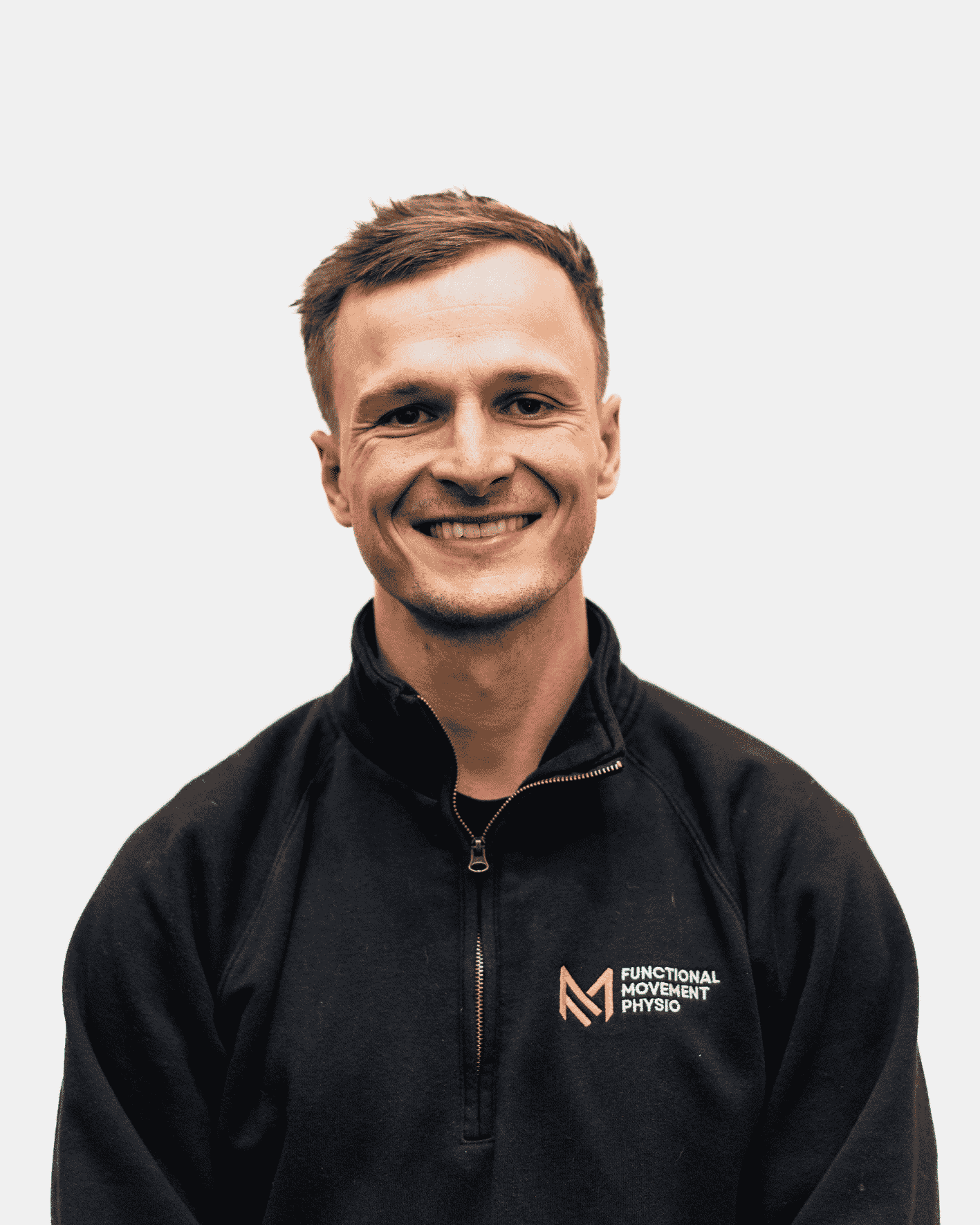
Article by
Stuart Goldfinch
HCPC PH112156
Specialist MSK Physiotherapist
Ex UK SAS Trainer
Graduate Sports Rehabilitator


