

Rest is often the worst thing you can do for a sprained ankle if you want to return to the pitch or the gym without the constant fear of it giving way again. While the initial instinct is to stop moving entirely, true stability isn't found in a state of total inactivity. It's built through purposeful, evidence based loading that prepares your body for the specific demands of high intensity sport.
You've likely been told to just wait it out or keep it elevated, yet weeks later, your ankle still feels like a loose hinge. It's frustrating to deal with conflicting timelines and that nagging anxiety every time you step onto uneven pavement or attempt to change direction. We understand that you don't just want the pain to stop; you want to feel powerful and secure in your movement once more. This is exactly why a generic approach to ankle sprain recovery Liverpool often falls short of the mark.
In this article, we provide an expert led checklist to help you move beyond basic rest and reclaim your full athletic potential. You'll learn why traditional advice fails, how a root cause approach prevents future injury, and the exact milestones you need to hit before returning to full performance. This is your professional roadmap for transitioning from physical limitation to peak stability.
Key Takeaways
- Understand why the traditional "rest and ice" approach often delays healing and how active recovery protects your long term mobility.
- Learn to identify the root cause of your instability by looking beyond the joint to the influence of your hips, glutes, and internal balance systems.
- Follow a phased checklist for ankle sprain recovery Liverpool that transitions you safely from acute management to foundational strength building.
- Discover the specific multi-directional drills and stability tests you must clear before returning to high intensity sports or running.
- Shift your mindset from simply managing pain to optimizing your physical capacity for lasting results and renewed confidence in your movement.
Why Traditional Ankle Sprain Advice Often Fails You
Standard advice for an ankle injury usually involves a bag of frozen peas and a week on the sofa. This passive approach is the primary reason why your ankle sprain recovery Liverpool might feel frustratingly slow. While the RICE protocol has been the default for decades, modern evidence suggests that total rest can actually do more harm than good for active individuals. You don't want to just wait for the pain to subside; you want to ensure the joint is resilient enough to handle your next training session.
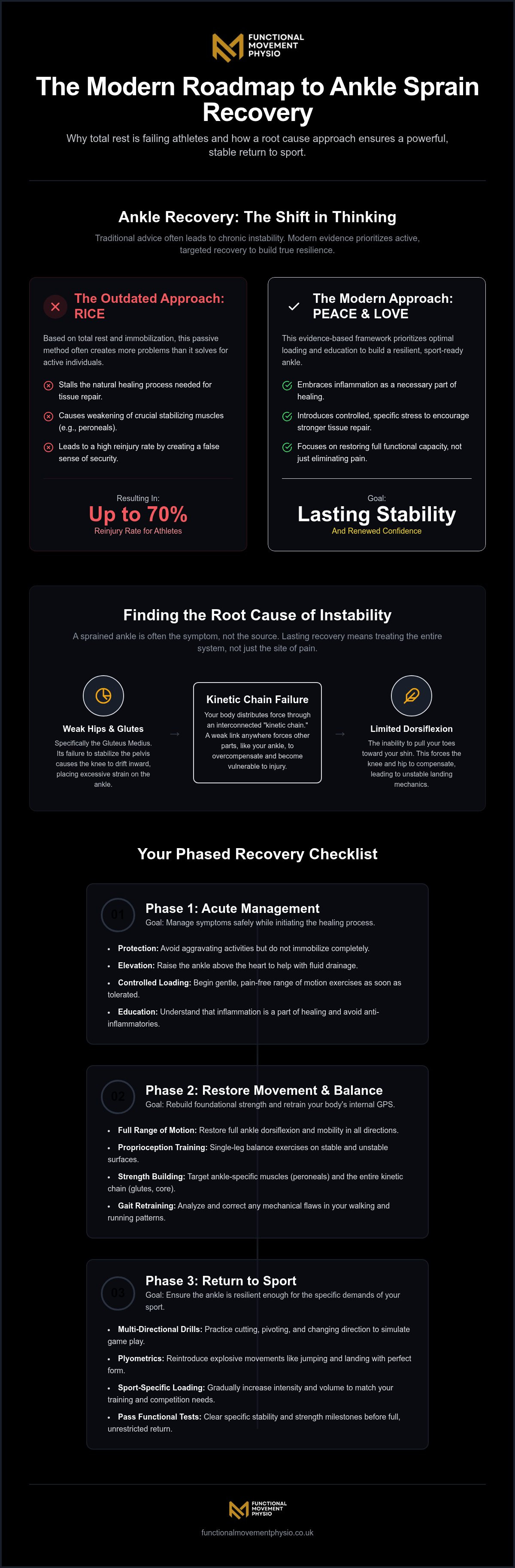
By relying on icing and complete immobilisation, you risk stalling the natural inflammatory process required for tissue healing. Over-reliance on ankle braces also creates a false sense of security while allowing the surrounding muscles to become lazy. This cycle of quick fixes and a lack of progressive rehabilitation is why athletes face a reinjury rate as high as 70 percent. You aren't just looking to stop the swelling; you're trying to prevent the next roll. Modern clinicians now prefer the PEACE and LOVE framework, which prioritises protection and elevation initially, followed by load and optimism. Unlike RICE, this approach acknowledges that inflammation is a necessary part of the healing journey.
The Myth of Total Rest
Complete inactivity is a recipe for long term dysfunction. When you stop moving, the muscles that provide dynamic stability, such as the peroneals, begin to weaken almost immediately. More critically, the talocrural joint can lose its essential range of motion, specifically dorsiflexion. For a comprehensive overview of sprained ankles, you'll find that the focus has shifted toward optimal loading. This involves introducing controlled, specific stress to the tissues to encourage stronger repair without risking further injury. If you stay off your feet for too long, you aren't protecting the ankle; you're making it more vulnerable to the next impact.
Moving Beyond the Symptoms
There's a significant difference between an ankle that doesn't hurt and an ankle that is ready for sport. A pain free joint is not necessarily a stable one. If you only treat the symptoms, you leave the root cause of the instability unaddressed. This is where a mentor-led approach to sports physiotherapy Liverpool becomes essential. We focus on restoring your full functional capacity, which includes retraining your proprioception. This is your body's internal GPS that tells your brain where your foot is in space. Without it, you are essentially playing on a joint that cannot protect itself during a sudden change of direction. True ankle sprain recovery Liverpool requires moving past the absence of pain and toward the mastery of movement.
The Root Cause Approach to Ankle Stability
To achieve lasting ankle sprain recovery Liverpool, you must look beyond the site of the pain. Most traditional treatments focus solely on the damaged ligament. While understanding clinical guidance on acute ankle sprains is vital for initial grading, it doesn't explain why your ankle was vulnerable in the first place. If you've suffered recurring rolls, the ankle is often the victim of a mechanical failure further up the leg.
We treat the body as a single, interconnected system. A weakness in your hip or a restriction in your mid back can change how your foot strikes the ground. Without addressing these underlying issues, you're simply waiting for the next injury to happen. True stability comes from ensuring every link in your movement chain is performing its job correctly.
The Kinetic Chain Connection
Your body uses a kinetic chain to distribute force during activity. If you have limited dorsiflexion, which is the ability to pull your toes toward your shin, your knee and hip must overcompensate. This often leads to a collapsed arch or an unstable landing position. When your mechanics are off, even a simple step can become a risk factor.
Gluteus medius weakness is another common culprit we see in the clinic. This muscle on the side of your hip is responsible for keeping your pelvis level when you stand on one leg. If it's lazy, your knee drifts inward and your ankle is forced to take lateral strain it wasn't designed for. By using gait analysis in Liverpool, we can pinpoint exactly where these mechanical leaks are happening during your stride.
Retraining the Brain and Body
An injury doesn't just damage tissue; it disrupts the neural pathways between your joint and your brain. This system, known as proprioception, acts as your body's internal GPS. It tells your brain exactly where your foot is in space without you having to look at it. It's the difference between a secure landing and a painful roll.
When you sprain an ankle, these sensors go offline. This is why your ankle feels untrustworthy or loose even after the swelling has gone. Strength training alone won't fix this. You need specific balance and reactive drills to wake these sensors up. We focus on sustainable movement patterns that retrain your brain to protect the joint automatically. If you're tired of the rest and repeat cycle, an Initial Physiotherapy Consultation is the first step toward finding your true root cause.
Phase 1 Checklist: Managing the Acute Injury Safely
The first 72 hours after an injury are critical for setting the stage for a successful ankle sprain recovery Liverpool. Your goal during this acute phase is to protect the damaged tissue while avoiding the trap of total immobilisation. While you might be tempted to reach for ibuprofen, it's vital to let the natural inflammatory response begin the repair process. This initial stage is about smart management rather than aggressive intervention.
Before you begin any home care, you must identify if your injury requires immediate clinical attention. Professional assessment is necessary if you experience any of the following red flags:
- An inability to take four steps, even with a limp.
- Intense tenderness directly on the bony prominences of the ankle.
- Significant bruising that appears rapidly or spreads toward the toes.
- Numbness or a "pins and needles" sensation in the foot.
If these symptoms are present, you should seek expert advice on ankle sprain recovery from a specialist to rule out a fracture or high ankle sprain. If the injury is a standard lateral sprain, you can move into the PEACE and LOVE protocol.
The PEACE and LOVE Protocol
Modern sports medicine has evolved beyond the RICE method. We now use the PEACE and LOVE framework to guide the first few days of your ankle sprain recovery Liverpool. During the "PEACE" phase (Days 1 to 3), you should focus on Protection, Elevation, Avoiding anti-inflammatories, Compression, and Education. Elevation is most effective when the ankle is higher than your heart, as this uses gravity to assist fluid drainage.
The "LOVE" phase begins as the initial pain subsides. This involves Load, Optimism, Vascularisation, and Exercise. Optimism is a frequently overlooked part of the process; your mental state directly influences your physical recovery. By maintaining a positive outlook and understanding that the tissue is healing, you reduce the protective guarding that can lead to long term stiffness.
Early Mobility Exercises
You don't need to wait for the pain to vanish entirely before you start moving. Gentle, pain free movement encourages blood flow and prevents the talocrural joint from becoming restricted. Start with these simple drills twice daily:
- Alphabet Tracing: Use your big toe as a "pen" to draw the capital letters of the alphabet in the air.
- Ankle Circles: Perform slow, controlled circles in both directions, staying within a range that doesn't cause sharp pain.
- Toe Curls: Scrunch your toes as if you are trying to pick up a towel from the floor to engage the small muscles of the foot.
The goal is to maintain the neural connection between your brain and the ankle sensors. Once you can put weight on the foot comfortably and have regained basic movement, you are ready to transition into building foundational strength.
Phase 2 Checklist: Restoring Movement and Balance
Once the acute swelling has settled, your focus shifts from protection to restoration. This is the stage where many people stop their rehab because the immediate pain has gone, but it's actually the most critical window for preventing future rolls. To ensure a successful ankle sprain recovery Liverpool, you must rebuild the physical capacity of the joint before testing it on the court or road. You need to regain full range of motion in all directions, particularly dorsiflexion, to prevent compensatory patterns from taking root in your knees and hips.
Strength is only one part of the equation. You also need to restore the communication between your ankle and your brain that was disrupted during the injury. Incorporating clinical pilates in Liverpool is an excellent way to develop this core to ankle stability, ensuring your whole body supports the joint during complex movements. This holistic approach moves you beyond mere symptom management and toward true physical optimization.
The Stability Checklist
Before progressing to higher impact activities, you should be able to clear these foundational markers. These tests ensure your lateral stabilisers are waking up and your balance is returning to baseline levels. Don't rush this process; quality of movement is far more important than the number of repetitions.
- Single leg stand: You should be able to balance on the injured leg for 30 seconds with your eyes open and minimal wobbling at the hip or ankle.
- Controlled calf raises: Perform 15 to 20 repetitions with perfect alignment, ensuring your ankle doesn't "roll out" at the top of the movement.
- Resisted eversion: Using a therapy band, push the outside of your foot against resistance to specifically target and strengthen the peroneal muscles.
Progressive Loading
Rehab isn't always comfortable. We often talk about "safe pain" during this phase. This means that a mild ache, perhaps a 2 or 3 out of 10, is acceptable during exercise, provided it doesn't linger into the next day. It's a sign that you're challenging the tissues enough to trigger adaptation without causing new damage. If the pain increases or persists, it's a signal to adjust the load rather than stopping entirely.
Managing soft tissue tension is also vital as you increase your activity levels. You can use sports massage in Liverpool to address the compensatory tightness that often develops in the calf and lower leg. This isn't just about feeling better; it's about maintaining the range of motion you've worked hard to regain. We view this process as a partnership between the expert and the individual, focusing on the resumption of meaningful personal activities through a structured, evidence based path.
Phase 3 Checklist: Returning to Sport in Liverpool
The final stage of ankle sprain recovery Liverpool is where you bridge the gap between basic rehabilitation and high performance sport. It isn't enough to simply be pain free; you must be "battle ready." This means testing your ankle under the specific stresses of your chosen activity, whether that's the rapid lateral shifts of Padel or the unpredictable landings of a football match. You need to prove to your brain that the joint is secure before you commit to a full speed game.
We focus on multi-directional loading to ensure the joint can handle force from every angle. You should begin with controlled linear hopping and progress to diagonal bounds. These drills expose any remaining hesitation in your movement. If you feel a "catch" or a lack of trust during these tests, it's a sign that your neuromuscular control hasn't fully returned. Reintroducing high impact running on varied surfaces, such as grass or trail paths, further challenges your stability and prepares you for the real world conditions of Liverpool's parks and pitches.
Court and Pitch Readiness
For those playing sports like Padel or tennis, lateral stability is non-negotiable. You must be able to perform a lateral shuffle and sudden change of direction without any "giving way" sensation. We focus heavily on landing mechanics; you should land softly with your knee aligned over your second toe, rather than letting the joint collapse inward. This level of intensity in training often mirrors ACL reconstruction rehab in Liverpool, as both require a high degree of confidence in the limb's ability to absorb force. Use this checklist to gauge your readiness:
- Perform a 5 metre lateral shuffle with a sudden stop and pivot without hesitation.
- Complete a triple hop test for distance, aiming for at least 90 percent symmetry with your uninjured leg.
- Execute a box jump with a "stick" landing, focusing on perfect knee and ankle alignment.
Your Long-Term Prevention Plan
Recovery doesn't end when the whistle blows. To maintain your results, you must continue your stability work as part of your regular warm up routine. This "prehab" approach keeps the neural pathways sharp and the supporting muscles resilient. Awareness of your environment is also key; be mindful of slippery court surfaces or uneven turf during the winter months. Proper footwear that provides adequate lateral support can make a significant difference in preventing a recurrence.
Before you dive back into competitive play, a final sports physiotherapy session acts as your official return to play check. We use objective testing to ensure your injured side is within a safe margin of your healthy side's strength and hop distance. This data-driven approach removes the guesswork, giving you the quiet confidence to push your limits once again.
Reclaim Your Athletic Potential
Lasting stability isn't found in a state of rest; it's earned through progressive loading and a deep understanding of your body's mechanics. By shifting your focus from the damaged ligament to the entire kinetic chain, you address the root cause of your injury rather than just the symptoms. Whether it's retraining your proprioception or strengthening your hips to protect the joint, every step of this checklist brings you closer to a confident return to the sports you love.
At our specialist sports injury clinic in the Liverpool City Centre, we move beyond generic advice to provide a comprehensive root cause assessment. We ensure your ankle sprain recovery Liverpool is handled with clinical precision and a personal commitment to your long term performance. You don't have to navigate this journey with uncertainty or the fear of another roll. Professional guidance ensures that every movement you make is a step toward peak capability.
It's time to stop managing your physical limitations and start mastering your movement once again. We're here to help you unlock your full physical capacity and move with absolute confidence.
Frequently Asked Questions
How long does it take to recover from a sprained ankle?
Recovery time depends on the severity of the ligament damage. A mild Grade 1 sprain might resolve in 2 to 4 weeks, while a more significant Grade 3 tear can take 12 weeks or longer to reach full athletic capacity. It's better to track your progress through functional milestones rather than just looking at the calendar. We focus on when your ankle can handle the specific loads required for your sport.
Should I wear an ankle brace while recovering?
You should use a brace as a temporary tool for protection during the acute phase or when first returning to high risk sports. However, over-relying on a brace can lead to muscle weakness and a decrease in your body's natural stability. The goal of ankle sprain recovery Liverpool is to build a joint that is strong enough to support itself without external help.
When can I start running again after an ankle sprain?
You can begin a gradual return to running once you have regained full range of motion and can perform a single leg calf raise without pain. We usually look for 90 percent strength symmetry compared to your uninjured side. Impact should be introduced slowly, starting with a walk-run programme on flat, even surfaces before moving to more challenging terrain or changing direction.
Is it a sprain or a fracture and how can I tell?
A fracture often involves an inability to bear weight and intense pain directly on the bone. If you cannot take four steps or if the bony lumps on the side of your ankle are extremely tender to touch, you need an X-ray. A sprain usually allows for some weight bearing, though it will be uncomfortable. A professional assessment is the only way to be certain of the damage.
Why does my ankle feel unstable months after the injury?
Persistent instability is often a sign of Chronic Ankle Instability, which occurs when the neural pathways between your ankle and brain haven't fully recovered. If your proprioception is dull, your brain won't react fast enough to prevent a roll. This is why we look at your whole kinetic chain, including hip and glute strength, to ensure your ankle sprain recovery Liverpool is truly complete.
Can sports massage help with my ankle recovery?
Sports massage is a highly effective tool for managing the secondary tension that builds up in your calves and shins during recovery. When you limp or change how you walk to protect an injury, other muscles overwork and become tight. Releasing this tension helps you maintain the range of motion needed for a normal gait and prevents further aches in the knee or hip joints.
Is walking on a sprained ankle good for recovery?
Walking is generally encouraged as soon as your pain levels allow for a relatively normal gait. Controlled loading helps to align the new collagen fibres in the healing ligament and prevents joint stiffness. If you can walk with only mild discomfort, around a 2 or 3 out of 10 on the pain scale, it's usually beneficial for your long term recovery and circulation.
What is the best exercise for a weak ankle?
There isn't one single "best" exercise, but single leg balance drills are fundamental for restoring joint position sense. Once you can stand on one leg for 30 seconds, you should add a challenge like closing your eyes or throwing a ball against a wall. This forces your ankle to react to unpredictable movements, which is exactly what happens during a game or a run.

Article by
Stuart Goldfinch
HCPC PH112156
Specialist MSK Physiotherapist
Ex UK SAS Trainer
Graduate Sports Rehabilitator


