

The recurring "niggle" that keeps you on the sidelines isn't just a stroke of bad luck. It's often a clear signal that your previous recovery focused on the symptoms rather than the underlying movement dysfunction. At our rugby injury rehabilitation clinic Liverpool, we understand the frustration of feeling ready to train, only to have a soft tissue strain flare up during the first high-intensity session. You deserve a recovery plan that matches the physical demands of the game.
It's common to feel stuck between conflicting advice from teammates and generic physiotherapy that doesn't account for the impact of a tackle. You want more than just to be pain-free; you want to know that your knee or shoulder will hold up under pressure. This article explains how identifying the root cause of your injury builds the long-term resilience needed for a safe return to play. We'll outline how clear performance benchmarks and evidence-based protocols can replace uncertainty with total confidence in your physical capacity. Discover how to move beyond temporary fixes and master your own physical potential.
Key Takeaways
- Understand why focusing only on symptoms leads to a cycle of re-injury and how identifying biomechanical leaks is the key to lasting recovery.
- Learn why generic, table-based treatments often fail to prepare your body for the unique high-intensity demands of a match day.
- Discover how our rugby injury rehabilitation clinic Liverpool uses over 20 years of expertise to bridge the gap between clinical recovery and peak performance.
- Follow a structured, five-stage framework that provides clear benchmarks for safely returning to full contact training without the fear of a setback.
- Gain the confidence to tackle and compete again by building a body that is resilient, optimized, and truly ready for the physical nature of the game.
The Frustrating Cycle of Recurring Rugby Injuries in Liverpool
You have spent weeks on the sidelines, icing your knee and watching your teammates from the touchline at Mossley Hill or West Park. It is a lonely place to be. Many players fall into a predictable cycle: they rest until the sharp pain subsides, return to full training, and then break down within the first twenty minutes of a match. This is the rehab loop. It happens because traditional advice often prioritizes temporary pain relief over long term physical robustness. A dedicated rugby injury rehabilitation clinic Liverpool doesn't just aim to stop the ache; it focuses on rebuilding your capacity for high velocity contact.
Rest and ice might reduce inflammation, but they do nothing to address why your hamstring wasn't able to handle a maximal sprint or why your ankle folded in the ruck. For a contact athlete, "not hurting" is a dangerously low bar for return to play. You need a transition from clinical treatment to peak performance that is as demanding as the game itself.
Why Traditional Quick Fixes Fail the Modern Player
Short term solutions like kinesiology tape or a quick sports massage provide a false sense of security. While these tools have their place in managing discomfort, they ignore the underlying mechanics that caused the issue. If your hip lacks the necessary range of motion, your lower back or knees will eventually pay the price during a scrum or a heavy landing. Returning to the pitch simply because you feel okay is a gamble that rarely pays off. In professional rugby, concussion remains the most common injury in rugby, accounting for 24% of all match injuries in recent seasons. Just as head injuries require strict, benchmarked protocols, your soft tissue and joint injuries need objective testing before you cross the white line. Liverpool clubs, from junior sides to senior leagues, demand a level of physicality that requires more than just a bit of tape and hope.
The Emotional Toll of Being Sidelined
The physical pain is only half the battle. There is a specific mental fatigue that comes with missing team selection and the Saturday afternoon buzz. This frustration often leads to a rushed return, fueled by a desire to help the team rather than a clinical readiness to perform. When you return without proper rehabilitation, that nagging doubt in the back of your mind affects your tackle height and your speed off the mark. Hesitation in rugby is a primary cause of further injury. We act as your high performance mentor, ensuring you return with the confidence that your body is more resilient than it was before the injury occurred. We want you to focus on the game, not your injury.
Why Generic Physiotherapy Often Misses the Mark for Rugby
Many athletes assume that any physiotherapist can treat any injury. While a generalist might help you walk without a limp, a specialist rugby injury rehabilitation clinic Liverpool focuses on the transition from the treatment table to the pitch. Effective rugby rehab is a blend of clinical physiotherapy and targeted strength conditioning. It's about more than just healing tissue; it's about restoring the physical capacity to withstand a heavy tackle at full speed. You need a plan that prepares you for the chaos of the game.
Generic "table-based" physiotherapy often stops once you have regained a basic range of motion. For a librarian, that might be enough. For a rugby player, it's just the start. Functional movement rehabilitation moves you off the treatment table and into dynamic, multi-planar exercises that mirror the demands of your position. Whether you are a front-row forward holding a scrum or a winger side-stepping at high velocity, your body needs to be conditioned for specific, high-intensity loads.
A critical concept often missed by generic protocols is force absorption. In a contact sport, your joints and muscles are subjected to massive, unpredictable forces. If your rehabilitation only involves static stretching and light resistance bands, you won't be prepared for the impact of a ruck. You must train your body to dissipate energy effectively. A dedicated rugby injury rehabilitation clinic Liverpool bridges the gap between basic mobility and match-day readiness by focusing on these high-impact mechanics.
The Problem with Symptom-Focused Treatment
Treating the site of pain is a common mistake that leads to recurring issues. If your knee hurts, the cause might actually be poor hip stability or an old ankle injury that has changed your movement patterns. Standard exercises often lack the intensity required to bridge the gap to full training. This is why we focus on strategies for preventing rugby injuries by looking at the whole kinetic chain. By addressing these biomechanical leaks, Specialist Physiotherapy Liverpool ensures that your recovery is sustainable and robust.
Rugby Mechanics: More Than Just Running
Rugby involves unique forces that are rarely replicated in a standard gym session. The sheer torque on your spine during a scrum or the explosive power needed to drive through a tackle requires specific neuromuscular control. Your rehab must mimic these high-velocity, high-impact movements to be effective. We often use Gait Analysis to identify subtle flaws in sprinting mechanics that could lead to hamstring tears or calf strains. If you're ready to stop guessing and start a precision-based recovery, you can schedule your initial consultation here to get a clear path back to the game.
The Root Cause Approach to Rugby Rehabilitation
At our rugby injury rehabilitation clinic Liverpool, we don't just ask where it hurts; we ask why it happened. Our philosophy centres on identifying biomechanical leaks. These are small inefficiencies in your movement patterns that force other parts of your body to overwork. If you have a "niggle" that refuses to clear, it's rarely a problem with the tissue itself. Instead, it's often a symptom of a failure elsewhere in the kinetic chain. We treat your body as a single, integrated system rather than a collection of isolated parts.
Old injuries are the most common drivers of new pain. An ankle sprain from three seasons ago might have left you with restricted joint mobility, causing your knee to collapse inward during a sprint. Over time, this creates excessive strain on your hamstrings or groin. Our assessment process for rugby players at our Liverpool clinic is exhaustive. We look at how you move, how you distribute weight, and how you generate power. By finding these silent drivers, we can break the cycle of re-injury and build a foundation for peak performance.
Identifying Biomechanical Leaks in Your Game
Specific movement limitations have predictable consequences on the pitch. For example, limited ankle dorsiflexion, the ability to pull your toes toward your shin, is a frequent cause of recurring calf and hamstring strains. If your ankle can't flex, your body finds that range elsewhere, often at the expense of your explosive power. Similarly, poor hip and pelvic stability puts your lower back at significant risk during the high compression of a scrum or the impact of a tackle. We often recommend Clinical Pilates Liverpool to help players develop the deep core control and hip stability required to protect the spine under load. This transition from isolated strength to functional movement is what separates a successful return to play from another setback.
Advanced Tools for Hard-to-Fix Injuries
Sometimes, chronic issues require a more direct intervention to kickstart the healing process. For players struggling with persistent tendon pain, such as Achilles or patellar tendinopathy, we utilize Shockwave Therapy. This non-invasive treatment sends acoustic waves into the affected tissue to stimulate blood flow and cellular repair. We may also integrate medical acupuncture to manage localized pain and reduce muscle guarding. These tools are never used in isolation; they are part of a broader strategy that includes objective testing. We use data, not guesswork, to track your progress and ensure you are meeting the physical benchmarks required for the demands of the modern game.
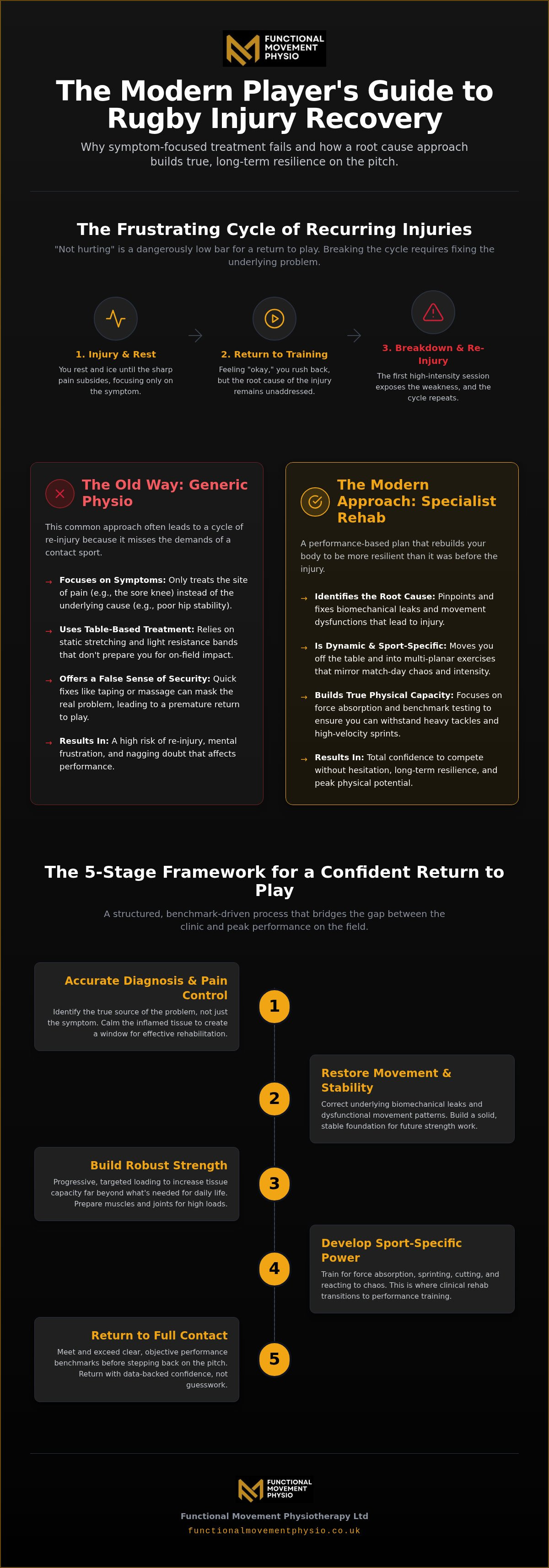
Actionable Benchmarks for a Safe Return to Full Contact
Returning to the pitch requires more than just a signature from a doctor. There is a vast difference between being medically fit, meaning your tissues have healed, and being performance ready. At our rugby injury rehabilitation clinic Liverpool, we use a criteria based roadmap to ensure you don't just survive your first game back, but actually perform. You should never rely on how an injury feels; you must rely on what the data says. This objective approach removes the guesswork and the anxiety of the first tackle.
The 5 Stages of Your Rugby Rehab Roadmap
Each stage of your recovery acts as a gate. You cannot move to the next until you have successfully passed the requirements of the current one. This structured progression at our rugby injury rehabilitation clinic Liverpool protects you from the common "too much, too soon" errors that lead to frustrating setbacks.
- Stage 1: Pain Management. The focus is on settling inflammation and restoring basic range of motion. We use manual therapy and targeted movement to get you moving comfortably in daily life.
- Stage 2: Strength Foundation. We build the capacity of the injured area. This involves low impact functional movements to ensure your muscles and tendons can handle load again.
- Stage 3: Sport-Specific Loading. Here, we introduce sprinting and rapid changes of direction. This mirrors the logic found in our Football Injury Physio Liverpool roadmap.
- Stage 4: Controlled Contact. You begin high velocity force absorption drills. This is where we test your ability to hit and be hit in a controlled, safe environment.
- Stage 5: Full Team Training. The final step is match ready testing within a team environment to confirm you are 100 percent ready for the Saturday whistle.
Objective Tests You Must Pass Before Playing
Subjective feelings are unreliable. You need clear, measurable benchmarks to prove you are ready. We look for limb symmetry, ensuring your injured side is within 90 percent of your healthy side in terms of strength and power. If there is a larger gap, you are significantly more likely to compensate and cause a secondary injury. We also measure specific power metrics, such as jump height and your reactive strength index, to see how your body handles explosive energy. Finally, we assess contact readiness. Can you hold a strong tackle position under an external load without pain or hesitation? If the answer is no, you aren't ready. Demand this level of objective data from your rehab provider to ensure your long term resilience.
Specialist Rugby Rehabilitation at Functional Movement Physio Liverpool
Choosing a specialised rugby injury rehabilitation clinic Liverpool ensures that your recovery is managed by experts who understand the unique physical toll of the sport. A generalist clinic may help you return to daily activities, but they often lack the technical depth required to prepare you for a high velocity collision. With over 20 years of experience in both elite and amateur sports, we provide the clinical authority and empathetic support needed to bridge that gap. We don't just want to get you back on the pitch; we want to ensure you stay there.
Our commitment to long term results means we never settle for temporary fixes. While symptom management is part of the process, our primary goal is to resolve the underlying biomechanical issues that led to your injury. This proactive approach to health management helps you master your own physical capabilities. We offer convenient appointment slots from 8 am to 8 pm to accommodate busy training schedules and work commitments, ensuring that professional level care is accessible when you need it most.
What to Expect During Your Initial Consultation
Your journey begins with a thorough 60 minute initial physiotherapy consultation. We take the time to conduct an exhaustive assessment of your injury and your entire movement history. This isn't a rushed session; it's a detailed investigation into how you move and where your physical capacity might be failing. Understanding these factors is essential for Finding the Best Physiotherapist in Liverpool who can deliver a root cause solution.
Following the assessment, you will receive a clear, written plan that outlines every step of your path back to the pitch. We believe in total transparency, so you'll always know exactly what benchmarks you need to hit. You will also receive immediate hands on treatment during this first visit to start the recovery process and provide relief. This combination of education and intervention ensures you leave the clinic feeling understood and professionally guided.
Book Your Assessment and Stop Guessing
It is time to stop the cycle of recurring pain and the frustration of "hit and miss" recovery. Whether you are playing grassroots rugby at a local club or competing at an elite level, we provide the same high performance mentoring to every individual. Our goal is to restore purposeful, pain free movement so you can play with total confidence. You don't have to navigate your recovery alone; we are here to act as your technical expert and supportive coach.
Reclaim Your Performance on the Pitch
You have learned that successful recovery from a rugby injury requires more than just waiting for the pain to fade. By choosing a specialist rugby injury rehabilitation clinic Liverpool, you are investing in a root cause approach that identifies movement dysfunction before it leads to another setback. We bridge the gap between basic healing and the high impact demands of a match day using objective testing protocols and over 20 years of clinical experience. This ensures you return to play with a body that is more resilient than it was before your injury.
Our team is here to ensure your return to full contact is safe, benchmarked, and sustainable. With appointments available from 8 am to 8 pm, we fit your recovery around your training and work life. Don't let uncertainty dictate your tackle technique or your speed off the mark. We are your partners in transitioning from physical limitation to peak performance.
It's time to master your physical capabilities and step back onto the pitch with total confidence.
Frequently Asked Questions
How long does rugby injury rehabilitation usually take?
Rehabilitation timelines vary significantly based on the specific injury and your physical starting point. A minor soft tissue strain might take three weeks, while the average time lost for a knee injury is approximately 50 days. We focus on passing functional benchmarks rather than simply counting calendar days. This ensure you return with the resilience needed to stay on the pitch rather than rushing back and risking a relapse.
Do I need a GP referral to visit your rugby injury clinic in Liverpool?
You do not need a GP referral to book an appointment at our rugby injury rehabilitation clinic Liverpool. We operate as a direct access clinic, allowing you to begin your recovery immediately after an injury occurs. This early intervention is often key to preventing secondary compensations. If you are using private medical insurance, check your policy, but for self-funding players, you can simply book online and start your assessment.
Can I still do gym work while undergoing rugby rehab?
You are actively encouraged to continue gym work, provided the movements don't aggravate your specific injury. We believe physical activity is the foundation of health and performance. We will provide you with a modified training plan that maintains your strength and cardiovascular fitness while we address the root cause of your pain. This "train around" approach ensures your transition back to full team training is as seamless as possible.
What is the most common rugby injury you treat in Liverpool?
Knee ligament issues and recurring soft tissue strains are the most frequent presentations at our rugby injury rehabilitation clinic Liverpool. Statistics from professional rugby show that knee injuries account for roughly 11.6% of match injuries. We also frequently manage the rehabilitation process for players following the mandatory 21 day graduated return to play protocol for concussions. Our goal is always to identify the biomechanical leak that made the injury possible.
Is sports massage better than physio for a rugby "niggle"?
Sports massage is an excellent tool for managing muscle tension, but it is not a substitute for physiotherapy. Massage treats the symptoms, while physiotherapy identifies the root cause. If you have a persistent "niggle", you need an assessment to understand why that area is being overloaded. We often combine both treatments to provide immediate relief while simultaneously building the long term strength and stability you need for contact.
When is shockwave therapy used for rugby players?
Shockwave therapy is typically introduced when a player is struggling with chronic tendon pain that hasn't responded to traditional exercise alone. It is highly effective for conditions like Achilles tendinopathy or patellar tendon issues. By sending acoustic waves into the damaged tissue, we can restart the healing process. It's a non-invasive option that helps you avoid more aggressive interventions while you continue to work on your functional movement patterns.
How do I know if I am ready for full contact training?
You are ready for full contact when your objective data confirms it, not just when you feel "okay". We look for limb symmetry where your injured side is within 90 percent of your healthy side's strength. You must also pass specific power tests and show that you can hold a tackle position under load without pain. These clear benchmarks provide the confidence you need to make that first hit without hesitation.
Do you provide rehab for post-operative rugby injuries like ACL repairs?
Yes, we provide comprehensive post-operative rehabilitation for players recovering from procedures such as ACL reconstructions, shoulder stabilisations, or meniscus repairs. These cases require a highly structured, phased approach to restore range of motion and strength safely. We work closely with your surgical guidelines to ensure every stage of your recovery is managed with clinical precision, focusing on a sustainable return to high performance rugby and long term wellness.

Article by
Stuart Goldfinch
HCPC PH112156
Specialist MSK Physiotherapist
Ex UK SAS Trainer
Graduate Sports Rehabilitator


