

What if the total rest you have been told to take is actually the very thing preventing your recovery? If you are struggling with sharp pain on the outside of your hip every time you try to sleep on your side, you need a plan that goes beyond passive waiting. Finding effective gluteal tendinopathy exercises Liverpool runners can rely on is often the missing link between chronic frustration and a return to the Waterfront. It is exhausting to feel stuck between a diagnosis of bursitis and the reality of a pain that simply will not quit.
You deserve more than just a temporary fix or a prescription for painkillers. You need a strategy that addresses the root cause of your discomfort through progressive loading and mechanical changes. This guide provides the exact exercise progression and lifestyle modifications needed to resolve lateral hip pain for good. We will move past the confusion of symptom masking and provide a clear roadmap that allows you to return to running at Sefton Park with confidence. You will learn how to transition from physical limitation back to your peak performance through evidence based care and a structured path to sustainable movement.
Key Takeaways
- Understand the critical difference between trochanteric bursitis and gluteal tendinopathy so you can stop wasting time on treatments that do not work for your specific condition.
- Identify the daily habits and sleeping positions that create compressive load, which often acts as the hidden barrier preventing your hip tendons from healing.
- Master a structured three phase progression of gluteal tendinopathy exercises Liverpool specialists use to transition from initial pain relief to high performance running.
- Learn why traditional stretching of the outer hip can actually worsen tendon irritation and how to replace it with targeted loading for better results.
- Discover how a specialist biomechanical assessment identifies the root cause of your hip overload to ensure your recovery is sustainable and permanent.
Identifying Gluteal Tendinopathy: Why Your Outer Hip Pain Lingers
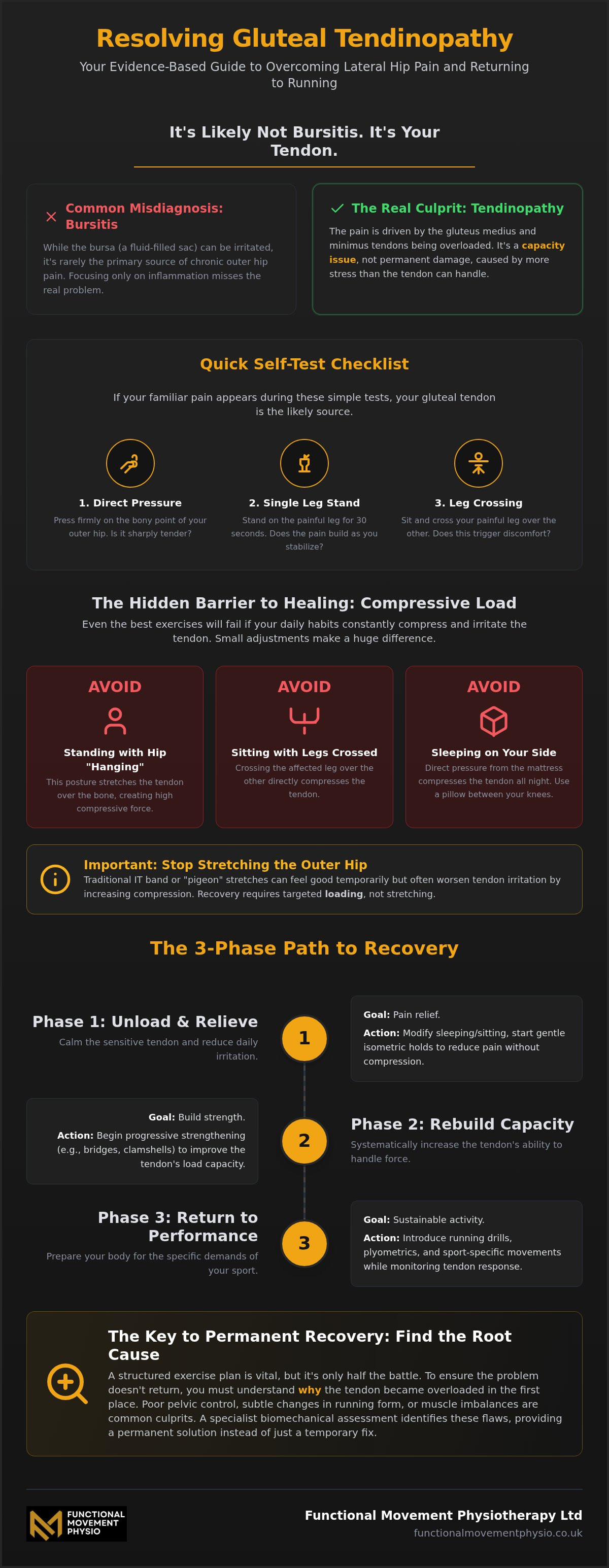
If you have been told you have hip bursitis, there is a high chance the diagnosis was slightly off. While the bursa can become irritated, modern clinical evidence shows that the primary driver of outer hip pain is actually the gluteus medius and minimus tendons. These structures attach your gluteal muscles to the bony point on the side of your hip, known as the greater trochanter. When these tendons are subjected to more stress than they can handle, they develop Gluteus medius tendonitis or tendinopathy. It is not a permanent wear and tear issue; it is a capacity problem.
You likely notice this pain most when the tendon is compressed or heavily loaded. This explains why sleeping on your side is so uncomfortable; the mattress pushes the tendon against the bone. Similarly, long walks or runs can leave you aching because the tendon is struggling to manage the repetitive force. To truly resolve this, you must look at the root cause. Often, your hip is overworking because of poor pelvic control or subtle changes in how you move. Starting a program of gluteal tendinopathy exercises Liverpool specialists recommend requires first understanding if your pain is actually coming from the tendon or a different structure entirely.
The Self-Test Checklist
You can perform a few simple movements at home to see if your lateral hip pain fits the typical pattern of tendinopathy. These tests are designed to provoke the tendon under specific types of load. If you experience your familiar pain during these tasks, it is a strong indicator that the tendon is the source of your frustration.
- Direct Pressure: Use your thumb to press firmly on the bony point on the outside of your hip. If it is sharply tender, the tendon is likely involved.
- Single Leg Stand: Stand on your painful leg for 30 seconds without holding onto anything. If the pain builds on the outside of the hip, your tendon is struggling to stabilize your pelvis.
- Leg Crossing: Sit in a chair and cross your painful leg over the other. This position stretches and compresses the tendon, which usually triggers discomfort in tendinopathy sufferers.
Who is Most at Risk?
Tendinopathy does not happen at random. We often see a spike in symptoms when runners suddenly increase their mileage on hard Liverpool pavements. The repetitive impact without adequate recovery time creates a "wear vs. repair" imbalance. However, it is not just about how much you move. There is a significant link between peri-menopause and tendon health, as dropping estrogen levels can reduce the tendon's ability to handle load.
It is also a myth that only "unfit" glutes cause this issue. We frequently treat highly active gym-goers who have strong muscles but poor movement patterns. If your technique is slightly off, you might be over-compressing the tendon during every squat or stride. Identifying these biomechanical flaws through gait analysis in Liverpool is the first step toward building a permanent solution rather than just masking the symptoms with rest.
The Lifestyle Checklist: Habits That Irritate Your Gluteal Tendons
Tendons are remarkably resilient structures, but they have a specific mechanical weakness: compression. When you have gluteal tendinopathy, the tendon is sensitive to being pressed or stretched against the bone. If your daily habits constantly squash the tendon, even the best gluteal tendinopathy exercises Liverpool has to offer will struggle to create lasting change. Recovery is not about total rest; it is about managing this compressive load so the tissue can finally begin to repair itself.
Total rest is often a trap. When you stop moving entirely, the tendon loses its capacity to handle force, making it even more sensitive when you eventually try to return to activity. Instead, we focus on activity modification. This means identifying the specific movements that provoke your pain and adjusting them just enough to keep you active without causing a flare up. Evidence based Physiotherapy for gluteal tendinopathy emphasizes this balance between protection and progressive loading.
Sleeping and Sitting Adjustments
Small changes in how you rest can significantly reduce nighttime irritability. If you are a side sleeper, placing a thick pillow between your knees prevents the top leg from dropping across your body, which reduces the compressive force on the hip tendon. In your waking hours, be mindful of how you sit. Avoid crossing your legs or sinking into low, soft sofas that force your hips into a deep angle. Even how you stand matters; many people subconsciously shift their weight onto one hip while waiting in a queue, which creates a sustained "hanging" stress on the tendon.
Liverpool Running and Walking Modifications
For runners in the city, your environment often dictates your load. If you are currently dealing with high levels of pain, it is wise to temporarily reduce hill sprints at Everton Brow. Running uphill increases the angle of hip flexion, which puts more pressure on the gluteal tendons. Similarly, you should monitor your stride length. Over striding increases the force your hip must absorb upon impact, often leading to a pelvic drop where the opposite side of your pelvis dips down as you land.
Your gym routine might also contain hidden irritants. Deep squats or lunges that drop your hip below the level of your knee can create high levels of compression. By slightly reducing the depth of these movements for a few weeks, you allow the tendon to settle without losing your hard earned strength. If you are unsure if your technique is contributing to the problem, a Gait Analysis in Liverpool can pinpoint these mechanical flaws. Correcting your form allows you to keep moving while the tendon heals. If you feel like you are guessing which habits are helping or hurting, you can schedule a professional review to get a tailored modification plan.
Progressive Exercise Checklist: Building Tendon Resilience
Progressive loading is the only way to build a tendon that can handle the demands of your life. If you have been told to stretch your tight hip, you might be accidentally making the problem worse. Stretching pulls the tendon tight against the bone, increasing the very compression we are trying to avoid. Instead, we use a structured checklist of gluteal tendinopathy exercises Liverpool patients can use to gradually increase tissue tolerance. The goal isn't just to stop the pain; it is to improve the load-taking capacity of the gluteal tendons so the issue doesn't return.
To monitor your progress, use the 24-hour pain rule. It is normal to feel some discomfort during or immediately after exercise. However, your pain levels should return to your baseline within 24 hours. If the pain lingers or feels significantly worse the next morning, you have likely overloaded the tendon and need to adjust the intensity of your next session. This feedback loop ensures you are always moving forward without causing a flare up.
Phase 1: Pain Management (Isometrics)
We begin with isometrics because they provide a natural numbing effect for the tendon. These exercises involve holding a muscle contraction without moving the joint, which builds strength without the irritation of repetitive movement. Isometric side-lying hip abduction holds involve lifting your leg and holding it for 45 seconds. You can also try wall-press holds, where you stand sideways to a wall and press your knee into it to engage the gluteus medius safely. Aim for 5 repetitions of 45-second holds to trigger the maximum analgesic effect.
Phase 2: Strengthening (Isotonics)
Once your pain is stable, we move to isotonic movements. This is where we build actual muscle and tendon resilience. When performing gluteal tendinopathy exercises Liverpool runners often find that slow, heavy lifting provides better results than high-rep toning routines. Weighted glute bridges are excellent here, provided you focus on maintaining perfect pelvic alignment. As you progress, we introduce step-ups and split squats. These functional movements mimic the demands of walking and running, teaching your hip to manage force while moving through a range of motion.
Phase 3: Clinical Pilates Integration
Long-term health requires more than just raw strength; it requires stability and control. Integrating Clinical Pilates in Liverpool allows you to bridge the gap between rehab and high-performance activity. Using reformer or mat-based exercises, we focus on deep pelvic stability and core engagement. This phase is about transitioning from isolated rehab exercises to life-ready movement. It ensures that when you return to the track or the gym, your body can maintain proper alignment even under fatigue, protecting the tendon from future overload.
Beyond the Gym: Advanced Recovery and Pain Monitoring
While specific loading is the foundation of your recovery, managing the biological environment around the tendon is equally vital. Many individuals seek quick fixes like corticosteroid injections to "dampen" the inflammation. However, research suggests these often fail long term because they don't address the underlying weakness. In fact, repeated injections can sometimes hinder the tendon's ability to repair its own collagen. We prefer active strategies like the gluteal tendinopathy exercises Liverpool athletes use to build actual tissue capacity rather than simply masking the signal of pain.
Understanding latent pain is a crucial part of your recovery checklist. Tendons are unique because they often don't hurt while you are moving; the real feedback arrives the following morning. This delayed response is a sign that the previous day's activity exceeded the tendon's current tolerance. Monitoring this "morning after" stiffness allows you to calibrate your exercise intensity with precision. If you wake up with increased pain that lasts more than an hour, it is a clear indicator to scale back the load in your next session.
Your lifestyle also dictates how fast your body can rebuild. Tendon repair is a metabolic process that requires adequate protein and, most importantly, high quality sleep. Your body does its best structural work during deep sleep cycles. If you are chronically under rested, your recovery will likely stall. Think of sleep and nutrition as the fuel for the work you are doing in the gym.
When to Consider Shockwave Therapy
If your hip pain has persisted for more than 3 months despite consistent gluteal tendinopathy exercises Liverpool protocols, your tendon might be "stuck" in a non-healing state. This is when we introduce more advanced interventions. Shockwave Therapy in Liverpool is a highly effective tool for breaking the cycle of chronic tendon pain. It uses acoustic pressure waves to create micro trauma in the tendon, which triggers a fresh healing response and increases blood flow to the area. Most patients find that a series of specialist sessions provides the "kickstart" needed to make their exercises more effective.
The Recovery Mindset
Accepting the timeline of tendon healing is essential for staying the course. Tendon tissue is slow to change, and a full recovery typically takes 12 to 24 weeks of consistent effort. You will experience good days and bad days. A temporary flare up after a long walk is a normal part of the process, not a sign of permanent damage. By following a structured Running Injury Clinic Liverpool plan, you ensure that these fluctuations are managed professionally, keeping you on the path toward peak performance.
Specialist Support in Liverpool: Resolving the Root Cause
A generic exercise sheet downloaded from the internet rarely provides the solution for long term hip pain. While those movements might be technically correct, they lack the specific timing and load management your unique tendon requires. Gluteal tendinopathy is a highly individual condition. To break the cycle of recurring pain, you need more than just a list of gluteal tendinopathy exercises Liverpool clinics might suggest; you need a bespoke roadmap built on a professional assessment. What works for one person might be too aggressive for another, leading to the "start stop" cycle of recovery that many of our clients find so frustrating.
At Functional Movement Physio, we move beyond symptom management to identify exactly why your hip is overloaded in the first place. This transition from "patient" to "high performer" starts with understanding your body's mechanics. Whether your goal is a pain free walk to the shops or a personal best at the Liverpool Half Marathon, our role is to act as your mentor and coach. We don't just treat the pain; we help you master your own physical capabilities so you can return to the activities you love with total confidence. This proactive approach ensures that your results are sustainable and your movement remains purposeful.
The Specialist Runner’s Assessment
For those whose hip pain prevents them from hitting the pavements of Liverpool, a standard consultation is often not enough. We utilize high speed video analysis to identify subtle pelvic instability during your gait. Often, the root cause of your hip pain isn't actually in the hip itself. A specific foot strike pattern or a slight inward collapse of the knee can place excessive compressive force on the gluteal tendons with every single step. By identifying these biomechanical "leaks," we can adjust your form and reduce the load on the tendon immediately.
For a deeper insight into how we dissect movement patterns to stop recurring injuries, you can read our Runner’s Assessment guide. This level of detail ensures that your rehab plan is not based on guesswork but on objective data. Combining this with a professional Gait Analysis in Liverpool provides the clarity needed to fix the root cause once and for all. It is about building a body that is resilient enough to handle the specific gluteal tendinopathy exercises Liverpool athletes need for their unique biomechanics.
Your Next Steps to Pain-Free Movement
The first step toward recovery is obtaining a clear, evidence based diagnosis. Before you begin heavy loading or plyometric work, you must be certain that you are treating a tendinopathy and not a different joint issue. When preparing for your Initial Physiotherapy Consultation, think about the specific movements that trigger your pain and how long it takes to settle the next morning. This information is vital for helping us calibrate your starting point and ensuring your exercise progression is safe and effective.
You can recover from gluteal tendinopathy. It is a process that requires patience and consistency, but with the right guidance, the results are permanent. You don't have to settle for a life of painkillers and avoided activities. By addressing the mechanical drivers of your pain and building a resilient body, you can achieve full movement once again. When you are ready to stop managing symptoms and start solving the problem, we are here to guide you through every phase of your recovery.
Take Control of Your Hip Health and Return to Performance
You now have the structural checklist needed to move from chronic hip pain back to the activities you love. Success requires shifting your focus from temporary symptom masking to building a resilient tendon through progressive loading. By implementing specific gluteal tendinopathy exercises Liverpool runners trust and modifying your daily habits to reduce compression, you can finally break the cycle of frustration and return to the Waterfront or Sefton Park with confidence.
Our clinic provides a specialist focus on root cause recovery, ensuring you don't just treat the pain but resolve why it started. We offer a sophisticated approach to rehabilitation, featuring on-site Shockwave therapy and deep expertise in runner-specific rehabilitation. This partnership between expert guidance and your commitment to movement is what unlocks your true physical potential and ensures your recovery is both sustainable and permanent.
You don't have to stay stuck with outer hip pain or settle for advice that doesn't work. We are ready to help you achieve sustainable results and return to full, purposeful movement in your daily life. Your journey from physical limitation to peak performance starts with a single step toward professional, evidence-based care.
Frequently Asked Questions
Can I still run with gluteal tendinopathy?
You can often continue running as long as your pain level remains low and returns to baseline within 24 hours. Total rest usually weakens the tendon further, so we recommend modifying your distance or intensity instead. Avoiding hills or excessive speed work during the early stages of gluteal tendinopathy exercises Liverpool protocols helps prevent irritation. If your pain exceeds a 3 out of 10 during the run, it's a sign to scale back immediately.
Is gluteal tendinopathy the same as hip bursitis?
They are distinct conditions, though they both cause lateral hip pain. Bursitis involves the inflammation of the fluid-filled sac that cushions the joint, whereas tendinopathy is a failure of the gluteal tendons to manage load. Research shows that most cases previously diagnosed as trochanteric bursitis are actually gluteal tendinopathy. The treatment for a tendon requires strengthening and loading, which is the opposite of the rest-based approach often recommended for bursitis.
Why is my hip pain worse at night when I lie on it?
Your pain increases at night because of the direct compression placed on the tendon. When you lie on the affected side, the mattress pushes the tendon against the greater trochanter bone. Even lying on the opposite side can be painful as the top leg drops across the midline, stretching and compressing the tendon. This mechanical pressure irritates the sensitive tissue, leading to the sharp, localized pain that frequently disrupts your sleep patterns and recovery.
Should I stretch my hip if it feels tight and painful?
You should avoid traditional glute stretches like the pigeon pose or pulling your knee across your chest. While your hip might feel tight, these movements increase the compressive load on the tendon by pulling it tight against the bone. This can lead to a significant flare up of symptoms. Instead of stretching, focus on gentle isometric holds to relieve the sensation of tightness without irritating the tendon structure or delaying your recovery process.
How long does it take for gluteal tendinopathy exercises to work?
Tendon tissue is slow to adapt, so you should expect a recovery period of 12 to 24 weeks. While you might feel an initial reduction in pain within the first few weeks of starting gluteal tendinopathy exercises Liverpool specialists provide, the structural changes required for long term resilience take much longer. Consistency is the most important factor. Skipping sessions or returning to high impact activities too early can reset your progress and extend the overall healing timeline.
What is the best sleeping position for lateral hip pain?
The most effective position is lying on your back with a pillow under your knees to reduce tension. If you must sleep on your side, lie on the unaffected side and place one or two thick pillows between your knees. This prevents your top leg from crossing the midline of your body, which significantly reduces the compression on the painful hip tendon. Avoid sleeping on the painful side until your tendon irritability has fully settled and recovered.
Are steroid injections recommended for gluteal tendinopathy?
Steroid injections are generally not recommended as a primary treatment because they don't address the root cause. While they can provide short term pain relief for 4 to 6 weeks, they don't improve the tendon's ability to handle load. Evidence suggests that individuals who rely on injections often have higher recurrence rates compared to those who follow a structured exercise program. We prioritize building strength and resilience over temporary chemical fixes that may weaken the tendon.
How do I know if my glute exercises are making the pain worse?
You can use the 24 hour pain rule to monitor your response to exercise. It's acceptable to feel a mild ache during your routine, but this shouldn't exceed a manageable level. If your pain is significantly worse the next morning or remains elevated 24 hours after your session, the exercise load was too high. This latent pain is the most reliable indicator that your current program needs to be adjusted by a professional to ensure progress.

Article by
Stuart Goldfinch
HCPC PH112156
Specialist MSK Physiotherapist
Ex UK SAS Trainer
Graduate Sports Rehabilitator


