

Why does that nagging calf strain or shoulder niggle keep returning the moment you increase your intensity? If you are searching for a sports injury clinic Liverpool city centre, you are likely tired of the rest and ice cycle that never seems to provide a permanent fix. It is exhausting to receive conflicting opinions from different professionals while fearing that you might have to give up your favourite activity for good. You deserve a recovery plan that matches your ambition rather than one that simply manages your symptoms.
You know that true recovery requires more than just masking the pain; it requires understanding why the injury happened in the first place. This article will show you how to identify a specialist who fixes the root cause of your pain so you can return to the gym, the pitch, or the track for good. We will walk through the specific markers of a high-quality clinic, from diagnostic precision to the transition into long-term performance management, ensuring you move from physical limitation to peak performance with confidence.
Key Takeaways
- Understand why generic advice like rest and ibuprofen often fails to address the underlying mechanical issues that keep you sidelined.
- Discover how to identify a sports injury clinic Liverpool city centre that prioritises identifying the root cause of your pain rather than just treating the symptoms.
- Learn why pain in your knee or calf might actually be a sign of poor stability or dysfunction in your hips and core.
- Use our practical checklist of questions to ask a potential physiotherapist to ensure they can help you return to peak performance.
- Find out how a comprehensive Initial Physiotherapy Consultation sets the stage for long term results and sustainable movement.
Navigating Sports Injury Recovery in Liverpool City Centre
You have likely been told that rest is the only solution for your recurring pain. For a dedicated runner or weightlifter, this is often the most frustrating advice possible. It ignores the fact that your body is built for movement and that total inactivity often leads to further weakness. A specialist sports injury clinic Liverpool city centre operates on a different frequency. Instead of focusing on what you should stop doing, we focus on the specific mechanical requirements of your sport.
Liverpool has evolved into a central hub for high-performance rehabilitation. With a dense population of competitive runners, CrossFit athletes, and field sports players, the demand for sophisticated care has never been higher. However, not all clinics are created equal. Distinguishing between a traditional practice and a movement-based specialist is the first step in understanding sports injuries and how to overcome them for good. You need a team that views your recovery as a performance project rather than a series of isolated symptoms.
The Difference Between General Physio and Sports Specialism
General physiotherapy often aims for the restoration of activities of daily living. This might mean walking to the shops without a limp or sitting at a desk without discomfort. While these are important milestones, they fall short of the needs of an athlete. Sports specialism is defined by high-load capacity and objective return-to-play metrics. We don't just want you to walk; we want you to sprint, jump, and lift without hesitation.
A specialist understands the unique demands of your activity. For example, the rotational forces in padel require different stability markers than the linear demands of marathon training. Functional movement is the foundation of this process. We assess how your entire kinetic chain works together. If one link is weak, another must overwork. Our approach to sports physiotherapy in Liverpool ensures that every joint and muscle group is prepared for the specific stresses of your chosen sport.
Why Your Choice of Clinic Determines Your Long-Term Success
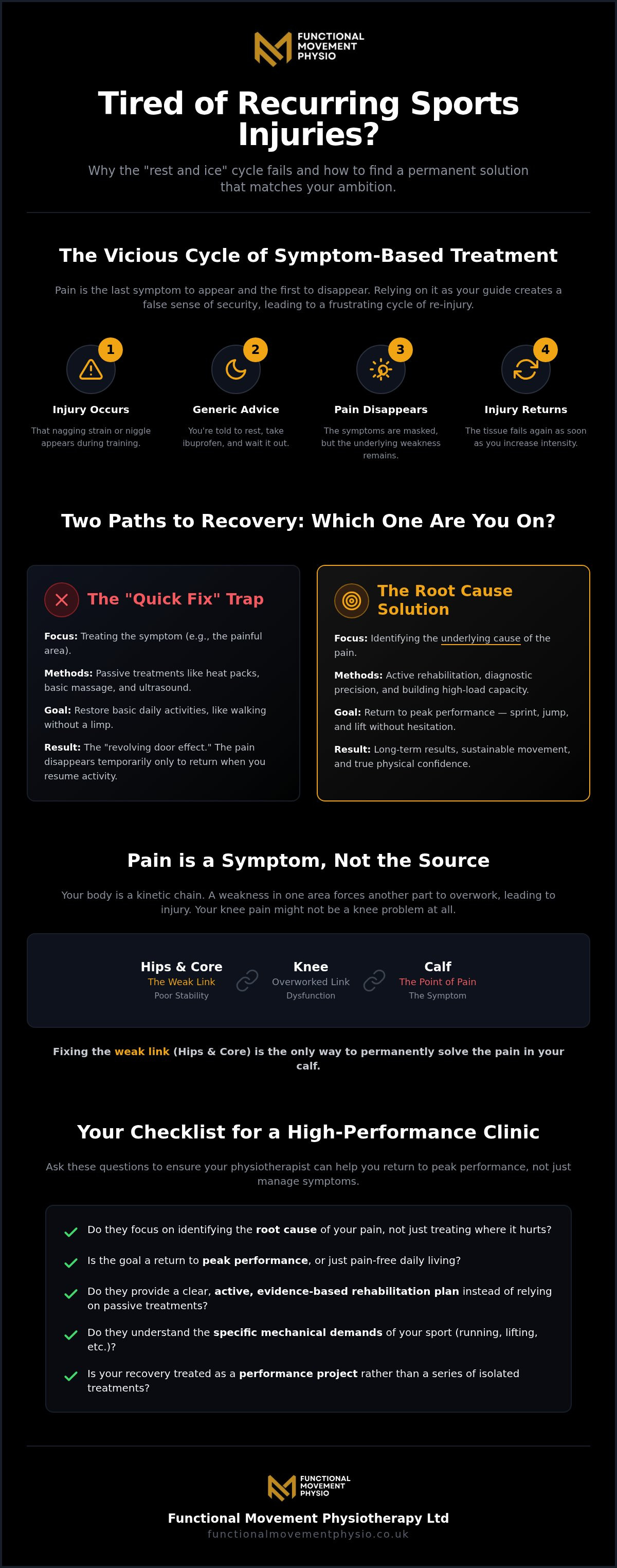
Choosing a clinic based solely on convenience can lead to a frustrating cycle of injury. Many traditional clinics rely on passive treatments like heat packs or basic massage. While these might feel good in the moment, they rarely fix the underlying issue. This often leads to the revolving door effect where your pain disappears for a few days only to return during your next heavy session. You deserve a partner in your performance who is committed to breaking this cycle.
A modern sports injury clinic Liverpool city centre should offer more than just a treatment table. It should provide a clear, evidence-based roadmap for your recovery. This involves moving beyond the "rub and crack" model and into active rehabilitation. By identifying the root cause of your dysfunction, we help you master your own physical capabilities. This transition from physical limitation to peak performance is only possible when your therapist acts as a coach and mentor, valuing your long-term wellness over temporary fixes.
The Problem: Why Quick Fixes and Symptom-Based Treatments Fail
If you have ever visited a GP for a running injury only to be told to rest and take ibuprofen, you know how dismissive that feels. This advice treats your body like a machine that just needs to be turned off and on again. It fails to address why your Achilles tendon or lower back reached its breaking point in the first place. When looking for a sports injury clinic Liverpool city centre, you need more than just a temporary reprieve from discomfort.
Masking symptoms with medication or total inactivity creates a false sense of security. Pain is often the last symptom to appear and the first to disappear. Relying on it as your only guide means you might return to training while the underlying structural weakness remains. This is why tissues fail again the moment you hit your previous mileage or lifting weight. True rehabilitation requires a deeper look into the mechanics of movement rather than just waiting for the fire to go out.
The Trap of the Passive Treatment Cycle
Passive treatments like heat packs, ultrasound, or basic sports massage certainly have their place in reducing immediate tension. However, they are often used as a crutch. These methods feel excellent during the session, but they do not build tissue resilience or improve your load tolerance. For weightlifters, relying solely on passive care can mask poor technique habits, leading to more significant issues during heavy compounds. While the NHS provides a good overview of what is physiotherapy, a specialist clinic must go further by integrating active loading into every stage of recovery.
Why Generic Exercise Sheets Do Not Work for Athletes
Many athletes fall into the trap of following generic, one-size-fits-all rehab protocols found on social media or handed out in busy clinics. These sheets ignore your unique compensations and the specific biomechanics of your sport. Your body is a master of adaptation; if your glutes aren't firing, your hamstrings will take the load. A generic hamstring stretch won't fix a glute stability problem. Finding a sports injury clinic Liverpool city centre that understands these nuances is critical for long-term health.
You need a bespoke plan that identifies your specific weak links to ensure sustainable progress. If you are tired of the cycle of recurring injuries, it may be time to schedule a thorough assessment to find out exactly what is holding you back.
The Root Cause Approach: What to Look for in a Specialist Clinic
Identifying the best sports injury clinic Liverpool city centre requires looking for a specific philosophy. We believe in fixing the engine, not just the warning light. If your knee pain is actually caused by a lack of hip control or poor ankle mobility, treating the knee alone will never provide a permanent solution. This is why a comprehensive initial consultation is non-negotiable. It must last long enough to assess your history, goals, and movement patterns in detail. A twenty-minute appointment is simply not enough time to perform a thorough biomechanical screen.
When evaluating your options, you should always verify credentials. You can Find a Chartered Physiotherapist to ensure you are receiving care from a regulated professional who adheres to high clinical standards. A true specialist acts as a mentor, guiding you through the transition from physical limitation to peak performance by using objective data to drive your recovery.
Biomechanical and Gait Analysis: Seeing the Unseen
The naked eye often misses the subtle compensations that lead to injury. Using gait analysis allows us to use video technology to identify energy leaks in your movement form. These leaks occur when force is dissipated through joints instead of being used to drive you forward. This level of precision is vital for runners in Liverpool who are struggling with recurring issues like shin splints or runners knee. Fixing your form is the only way to ensure the injury doesn't return the moment you increase your mileage.
Advanced Modalities: When to Look for Shockwave Therapy
For chronic issues that haven't responded to traditional methods, Shockwave Therapy is a vital tool. This technology uses acoustic pulses to stimulate a healing response in "stuck" injuries like Achilles tendonitis or plantar fasciitis. It essentially reboots the repair process in tissues that have become degenerative. Not every sports injury clinic Liverpool city centre invests in this high-level medical equipment, but for stubborn tendon pain, it is often the missing piece of the puzzle.
Clinical Pilates and Functional Strength
Rehabilitation shouldn't end when the pain stops. Clinical Pilates bridges the gap between basic recovery and high-level performance. It focuses on core stability and spinal control, which are the foundations of all athletic movement. By building a robust core, you protect your limbs during high-impact sports and heavy lifting. Strength is the ultimate insurance policy against future injury, and a specialist clinic will ensure you leave stronger than you were before the pain started.
Practical Steps: How to Evaluate Your Physiotherapist
Choosing a sports injury clinic Liverpool city centre shouldn't be a gamble. You are investing your time, money, and physical health into a professional partnership. To ensure you find a specialist who values long-term results over temporary relief, you must be prepared to ask direct questions. A high-quality clinic will welcome your curiosity because it demonstrates your commitment to the recovery process. You deserve a therapist who acts as a high-performance mentor, not just a service provider.
Before booking your first session, look for these markers of a performance-led practice on their website or during a phone enquiry:
- Transparent pricing structures that encourage commitment to a full recovery phase.
- A clear emphasis on active rehabilitation and movement correction rather than just passive manual therapy.
- Evidence of specialized equipment like video gait analysis or shockwave therapy.
- Consistent social proof from other athletes or active individuals in the local area.
Ask About the Assessment Process
The initial consultation is the most important part of your journey. You should ask if the clinic offers a full hour for this first meeting. If the assessment is rushed, the therapist is likely only looking at where it hurts right now. You want a specialist who observes how you move through various planes of motion to find the underlying cause of your tissue failure. They should provide you with a written rehabilitation roadmap that details exactly how you will progress from pain management to full strength. If they cannot explain why your injury happened, they cannot guarantee it won't happen again.
Verify Specialist Experience in Your Sport
Every sport places unique demands on the human body. A footballer dealing with a recurring groin strain requires a vastly different rehabilitation strategy than a swimmer with shoulder impingement or a powerlifter with lower back pain. When you call a potential sports injury clinic Liverpool city centre, ask about their experience with your specific activity.
Do they understand the mechanics of a heavy squat or the specific gait cycle of a marathon runner? A specialist should be able to discuss the specific stresses of your gym routine or local sports club requirements. This tailored knowledge ensures that your rehab exercises aren't just generic movements, but purposeful drills designed to rebuild your sport-specific capacity and resilience. A good physio will help you master your own physical capabilities so you can train without fear.
Why Functional Movement Physiotherapy is Your Partner in Performance
Functional Movement Physiotherapy is built for the individual who views their body as a high-performance vehicle. We understand that for you, exercise isn't just a hobby; it's a foundation of health and identity. As a specialist sports injury clinic Liverpool city centre, we have spent years refining a methodology that moves beyond symptom management. Our focus is on unlocking your potential by restoring full, purposeful movement in daily life and competitive sport.
Every journey begins with a comprehensive Initial Consultation. This isn't a quick chat; it's a deep diagnostic process where we identify the specific movement dysfunctions holding you back. By integrating precise manual therapy with targeted sports massage and functional strength conditioning, we ensure that every intervention serves a greater purpose. We don't just want you to feel better; we want you to be better.
A Tailored Roadmap for Every Athlete
Your recovery plan is as unique as your gait. We don't believe in generic protocols because we know your body has its own set of compensations and strengths. Our approach is a collaborative partnership where we act as your high-performance mentor. We guide you through the initial phase of pain reduction, but we don't stop there. We stay in your corner through the strength-building phase and the final transition back to high-load activity.
This roadmap provides the structure and safety you need to push your limits. Whether you are recovering from surgery or managing a chronic niggle, we provide the evidence-based guidance to ensure your return is permanent. We prioritise long-term wellness over temporary fixes, ensuring you master your own physical capabilities along the way. The goal is always the restoration of full physical capacity so you can return to the gym, the pitch, or the track for good.
Modern Facilities in the Heart of Liverpool City Centre
Convenience should never come at the expense of clinical excellence. Located in the vibrant core of the city, our sports injury clinic Liverpool city centre offers a professional environment equipped with the tools necessary for modern rehabilitation. Our facilities are designed to mirror the high-performance settings of professional athletes, providing a space where you can focus entirely on your physical optimisation.
Choosing Functional Movement Physiotherapy means choosing a team that understands your drive. We know the fear of being sidelined and the frustration of slow progress. Our mission is to alleviate that anxiety through clinical authority and empathetic encouragement. You aren't just another patient on a list; you are an athlete seeking to reclaim your peak capacity. We are here to ensure you get there with quiet confidence and sustainable results.
Take the First Step Toward Peak Performance
You now have the framework to distinguish between a temporary fix and a permanent solution. Choosing a specialist sports injury clinic Liverpool city centre means finding a partner who prioritises your long-term movement over short-term symptom relief. By focusing on root cause analysis, you move beyond masking pain and begin the process of building true physical resilience through movement mastery.
Our team at Functional Movement Physiotherapy is dedicated to this high-performance mission. We provide expert runner’s assessment packages and advanced shockwave therapy to ensure every aspect of your mechanical function is fully optimised for your specific sport. Whether you are returning to the gym, the pitch, or the track, you deserve a bespoke plan that reflects your personal ambition and respects your body's potential for resilience.
It's time to stop managing your limitations and start mastering your capabilities. We look forward to helping you restore full, purposeful movement to your daily life and seeing you return to the activities you love with confidence.
Frequently Asked Questions
How many sessions will I need to see results?
Most patients notice a shift in symptoms within 1 to 3 sessions. However, resolving the root cause of an injury requires a structured approach. We typically work in phases, with Phase 1 focusing on pain management and Phase 2 on building tissue resilience and strength. A standard rehabilitation block often involves 4 to 6 sessions to ensure the underlying mechanical issues are corrected and to prevent the injury from returning during high-load activity.
Do I need a GP referral to visit a sports injury clinic in Liverpool?
You don't need a GP referral to visit our sports injury clinic Liverpool city centre. Direct access allows you to begin your recovery immediately without waiting for a doctor's appointment. This speed is vital for athletes who want to minimise downtime. While we often communicate with GPs or consultants regarding your progress, you are free to book your Initial Physiotherapy Consultation directly through our website to start your movement assessment process today.
What should I wear to my first sports physiotherapy appointment?
Please wear comfortable athletic clothing that allows for a full range of movement. For lower limb issues, shorts are essential so we can perform a thorough biomechanical assessment and gait analysis. For upper body or back issues, a vest or tank top is recommended. We need to see how your joints and muscles interact during specific drills. This ensures our evaluation is precise and focused on identifying the engine failure, not just the warning light.
Can sports massage fix my injury on its own?
Sports massage is an excellent tool for reducing immediate tension and managing symptoms, but it rarely fixes an injury on its own. It addresses the soft tissue tightness without correcting the movement dysfunction that caused the tightness. To achieve long term results, we integrate massage with active rehabilitation and strength conditioning. This ensures we are not just providing a temporary reprieve but are actually building the capacity your body needs for high-performance sport.
Is Shockwave Therapy painful and how many sessions are required?
Shockwave Therapy involves some moderate discomfort as it stimulates a healing response in chronic tissues, but it is generally well tolerated. Most patients describe a deep, pulsing sensation during the treatment. For chronic tendon issues like Achilles tendonitis, a course of 3 to 5 sessions is typically required. These are usually spaced one week apart to allow the tissue to regenerate. It is a highly effective modality for injuries that haven't responded to traditional care.
Do you work with health insurance providers for sports injuries?
We recommend checking directly with your provider to confirm your level of coverage for private physiotherapy services. Every insurance policy has specific requirements regarding clinician registration and claim procedures. While we focus on providing a high-performance mentorship model, we can provide the necessary receipts and clinical notes required for you to process a claim if your policy allows for reimbursement for Chartered Physiotherapy services. Always verify your specific policy details before starting treatment.
What is the difference between a sports therapist and a physiotherapist?
The primary difference lies in the breadth of training and legal regulation. Physiotherapists are regulated by the Health and Care Professions Council (HCPC) and are trained to treat a wide range of medical conditions across various systems. A sports therapist focuses specifically on musculoskeletal issues and sports-specific rehabilitation. When you visit a specialist sports injury clinic Liverpool city centre, you benefit from a physiotherapist's clinical authority combined with a modern focus on movement mastery and peak performance.
How soon can I return to the gym after a sports injury?
You can often return to the gym almost immediately, provided your routine is modified to protect the injured tissue. We don't believe in total rest unless it is clinically necessary. Instead, we help you find a safe zone of movement where you can maintain your fitness without aggravating the injury. Your therapist will provide a specific roadmap that outlines which exercises to prioritise and which to avoid as you transition back to full training capacity.
Article by
Stuart Goldfinch
HCPC PH112156
Specialist MSK Physiotherapist
Ex UK SAS Trainer
Graduate Sports Rehabilitator


