

You swing your legs out of bed, but the moment your feet hit the floor, a sharp, searing pain shoots through your heel. It's that familiar morning stiffness that makes the short walk to the kitchen feel like a struggle. If you've been searching for shockwave therapy for Achilles tendonitis Liverpool, you're likely frustrated by a cycle of pain that disappears during your run only to return twice as bad the next morning.
It's exhausting to be told to just rest it when you know that temporary inactivity hasn't solved the underlying issue. You want to move with confidence again, without the constant fear that your next sprint will lead to another setback. This guide will show you how shockwave therapy can reboot your body's stalled healing process and provide a sustainable path back to peak performance without recurring pain.
We'll move beyond simple symptom management to look at the mechanical root causes of your discomfort. You'll learn how this clinical intervention works as a biological catalyst, creating a vital window of opportunity to strengthen your tendon and restore your full, purposeful movement in daily life.
Key Takeaways
- Understand why complete rest often fails and how prolonged inactivity can lead to further tendon deconditioning.
- Discover how shockwave therapy for Achilles tendonitis Liverpool uses acoustic pressure waves to stimulate neovascularisation and restart your body's healing response.
- Learn to identify the mechanical root cause of your pain instead of relying on temporary quick fixes that only mask symptoms.
- Explore how to use the post-treatment relief window to follow a progressive roadmap of tendon strengthening and loading.
- Gain insights into why a structured, high-performance rehab plan is essential for achieving sustainable results and returning to the sports you love.
Why Your Achilles Pain Persists and How Shockwave Therapy in Liverpool Can Help
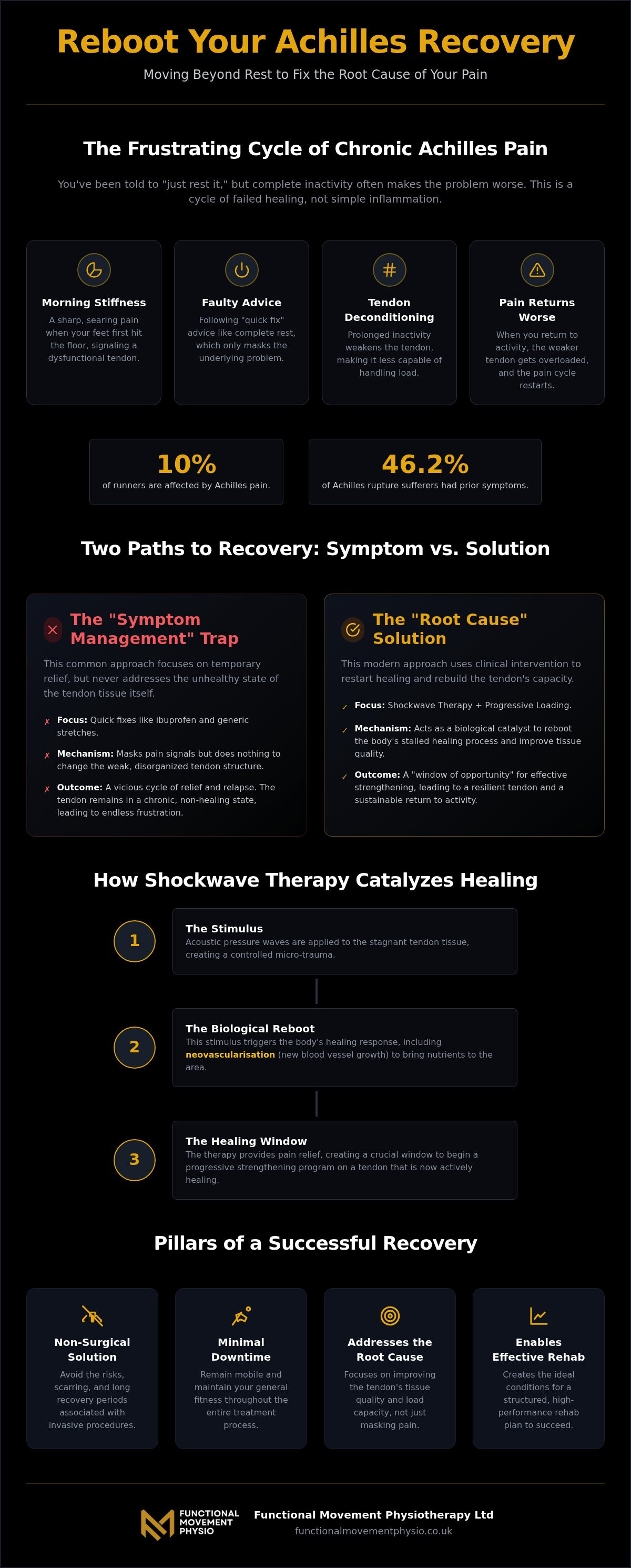
Achilles tendonitis often feels like a constant barrier between you and the activities you love. Whether you are a runner training for the Liverpool Marathon or someone who enjoys long walks along the Albert Dock, chronic pain can make every step feel like a chore. You have likely tried rest, ice, and generic stretches, yet the pain remains. This is where shockwave therapy for Achilles tendonitis Liverpool offers a different path. Data from the Journal of Orthopaedic & Sports Physical Therapy suggests that Achilles pain affects approximately 10% of runners, confirming that you are far from alone in this struggle.
Shockwave therapy is a catalyst that reboots the body's natural healing response in stagnant tissues. It isn't a passive treatment; it's an intervention designed to trigger biological change. What is Shockwave Therapy? Technically known as Extracorporeal Shockwave Therapy (ESWT), it is a non-invasive procedure that uses acoustic pressure waves to treat chronic tendon pain. It is particularly effective for those in Liverpool who have tried traditional methods without success.
Recognising the Signs of Chronic Achilles Tendinopathy
The symptoms of chronic Achilles issues are distinct and often debilitating. You might experience morning stiffness that feels like your heel is made of wood, requiring several minutes of hobbling before you can walk normally. Another common sign is pain that flares up after a run or a long walk in the city, often feeling twice as bad the next day. This pattern suggests the tendon isn't coping with the loads you are placing upon it.
Beyond the physical discomfort, there is a significant mental toll. Feeling 'stuck' in a cycle of injury where you make progress only to regress is exhausting. This frustration is a sign that your tendon has entered a chronic, non-healing state where the body has essentially given up on repairing the damage. It's a common hurdle for gym-goers and athletes who feel their progress has plateaued.
Why Liverpool Athletes are Turning to Shockwave Therapy
Athletes across Merseyside are increasingly choosing this intervention for several reasons. Speed of recovery is paramount. If you are part of a local running club or play competitive sports, you don't have months to wait for a tendon to settle on its own. You need a proactive solution that addresses the tissue quality directly.
- Minimal downtime: Unlike surgery, you can remain mobile throughout the treatment process and maintain your general fitness.
- Non-surgical: It avoids the risks, scarring, and long recovery periods associated with invasive procedures.
- Expertise: Access to specialist clinical expertise at Functional Movement Physio ensures the treatment is part of a wider, functional plan tailored to your specific movement patterns.
By choosing shockwave therapy for Achilles tendonitis Liverpool, you are opting for a method that focuses on long term results rather than just temporary relief. It provides the necessary stimulus to transform a degenerative tendon back into a healthy, load-bearing structure. This is the first step in moving from physical limitation to peak performance.
The Problem: Why Traditional Rest and Quick Fixes Fail Your Achilles
You've likely been told to "just rest it" for a few weeks. While this advice sounds logical, complete inactivity is often the worst thing for a chronic tendon. Achilles tendonitis is rarely a case of simple inflammation that just needs to calm down. Instead, it's frequently a state of failed healing. The tendon tissue has become disorganized and weak, losing its ability to act like a functional spring. When you search for shockwave therapy for Achilles tendonitis Liverpool, you're usually at a point where standard advice has already failed you.
Quick fixes like ibuprofen or generic calf stretches might offer a few hours of relief, but they only mask the symptoms. They don't change the structure of the tendon or improve its capacity to handle weight. A 2024 UK study found that 46.2% of participants who suffered an acute Achilles tendon rupture had experienced previous Achilles tendinopathy before their injury. This shows that ignoring a "grumbling" tendon or relying on temporary relief can lead to much more serious setbacks. We see many patients who have spent months in a frustrating stop-start cycle because their initial treatment didn't address the tissue quality.
The Myth of Total Rest for Tendon Injuries
Tendons require controlled loading to stay strong and resilient. When you stop moving entirely, the tendon deconditions. It becomes even less capable of handling the high-tensile stress required for running or jumping. Waiting for it to get better often leads to a longer recovery because you're essentially making the tendon weaker every day you stay on the sofa. To get back to peak performance, we have to move away from the idea that silence in the tendon equals healing.
The Frustration of the Recurring Injury Cycle
It's a familiar story: you rest for a fortnight, feel great during a light jog, and then wake up the next morning in agony. This cycle happens because the underlying mechanical issue was never addressed. Relying on temporary relief while the tissue remains poor is a recipe for long-term frustration and a loss of confidence in your body's capabilities. You start to fear the very activities that keep you healthy.
Traditional treatments often fail because they don't look at why the tendon was overloaded in the first place. Was it your gait? Was it a sudden spike in training volume? Without identifying these factors, even the most expensive treatments won't provide a permanent fix. If you're tired of the guesswork, an initial physiotherapy consultation can help pinpoint exactly where your movement patterns are failing you, allowing us to build a plan that actually lasts.
The Root Cause Approach: How Shockwave Therapy Reboots Your Healing
Shockwave therapy works by creating controlled micro-trauma in the chronic tissue to stimulate a new healing response. When a tendon has been in a state of failed healing for months, it becomes stagnant and lacks the necessary blood flow to repair itself. The acoustic pressure waves used in shockwave therapy for Achilles tendonitis Liverpool act as a biological wake-up call for these tissues. This process promotes neovascularisation, which is the growth of new blood vessels. Better blood flow means improved nutrient delivery to a tissue that is notoriously poor at healing on its own.
Our approach integrates this advanced technology with a deep dive into your unique movement patterns. We don't just look at the machine; we look at the person. We understand that the pain in your heel is often just the final link in a chain of mechanical issues. By using shockwave therapy as a catalyst, we create a window of reduced pain, allowing us to address the functional flaws that caused the injury in the first place.
The Science of Acoustic Pressure Waves
These high-energy pulses are designed to break down calcification and disorganized scar tissue that may have formed during your months of frustration. During the treatment, the waves also influence substance P, a neurotransmitter involved in pain signaling. By modulating this, shockwave therapy can significantly reduce pain sensitivity. This makes it easier for you to begin the essential strengthening exercises required for long-term recovery.
This evidence-based method is supported by NICE guidelines for chronic tendinopathy. While the research continues to evolve, clinical experience shows that ESWT is a powerful adjunct when traditional physiotherapy has plateaued. It provides the necessary stimulus to transform a degenerative tendon back into a healthy, load-bearing structure, moving you closer to your goal of purposeful movement.
Identifying Your Biomechanical Load Drivers
The machine is only one part of the solution. We look beyond the heel to find the root cause, such as hip instability or poor gait analysis results. If your hips aren't providing enough power, your Achilles is often forced to compensate. This excessive demand leads to the very overload that caused your pain. We use specialist assessments to see exactly how you move and where your efficiency is breaking down.
Stiff ankles or weakness in the deeper calf muscles are also common drivers of Achilles issues. Without a personalised assessment before starting any therapy, you are simply treating the symptom rather than the source. By identifying these load drivers, we ensure your path back to running is built on a foundation of resilient, optimized movement. This holistic perspective is what separates a temporary fix from a sustainable recovery.
Actionable Advice: A Progressive Roadmap to Lasting Achilles Recovery
Shockwave therapy for Achilles tendonitis Liverpool provides a unique window of opportunity. While the acoustic waves stimulate tissue repair and reduce pain sensitivity, they don't make the tendon stronger on their own. You must use this period of reduced discomfort to reintroduce controlled stress to the tissue. Recovery is a journey of progressive loading, moving from simple static holds to high-speed dynamic movements that mimic the demands of your sport.
Consistency with your rehabilitation is what ensures your results are sustainable. We combine our clinical sessions with specific home exercises designed for your unique athletic goals. This isn't about generic stretches; it's about a structured plan that evolves as your tendon adapts. By following a clear roadmap, you can move away from the frustration of recurring pain and toward peak performance.
Phase One: Settling the Pain and Initial Loading
During this initial stage, we focus on settling your pain levels. We often use isometric holds, which involve contracting the calf muscle without moving the ankle joint. These exercises are highly effective at reducing tendon pain and starting to build initial tolerance in the tissue. You'll also need to manage your daily activity levels to avoid flare-ups that could stall your progress in these early weeks.
When you attend your first shockwave therapy session in Liverpool, we'll explain the sensation and how to monitor your response. Most patients feel an immediate change in tissue tension, which we immediately capitalise on with low-level loading drills. This phase is about calming the system down while keeping the muscle active.
Phase Two: Building Strength and Resilience
Once the initial morning stiffness has settled, we transition to isotonic exercises. This typically involves heel raises with added weight to challenge the tendon's capacity and improve its structural integrity. We don't just focus on the heel; we address the root cause weaknesses identified in your initial consultation, such as glute inactivity or poor ankle mobility that may be forcing the Achilles to overwork.
Monitoring your tendon's response is vital during this phase. We look for a stable pain response that settles within 24 hours of exercise. This ensures we are pushing the tissue enough to trigger adaptation without causing further irritation. It's a delicate balance that requires professional guidance to ensure you are progressing at the right pace for your specific injury state.
Phase Three: Return to Sport and Performance
The final stage involves preparing you for the high-tensile demands of running and sports. We introduce plyometric movements and running-specific drills that test the tendon's ability to store and release energy like a spring. This is where we ensure your movement patterns are efficient to prevent future injuries from occurring when you return to Sefton Park or the gym.
If you've struggled with other tendon issues, you might find our guide on Tennis Elbow Physio Treatment useful for understanding how similar principles apply to different parts of the body. Our goal is always the restoration of full, purposeful movement, ensuring you have the physical capacity to meet your lifestyle demands without fear of setback.
Start Your Recovery Journey at Functional Movement Physio Liverpool
Functional Movement Physio Liverpool provides more than just a treatment room. We offer a specialist environment designed for individuals who refuse to let physical limitations define their lifestyle. Our clinic is built on the belief that recovery is a partnership between the expert and the individual. We combine clinical authority with empathetic encouragement to guide you from a state of frustration back to peak performance.
When you choose us for shockwave therapy for Achilles tendonitis Liverpool, your recovery is managed by experts who understand the specific demands of running and court sports. We know that a runner tackling the paths of Sefton Park requires a different level of tendon resilience than a casual walker. Similarly, the explosive lateral movements of a padel court demand a tendon that can handle rapid storage and release of energy. We don't just treat the pain; we help you master your physical capabilities.
Why Choose Our Liverpool Clinic for Your Achilles?
Our approach is unique because we never use technology in isolation. You have access to advanced shockwave technology seamlessly integrated with sports physiotherapy. This ensures that while the shockwaves are rebooting your tissue's healing response, we are simultaneously addressing the movement flaws that led to the injury in the first place.
We treat every individual like an athlete, regardless of your current level. Whether you are a competitive marathoner or someone looking to get back to the gym, you deserve a high-performance standard of care. Our personalised plans focus on long-term results and sustainable movement rather than temporary fixes that fail as soon as you increase your training volume. We aim to restore full, purposeful movement to your daily life.
Take the First Step Toward Pain-Free Movement
It's time to stop letting Achilles pain dictate what you can and cannot do. You've likely spent enough time waiting for the pain to disappear on its own, only to be disappointed when it returns. If you are interested in a broader perspective on recovery, you can read our guide on managing chronic pain without medication.
Your journey begins with an initial physiotherapy consultation. This is a comprehensive assessment where we identify the root cause of your pain using functional testing and movement analysis. We then build a bespoke roadmap that includes shockwave therapy as a powerful catalyst for your recovery. Our goal is to get you back to the activities you love with absolute confidence in your body's strength and resilience.
Restore Your Purposeful Movement
You don't have to accept a life of morning stiffness and restricted activity. By moving beyond temporary symptom management, you can address the mechanical drivers of your pain and build a body that is more resilient than before. Our Specialist Runner's Assessment ensures we don't just treat the site of your pain, but the movement flaws that created it. This expert root cause diagnosis is the foundation of everything we do.
Integrating shockwave therapy for Achilles tendonitis Liverpool into a structured, high-performance rehab plan is the most effective way to secure long term results. Our modern Liverpool clinic is designed to support you through every stage of this transition, from initial pain relief to peak athletic performance. It's time to stop second-guessing your recovery and start moving with absolute confidence again.
We are ready to help you unlock your physical potential and return to the sports you love. Your path back to peak performance starts with a single, professional step.
Frequently Asked Questions
How many sessions of shockwave therapy will I need for my Achilles?
Most patients require between 3 and 6 sessions to achieve lasting results. These are usually spaced 7 to 10 days apart to allow the tissue to respond to the stimulus. When you choose shockwave therapy for Achilles tendonitis Liverpool, we monitor your progress at each stage. This frequency ensures we are providing enough biological trigger to restart the healing process without overloading the tendon during its recovery phase.
Is shockwave therapy for Achilles tendonitis painful?
You will likely feel some discomfort during the procedure, but it shouldn't be unbearable. Most people describe it as a repetitive tapping or a deep ache. We always adjust the intensity of the acoustic waves to match your specific tolerance levels. It's common for the initial sensitivity to decrease as the session progresses, often leaving the area feeling significantly looser and less painful immediately after the treatment.
Can I continue running while receiving shockwave therapy in Liverpool?
You can usually continue some level of activity, but we will likely modify your training volume. Total rest is often counterproductive because tendons need controlled loading to stay strong. We use the relief provided by shockwave therapy for Achilles tendonitis Liverpool to keep you moving safely. This might mean shorter runs or lower intensity sessions while we focus on fixing the root cause of your injury through specific strengthening.
How soon will I see results after starting shockwave treatment?
Many patients feel a reduction in pain after just one session, but the true biological repair takes time. The growth of new blood vessels and the reorganisation of tendon tissue typically happen over 8 to 12 weeks. While the immediate pain relief is a great sign, it's vital to stay consistent with your loading exercises to ensure the structural changes in the tendon are permanent and sustainable.
Are there any side effects to shockwave therapy for tendons?
Side effects are generally mild and temporary, including slight bruising, swelling, or redness in the treated area. Some patients report a dull ache for 24 hours after the session, which is a normal sign that the body's inflammatory healing response has been triggered. Because the treatment is non-invasive, there's no downtime required, and you can return to your daily activities in the city immediately after leaving our clinic.
Is shockwave therapy better than steroid injections for Achilles pain?
Shockwave therapy is often a better choice for long-term recovery because it stimulates natural tissue repair. Steroid injections can provide rapid pain relief but may actually weaken the tendon structure over time, potentially increasing the risk of a rupture. Our approach focuses on improving the quality of the tissue and fixing movement flaws, providing a sustainable path back to sports rather than just masking the symptoms temporarily.
Do I need a GP referral to book shockwave therapy at your clinic?
You don't need a GP referral to start your treatment with us. As a private clinic, we offer direct access to our specialist services, including your initial physiotherapy consultation. During this first visit, we'll perform a thorough assessment to ensure that shockwave treatment is the most appropriate intervention for your specific condition. This direct path allows you to start your recovery journey without unnecessary delays or administrative hurdles.
What should I wear for my shockwave therapy session?
You should wear loose-fitting clothing that allows easy access to your lower leg and heel. Shorts are the best option, as they ensure we can apply the shockwave probe directly to the skin without obstruction. If you're coming straight from work, feel free to bring a change of clothes with you. Having clear access to the Achilles allows for a more precise and effective treatment during your clinical session.
Article by
Stuart Goldfinch
HCPC PH112156
Specialist MSK Physiotherapist
Ex UK SAS Trainer
Graduate Sports Rehabilitator


