

Most people believe that a visible six-pack is the ultimate sign of a healthy spine, but the truth is that aesthetic muscles often have very little to do with functional stability. With over 619 million people worldwide currently navigating low back pain, it's clear that traditional approaches aren't always hitting the mark. You might've spent weeks performing endless planks, only to find that building core strength to prevent back pain feels like a losing battle when your lower back still stiffens up after every gym session. It's frustrating to follow conflicting online advice only to feel more fragile than when you started.
We understand the fear that comes with a potential disc issue or the nagging worry that your favorite activities are now off-limits. This guide moves beyond the superficial to help you discover how a functional core acts as a sophisticated internal brace for your spine. You'll learn why common exercises often fail and how to implement sustainable, evidence-based movements that restore your confidence. We're going to explore the biomechanical root causes of your discomfort and provide a clear path toward returning to running and lifting without the constant shadow of recurring pain.
Key Takeaways
- Challenge the common myth that a visible six-pack is the same as a functional core that protects your spine.
- Explore the vital role of the deep abdominal muscles and diaphragm in building core strength to prevent back pain.
- Learn how to synchronize your breathing with movement to provide a stable foundation for every activity you perform.
- Discover a sustainable progression that allows you to return to the gym or running track with confidence and resilience.
The Frustration of Recurring Back Pain and the Core Strength Myth
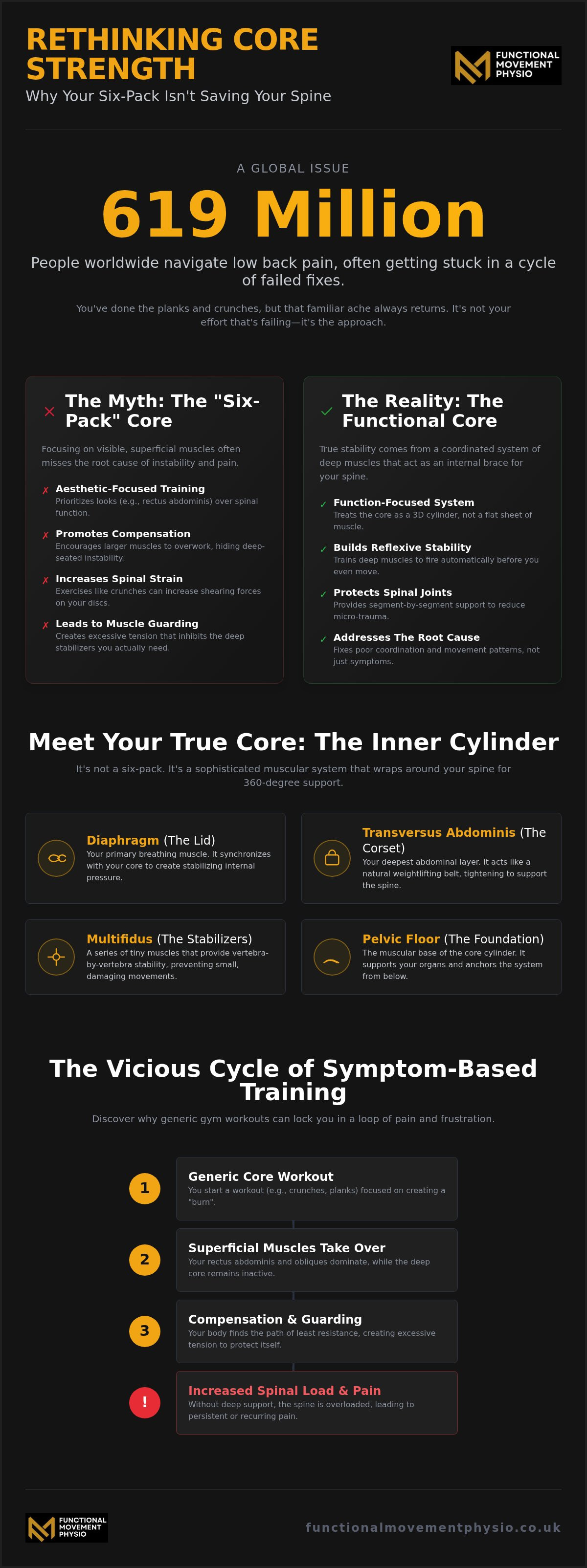
You have likely been told that a weak core is the sole reason for your back pain. It is a common refrain in gyms and clinical settings alike. You might have dedicated months to planks, crunches, and sit-ups, yet that familiar ache remains or returns the moment you increase your activity level. This disconnect exists because the standard approach to building core strength to prevent back pain often focuses on the wrong muscles and the wrong mechanical goals. If you are doing the work but not seeing the results, it's not because you aren't trying hard enough; it's because the "weakness" you've been told about is often a matter of poor coordination rather than a lack of muscle mass.
Quick fixes like heat patches, foam rolling, or generic gym routines provide temporary relief at best. They fail to address the long-term issue because they ignore your unique movement patterns. Your body is an expert at finding the path of least resistance. If your strategy for core stability relies solely on tensing your superficial abdominal muscles, you are likely missing the deeper layers that actually support your vertebrae. This article explains why your current approach might be missing the mark and how building core strength to prevent back pain requires a shift from superficial tension to deep, reflexive stability.
The Problem With Symptom-Based Training
Treating only the pain site ignores why the back is being overloaded in the first place. When you focus on "fixing" the area that hurts, you overlook the biomechanical triggers that cause the stress. Generic exercises often lead to compensation patterns where larger, more powerful muscles overwork to make up for deep-seated instability. If you feel your lower back "taking over" or straining during an ab workout, your core is not actually working. Instead of stabilizing the spine, you are inadvertently increasing the shearing forces on your discs. This cycle of overworking the wrong muscles is a primary reason why many people find their symptoms persist despite regular exercise.
Why Conflicting Advice Keeps You Stuck
Online influencers frequently promote high-intensity core movements that are often unsuitable for anyone dealing with recurring back issues. These "burn" focused workouts prioritize aesthetics over function. For many, this leads to muscle guarding, a state where the body creates excessive tension to protect itself. This guarding actually inhibits the deep stabilizers you need most. You don't need more intensity; you need a structured approach that prioritizes spinal safety. This is why many of our clients find that Clinical Pilates in Liverpool is the bridge they need to move from pain back to peak performance.
The Root Cause Approach: Deep Core vs Superficial Abs
True core stability isn't found on the surface. While gym culture often fixates on the rectus abdominis (the six-pack), a root cause approach focuses on the deep muscles that provide internal stability to your spine. Think of your core not as a flat set of muscles, but as a complex cylinder. This cylinder is capped by your diaphragm at the top and the pelvic floor at the bottom, with deep abdominal and back muscles wrapping around the middle. Building core strength to prevent back pain effectively requires you to address this entire system rather than just the parts you can see in the mirror.
The transversus abdominis is the body's natural weightlifting belt. When this muscle functions correctly, it provides a base level of tension that supports your internal organs and stabilizes your lumbar spine. Back pain often occurs when these deep stabilizers stop firing reflexively during daily tasks like reaching for a cupboard or lifting a shopping bag. If your body has lost the ability to pre-set these muscles before you move, your spinal joints are left vulnerable to micro-trauma, regardless of how many sit-ups you can do.
The Role of the Transversus Abdominis and Multifidus
The transversus abdominis (TvA) acts as a deep corset to support the lower back, providing essential tension that keeps the spine neutral under load. Working alongside it is the multifidus, a series of tiny muscles that provide segment-to-segment stability for each individual vertebra. When these deep muscles are asleep, your larger, global back muscles must overwork just to keep you upright. This leads to the chronic fatigue and stiffness you feel after a long day of sitting or standing because the wrong muscles are doing the heavy lifting.
How Clinical Pilates Targets the Root Cause
Clinical Pilates focuses on isolating these deep muscles through controlled, precise movements that bypass the overactive superficial layers. Research into Core strength training for chronic low back pain highlights that training these deep trunk muscles is significantly more effective for long-term relief than general exercise alone. By practicing specific patterns, you can retrain the brain-to-muscle connection that is often disrupted by chronic pain. If you're local to the area, our Clinical Pilates Liverpool sessions provide the expert guidance needed to master these techniques. If you're ready to stop guessing and start moving with precision, you can book an assessment with us today.
How to Build Core Strength to Prevent Back Pain
Building core strength to prevent back pain requires a disciplined progression from isolation to integrated movement. You cannot expect your body to stabilize during a heavy squat if it cannot maintain control during a simple floor exercise. The goal is to move from conscious activation to reflexive stability, where your core protects you without you having to think about it. This process prioritizes consistency over intensity. Retraining the neuro-muscular pathways that have been disrupted by pain takes time, but it's the only way to achieve lasting results.
One of the most critical components of this journey is learning to breathe and stabilize simultaneously. Many people instinctively hold their breath when they try to "engage their core," which actually increases internal pressure in a way that can stress the spinal discs. Instead, you must learn to maintain a light, supportive tension while the diaphragm moves freely. This coordinated effort between the breath and the deep stabilizers creates a functional cylinder of support that remains active during every movement you make.
Step 1: Master the Pelvic Tilt and Transverse Activation
Lie on your back with your knees bent and feet flat on the floor. Focus on gently drawing your belly button toward your spine without tensing your neck or shoulders. This isn't a forceful suck-in; it's a subtle activation of the transversus abdominis. Ensure you can maintain this light tension while breathing normally. This foundational step ensures you aren't relying on breath-holding to create stability. If you feel your back arching or your ribs flaring, you've lost the connection. Reset and try again with less force.
Step 2: Progressing to the Dead Bug and Bird-Dog
Once you've mastered the basic activation, move to the Dead Bug. This exercise teaches you to move your limbs while keeping your spine neutral. The key is to keep your lower back in contact with the floor as you lower an opposite arm and leg. Next, the Bird-Dog builds endurance in the multifidus and glutes. Unlike generic gym advice that often leads to arching the lower back during these moves, focus on slow, controlled movements. Quality of movement is far more important than the number of repetitions you complete.
Step 3: Integrating Core Strength Into Daily Life
The final step is taking these skills into the real world. You must learn to engage your core when lifting shopping bags, getting out of a chair, or picking up a child. This transition from "exercise" to "movement" is the key to long-term prevention. It turns every daily task into a mini-rehab session. For those who want a more tailored approach, you can read more about Clinical Pilates for back pain in Liverpool to see how we help clients bridge the gap between clinical rehab and peak performance.
Why Generic Gym Workouts Often Worsen Back Pain
It is a common sight in local gyms: someone struggling with a stiff back decides to "strengthen" it by performing high-rep sit-ups or heavy squats. You might think that more intensity is the answer, but if your deep stabilizers aren't engaged, those heavy loads are transferred directly to your spinal discs. Building core strength to prevent back pain is not about the quantity of repetitions; it is about the quality of the recruitment. Traditional sit-ups can increase intradiscal pressure by up to 30 percent, which is often enough to turn a minor irritation into a significant injury.
Without a professional assessment, it is nearly impossible to tell if your technique is protecting your spine or actually causing damage. Your body is incredibly efficient at finding workarounds. If your deep core is not firing, your hip flexors and lower back muscles will jump in to do the work. This creates a cycle where you feel like you are training your core, but you are actually just reinforcing the movement patterns that caused your pain in the first place. Breaking this cycle requires a move away from the "no pain, no gain" mentality toward a more sophisticated approach.
The Danger of Excessive Spinal Flexion
Repeatedly crunching the spine can irritate disc bulges and nerve roots by placing them under constant compression. For most people with recurring pain, the goal should be stability rather than excessive mobility in the lumbar region. This means focusing on "anti-rotation" and "anti-extension" exercises, which train your muscles to resist unwanted movement and keep the spine neutral. If you are unsure if your current routine is helping or hurting, our physiotherapy Liverpool experts can provide a full biomechanical screen to correct your form.
Common Mistakes in Planking and Bracing
The plank is often hailed as a gold standard, but it is frequently performed with poor mechanics that stress the lower back. If you arch your spine or let your hips sag toward the floor, the load shifts from your abdominals to your spinal joints. Similarly, over-bracing, where you hold your breath and create excessive, rigid tension, can lead to increased abdominal pressure and even pelvic floor issues. A specialist can help you find the "sweet spot" where you have enough stability to protect your spine without creating the kind of tension that limits your natural movement.
Achieving Sustainable Results and Long Term Movement
The ultimate goal of building core strength to prevent back pain is the full resumption of the activities you love. Whether you are an injured runner wanting to hit the trails again or a gym-goer tired of lower back stiffness, the transition from physical limitation to peak performance requires a dedicated strategy. Sustainable progress is only possible when you move away from the temporary mindset of "fixing a problem" and embrace the goal of optimizing your total physical capacity. By focusing on how your body functions as a whole, you build a level of resilience that protects you far beyond the walls of a clinic.
Regular check-ups and professional guidance are essential components of this journey toward long-term wellness. These sessions allow us to catch subtle movement imbalances before they manifest as recurring pain. At Functional Movement Physiotherapy, we don't just treat your symptoms; we help you master your own physical capabilities. Our approach in Liverpool is built on the philosophy that movement is the foundation of health. When you understand the technical methodology behind your recovery, you become a proactive manager of your own physical health and performance.
The Importance of a Professional Assessment
Identifying the root cause of your discomfort is the only way to stop the cycle of recurring pain. Often, back pain is a secondary symptom of a biomechanical issue elsewhere in the body. For example, a specialist runner's assessment or a comprehensive Gait Analysis in Liverpool can reveal if your back pain actually starts with how your feet strike the ground. By conducting a thorough biomechanical screening, we can pinpoint these hidden triggers and ensure that your efforts in building core strength to prevent back pain are directed exactly where they are needed most.
Your Path to Pain-Free Performance
Your journey begins with a personalized plan that matches your current physical capacity. We prioritize the quality of your movement over the quantity of your repetitions to ensure that every exercise reinforces spinal safety. For many of our clients, Clinical Pilates 1:1 serves as the gold standard for this type of core rehabilitation, providing the precision needed to restore full function. This structured, step-by-step progression creates a sense of safety and confidence as you return to higher-intensity activities without the fear of a setback.
If you are ready to move beyond symptom management and achieve sustainable results, the first step is a professional evaluation to uncover the underlying causes of your condition. Book your Initial Physiotherapy Consultation to find the root cause of your back pain today.
Take Control of Your Spinal Health and Performance
Building core strength to prevent back pain is a journey of retraining your body's natural stability rather than simply chasing aesthetic results. You now understand that a functional core involves a deep system of stabilizers, including the transversus abdominis and pelvic floor, working in harmony to protect your spine. By moving away from generic gym routines and focusing on precise, integrated movements, you can stop the cycle of recurring stiffness and return to the activities you love with complete confidence.
Our Liverpool city centre clinic specializes in identifying the biomechanical root causes that keep you feeling stuck or fragile. Through root cause focused physiotherapy and specialist Clinical Pilates sessions, we help you transition from physical limitation to peak performance. You don't have to navigate this process alone or settle for temporary relief that fails to last. We are here to help you master your own physical capabilities and build a body that is resilient and pain-free for the long term.
Take the first step toward lasting recovery and reclaim your active lifestyle with professional guidance tailored to your unique movement patterns.
Frequently Asked Questions
Is a plank good for lower back pain?
A plank can be beneficial, but only if you perform it with correct mechanics that avoid shifting the load to your spine. Many people inadvertently sag their hips or arch their backs, which irritates the lumbar joints. If you cannot maintain a neutral pelvis, the plank becomes a back-straining exercise rather than a stability-building one. A professional assessment ensures you're actually using your deep stabilizers instead of hanging on your ligaments.
How long does it take to build core strength for back support?
You will often feel improvements in coordination and spinal "connectedness" within two to four weeks of consistent, targeted training. However, building significant muscle endurance and structural changes typically takes eight to twelve weeks of progressive work. The timeline for building core strength to prevent back pain depends on your starting point and consistency. It's about retraining the brain-to-muscle connection first, followed by physical conditioning that supports long-term health.
Can I do core exercises if I have a disc bulge?
Yes, and it is usually a vital part of recovery, provided the exercises avoid excessive spinal flexion or high-impact loads. Most disc issues respond well to "anti-extension" and "anti-rotation" moves that keep the spine in a neutral, safe position. It is essential to have a clinical evaluation first to determine which specific movements are safe for your unique injury. This ensures your rehab doesn't inadvertently worsen any nerve irritation.
Why does my back hurt more after doing sit-ups?
Sit-ups significantly increase intradiscal pressure and often force the hip flexors to overwork, which pulls directly on the lumbar spine. If your deep stabilizers aren't firing correctly, the repetitive bending motion of a sit-up can irritate the spinal joints and nerves. This is a classic example of a "core" exercise that actually bypasses the muscles you need for stability while placing unnecessary stress on the sensitive structures of your lower back.
What is the best exercise for deep core stability?
There is no single "best" exercise for everyone, but the Dead Bug is widely considered the gold standard for isolating the transversus abdominis. It allows you to practice limb movement while keeping your spine perfectly still and supported by the floor. This teaches your brain how to stabilize the trunk before you move into more complex, upright activities. Clinical Pilates often uses variations of this move to build deep, reflexive stability.
Do I need a gym membership to build a strong core?
You don't need a gym membership or expensive equipment to develop a functional core. Most foundational stabilization exercises, like the Bird-Dog or pelvic tilts, use your own body weight and can be done comfortably at home. The key isn't the environment or the machines; it's the precision of your movement and the consistency of your practice. A professional guide can show you how to optimize your home routine for maximum results.
How often should I do core exercises to prevent back pain?
Consistency is more important than intensity, so aim for short sessions of ten to fifteen minutes three to five times per week. This frequency helps keep the neural pathways "awake" and ensures your deep stabilizers are ready to fire during daily activities. Building core strength to prevent back pain isn't a one-off event; it's a habit of maintaining functional tension that protects your spine during everything from heavy lifting to prolonged sitting.
Can Clinical Pilates help with chronic sciatica?
Clinical Pilates is highly effective for chronic sciatica because it focuses on decompressing the spine and improving the space for the nerve roots. By strengthening the deep stabilizers, you reduce the shearing forces that often contribute to nerve irritation. Our specialist sessions in Liverpool are designed to identify the biomechanical root cause of your sciatica, ensuring that your exercise program provides lasting relief rather than further aggravating the sciatic nerve.
Article by
Stuart Goldfinch
HCPC PH112156
Specialist MSK Physiotherapist
Ex UK SAS Trainer
Graduate Sports Rehabilitator


