

What if the reason your knee pain won't go away is that the problem isn't actually in your knee? You have likely spent weeks resting, icing, and avoiding the stairs, yet that sharp ache returns the moment you try to run or squat. If you are searching for patellofemoral pain syndrome physio Liverpool, you are probably frustrated by conflicting online advice and the fear that this injury will permanently sideline your training. It's exhausting to feel like you're doing everything right while your progress remains stalled.
We understand how discouraging it is to feel held back by your own body when all you want is to stay active. You deserve a clear diagnosis that finally makes sense of your symptoms rather than another temporary fix. In this article, you'll discover why traditional treatments often fail and how a specialist root cause approach can resolve your pain for good. We'll explore the mechanics behind your discomfort and outline a path that keeps you moving during your recovery, ensuring you return to peak performance without restriction.
Key Takeaways
- Understand why your knee aches after sitting or climbing stairs by identifying the specific irritation between your kneecap and thigh bone.
- Discover why relying on knee sleeves and the myth of weak quads often fails to provide lasting relief for chronic discomfort.
- Learn how a specialist patellofemoral pain syndrome physio Liverpool approach identifies issues in your hips or feet that are actually causing your knee pain.
- Master the concept of relative loading so you can keep training and stay active without worsening your injury.
- Find out how a comprehensive initial assessment focuses on your long-term movement goals rather than just temporary symptom management.
Understanding Patellofemoral Pain Syndrome: The Problem
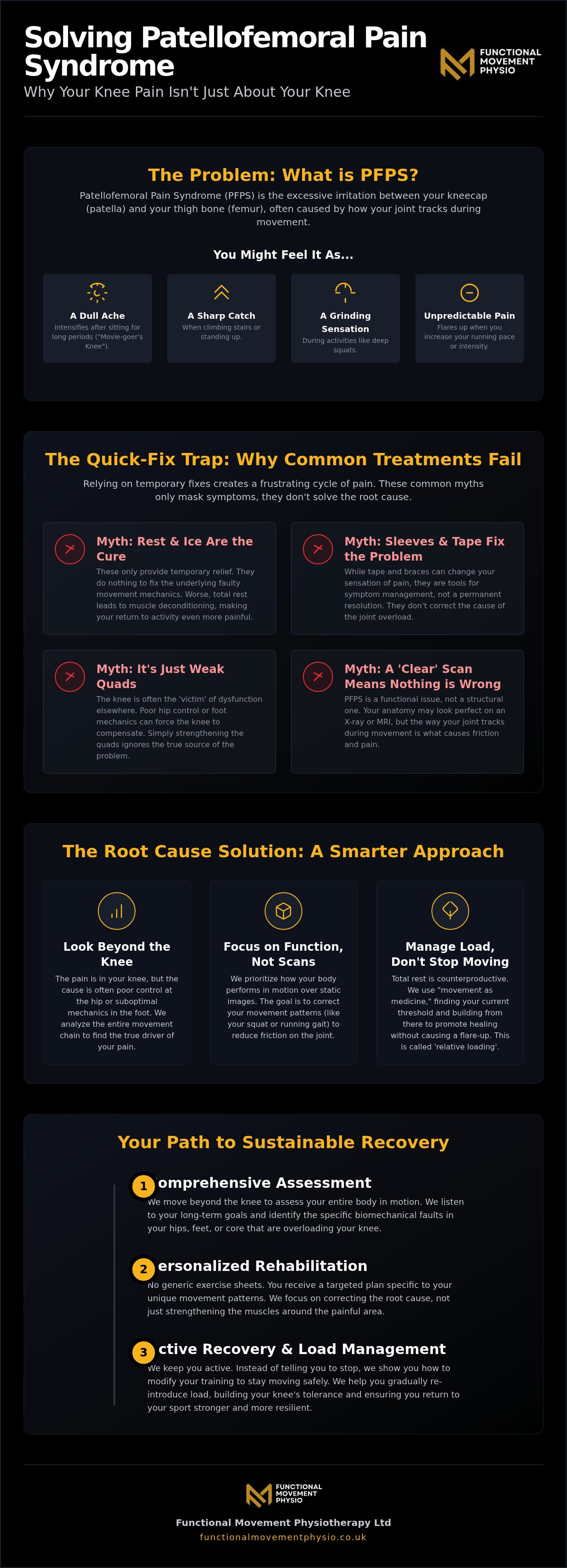
Your knee pain isn't just an inconvenience; it's a barrier to the lifestyle you've built. Whether you are tackling a weekend run through Sefton Park or preparing for a Hyrox event at one of our local Liverpool gyms, that nagging ache behind the kneecap is a signal that something is wrong. This condition, medically known as Patellofemoral Pain Syndrome (PFPS), occurs when there is excessive irritation between the back of your kneecap and your thigh bone.
Many people describe it as 'movie-goer’s knee' because the dull ache intensifies after sitting for long periods. You might also feel a sharp catch when climbing stairs or a grinding sensation during a heavy squat. For those seeking patellofemoral pain syndrome physio Liverpool, the frustration often stems from the unpredictable nature of the pain. It might vanish during a walk only to flare up the moment you pick up the pace on your favorite running route along the Mersey.
Why quick fixes and symptom masking fail
When the pain starts, the natural instinct is to reach for an ice pack or a bottle of ibuprofen. While these might dampen the immediate irritation, they do nothing to address why the joint is being overloaded in the first place. Masking the sensation doesn't fix the mechanics. Similarly, generic 'knee strengthening' printouts from standard clinics often fail because they treat every knee the same. If your issue is actually coming from your hip or foot, doing endless leg extensions won't help. The common 'rest and wait' advice is equally flawed for active people; it often leads to muscle deconditioning, making the eventual return to sport even more painful.
The frustration of the 'no-diagnosis' diagnosis
It is incredibly common for patients in Liverpool to arrive at our clinic after being told their X-rays or MRIs are completely clear. This 'no-diagnosis' diagnosis is confusing when you can clearly feel the pain. The reality is that PFPS is rarely a structural problem where something is 'broken' or 'torn'. Instead, it is a functional issue. Your anatomy might look perfect on a scan, but the way your joint tracks during movement is causing the friction. To find a lasting resolution, we must look at movement-based answers rather than waiting for a surgical fix that isn't necessary. Finding a specialist patellofemoral pain syndrome physio Liverpool means shifting the focus from the image on a screen to the way your body performs in motion.
The Quick Fix Trap: Why Your Knee Pain Keeps Coming Back
It’s a cycle many active people in Liverpool know all too well. You feel a twinge, you buy a knee sleeve from a local chemist, and you take a week off. The pain settles, you head back to the gym, and within twenty minutes of your first session, the ache is back. This is the quick fix trap. While accessories like tape or compression sleeves can alter the sensation of pain, they rarely change the underlying mechanics causing the issue. They are tools for symptom management, not for a permanent resolution.
One of the most persistent myths in recovery is that 'weak quads' are the sole culprit. You might have been told to simply strengthen your thighs to fix the tracking of your kneecap. However, the knee is often the 'victim' of dysfunction occurring elsewhere in the chain. If your hip control is lacking or your foot mechanics are suboptimal, your knee is forced to compensate. Simply hammering the quads ignores the broader diagnosis and treatment for knee pain that looks at the body as a whole.
There is also a significant psychological toll when you are told to stop doing what you love. Being told to 'just stop running' isn't a solution; it's a sentence. It breeds anxiety and a fear of movement that can be more paralyzing than the physical irritation itself. We believe in keeping you active while we work, ensuring your identity as an athlete remains intact throughout the process.
The myth of total rest
Total rest is rarely the answer for patellofemoral pain syndrome physio Liverpool. When you stop moving entirely, your muscles begin to decondition and your joints lose their tolerance for load. This is why the pain returns the moment you resume training. Instead of complete cessation, we advocate for movement as medicine. By applying the right amount of stress to the tissues, we can promote healing without causing a flare up. It's about finding your current threshold and building from there.
Why generic exercises miss the mark
Standard exercise sheets featuring wall sits or leg extensions often fail because they aren't specific to your unique biomechanics. A wall sit might even aggravate your symptoms if the joint angles aren't managed correctly. Every runner has a different gait, and every lifter has a different squat pattern. Effective rehabilitation requires a bespoke plan from a specialist physiotherapist liverpool who understands these nuances. If you are tired of the cycle of temporary relief, it might be time to discuss a long term plan that actually addresses your root cause.
The Root Cause Approach: Looking Beyond the Knee Joint
To achieve a long term resolution, we must look beyond where it hurts. Think of your knee as the middle child of your lower limb. It is caught between the hip and the foot, and it is often forced to compensate for their shortcomings. If your hip lacks stability or your foot doesn't absorb impact correctly, the knee joint inevitably absorbs the excess stress. This is why a specialist gait analysis liverpool is so effective; it allows us to see these compensations as they happen in real time.
When you seek patellofemoral pain syndrome physio Liverpool, our goal is to identify which of these 'neighbors' is causing the trouble. Research into physical therapy for patellofemoral pain consistently shows that strengthening the hip and ankle is just as important as treating the knee itself. By evaluating your entire movement chain, we move past the surface level symptoms to fix the mechanics that are actually driving your discomfort.
Hip stability and pelvic control
Your gluteus medius is a primary stabilizer of the hip. If this muscle is weak, your pelvis may drop or your thigh bone may rotate inward during a run or a heavy squat. This movement, known as valgus collapse, puts immense pressure on the underside of the kneecap. Addressing these imbalances is a core part of your recovery. We often use similar principles to those found in Gluteal Tendinopathy Exercises Liverpool to restore functional control and ensure your pelvis remains level under load.
Foot mechanics and loading strategies
Your feet are your foundation. If you have stiff ankles or excessive overpronation, your kneecap cannot track smoothly in its groove. Your choice of footwear and your specific running style also play a role in how much force travels through your joints. A 'heavy' foot strike or overstriding significantly increases the force your knee must manage with every step. Our Runner's Assessment is designed to pinpoint these specific loading issues. By identifying whether you are overstriding or lacking ankle mobility, we can adjust your technique to reduce strain and help you return to the activities you love.
Actionable Advice: Sustainable Steps for Long-Term Progress
Recovery doesn't have to mean a complete stop. In fact, total rest often does more harm than good for your long term progress. We use a strategy called relative loading. This approach allows you to stay active by adjusting the volume or intensity of your training so it stays within your knee's current tolerance. If you are looking for patellofemoral pain syndrome physio Liverpool, you need a plan that keeps you in the gym or on the track while we fix the underlying mechanics.
One of the most effective ways to reduce knee stress during a run is to increase your cadence. By taking shorter, more frequent steps, you decrease the vertical impact and the shear force on your kneecap. Try increasing your steps per minute by 5% to 10%. You will likely notice that the 'heavy' feeling in your joints begins to lift almost immediately. This simple change can be the difference between a painful mile and a successful training session.
Managing your training load
You don't need to be pain-free to exercise, but you do need to be smart about it. We use the 24-hour rule to monitor your progress. It is acceptable to feel mild discomfort, perhaps a 3 out of 10, during your workout. The key is that this pain must return to its baseline level within 24 hours. If you are still aching the next morning, the load was too high. You don't need to quit; you just need to reduce the duration or speed of your next session until your joint adapts. Consistency is always more important than intensity during the early stages of rehab.
You can also manage pressure by making small adjustments to your environment. For runners, avoiding steep downhill sections can significantly lower the load on the patellofemoral joint. Gym athletes often find that switching from a traditional back squat to a split squat allows for better pelvic control without the usual flare-up. These modifications keep you moving while your tissues build the necessary resilience.
Foundational strength and stability
True resilience is built through purposeful, compound movements. While isolation exercises have a role, movements like split squats and glute bridges are non-negotiable for lasting knee health. These exercises teach your hips and knees to work in harmony, preventing the inward collapse that drives irritation. Focus on the quality of every repetition rather than the amount of weight on the bar. If you cannot control the movement, you aren't building the stability you need.
Many of our clients find that Clinical Pilates Liverpool is an excellent way to build this foundation. It emphasizes functional stability and precise control, ensuring your body is prepared for the demands of high-performance sport. By mastering these foundational patterns, you create a sustainable movement strategy that protects your knees for the long term.
Specialist PFPS Physiotherapy in Liverpool: Your Path Forward
You have likely spent months managing your symptoms with ice, rest, and generic advice found online. If you are searching for patellofemoral pain syndrome physio Liverpool, it's because you are ready to move beyond temporary relief. Our approach at Functional Movement Physio isn't about masking pain; it's about a dedicated partnership designed to restore your physical potential. We don't just treat the joint; we empower you to master your own movement patterns.
Your journey begins with an Initial Physiotherapy Consultation. This is a deep-dive into your injury history, your training load, and your specific lifestyle goals. We look at the whole picture to understand why your knee reached its breaking point. While we focus on long-term mechanical fixes, we may also integrate Shockwave Therapy or Medical Acupuncture to settle secondary soft tissue irritation and accelerate your progress.
What to expect from your specialist assessment
Our assessment process is rigorous and movement-centric. We use biomechanical testing and specific movement screening to see how your body handles load. Whether you are a Hyrox competitor training in a local Liverpool gym or a runner tackling the wind on the Otterspool Promenade, your plan must be specific to your environment. We don't use one-size-fits-all protocols. Instead, we build a tailored roadmap that addresses your unique compensations, from hip instability to ankle stiffness. This data-driven approach ensures that every exercise you perform is moving you closer to a pain-free return to sport.
We believe in a collaborative relationship. You aren't a passive recipient of treatment; you are an active athlete in recovery. We provide the expertise and the clinical tools, but we also give you the knowledge to manage your own health. This transparency builds the quiet confidence you need to push through the challenges of rehabilitation and achieve sustainable results.
Take the first step toward recovery
It's time to stop guessing and start fixing. The fear of worsening your injury often leads to avoidance, which only prolongs the cycle of pain. As a specialist Running Injury Clinic Liverpool, we have helped countless individuals transition from physical limitation to peak performance. We understand the specific demands of the Liverpool sporting community and what it takes to get back to the activities you love without the constant worry of a flare-up.
The ultimate goal is the restoration of full, purposeful movement in your daily life. Whether that's squatting without a second thought or finishing a marathon without knee pain, we are here to guide you. Don't let patellofemoral pain syndrome dictate what you can and cannot do. Take control of your recovery today and build a body that is resilient, capable, and ready for whatever challenge you set next.
Book your appointment now to start your journey back to full performance.
Restore Your Movement and Reclaim Your Performance
You've learned that persistent knee pain is rarely just a knee problem. By shifting your focus from temporary fixes to the root cause, you can finally break the cycle of rest and recurrence. Whether it's stabilizing your hips or refining your running gait, the goal is to build a body that is stronger than the demands you place on it. You deserve a recovery plan that respects your need to stay active.
Choosing specialist patellofemoral pain syndrome physio Liverpool means moving beyond generic advice toward a plan built on your unique biomechanics. As a specialist runner's injury clinic, we use expert biomechanical gait analysis to ensure you don't just feel better today, but stay active for years to come. Our focus remains on long-term results rather than masking symptoms with short-term fixes.
You don't have to accept physical limitations as your new normal. With the right partnership and a clear strategy, you can return to the training and activities you love with complete confidence. It's time to stop managing your pain and start mastering your movement.
Frequently Asked Questions
What does Patellofemoral Pain Syndrome feel like?
It typically feels like a dull, persistent ache located behind or around the kneecap. You will notice the discomfort intensifies during activities that load the joint, such as climbing stairs, squatting, or running on uneven surfaces. Many people also experience a sharp catch or a grinding sensation, often referred to as crepitus. If you feel stiffness after sitting for long periods, this is another classic sign that the joint is under excessive stress.
Can I continue running with Patellofemoral Pain Syndrome?
Yes, you can often continue running, provided you manage your training load carefully. Complete rest usually leads to muscle deconditioning, which makes the problem worse. We focus on relative loading, where you adjust your distance, speed, or terrain to keep pain levels manageable. By working with a specialist patellofemoral pain syndrome physio Liverpool, you can refine your gait and cadence to stay active while we address the underlying mechanical issues.
How long does it take to recover from PFPS with physiotherapy?
Recovery times vary based on how long you have had the pain and the complexity of your movement issues. Most individuals see significant functional improvement within 6 to 12 weeks of starting a structured, root-cause program. This timeline allows enough time for muscle adaptations in the hips and quads to take effect. Consistency with your prescribed movements is the biggest factor in achieving a long-term resolution and returning to high-performance training.
Do I need a knee brace for Patellofemoral Pain Syndrome?
You don't necessarily need a brace, as it often acts as a temporary symptom masker rather than a permanent fix. A brace can change the sensation of pain, which might help you through a specific event, but it does not address the hip weakness or foot mechanics causing the irritation. Our goal is to build your body's internal stability through targeted exercises and gait adjustments, eventually making external supports unnecessary for your training.
Will Patellofemoral Pain Syndrome go away on its own?
It is unlikely to resolve permanently without intervention because the pain is usually driven by a movement strategy problem. While the irritation might settle with rest, the ache almost always returns once you resume your normal activity levels. Without identifying whether the issue stems from poor pelvic control or stiff ankles, you remain stuck in a cycle of temporary relief. Addressing the root cause is the only way to ensure lasting recovery.
Is walking good for Patellofemoral Pain Syndrome?
Walking is generally an excellent low-impact activity that helps maintain joint health and blood flow. However, you should monitor how your knee reacts to hills or long distances, as these can increase the pressure behind the kneecap. If walking triggers an ache that lasts into the next day, you may need to reduce your volume temporarily. We use walking as a foundational movement to build tolerance before transitioning you back into more demanding activities.
What are the best exercises for Patellofemoral Pain Syndrome?
The most effective exercises focus on the neighbors of the knee: the hips and the feet. Strengthening the gluteus medius through movements like glute bridges helps prevent the knee from collapsing inward. Compound movements like split squats are also vital for building functional tolerance. By following a plan from a patellofemoral pain syndrome physio Liverpool, you ensure your exercises are tailored to your specific biomechanics rather than following a generic and often ineffective printout.
Can Patellofemoral Pain Syndrome cause permanent damage?
It rarely causes permanent structural damage to the joint, but leaving it untreated can lead to long-term changes in how you move. Chronic irritation can cause you to subconsciously avoid using certain muscles, leading to significant weakness and deconditioning. This makes you more susceptible to other injuries in the future. Addressing the functional issues early prevents these compensatory patterns from becoming permanent habits, allowing you to maintain your physical capacity and performance as you age.

Article by
Stuart Goldfinch
HCPC PH112156
Specialist MSK Physiotherapist
Ex UK SAS Trainer
Graduate Sports Rehabilitator


