

What if the rest you've been prescribed is actually making your tennis elbow worse? It is a common frustration for athletes and active individuals who find that "taking it easy" does little to resolve the sharp pain felt when gripping a kettlebell or racquet. If you are searching for effective tennis elbow physio treatment Liverpool options, you likely want more than a temporary pause in activity. You deserve a strategy that addresses why the tendon reached its limit rather than just masking the discomfort.
We understand the anxiety that comes with a recurring injury and the fear that it might stop you from playing sport permanently. While 81% of UK specialists now recommend physiotherapy as the primary treatment path, not all approaches are equal. This article explains why traditional quick fixes often fail and compares the evidence-based paths that target the root cause of your pain. You will gain a clear understanding of your injury and a realistic rehab plan designed to restore your physical capacity and get you back to peak performance with long-term resilience.
Key Takeaways
- Understand why tennis elbow is a failure of tendon load capacity rather than a simple inflammation issue.
- Discover how assessing your shoulder and wrist mobility identifies the true root cause of your persistent elbow pain.
- Compare the most effective options for tennis elbow physio treatment Liverpool to see why progressive loading outperforms traditional rest and ice.
- Learn how advanced tools like Shockwave Therapy provide a non-invasive solution for chronic cases that haven't responded to exercise alone.
- See how a personalized, sustainable rehab plan allows you to return to the gym or court with confidence and full physical capacity.
Persistent Elbow Pain: More Than Just a Sports Injury
You feel it every time you reach for a kettlebell or try to open a heavy door. That sharp, searing sensation on the outside of your elbow isn't just a minor annoyance. It's a sign that your body is struggling to keep up with the physical demands you're placing on it. While many people refer to this as "tennis elbow," the clinical reality is often more complex. To truly understand What is Tennis Elbow? is to recognise that it's rarely about simple inflammation. It is actually a failure of the tendon to manage load effectively.
You don't have to be a professional athlete to experience this. In Liverpool, we see this condition frequently in Padel players, weightlifters, and even office workers who spend their days at a keyboard. The repetitive strain on your forearm extensors leads to a breakdown in the tendon's structural integrity. When you seek tennis elbow physio treatment Liverpool, you need a provider who understands that your pain isn't isolated. It's a functional breakdown that often radiates down your forearm, turning simple tasks like turning a key—an essential action for local property maintenance experts like Key Qualities—or gripping a coffee mug into a painful challenge.
Recognising the Symptoms of Tendinopathy
The most common sign is a specific point of tenderness directly over the bony prominence on the outside of your elbow. This isn't a vague ache. It's a sharp, localized pain. You might experience morning stiffness that seems to ease off slightly as you move, only to return with a vengeance after a day of work or a session at the gym. A significant red flag is a sudden drop in grip strength. If you find your hand "giving way" when holding a racquet or a barbell, your tendon is signaling that it no longer has the capacity to support those forces.
Why 'Wait and See' is a Risky Strategy
The "wait and see" approach is perhaps the most common advice given, yet it's often the most damaging. Tendons are unique. Unlike muscles, they don't have a rich blood supply, which means they don't simply "heal" with total rest. In fact, complete inactivity often makes the tendon more sensitive and less capable of handling weight in the future. Ignoring these early warning signs can lead to chronic disorganisation of the tendon fibers. By choosing a proactive tennis elbow physio treatment Liverpool path early, you prevent the condition from becoming a permanent fixture in your life. Early intervention allows us to identify the root cause before the tendon structure undergoes long-term changes.
Comparing Treatment Strategies: Why Traditional Quick Fixes Often Fail
If you've spent weeks resting your arm or applying ice packs with no lasting change, you aren't alone. Many people seeking tennis elbow physio treatment Liverpool are initially given generic advice to simply "give it time." This passive approach is fundamentally flawed. Tendons are dynamic structures that require controlled stress to maintain their strength. When you stop using the arm entirely, the tendon becomes weaker and even less capable of handling the force required for your next gym session or match.
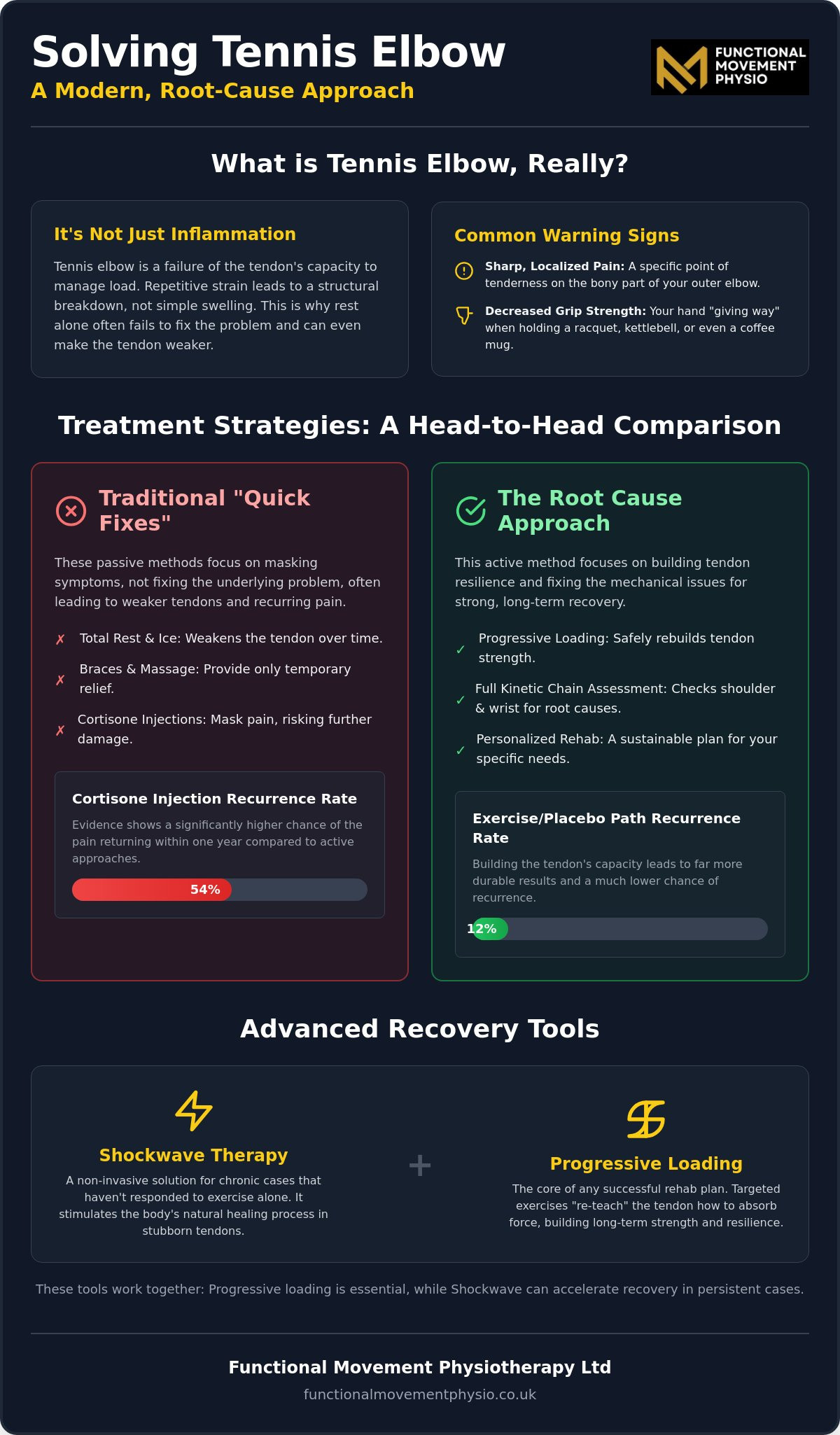
Cortisone injections are another common "quick fix" that often backfires. While they might provide immediate relief from sharp pain, they don't address the underlying tendon failure. In fact, evidence suggests that corticosteroid injections have a 54% recurrence rate at one year, which is significantly higher than the 12% seen in those who follow a placebo or exercise path. By temporarily masking the pain, you risk further damaging the tissue because you lack the sensory feedback to know when you're overdoing it. Comparing Treatment Strategies reveals that while medical interventions have their place, they rarely solve the mechanical issue at play.
Passive vs Active Recovery
It's easy to confuse feeling better with getting better. Passive treatments like sports massage or wearing a brace can reduce your immediate discomfort, but they don't build resilience. They are support acts, not the main event. Braces, for instance, might help you get through a workday, but they do nothing to fix the underlying weakness in the forearm extensors. Active recovery, on the other hand, involves progressive loading. This means we specifically "re-teach" your tendon how to absorb and distribute force through targeted exercises. While passive care provides a temporary window of relief, active loading is what builds the long-term health needed to return to high-performance activities.
The Problem with Symptom Chasing
Focusing solely on the site of the pain is like trying to fix a leaking pipe by only mopping the floor. You might clear up the mess for a day, but the water will keep coming. Symptom-based treatment fails because it ignores the mechanical overload that caused the injury in the first place. This creates a frustrating cycle of recovery and re-injury that can sideline you for months. To break this loop, you need a comprehensive assessment that looks beyond the elbow to find out why that specific joint reached its breaking point. Symptom chasing treats the effect while leaving the cause to fester.
If you're tired of temporary fixes and want a plan that actually sticks, exploring a professional tennis elbow physio treatment Liverpool plan is the first step toward sustainable movement.
The Root Cause Approach: Assessing Beyond the Elbow
Your elbow is often the victim of poor movement elsewhere in the body. When you experience pain on the outside of your arm, it's easy to assume the problem starts and ends at the joint. However, effective tennis elbow physio treatment Liverpool must look at the entire kinetic chain. We don't just treat the "what" (the pain site); we investigate the "why" (the mechanical failure). This holistic approach is essential because the lateral elbow tendons are frequently overloaded due to compensations for weaknesses in the shoulder or stiffness in the wrist.
Understanding the broader context of your movement is a core part of our philosophy. Much like the principles discussed in our post about finding the root cause of my running pain, we recognise that symptoms are rarely the actual problem. They are the distress signal. Functional movement patterns are the foundation of our tennis elbow physio treatment Liverpool, ensuring that your recovery is built on a solid mechanical base rather than just temporary symptom relief.
The Shoulder and Wrist Connection
Your shoulder acts as the foundation for all arm movements. If your rotator cuff muscles are weak or fatigued, they can't stabilise the upper arm effectively during high-velocity movements like a Padel serve or a heavy bench press. This instability forces the smaller muscles and tendons in your elbow to work significantly harder to maintain control. Over time, this extra demand leads to the micro-tears and structural changes associated with tendinopathy.
A comprehensive assessment identifies hidden contributors such as:
- Reduced thoracic (upper back) rotation which limits your reach.
- Rotator cuff weakness forcing the forearm to compensate.
- Poor grip mechanics during lifting or racquet sports.
- Limited wrist mobility that places extra strain on the lateral tendons.
If your wrist cannot extend or flex through its full range, your body will find that range elsewhere, usually by straining the tendons at the elbow. A comprehensive guide to tennis elbow treatment often highlights the importance of clinical assessment to distinguish between isolated joint issues and these kinetic chain dysfunctions.
Personalised Biomechanical Analysis
We take the time to analyse how you move during the activities that matter most to you. Whether you're a regular at the local Liverpool courts or a dedicated gym-goer, your specific form dictates the load on your joints. By observing your grip, your swing path, or your lifting technique, we can pinpoint specific biomechanical flaws. Correcting these patterns doesn't just reduce your current pain; it builds a foundation for sustainable, long-term performance. We don't want to just get you back to sport; we want to make you more resilient than you were before the injury occurred.
Advanced Recovery Tools: Comparing Shockwave Therapy and Loading
When you have been struggling with persistent pain for six months or longer, the standard "rest and ice" advice feels increasingly hollow. For these stubborn cases, a more sophisticated intervention is required. At our clinic, we often integrate Shockwave Therapy alongside traditional exercise to break through recovery plateaus. This technology is a game-changer for individuals who feel "stuck" in their rehab journey. It offers a non-invasive alternative to more drastic measures like surgery or repeated injections, which we know have high recurrence rates.
Extracorporeal Shockwave Therapy (ESWT) uses high-energy acoustic pulses that penetrate deep into the affected tendon. This isn't a simple vibration; it is a mechanical force that creates micro-trauma in the tissue. This controlled stimulus re-ignites the body's natural healing process in tendons that have become "stagnant" or chronic. It is an essential component of modern tennis elbow physio treatment Liverpool, particularly when the tendon structure has undergone significant changes that exercise alone cannot quickly reverse.
When to Choose Shockwave Therapy
Shockwave Therapy is ideal for patients who have tried traditional physiotherapy elsewhere without success. If your symptoms have persisted for more than three months, the tendon has likely entered a state of disrepair where the cells are no longer responding to light activity. Research indicates that for cases not responding to other treatments, shockwave therapy has an 89% success rate at 52 weeks. Much like our approach to shockwave therapy for Achilles tendonitis Liverpool, we use these pulses to stimulate blood flow and break down any calcifications that may be contributing to your discomfort.
Progressive Loading: The Foundation of Rehab
While advanced tools like ESWT are powerful, they are not a replacement for building strength. Progressive loading remains the "gold standard" for long-term health. We move you through a structured sequence, starting with isometric holds to reduce pain, before advancing to heavy slow resistance training. Progressive loading facilitates a process called mechanotransduction, where the tendon cells respond to physical stress by producing new collagen and realigning fibers to increase overall load capacity. This ensures your elbow doesn't just feel better today; it stays resilient during your next heavy lifting session or high-intensity match.
If you are ready to move beyond temporary relief and build a body that can handle the sports you love, book your Initial Physiotherapy Consultation today to see if you are a candidate for Shockwave Therapy as part of your tennis elbow physio treatment Liverpool plan.
Starting Your Sustainable Recovery Journey in Liverpool
Recovery from chronic tendon pain doesn't happen by accident. It requires a deliberate, evidence-based strategy that moves beyond managing symptoms to optimizing your physical capacity. If you've felt frustrated by conflicting advice or the fear that your injury will stop you from playing the sports you love, it's time for a different approach. Our tennis elbow physio treatment Liverpool is built on the philosophy that you are a partner in your own recovery. We aim to bridge the gap between physical limitation and peak performance, ensuring you return to the court or the gym with more than just a temporary fix.
Your journey starts with a comprehensive Initial Physiotherapy Consultation. This is a 45-minute session dedicated to understanding the unique biomechanical factors that led to your injury. We don't believe in generic exercise sheets or "one size fits all" solutions. Instead, we assess your entire movement profile to create a roadmap that is both realistic and sustainable. By the end of this first session, you won't just have a diagnosis; you'll have a clear understanding of the "why" behind your pain and a structured plan to fix it.
What to Expect at Your Initial Consultation
We begin with a detailed discussion of your injury history and specific sports goals. Whether you want to return to a competitive Padel league or simply want to lift weights without a sharp, burning sensation, your goals dictate our rehab focus. This is followed by a thorough physical assessment where we analyze:
- The load capacity and structural integrity of your lateral elbow tendons.
- Shoulder stability and rotator cuff strength to identify compensations.
- Wrist mobility and grip mechanics during functional movements.
- Upper back (thoracic) rotation and its impact on your arm's reach.
We also include your first treatment session during this initial visit. This ensures you begin the recovery process immediately, moving from the frustration of injury toward the achievement of sustainable results.
Booking Your Appointment
Our specialist clinic is conveniently located for those living and working in Liverpool, offering a modern environment designed for high-performance recovery. We understand that our clients lead busy lives, which is why we offer flexible appointment times to suit your schedule. You don't have to accept "wait and see" as a solution. It's time to master your own physical capabilities and achieve the restoration of full, purposeful movement in your daily life.
Take the first step toward a pain-free return to sport by booking your Initial Physiotherapy Consultation at book appointment. We are here to help you move beyond your current limitations and reach your physical potential.
Take Control of Your Recovery and Return to Performance
Tennis elbow is more than a localized ache; it is a signal that your body's load capacity has been exceeded. You now understand that while traditional rest often weakens the tendon, a structured path involving progressive loading and advanced tools like Shockwave Therapy offers a sustainable way out of chronic pain. Lasting relief comes from looking beyond the elbow to address the shoulder, wrist, and movement patterns that contribute to the initial overload.
When you choose the right tennis elbow physio treatment Liverpool, you're investing in a specialist root-cause approach led by an expert team focused on functional movement. We utilize evidence-based protocols and Advanced Shockwave Therapy to stimulate healing in persistent cases, ensuring you aren't just managing symptoms but building the resilience needed for high-performance sport and daily life.
Book your initial consultation at our Liverpool clinic today to receive a clear diagnosis and a personalized roadmap for your recovery. You don't have to stay stuck in a cycle of re-injury. Full, purposeful movement is within your reach, and we are ready to help you master your physical capabilities once again.
Frequently Asked Questions
How many physio sessions will I need for tennis elbow?
Most patients experience significant improvement within 8 to 12 weeks of a structured rehabilitation program. The exact number of sessions depends on how long you've had the pain and your specific return to sport goals. Our focus is on providing you with the tools and loading strategies to manage your recovery independently and sustainably.
Is shockwave therapy better than traditional physio for elbow pain?
Shockwave therapy isn't a replacement for physiotherapy but a powerful tool for chronic cases that haven't responded to exercise alone. For tendons that have been painful for over three months, it has an 89% success rate in triggering a new healing response. It works best when combined with a progressive loading program to build long-term tissue resilience.
Can I continue to play tennis or padel while receiving treatment?
You can usually continue to play if we modify your training volume and technique to stay within a safe "load window." Total rest is actually harmful for tendons as it leads to further weakness and deconditioning. We help you identify which movements are safe so you can maintain your fitness while your elbow heals.
Why does my tennis elbow keep coming back after I rest it?
Your pain likely recurs because rest doesn't fix the underlying weakness or the biomechanical root cause. When you seek tennis elbow physio treatment Liverpool at our clinic, we look at your shoulder and wrist function to see why the elbow is being overloaded. Without increasing the tendon's capacity to handle force, the pain will return the moment you resume sport.
What is the difference between tennis elbow and golfer's elbow?
The primary difference is the location of the pain and the tendons involved. Tennis elbow affects the outside of the joint, while golfer's elbow occurs on the inside. Both conditions are types of tendinopathy caused by repetitive strain, but they require specific, targeted loading exercises to ensure the correct muscle groups are strengthened.
Will I need an MRI scan before starting physio in Liverpool?
An MRI is rarely required because a clinical examination is usually sufficient to diagnose the issue and begin treatment. We use functional testing to assess your movement patterns and tendon health immediately. Scans are typically only considered if your symptoms don't improve after 6 to 12 months of consistent, evidence-based physiotherapy.
Are the exercises for tennis elbow painful to perform?
Some mild discomfort is often necessary to stimulate the tendon to adapt and grow stronger, a process called mechanotransduction. We use a specific pain monitoring scale to ensure you're working at an intensity that's effective but safe. You shouldn't experience sharp pain, and any dull ache should settle quickly after your session.
How do I book a specialist elbow assessment at your Liverpool clinic?
You can book an Initial Physiotherapy Consultation through our online booking system. This session includes a full biomechanical assessment of your arm and a clear roadmap for your recovery. We offer flexible appointment times to fit your schedule, allowing you to start your journey back to peak performance without delay.
Article by
Stuart Goldfinch
HCPC PH112156
Specialist MSK Physiotherapist
Ex UK SAS Trainer
Graduate Sports Rehabilitator


