

What if the very stretches you've been told will fix your sciatica are actually the reason your pain keeps coming back? You've likely felt those sharp, electric shock sensations shooting down your leg and worried that every gym session might result in a "slipped disc." As a sciatica specialist physio Liverpool, I see active individuals every day who are frustrated by conflicting advice and a fear of movement that keeps them sidelined from the activities they love.
I understand the anxiety that comes with nerve pain. It's time to move beyond temporary fixes and generic advice. This article will show you how a specialist root cause approach identifies the true source of your irritation, providing a sustainable path back to pain-free movement. We'll explore exactly why your nerve is reacting and how to address the underlying issues rather than just masking the symptoms.
By the end of this guide, you'll have a clear, step-by-step plan for long-term recovery. We'll bridge the gap between physical limitation and peak performance, ensuring you can return to the gym or the running track with total confidence. You'll gain the tools to master your own physical capabilities and achieve lasting results.
Key Takeaways
- Working with a sciatica specialist physio Liverpool ensures you receive a biomechanical assessment that looks beyond the leg pain to find the true source of nerve irritation.
- You will learn why generic stretches often make sciatica worse and why focusing on the root cause is the only way to achieve sustainable, long-term relief.
- Discover how improving hip mobility and core control can alleviate pressure on the sciatic nerve and restore your confidence in movement.
- Gain practical strategies to stay active and manage your symptoms during daily tasks, allowing you to return to the gym or running without fear.
- Understand how an Initial Physiotherapy Consultation provides the clear, step-by-step recovery plan you need to move from physical limitation back to peak performance.
Sciatica Specialist Physio Liverpool: Moving Beyond Nerve Pain
Sciatica is more than just a literal pain in the backside. It occurs when the sciatic nerve, the longest nerve in your body, becomes irritated or compressed. When you search for What is sciatica?, you often find clinical definitions that describe the sensation but miss the context of your daily life. For many active people in Liverpool, this irritation feels like a physical barrier between you and the gym. It is deeply frustrating to feel limited by your own body, especially when you are used to being high-performing and proactive with your health.
You might feel stuck in a cycle of resting for a few days, feeling a slight improvement, and then having the pain flare up the moment you try to return to your normal routine. This "stop-start" existence is exhausting. It creates a fear of movement that can make even simple tasks feel like a risk. Ultimately, sciatica is a symptom of an underlying mechanical issue that indicates something in your movement chain is not functioning as it should.
Why a Specialist Approach Matters
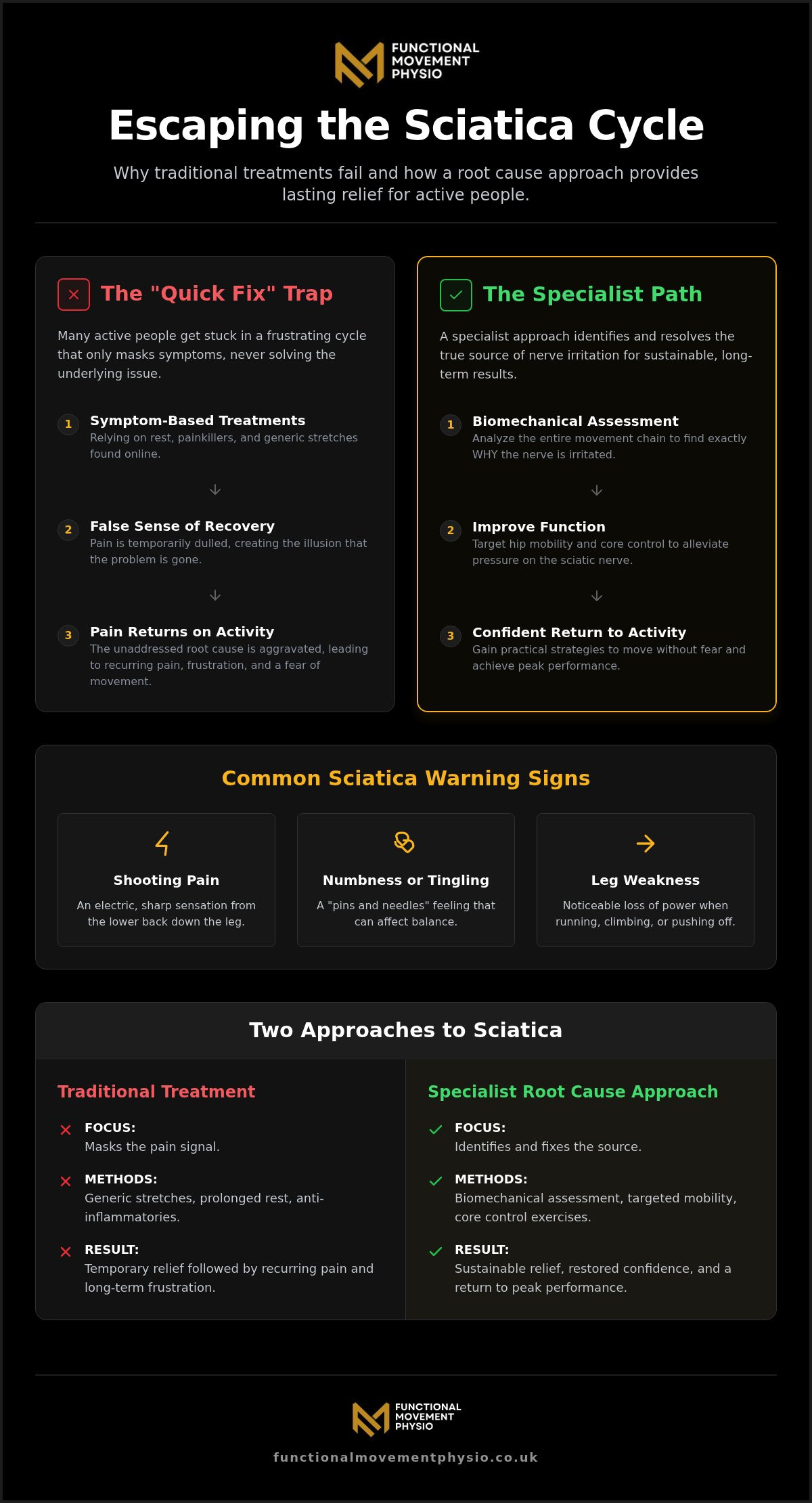
Generic advice often tells you to rest or perform basic "back stretches" found online. However, if your nerve is being pinched by a specific movement pattern, those generic stretches might actually make your condition worse. Seeing a sciatica specialist physio Liverpool means moving beyond simple symptom management. We look at how you move as a whole person, not just a set of symptoms. A specialist approach focuses on functional restoration, identifying why the nerve is under stress rather than just trying to quiet the pain temporarily. We analyze your entire movement chain to ensure we aren't just putting a plaster on a deeper problem. This level of detail is what allows you to transition from physical limitation back to peak performance.
Common Symptoms You Might Experience
The way sciatica presents can vary depending on where the nerve is being compressed. For runners and gym-goers in Liverpool, these symptoms often flare up during specific activities or after long periods of sitting. You might notice:
- Shooting pain: An electric, sharp sensation that travels from your lower back, through the glutes, and often down to your foot.
- Numbness or tingling: A "pins and needles" feeling that can make you feel unsteady or affect your balance during a workout.
- Weakness: A noticeable loss of power in your leg, which you might feel most when climbing stairs or pushing off during a run.
Identifying these specific patterns is the first step toward a successful recovery. During an Initial Physiotherapy Consultation, we map these symptoms to your movement patterns to find the root cause. Understanding these signals allows us to build a path toward full, purposeful movement in your daily life.
The Problem: Why Traditional Sciatica Treatments and Quick Fixes Fail
Many people in Liverpool spend months trapped in a cycle of "wait and see." You visit a general practitioner and are told to take anti-inflammatories and rest for six weeks. While this might settle the initial inflammation, it does nothing to address why the nerve became irritated in the first place. This passive approach often leads to a worsening mechanical problem because the underlying movement dysfunction remains uncorrected. As a sciatica specialist physio Liverpool, I see patients every week who have followed this advice only to find their pain returns the moment they try to be active again.
The danger of relying on quick fixes is that they provide a false sense of recovery. When you mask the pain without changing the movement pattern, you are likely to cause further irritation. This is particularly true for runners and gym-goers who want to push through the discomfort. Without a specialist assessment, you are essentially guessing which movements are safe and which are making the compression worse.
The Painkiller Paradox
Medication creates a paradox in your recovery. It dulls the warning signal your body is sending, which can lead you to believe you are ready to return to high-intensity activity. If you don't feel the pain, you might reinforce the exact movement pattern that is compressing your nerve. You feel better for a few hours, but you regress quickly once the medication wears off. Relying on pills leaves the root cause untouched. True recovery requires active rehabilitation rather than just waiting for the chemistry to change. If you are tired of the cycle of temporary relief, an Initial Physiotherapy Consultation is the first step toward a permanent solution.
When Stretches Do More Harm Than Good
There is a persistent myth that all back pain needs more flexibility. Common advice often includes "knees to chest" stretches or intense hamstring pulls. However, if your sciatica is caused by a disc bulge, these flexion-based movements can actually pinch the nerve further by pushing the disc material outward. Actionable Steps to Manage Sciatica must be tailored to your specific mechanical trigger. You might not need more range of motion; you might need better spinal stability and core control. Performing the wrong exercises reinforces improper movement patterns and keeps the nerve in a state of high sensitivity. A sciatica specialist physio Liverpool helps you identify which exercises are productive and which are simply keeping you in pain.
The Root Cause Approach: Identifying the Source of Your Sciatic Nerve Irritation
At our Liverpool clinic, we don't treat sciatica as a standalone diagnosis. It is a symptom of a mechanical disruption elsewhere in your body. While NHS information on sciatica provides a helpful baseline for understanding the condition, a sciatica specialist physio Liverpool focuses on the specific "why" behind your nerve irritation. We perform a deep-dive biomechanical assessment to determine if the pressure is coming from a disc, a specific muscle like the piriformis, or a joint dysfunction. This distinction is vital because the treatment for a disc issue is often the opposite of what is required for a muscular imbalance.
We look closely at your hip mobility and core control to see how they influence your lumbar spine. For runners and gym-goers, the issue often starts at the ground. A poor foot strike can cause your pelvis to tilt or rotate excessively, creating a "tug-of-war" on the sciatic nerve. If your foot doesn't absorb impact correctly, that energy travels up the leg and into the lower back, where it can irritate the nerve roots. Identifying these connections allows us to build a recovery plan that actually lasts.
Biomechanical Analysis for Sciatica
We examine your movement patterns in real-time to see where your system is breaking down. By using Gait Analysis Liverpool, we see how you move under load. This reveals pelvic imbalances that might be invisible during a standard seated exam. If your pelvis drops or rotates when you run, it puts an asymmetrical strain on your lower back. This constant micro-trauma keeps the nerve in a state of high sensitivity, preventing it from healing even if you are taking time off from the gym.
Personalised Treatment Pathways
Once we identify the mechanical source of the irritation, we move into a targeted treatment phase. We use manual therapy to reduce immediate nerve tension and desensitise the area, which provides the window of relief needed to start active rehab. For chronic cases where the nerve has been irritated for months, Shockwave Therapy can be an effective way to stimulate the body's natural healing response.
The final stage of our approach is building a resilient spine that can handle the demands of your lifestyle. We often integrate Clinical Pilates to help you master the core control and spinal alignment required for peak performance. This isn't just about getting rid of pain; it's about optimizing your movement chain so the issue never returns. This transition from physical limitation to physical mastery is the hallmark of a specialist approach.
Sustainable Progress: Actionable Steps to Manage Sciatica and Restore Movement
Managing sciatica while working in Liverpool often requires simple but consistent changes to your daily environment. If you spend hours at a desk, avoid staying in one fixed position for longer than 30 minutes. Alternate between sitting and standing to prevent the nerve from becoming compressed by static load. To find a neutral spine position, gently tilt your pelvis forward and backward while standing until you find the midpoint where your lower back feels most supported and tension-free. This posture reduces the mechanical stress on your discs and allows the nerve space to breathe.
For runners, load management is the difference between recovery and relapse. Instead of complete rest, which can lead to stiffness and muscle atrophy, you should aim for relative rest. This means adjusting your mileage or intensity to a level that doesn't provoke your symptoms. A sciatica specialist physio Liverpool can help you determine your current capacity and build a plan that gradually increases stress on the tissue without causing a flare-up. This proactive approach ensures you're moving forward without the fear of a setback.
Immediate Strategies for Nerve Relief
During an acute flare-up, your priority is to decompress the spine and reduce nerve sensitivity. You can achieve this through specific positioning and gentle mobility work that respects the nerve's current state. Consider these strategies:
- Decompression positions: Lying on your back with your knees bent and feet flat, or with your lower legs resting on a chair, helps open up the joint spaces in the lower back.
- Nerve flossing: This is a gentle movement technique designed to help the nerve glide smoothly through its surrounding tissues without being aggressively stretched.
- Active recovery: Movement is medicine, but it must be the right kind. A gentle walk through Sefton Park is often better than total bed rest, as it promotes blood flow and prevents muscle guarding.
Building Long-Term Resilience
Transitioning from pain relief to strength and conditioning is essential for a permanent recovery. Once your symptoms have settled, you must focus on building the structural integrity of your spine and pelvis. We often recommend Clinical Pilates for Back Pain as a way to develop the deep core stability required to protect your nerve during more intense activity. This isn't about general fitness; it's about mastering the specific control required for your sport or lifestyle.
Monitor your progress using functional milestones rather than just the absence of pain. Can you sit for an hour without discomfort? Can you perform a bodyweight squat with perfect form? These markers tell us that your movement patterns are becoming more robust and that you are ready to return to peak performance. We're here to guide you through each stage of this progression, ensuring your results are sustainable.
Your Recovery Plan: Booking a Sciatica Specialist in Liverpool
Your recovery begins with a clear, evidence-based understanding of your body. When you book an Initial Physiotherapy Consultation at our clinic, you aren't just signing up for a series of exercises. You're entering a professional partnership designed to bridge the gap between your current physical limitation and your peak performance. As a sciatica specialist physio Liverpool, I focus on a comprehensive evaluation of your movement patterns to ensure we never settle for temporary relief or generic advice.
This first session is a deep dive into your history, your biomechanics, and your specific goals as a runner or gym-goer. We are committed to identifying the root cause of your pain, which means we don't just look at where it hurts; we look at why the irritation started. Whether the source is a pelvic imbalance, poor core control, or a foot strike issue, we find the "why" so you can move forward with confidence. You deserve a recovery plan that is as unique as your movement signature.
Why Choose Functional Movement Physio?
We understand that for an active person, "rest" is often the most frustrating advice to receive. That's why our approach focuses on sports-specific rehabilitation that keeps you as active as safely possible throughout your recovery. We don't offer quick fixes that fail to address the long-term health of your spine. Instead, we create a supportive environment where your performance goals are the priority. Whether you're training for a marathon or simply want to return to the squat rack without fear, our expertise in functional movement patterns ensures your results are sustainable.
Start Your Journey Today
Our clinic is located in the heart of Liverpool, serving as a hub for individuals who refuse to let nerve pain define their physical capacity. We've made starting your recovery as simple as possible through our online booking system. You don't need to wait for a GP referral or spend months on a waiting list to see a sciatica specialist physio Liverpool. By taking this first step, you're choosing to master your own physical capabilities rather than just managing symptoms.
You don't have to live with the fear of worsening a disc injury or the frustration of recurring leg pain. Let's work together to restore your full, purposeful movement in daily life. Your path to a pain-free future starts with a thorough, professional assessment of your movement health.
Take Control of Your Recovery and Return to Performance
You have learned that sciatica isn't a permanent sentence but a signal that your movement chain needs adjustment. By moving beyond temporary painkillers and generic stretches, you can finally address the specific mechanical triggers in your hips, core, or foot strike that irritate the nerve. Working with a sciatica specialist physio Liverpool ensures you receive an expert sports injury rehabilitation plan tailored to your unique lifestyle right here in the City Centre.
Our focus on functional movement and root cause diagnosis allows for personalised recovery plans that deliver long term results. You don't have to settle for physical limitation when peak performance is within reach. Ready to find the root cause of your pain?
It is time to stop guessing and start moving with purpose. We're here to support you every step of the way as you reclaim your physical freedom and return to the activities you love without the fear of a relapse. We look forward to helping you master your physical capabilities and achieve the sustainable results you deserve.
Frequently Asked Questions
How do I know if my leg pain is actually sciatica?
Sciatica typically presents as a sharp, shooting pain or electric shock sensation that travels from your lower back through the glutes and down the leg. Unlike general muscle aches, it often includes numbness, tingling, or weakness in the foot. A sciatica specialist physio Liverpool uses specific clinical tests during an Initial Physiotherapy Consultation to confirm if the nerve is the source of your discomfort rather than a simple muscle strain.
Can a sciatica specialist in Liverpool help me avoid surgery?
Specialist physiotherapy is highly effective at managing the mechanical causes of sciatica, which often removes the need for surgical intervention. By identifying the root cause, such as a disc issue or pelvic imbalance, we create a structured plan to decompress the nerve and restore function. Most cases resolve with proactive, non-invasive treatment focused on long term movement optimization rather than just symptom masking or temporary relief.
Is it safe to exercise when I have sciatica symptoms?
It is generally safe and beneficial to stay active, provided you avoid movements that increase your nerve symptoms. Total bed rest can lead to stiffness and delayed recovery. We help you identify safe zones of movement and adjust your gym or running routine so you can maintain your fitness without flaring up the nerve. Relative rest is always superior to complete inactivity for your long term recovery.
How many sessions will I need to see an improvement?
Most individuals notice a significant change in their symptoms within three to six sessions, though the total duration depends on the severity of the irritation. We focus on achieving sustainable results rather than quick, temporary fixes. Your recovery plan will include specific milestones, moving from initial pain relief to full strength and conditioning, ensuring you have the resilience to return to your peak performance safely and effectively.
Why does my sciatica feel worse after I sit for a long time?
Sitting increases the mechanical load on your lumbar discs and can physically compress the sciatic nerve against the structures of your pelvis. This static position often leads to increased inflammation and sensitivity in the nerve. We provide practical strategies for your Liverpool workspace, such as finding a neutral spine position and using regular movement breaks to prevent this cumulative stress from triggering a painful flare up during your day.
Do I need an MRI scan before seeing a sciatica specialist?
You don't need an MRI scan before your first appointment. A thorough clinical assessment is often more useful for determining the root cause of your pain than an image alone. Many people have disc bulges on scans but no pain, while others have severe pain with normal scans. We use functional testing to understand how your body moves and only recommend imaging if specific red flag symptoms are present.
What is the difference between a general physio and a sciatica specialist?
A sciatica specialist physio Liverpool focuses specifically on the complex relationship between spinal mechanics and nerve health. While a generalist might offer broad stretches, a specialist performs a deep dive biomechanical assessment to find the exact trigger of your irritation. We use advanced interventions like gait analysis or Shockwave Therapy to address chronic nerve issues that haven't responded to standard treatments, focusing on your specific movement goals.
Can clinical pilates really help with nerve pain?
Clinical Pilates is an excellent tool for building the deep core stability and spinal alignment required to protect the sciatic nerve. It focuses on controlled movement patterns that reduce the load on your lower back joints and discs. By mastering these techniques, you create a more resilient system that can handle the high impact demands of running or weightlifting without the risk of recurring nerve irritation in the future.

Article by
Stuart Goldfinch
HCPC PH112156
Specialist MSK Physiotherapist
Ex UK SAS Trainer
Graduate Sports Rehabilitator


