

What if your MRI scan isn't a map of your future, but simply a snapshot of a moment in time? Receiving a report that mentions a protrusion or herniation is often a source of significant anxiety, especially when you are told to simply rest and take ibuprofen. If you are searching for physio for disc bulge in back Liverpool, you have likely felt the frustration of being treated like a clinical finding rather than an active individual. It's completely normal to feel as though your spine is permanently damaged when you read those scary technical terms.
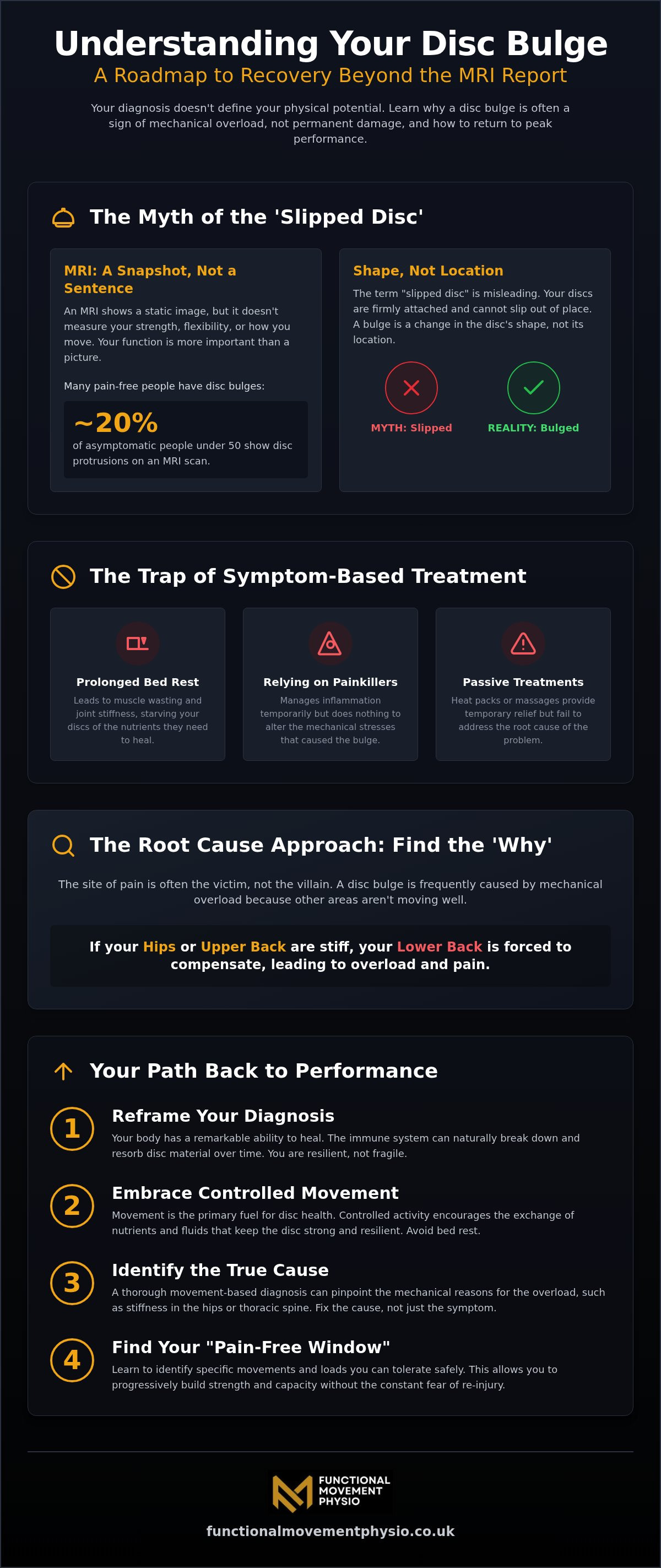
However, a disc bulge is often a sign of mechanical overload rather than a structural failure. Research indicates that around 20% of people under the age of 50 have disc protrusions without any pain at all. This means your scan doesn't define your physical potential. You'll discover why your diagnosis doesn't mean the end of your training and how a root cause approach can get you back to peak performance. We will examine the transition from physical limitation to full, purposeful movement.
Key Takeaways
- Learn why the term "slipped disc" is a clinical misnomer and how your spine remains structurally resilient despite an intimidating MRI report.
- Discover why complete bed rest often delays healing and how relying on painkillers fails to resolve the mechanical cause of your discomfort.
- Understand how identifying mechanical overload in your hips or upper back is the foundation of effective physio for disc bulge in back Liverpool.
- Identify your specific "pain-free window" to safely progress back to the gym or running without the constant fear of re-injury.
- Transition from simply managing symptoms to optimizing your physical capacity through a thorough movement-based diagnosis.
The Myth of the Slipped Disc and Why Your MRI is Not a Life Sentence
The term slipped disc is one of the most persistent myths in healthcare. It creates an image of a spinal component sliding out of place like a loose tile. In reality, your discs are incredibly robust structures firmly attached to the vertebrae by dense ligaments. They cannot simply slip out. When you seek physio for disc bulge in back Liverpool, it's vital to understand that a spinal disc herniation or bulge is a change in the disc's shape, not a change in its location. You aren't fragile, and your spine isn't unstable.
A disc bulge is a common finding that frequently exists in people with no pain at all. It is often a normal adaptation to the stresses of life, much like getting grey hair or wrinkles as we age. Your MRI scan provides a useful internal picture, but it rarely tells the whole story of your back health or your future physical capacity. It's a piece of data, not a destiny.
Why your scan results might be misleading
Research shows that disc bulges appear in high percentages of healthy, pain-free individuals. Studies indicate that around 20% of asymptomatic people under the age of 50 show a disc protrusion on an MRI scan. If you are searching for physio for disc bulge in back Liverpool, you might be focused on the scary terminology in your report. However, a scan is merely a snapshot in time. It doesn't account for your strength, your flexibility, or how you move during daily activities. We encourage you to focus on your function rather than just a static image of your spine.
The reality of disc healing and resorption
The body possesses a remarkable physiological process called resorption. When disc material moves beyond its usual boundaries, the immune system often identifies it as foreign and works to break it down. This natural healing process means many bulges resolve or shrink over time without any need for surgical intervention. The fear that a bulge will only get worse is one of the biggest barriers to recovery. It often leads to unnecessary avoidance of the activities you love.
Movement acts as the primary fuel for disc health. Controlled activity encourages the exchange of nutrients and fluids that keep the disc resilient. By identifying the mechanical reasons why your disc was under pressure, we can help you return to training with confidence. You don't have to live in a state of permanent caution. With the right guidance, your body can adapt and thrive again.
The Problem: Why Rest and Quick Fixes Often Fail for Disc Bulges
When you are diagnosed with a disc bulge, the standard advice is often to rest and wait. This "wait and see" approach is incredibly frustrating for active individuals who want to get back to the gym or the road. If you have been searching for physio for disc bulge in back Liverpool, you've likely realized that simply taking ibuprofen doesn't fix the underlying issue. While medication can manage acute inflammation, it does nothing to alter the mechanical stresses that caused the bulge in the first place.
Prolonged bed rest is particularly damaging. It was once the gold standard of care, but we now know it leads to muscle wasting and joint stiffness. Your spine needs controlled movement to recover. By staying stationary, you are effectively starving your discs of the nutrients they need to heal. This often creates a cycle where you feel better while lying down, but the moment you stand up or lift something, the pain returns with a vengeance.
The trap of symptom-based treatment
Treating the site of pain without looking at the rest of the body is a recipe for short-term results. You might find that heat packs or sports massage provide temporary relief, but this rarely lasts. This is because the lower back is often the "victim" of poor mechanics elsewhere. If your thoracic spine is stiff or your hips lack mobility, your lower back has to move more to compensate. "Just taking it easy" leads to weakness in the deep stabilizing muscles, which further decreases your spinal stability and makes you more prone to recurring issues.
Why your current rehab might be stalling
Generic advice can often be counterproductive. Many people try to "stretch out" their back pain by touching their toes or pulling their knees to their chest. However, a clinical overview of disc herniation suggests that excessive spinal flexion can actually increase internal disc pressure, potentially irritating the nerve further. Similarly, aggressively stretching the hamstrings can put unnecessary tension on the sciatic nerve if it's already sensitized.
Effective physio for disc bulge in back Liverpool requires a focus on why the disc is under stress, not just where it hurts. Inflammation is a natural part of the healing response, but it must be managed through appropriate loading rather than total avoidance. If you feel stuck or worried that your back is failing, it is time to move beyond quick fixes. You can gain clarity on your specific mechanical drivers by booking an Initial Physiotherapy Consultation today.
The Root Cause Approach: Identifying Why Your Disc Bulged
A disc bulge is rarely a random occurrence. In most cases, the disc is simply the "victim" of mechanical dysfunction elsewhere in your kinetic chain. If you are seeking physio for disc bulge in back Liverpool, you need to understand that your pain is a symptom of a larger movement problem. When certain joints become stiff or muscles become inhibited, your lower back is forced to overwork to compensate for that lack of mobility.
Our specialist physiotherapy in Liverpool focuses on identifying these mechanical links. By assessing how you move, we can determine if your disc is being subjected to improper spinal loading. This often happens due to repetitive lifting patterns or prolonged sitting that places the spine in a compromised position. Moving beyond just managing disc-related back pain requires a deep dive into your unique physical mechanics.
The hip-back connection in disc injuries
Your hips and lower back work in a close partnership. If your hips cannot rotate or hinge effectively, your lumbar spine will move more than it is designed to. This excessive movement creates shear forces that can irritate or bulge the disc material. By improving your hip rotation, we can immediately take the pressure off a sensitised disc, allowing the healing process to accelerate. We often use Clinical Pilates for back pain in Liverpool as a powerful tool for this movement re-education.
Core stability vs. core strength
Many gym-goers believe that having a high level of core strength is enough to prevent injury. However, a "strong" core is ineffective if it doesn't know how to stabilise the spine during dynamic movement. True stability is about the timing and coordination of the deep muscles that protect your intervertebral discs. It's the difference between bracing for a heavy lift and maintaining control during a simple daily task. You can find more detail in our guide on building core strength to prevent back pain.
Actionable Advice: Safe Movement Progression for Back Recovery
Recovery is not about waiting for the pain to vanish before you move; it's about finding the right ways to move while you heal. When seeking physio for disc bulge in back Liverpool, the goal is to identify your pain-free window. This is the range of motion where you can move comfortably without triggering sharp or radiating sensations. Pushing through "nerve pain" is counterproductive, as it often increases sensitivity. Instead, you should aim for consistent, gentle movement that respects your body's current limits.
Low-impact activities like walking are vital for spinal health. Walking encourages blood flow to the spinal tissues and helps maintain the natural pumping action that provides nutrients to your discs. Start with short, frequent bouts rather than one long trek. If you can walk for ten minutes without an increase in symptoms, you have found a safe baseline to build upon. This proactive approach prevents the stiffness and muscle wasting that typically follow a diagnosis.
Finding your directional preference
Every disc bulge is unique. Some individuals find that bending backward (extension) centralises their pain, while others feel significantly better when rounding their spine (flexion). This is known as your directional preference. You can test this by gently performing standing backbends or lying on your stomach. If a movement makes the pain travel further down your leg, stop immediately. Generic YouTube routines often fail because they prescribe flexion exercises to people who actually need extension. Professional physio for disc bulge in back Liverpool ensures your exercise plan matches your specific mechanical needs.
Daily habits to protect your spine
Managing a disc bulge requires changing how you interact with your environment. The "hip hinge" is a non-negotiable skill for back recovery. By bending at the hips rather than the waist, you keep your spine in a neutral, protected position during daily tasks like unloading the dishwasher or picking up a gym bag. This simple adjustment removes the repetitive shear forces that irritate an injured disc.
Your workstation setup also plays a major role in your recovery. Avoid sustained spinal compression by using a lumbar support and changing positions every thirty minutes. During the early stages of rehab, you may experience significant muscle guarding as your body tries to protect the area. Incorporating a sports massage in Liverpool can help manage this tension, allowing you to move more freely and engage in your rehabilitation exercises with greater ease.
Specialist Physio for Disc Bulge in Back Liverpool: Your Path Back to Performance
Your journey to recovery begins with a comprehensive Initial Physiotherapy Consultation at our Liverpool City Centre clinic. We don't just review your MRI report; we evaluate the person behind the scan. By performing a detailed movement analysis, we can identify exactly why your disc is under stress. This process goes beyond mere symptom management to find the root cause of your mechanical overload, ensuring we address the "why" as well as the "where."
Our focus is on getting you back to the gym, the running track, or your chosen sport. We understand that for an active individual, simply being able to sit without pain is not enough. We aim for long-term resilience rather than a temporary fix. This partnership between expert and athlete ensures that you aren't just recovering, but optimizing your physical capacity for the future. You deserve a plan that reflects your lifestyle and your ambitions.
Personalised rehabilitation for active bodies
We specialise in bridging the gap between clinical rehabilitation and peak performance. Your recovery plan is tailored to your specific goals and movement habits. We frequently integrate Clinical Pilates 1:1 sessions into our back recovery plans to rebuild functional movement patterns and spinal control. For those dealing with acute nerve pain or significant muscle guarding, we may incorporate medical acupuncture in Liverpool. This helps settle the nervous system, allowing you to engage more effectively with your active rehab exercises and progress toward your goals faster.
Why Liverpool athletes trust our root cause strategy
Many of our clients are runners and gym-goers who have previously been told to "just stop training" or "take it easy." We challenge the idea that a disc bulge is a life sentence. Our physio for disc bulge in back Liverpool focuses on helping you master your own physical capabilities. We provide the education and tools necessary to prevent future relapses, turning a period of injury into an opportunity for physical growth.
If you are struggling with radiating leg pain alongside your back issues, you can explore our sciatica specialist physio Liverpool guide for specific advice on nerve-related relief. We are here to guide you from physical limitation back to your peak performance. You don't have to settle for a life of modified activity when sustainable, high-level movement is within your reach.
Reclaim Your Movement and Master Your Recovery
You've learned that a disc bulge diagnosis is simply a signal to change how you move, not a reason to stop. Your MRI report doesn't dictate your future performance or your ability to return to the gym. By shifting your focus from the site of pain to the mechanical root cause, you can stop the cycle of recurring injury. Our specialist physio for disc bulge in back Liverpool focuses on identifying hidden dysfunctions in your hips and spine to ensure you aren't just pain-free, but physically resilient.
At our Liverpool city centre specialist clinic, we provide the expert root cause movement analysis needed to bridge the gap between clinical rehab and peak performance. We're trusted by local runners and athletes because we value long-term wellness over temporary fixes. You don't have to navigate this journey alone or feel stuck by scary scan results.
It's time to stop managing symptoms and start mastering your own physical capabilities. We're ready to help you unlock your full potential and restore purposeful movement to your daily life.
Frequently Asked Questions
Is physiotherapy effective for a bulging disc in the lower back?
Physiotherapy is highly effective because it addresses the mechanical drivers of the injury rather than just the symptoms. When you choose physio for disc bulge in back Liverpool, we look beyond the scan to see how your movement patterns are overloading your spine. By improving hip mobility and core stability, we take the pressure off the disc; this allows your body's natural healing processes to take over efficiently.
How long does it take for a disc bulge to heal with physio?
Most disc bulges show significant improvement within six to twelve weeks of consistent, movement-based rehabilitation. While the physiological process of resorption varies between individuals, your functional recovery often happens much faster once we identify the root cause. We focus on getting you back to your meaningful activities as quickly as possible while ensuring the results are sustainable and your spine remains resilient under load.
Can I still go to the gym if I have a disc bulge in my back?
You can certainly continue gym training, provided your movements stay within a pain-free window. We encourage active recovery rather than total rest, as movement is essential for disc health. During your consultation, we identify which lifts are safe and which require temporary modification. Our goal is to bridge the gap between clinical rehab and high-performance training, ensuring you don't lose your hard-earned strength during recovery.
Should I get an MRI before seeing a physio for back pain in Liverpool?
An MRI is rarely necessary before starting treatment. Searching for physio for disc bulge in back Liverpool is often the best first step, as clinical guidelines suggest that routine imaging can lead to unnecessary fear without changing the treatment plan. A thorough physical assessment is usually more valuable for identifying the mechanical cause of your pain. If your symptoms suggest a serious underlying issue, we will guide you toward imaging.
Will a disc bulge eventually require surgery?
Surgery is only required in a very small percentage of cases, typically when there is progressive neurological loss or severe, unrelenting pain. Most people find that a structured, root-cause-focused rehabilitation program is enough to resolve their symptoms. Research indicates that the body has a high capacity for natural disc resorption. We focus on optimizing your physical capabilities so that surgical intervention becomes a last resort rather than an inevitability.
What exercises should I avoid with a bulging disc?
You should generally avoid any exercise that causes pain to travel further down your leg, a process known as peripheralisation. While there are no "forbidden" movements, excessive spinal flexion or high-impact loading may be irritating in the early stages of recovery. It's important to avoid generic routines found online; they may not match your specific directional preference. We tailor your program to ensure every movement supports your spinal health.
Can a disc bulge cause sciatica or leg pain?
Yes, a disc bulge can cause sciatica if the disc material or associated inflammation irritates a nearby nerve root. This often results in sharp, shooting pain, numbness, or tingling in the leg. However, leg pain can also stem from other mechanical issues in the hips or pelvis. We use movement analysis to confirm if the disc is the true source of your leg pain or if other factors are involved.
How is a disc bulge different from a herniated disc?
A disc bulge is a broad, symmetrical extension of the disc material beyond its normal space, while a herniation is a more localized protrusion. While these terms sound different on a report, they both represent changes in the disc's shape. Neither term accurately predicts your level of pain or your ability to recover. Both conditions respond exceptionally well to a movement-based approach that addresses the underlying mechanical stress.

Article by
Stuart Goldfinch
HCPC PH112156
Specialist MSK Physiotherapist
Ex UK SAS Trainer
Graduate Sports Rehabilitator


