

Resting your legs for weeks only to feel that familiar, sharp ache return during your first mile back is a clear sign that your recovery strategy is missing the mark. If you are searching for a shin splints prevention clinic Liverpool runners trust, you are likely tired of the frustrating cycle that leaves you feeling stuck and apprehensive. You probably agree that conflicting online advice and generic "quick fixes" have done little to provide the sustainable results you actually need.
You'll discover how to identify the precise biomechanical root cause of your discomfort using professional assessment techniques. I will show you how to implement a structured prevention strategy used by elite specialists to optimise your movement and build resilient lower legs. We'll explore the technical methodology behind gait analysis and the specific loading protocols required to help you return to the pavement with absolute confidence and a clear path toward pain-free running.
Key Takeaways
- Understand why rest is only a temporary pause in symptoms and why active load management is the key to stopping recurring pain.
- Identify how imbalances in your kinetic chain lead to bone overload and discover the methodology for fixing these root causes.
- See how our shin splints prevention clinic Liverpool uses technical video analysis to pinpoint the exact biomechanical issues in your running gait.
- Master practical strength and mobility exercises designed to increase the capacity of your lower legs and protect your tibia from future stress.
- Discover the relationship between stride length and impact force to refine your technique for a sustainable return to peak performance.
The Problem with Traditional Shin Splints Management
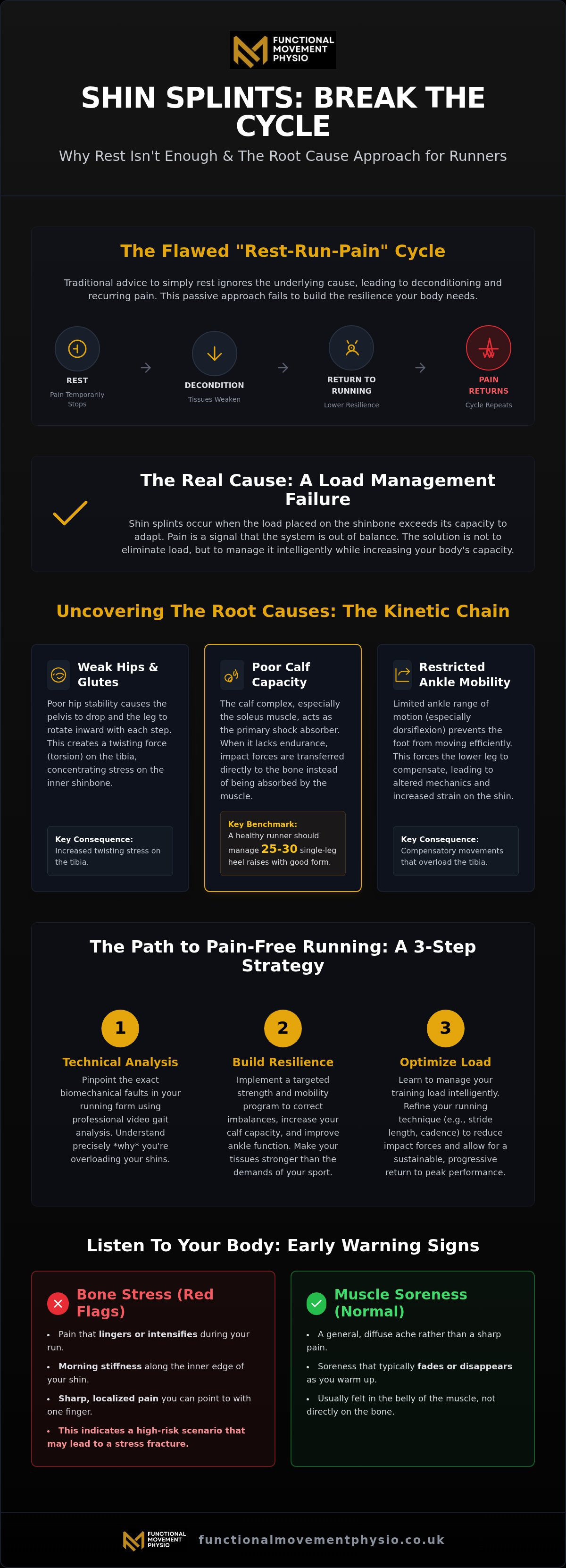
Many runners view pain as a debt they must pay with time spent on the sofa. This is the first mistake in managing your recovery. Shin splints (medial tibial stress syndrome) account for up to 15 percent of all running injuries, yet the standard advice remains remarkably outdated. If you've visited a general practitioner or searched online, you've likely been told to just rest it. At our shin splints prevention clinic Liverpool, we see the fallout of this passive approach every day. It doesn't work because it ignores the physical mechanics of why you're hurting.
Medial Tibial Stress Syndrome (MTSS) is not a mystery; it's a load management failure. Your bone and the surrounding connective tissue haven't adapted to the stress you're putting them through. Quick fixes like icing or using compression sleeves might dull the ache, but they do nothing to address why the overload happened in the first place. Research indicates that 75 percent of runners report having sustained at least one injury, and without identifying the root cause, most will find themselves in a cycle of recurring pain. Visiting a specialist shin splints prevention clinic Liverpool ensures you move beyond these temporary fixes toward a permanent solution.
The Myth of the Mandatory Rest Period
Total inactivity is often the worst thing you can do for your long term health. While rest stops the immediate pain, it also leads to tissue deconditioning. Your muscles and bones become weaker, not stronger, during prolonged periods of stillness. When you finally return to the pavement, your shins are actually less resilient than they were before you stopped. This is why Liverpool athletes often feel stuck in a frustrating rest-run-pain cycle that feels impossible to break without a structured loading plan.
Recognising the Warning Signs Early
Catching the issue before it becomes a chronic limitation is vital for your progress. You must learn to differentiate between general muscle soreness and bone stress. Muscle soreness usually fades as you warm up, but bone-related pain often lingers or intensifies during your session. Morning stiffness along the inner edge of your shinbone is a significant red flag that your body is struggling to repair itself. If you feel a sharp, localised pain that you can point to with one finger, you're likely dealing with a high-risk scenario. Training through this doesn't show toughness; it risks a stress fracture.
Understanding the Root Cause: Why Your Shins Are Overloading
Shin splints are not just a "running injury"; they are a symptom of a system out of balance. At our shin splints prevention clinic Liverpool, we view the tibia as a living structure that must adapt to the forces you apply. When the load on the bone exceeds its current capacity, the periosteum, the thin, highly sensitive layer of connective tissue covering the bone, becomes inflamed. This is the physiological reality behind the pain you feel along the inner edge of your leg.
Understanding this requires looking at the entire kinetic chain. Your shins are often the "victim" of dysfunction happening further up or down the leg. By following a structured approach to shin splint prevention and treatment, you can move away from chasing symptoms and start addressing the structural imbalances that cause overload.
The Hip and Glute Connection
Running is essentially a series of single-leg hops. If your hip stabilisers and gluteal muscles are weak, your pelvis drops and your leg rotates inward excessively. This internal rotation creates a twisting force on the tibia, significantly increasing the stress on the bone lining. This is precisely why we evaluate pelvic control during a Runner’s Assessment. Identifying these weaknesses allows us to redirect force away from your shins and back into the larger, more powerful muscles of your hips.
Calf Capacity and Ankle Mobility
Your calf complex, specifically the soleus muscle, is the primary shock absorber when you run. The soleus can handle forces up to eight times your body weight. If this muscle lacks endurance, the workload shifts directly onto the bone. Additionally, if you have restricted ankle mobility, your foot cannot move through its full range, forcing the lower leg to compensate with every stride. You can check your own calf endurance by performing single-leg heel raises; a healthy runner should comfortably manage 25 to 30 repetitions with good form.
To truly understand how these forces interact in real time, a professional gait analysis is often the most effective way to see your movement patterns clearly. If you're ready to stop guessing and start a targeted recovery, you can book a consultation with our specialist team today.
Building Structural Resilience: Actionable Strength and Mobility Steps
Building structural resilience requires a deliberate shift in mindset. Instead of avoiding impact, you must prepare your body to handle it. Progressive overload is the gold standard for bone and tendon health. By gradually increasing the stress on your tissues, you encourage them to adapt and grow denser. This is a core pillar at our shin splints prevention clinic Liverpool, where we focus on building long term capacity rather than chasing short term relief. If you don't give the bone a reason to get stronger, it won't.
Stability starts far above the shin. Weakness in the pelvis or a lack of core control often manifests as pain in the lower leg because the body is searching for stability elsewhere. Integrating Clinical Pilates into your weekly routine is an effective way to improve this foundational strength and pelvic alignment. Consistency is your most powerful tool in this process. It's far more effective to commit to ten minutes of targeted loading every day than a single two-hour session once a week.
Essential Exercises for Shin Resilience
- Bent knee calf raises: Unlike straight-leg raises, the bent knee version targets the soleus specifically. This muscle is your primary shock absorber, handling significant forces during every running stride.
- Tibialis anterior strengthening: Strengthening the muscle on the front of your leg helps balance the forces applied by the calf. You can do this by using a resistance band to pull your toes toward your shin against tension.
- Single leg balance: Standing on one leg for 60 seconds improves neuromuscular control. This stabilises the ankle joint during the landing phase of your stride, preventing excessive rolling or twisting.
Mobility Drills for Better Biomechanics
- Wall-based ankle mobility: Stand facing a wall and drive your knee forward over your toes while keeping your heel firmly on the ground. Improving your ankle's range of motion prevents the foot from collapsing inward to find extra room.
- Hip flexor releases: Tight hips can cause your pelvis to tilt forward, which often leads to a heavy heel strike. Stretching the hip flexors allows for a more efficient leg swing and a lighter landing.
- Routine integration: Follow expert shin splint prevention advice by adding these drills to your pre-run warm up. Dynamic movement is always superior to static stretching before you start your session.
These steps provide the foundation for a body that can withstand the demands of high-mileage training. By prioritising strength and mobility, you move away from being an "injured runner" and toward becoming an athlete who understands their own physical limits and how to expand them safely.
Technical Optimisation: Refining Your Running Form and Load
Your running form is a technical skill that dictates how much force your shins must absorb with every step. If your technique is inefficient, even the strongest muscles will eventually fail to protect the bone. At our shin splints prevention clinic Liverpool, we focus on refining these mechanics to ensure your training load remains sustainable. Small changes matter when you're looking for long term results.
Overstriding is one of the most common technical errors we see in injured runners. When your foot lands too far in front of your centre of mass, it acts like a brake. This creates a massive spike in impact force that travels directly up the tibia. By shortening your stride and increasing your step rate, you can significantly reduce this stress and improve your overall efficiency. You'll find that you move more fluidly and with less effort.
A professional Gait Analysis is the most effective way to identify these inefficiencies. We use video technology to break down your movement frame by frame. This allows us to see exactly how your foot strikes the ground and how your body weight is distributed. This data removes the guesswork from your recovery and helps you run without fear of flare-ups.
Cadence and Foot Strike Patterns
Increasing your cadence, or the number of steps you take per minute, is a powerful way to protect your shins. Research suggests that increasing your step rate by 5 to 10 percent can reduce the load on your joints by up to 20 percent. This change naturally discourages heavy heel striking and promotes a softer, more mid-foot landing. It shifts the work away from the bone and back into the muscles designed to handle it.
Try using a metronome app during your next run to find your baseline rhythm. Aim to add 5 percent to that number for your next session. It might feel strange initially, but this small adjustment makes your running more efficient and far less damaging to your shinbone. Consistency with these small tweaks leads to permanent change.
Running Routes and Surfaces in Liverpool
The environment where you train plays a significant role in injury prevention. Hard pavement, like the surfaces along the Liverpool Waterfront, offers very little shock absorption. If you're recovering from pain, consider moving your sessions to the softer trails of Sefton Park or the grassier areas of Princes Park to reduce the immediate impact on your shins.
Be mindful of the camber on Liverpool’s roads as well. Many roads are slightly sloped for drainage. This can cause an uneven load on your legs if you always run on the same side of the street. Varying your routes and progressing slowly from the treadmill to the Otterspool Promenade ensures your shins have time to adapt to changing textures and inclines without overloading.
Expert Support at Our Liverpool Shin Splints Prevention Clinic
Professional intervention is the bridge between a recurring injury and a sustainable running career. While self-management strategies provide the foundation, a clinical environment offers the precision needed to break a chronic cycle of pain. At our shin splints prevention clinic Liverpool, we move beyond generic advice to provide a diagnostic environment where data dictates your recovery. We don't just aim to get you back on your feet; we aim to make you a more resilient athlete than you were before the injury occurred.
For those dealing with long term issues where the tissue has failed to heal correctly, we offer advanced interventions such as Shockwave Therapy. This evidence based treatment uses acoustic pressure waves to stimulate a healing response in the affected area, effectively "restarting" the repair process in stubborn cases. It is a powerful tool when combined with a structured loading programme, ensuring that even chronic Medial Tibial Stress Syndrome can be managed effectively.
The Specialist Runner’s Assessment
The first step in your journey is a comprehensive Runner’s Assessment. This is not a simple check-up; it is a deep dive into your unique biomechanics. We utilise high speed video analysis to capture your movement in real time, allowing us to see exactly how your body handles impact. This is paired with objective strength testing to identify the specific muscular imbalances or "weak links" in your kinetic chain that are forcing your shins to overwork.
Once we have this data, we create a tailored conditioning plan. This roadmap is designed for long term results, focusing on progressive tissue loading and technical refinement. You will leave with a clear understanding of your body's current capacity and a specific strategy to expand it. This structured approach removes the anxiety of "too much, too soon" and replaces it with a logical, step by step progression back to peak performance.
Why Liverpool Runners Choose Functional Movement Physio
Our clinic is built on a philosophy of partnership. We act as high performance mentors, guiding you through the complexities of injury rehabilitation with quiet confidence. Liverpool runners choose us because we understand the local landscape, from the hard pavements of the city centre to the undulating trails of our local parks. We speak your language and share your goal: the restoration of full, purposeful movement.
We are committed to evidence based practice, ensuring that every intervention we suggest is backed by clinical research. This dedication to functional results means we focus on performance optimisation rather than just temporary pain relief. By choosing our shin splints prevention clinic Liverpool, you are investing in a team that values your long term wellness and your ability to run without limits for years to come.
Take Control of Your Recovery and Return to the Road
Breaking the cycle of recurring pain requires a shift from managing symptoms to mastering your own physical capacity. You now understand that structural resilience is built through progressive loading and technical optimisation rather than complete inactivity. By addressing the root cause of your overload, you ensure that every mile you run contributes to your strength instead of your limitation.
Our shin splints prevention clinic Liverpool provides the expert guidance needed to navigate this transition safely. With a Specialist Runner’s Assessment and high speed video analysis, our team identifies the precise biomechanical factors affecting your performance. Located in our convenient Liverpool city centre clinic, we are ready to help you unlock your full potential and achieve sustainable results.
Reclaiming your love for running starts with a single, professional step. We look forward to partnering with you to restore full, purposeful movement to your daily life.
Frequently Asked Questions
Can I still run with shin splints if the pain is mild?
You can often continue running if your pain remains below a three on a ten-point scale and doesn't linger the next morning. However, you must avoid pushing through sharp or worsening discomfort that changes your running form. The goal is to find a safe level of load that allows your tissues to adapt without becoming further inflamed. If you're unsure, a professional assessment is the safest way to determine your specific limits.
How long does it take for shin splints to go away completely?
Most runners see significant improvement within three to six weeks of starting a structured loading programme. However, complete resolution for chronic cases can take up to twelve weeks of consistent work. This timeline depends on your dedication to strengthening exercises and how well you manage your training volume. We focus on building long term resilience so that once the pain is gone, it stays away for good.
Do I really need expensive running shoes to prevent shin splints?
Price doesn't guarantee protection against injury. While a well-fitted shoe provides comfort, it cannot compensate for weak muscles or poor running mechanics. We prioritise improving your body's internal shock absorption through targeted strength training rather than relying solely on external gear. Research shows that comfort is the most reliable indicator of a good shoe, so choose what feels most natural for your specific foot shape and stride.
What is the best surface for running in Liverpool if I have shin pain?
Sefton Park offers some of the best terrain for recovering runners due to its mix of soft grass and well-maintained trails. These surfaces provide more give than the hard concrete found along the Liverpool Waterfront. You should also be cautious of the camber on city roads, which can place uneven stress on your shins. Varying your routes helps prevent repetitive loading on a single side of the shinbone.
Is shockwave therapy effective for recurring shin splints?
Shockwave therapy is a powerful intervention for stubborn, recurring cases that haven't improved with traditional physiotherapy. It works by sending acoustic pressure waves into the affected tissue to stimulate a healing response and reduce pain. At our shin splints prevention clinic Liverpool, we use this technology to treat the underlying tissue dysfunction. It's most effective when used as part of a comprehensive plan that includes gait retraining and specific strength work.
How do I know if my shin pain is a stress fracture?
A stress fracture typically presents as a very specific, pinpoint pain that is tender to the touch. Unlike standard shin splints, which often feel like a dull ache along a larger area, a fracture may cause pain even when you aren't active. If you notice swelling or if the pain keeps you awake at night, you should seek a professional diagnosis immediately to prevent a more serious injury from developing.
Why does my shin pain return as soon as I increase my mileage?
Your pain returns because your training volume is increasing faster than your bone's ability to repair itself. This "too much, too soon" trap is a common issue we address at our shin splints prevention clinic Liverpool. To stop the cycle, you need to strengthen the muscles that support the tibia and refine your running form. This ensures your shins can handle the higher forces associated with longer distances and faster paces.
What exercises can I do at home to prevent shin splints?
Single-leg heel raises are the most effective exercise you can do at home to build calf endurance. Aim for three sets of 25 repetitions on each leg with a slight bend in your knee to target the soleus muscle. You can also perform toe curls with a towel to strengthen the small muscles in your feet. These simple movements create a more stable foundation for every step you take while running.

Article by
Stuart Goldfinch
HCPC PH112156
Specialist MSK Physiotherapist
Ex UK SAS Trainer
Graduate Sports Rehabilitator


