

Resting completely may ease an irritated Achilles tendon, but it won’t rebuild its capacity to cope with running, training or everyday movement. Effective Achilles tendinopathy treatment in Liverpool focuses on understanding what has overloaded the tendon and gradually restoring its strength.
Morning stiffness, tenderness or pain during exercise can make it difficult to know whether to keep moving or stop. Symptoms may also flare after activity. Pushing through or relying on short-term pain relief alone may leave the underlying problem unchanged.
This article explains how tendon overload can lead to Achilles pain, which symptoms matter and how a tailored exercise programme can support recovery. You’ll also learn where shock-wave therapy may fit, why the approach depends on the tendon’s location and sensitivity, and how physiotherapy can help you work towards returning confidently to the activities that matter to you.
Key Takeaways
- Recognising when Achilles pain is linked to tendon overload can help you understand why it flares during activity or feels stiff afterwards.
- The tendon’s pain location and sensitivity influence which rehabilitation approach is appropriate.
- Progressive strengthening can help rebuild the tendon’s capacity, while complete rest alone may not restore its function.
- Eccentric exercises and shock-wave therapy can form part of treatment, but their suitability depends on your symptoms and progress.
- A physiotherapy assessment can help identify what is driving your pain and shape a plan towards returning to the activities that matter to you.
The Problem
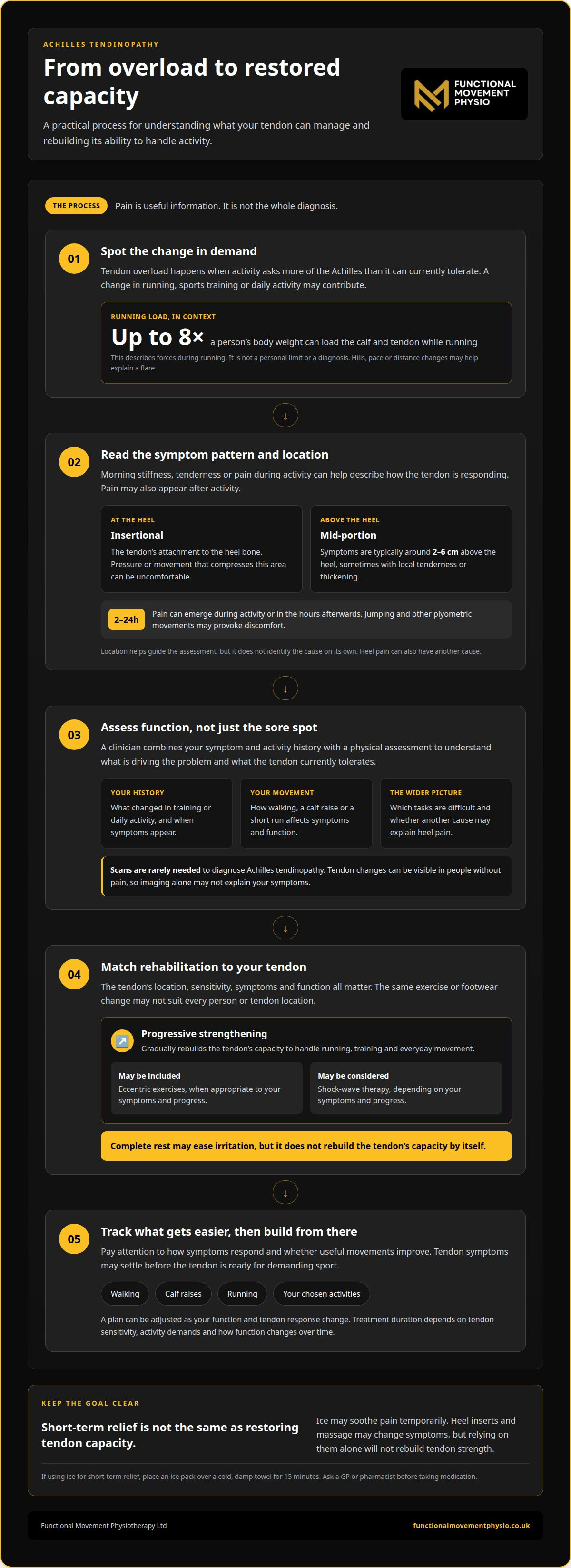
Achilles tendinopathy is pain and reduced function linked to the tendon’s ability to manage load. It often follows a change in running, sports training or daily activity that asks more of the calf and tendon than they can currently tolerate. The condition is generally understood as load-related, rather than simply inflammation. This matters because reducing pain alone does not necessarily restore the tendon’s capacity.
Insertional and mid-portion tendinopathy
The location of your pain helps distinguish two common types. Insertional tendinopathy affects the point where the Achilles tendon attaches to the heel bone. Mid-portion tendinopathy affects the tendon higher up, typically around 2-6 cm above the heel. These locations can involve different sensitivities, so the same exercise or footwear change may not suit both.
With insertional pain, pressure or movement that compresses the tendon near the heel can be uncomfortable. Mid-portion symptoms are felt further up the tendon, often as localised tenderness or thickening. The distinction is useful, but does not identify the cause on its own. A clinician considers your symptom history and examines the tendon, rather than relying on pain location alone.
Symptoms that help explain the problem
Morning stiffness is a common clue: your first steps after getting out of bed may feel worse, then ease as you move. The tendon may also feel tender to touch, appear thickened, or have a lump and swelling. Pain can emerge during activity or in the hours afterwards, sometimes 2-24 hours later. Jumping and other plyometric movements can provoke discomfort because they place a quick demand on the calf and tendon.
These symptoms can interrupt running, gym training and walking upstairs, but pain does not automatically mean the tendon has torn. Heel pain can also have another cause, such as plantar fasciitis. A detailed history and physical assessment help distinguish these problems. Scans are rarely needed to diagnose Achilles tendinopathy, and tendon changes can be visible without pain.
Why quick fixes may fall short
Ice may temporarily soothe a painful area, but it does not change the tendon’s ability to handle exercise. For short-term relief, an ice pack can be placed over a cold, damp towel on the tendon for 15 minutes. Medication also needs careful consideration: ask a GP or pharmacist before taking it. Anti-inflammatory medicines or corticosteroid injections may ease symptoms briefly, but they don’t appear to provide longer-term benefit.
Heel inserts may change ankle position and reduce tension during some movements, but relying on them alone will not rebuild tendon strength. Massage may address the surrounding calf muscles, yet symptom relief is different from restoring the tendon’s capacity. If you use either approach, consider whether walking, calf raises or running become easier, not just whether the area feels temporarily less sore.
The key takeaway is to treat symptom patterns as useful information, not the whole diagnosis. Whether pain sits at the heel attachment or 2-6 cm above it, the next step is understanding what loads provoke it and what the tendon can currently tolerate. That distinction matters more than chasing one quick fix.
The Root Cause Approach
In the UK, Achilles tendinopathy is generally managed with physiotherapy and an exercise plan tailored to your symptoms and function. Achilles tendinopathy treatment in Liverpool should take account of what triggers your pain, where it is located and how it affects your activity.
Tendon Overload and Loading
Tendon overload means the demands placed on the Achilles tendon exceed its current capacity. Running can load the calf with up to eight times a person’s body weight, so changes in hills, pace or distance may help explain why symptoms began.
That figure describes the forces involved in running, not a personal limit or a diagnosis. A clinician considers your training history alongside your tendon’s response to movements such as walking, a calf raise or a short run. This helps distinguish a recent increase in demand from other factors that may contribute to pain.
The Achilles tendon transfers force from the calf to the heel, helping you push off when walking, running and jumping. When symptoms affect that function, a useful assessment looks beyond the painful spot. It considers which tasks are difficult, which movements you can still manage and how symptoms change with activity.
Imaging is rarely needed to diagnose Achilles tendinopathy. Tendon changes can also appear in people without pain, so a scan alone may not explain your symptoms. A clinical assessment brings together your history and physical findings. This can help clarify whether the tendon is the likely source and which demands need attention.
Tendon Dysrepair and Degeneration
Tendon dysrepair describes changes in the tendon’s structure when its normal response to repeated demands is disrupted. Mid-portion tendinopathy is commonly described as degeneration rather than simply inflammation.
This distinction matters because pain does not directly reveal the tendon’s structure. A tender or thickened tendon can be assessed alongside your movement and activity history, rather than treated as proof of a particular level of damage. A physiotherapist uses these details to understand how the condition affects your function and guide the next clinical decision.
Symptoms can also overlap with other causes of heel pain. Plantar fasciitis, for example, can cause pain around the heel. If the location or behaviour of your pain does not fit the expected tendon pattern, consider the wider picture instead of assuming every heel symptom comes from the Achilles.
Treatment Duration and Surgery
How long treatment takes depends on the tendon’s sensitivity, your activity demands and how your function changes over time. Tendon symptoms may settle before the tendon is ready for demanding sport, so your return to activity is guided by your ability to manage the relevant movements, not pain relief alone.
Surgery may be considered if other treatments do not help. Procedures can remove damaged tendon tissue or transfer another tendon to support healing and function. Recovery involves immobilisation in a cast or boot and may take several months. It also brings practical risks, including restricted movement and a prolonged period before returning to demanding activity.
A clinician considers your symptoms, everyday function and response to treatment when discussing whether surgery is appropriate. For Achilles tendinopathy treatment in Liverpool, an assessment can help clarify what may be driving your symptoms and which next step suits your needs.
Practical Steps for Long-Term Progress
Exercise builds the capacity of the calf and Achilles tendon, while shock-wave therapy may support a broader rehabilitation plan. The right approach depends on your symptoms, activity demands and response to loading.
For Achilles tendinopathy, progressive calf strengthening is central. Slow exercises that combine lifting and lowering are generally preferred to relying on eccentric lowering alone, and slow, heavy resistance training is commonly recommended twice per week. A physiotherapist can adapt the exercise and frequency to your current tolerance.
Choose and progress calf exercises
Eccentric calf exercises focus on the controlled lowering phase of a heel raise. They can be useful, but may not suit the early stages of an irritable injury. Physiotherapy guidance helps determine when to introduce them and whether your symptoms allow the load to increase.
A commonly used eccentric programme lasts 12 weeks and uses three sets of 15 repetitions. Studies have used the exercises one, two or three times daily, so that schedule isn’t a universal prescription. A programme should reflect your tendon’s response, the location of pain and whether you can maintain good control. The calf includes the gastrocnemius and soleus, and exercise position can alter their contribution.
Progression matters as much as the exercise choice. Added resistance is generally introduced once you can tolerate at least 15 heel raises. With added load, a target range of 6-12 repetitions is used. Keep pain during exercise, immediately afterwards and the next morning at no more than 5/10, and aim for symptoms to return to baseline by the next day. If they remain elevated, reduce the load or repetitions rather than abandoning movement altogether.
Use the next morning as a practical check on your response. For example, if a loaded heel raise feels manageable during training but makes your first steps noticeably worse, the previous session may have been too demanding. Adjust one part of the programme, such as resistance or repetitions, and observe your response. Changing one variable at a time makes the effect easier to understand.
Where shock-wave therapy fits
Extracorporeal shock-wave therapy delivers acoustic waves to the affected area. It is a treatment option for Achilles tendinopathy, but does not replace progressive strengthening or identify why the tendon became overloaded. Eccentric exercise and shock-wave therapy have some of the strongest evidence among treatments for this condition. Their role should be considered alongside your exercise plan, symptoms and goals.
For example, a runner who struggles to progress calf exercises may discuss whether shock-wave therapy for Achilles tendinopathy is appropriate alongside continued rehabilitation. The therapy should fit the wider plan, rather than serve as a stand-alone route back to running. Your treatment priorities may also change as everyday activity becomes easier and training demands increase.
Make progress sustainable
Keep a simple record of exercise, running and next-day symptoms. This gives you and your physiotherapist practical information for adjusting the load. A progressive plan balances strengthening with activity management, helping you build towards meaningful movement without repeatedly exceeding what the tendon can tolerate.
Functional Movement Physio: Follow-up Physiotherapy Treatment
Functional Movement Physio provides Follow-up Physiotherapy Treatment to help you progress an Achilles rehabilitation plan, address setbacks and work towards meaningful activity. If you have not had an assessment, an Initial Physiotherapy Consultation is the starting point for understanding your symptoms and movement needs.
Follow-up care can help when conflicting advice leaves you unsure whether to rest, run or strengthen. Achilles pain can change as your activity changes, so a plan that suited an earlier stage may need adjusting. The focus is not simply on making the tendon feel quieter. It is on understanding what affects your symptoms and building your capacity to move.
Make your rehabilitation specific
Your follow-up appointment can focus on how the tendon responds to your current exercises and daily demands. For example, if calf raises feel manageable but running brings back morning stiffness, that difference can guide the next adjustment. Exercise load, movement quality and your activity goals all help shape practical decisions.
Progress is not always a straight line. A flare after a training change does not automatically mean you have caused further injury, but it can show that the recent demand was too high. Reviewing your response helps identify whether to adjust repetitions, resistance, running volume or recovery between sessions. You can then make a measured change instead of repeatedly stopping and restarting activity.
Build towards the movement you need
Rehabilitation should reflect what you want to return to, whether that is running, gym training, walking comfortably or playing sport. Each has different physical demands. Returning to a steady walk does not test the tendon in the same way as repeated hills, sprinting or jumping. Follow-up Physiotherapy Treatment can help keep your plan relevant as your movement goals become more demanding.
Appointments can also help you make sense of changes in your symptoms. You might feel better during everyday activity but still hesitate to increase running, or manage strength exercises but struggle with faster movements. Discussing these differences connects your exercise plan to real-life demands and gives you a clearer basis for progressing, rather than relying only on how the tendon feels at rest.
Useful points to bring into a follow-up include:
- Which exercises you completed and how they felt during each session.
- Whether discomfort settled by the next day or affected your morning movement.
- Changes in walking, running, gym training or other important activities.
- Any new concern, such as increasing tenderness or difficulty completing familiar tasks.
These details make the discussion specific. If an exercise repeatedly causes a lasting flare, your plan can be reviewed. If your current routine feels comfortable, the next step may be to develop strength or activity tolerance. The aim is sustainable progress that addresses the factors affecting your tendon, rather than relying on temporary symptom relief alone.
Physiotherapy is not a substitute for appropriate medical assessment when symptoms suggest another problem. If ongoing Achilles tendon pain limits your activity, an assessment can clarify the next practical step and help you move forward with a plan shaped around your needs.
Take Your Next Step Towards Confident Movement
Achilles pain can make you second-guess every run, training session and morning step. Your next move does not need to be dramatic. Start with a clear assessment of what currently limits you and what needs to change for you to move with greater confidence.
Functional Movement Physio offers an Initial Physiotherapy Consultation and Follow-up Physiotherapy Treatment to help you develop and adapt a plan around your movement goals. Sports Massage (30 Minutes) is also available, but lasting progress depends on addressing the factors affecting your tendon and rebuilding capacity, not relying on temporary symptom relief. If you’re considering Achilles tendinopathy treatment in Liverpool, choose a next step that focuses on the reason your symptoms persist and supports your return to purposeful activity.
With a clearer plan, you can build towards the activities that matter to you, one considered step at a time.
Frequently Asked Questions
How can I get help?
Book an Initial Physiotherapy Consultation with FM Physio to have your Achilles symptoms and movement assessed. Explain when the pain started, which activities provoke it and what you have already changed. For example, note whether discomfort appears during a run, later that day or during your first steps the next morning. These details help the physiotherapist understand your situation and plan an appropriate next step.
Why do I have pain in my Achilles tendon?
Achilles tendon pain often develops when its workload increases beyond what it can currently manage. A new running route with hills, faster sessions after a break or adding jumping exercises to gym training can all change the demand. Symptoms can also relate to tendon sensitivity and pain location. An assessment considers your activity history and movement, rather than assuming a single cause from pain alone.
When should someone with Achilles tendon pain see a GP or physiotherapist?
See a physiotherapist if Achilles pain keeps interrupting your usual walking, running or training, or if you are unsure how to adjust your activity. An assessment can help distinguish tendon-related symptoms from other causes of heel pain and guide your rehabilitation. Contact your GP if you are concerned about your symptoms or they change significantly. You do not need a GP referral to book physiotherapy at FM Physio.
Which private physiotherapists in Liverpool specialise in Achilles tendinopathy?
FM Physio provides physiotherapy and sports injury rehabilitation in Liverpool, including care for Achilles and other overuse injuries. Its physiotherapists can assess how your symptoms relate to movement and activity, then discuss a suitable plan. To get started, book an Initial Physiotherapy Consultation. You can explain your training demands, such as returning to regular runs or managing pain during gym sessions.
Are shock-wave therapy or injections effective for Achilles tendinopathy?
Shock-wave therapy can be considered alongside progressive exercise, rather than as a replacement for strengthening. Evidence supports it as a treatment option, particularly as part of a broader rehabilitation approach. Injections may provide short-term symptom relief, but do not appear to offer the same longer-term benefit. Discuss the potential role of each option with a clinician who can consider your symptoms and activity goals.
What activities should be avoided or modified during Achilles tendinopathy recovery?
You don’t necessarily need to stop every activity. Modify the movements that cause a lasting flare, such as sprinting, hill running or repeated jumping, while keeping manageable activity in your routine. If you run, keep discomfort minimal and check that it settles within 24 hours afterwards. A marked next-day increase suggests your recent activity may need adjusting. Use your response to guide gradual changes, not guesswork.

Article by
Stuart Goldfinch
HCPC PH112156
Specialist MSK Physiotherapist
Ex UK SAS Trainer
Graduate Sports Rehabilitator


