

Pain relief alone isn’t the finish line. A sports injury clinic in Liverpool can assess what may be driving your symptoms and build a rehabilitation plan around your movement and goals. You’ll get a clearer route forward: what may be aggravating the problem, what to focus on and how to work towards returning to activity with confidence.
If you’re a runner whose pain keeps returning, a gym-goer unsure whether to train or rest, or you’ve tried conflicting advice, it’s understandable to feel cautious. A thorough assessment looks beyond the sore spot and considers how you move, when symptoms appear and what your body needs to manage activity comfortably.
This guide explains what to expect during assessment and rehabilitation, how to build progress step by step, and how to book a consultation. You’ll also find practical guidance on accessing sports injury care in Liverpool and Merseyside, helping you make an informed next move towards the activities that matter to you.
Key Takeaways
- Learn how rehabilitation can progress from understanding your injury to rebuilding confidence in movement.
- See what a consultation may involve and what information can help make the appointment useful.
- Explore how to narrow down clinic locations across Liverpool and Merseyside based on your needs.
- Understand how assessment can look beyond the painful area to consider what may be contributing to recurring symptoms.
- Find out how one-to-one Clinical Pilates may fit into a broader plan for returning to activity.
Sports injury rehabilitation
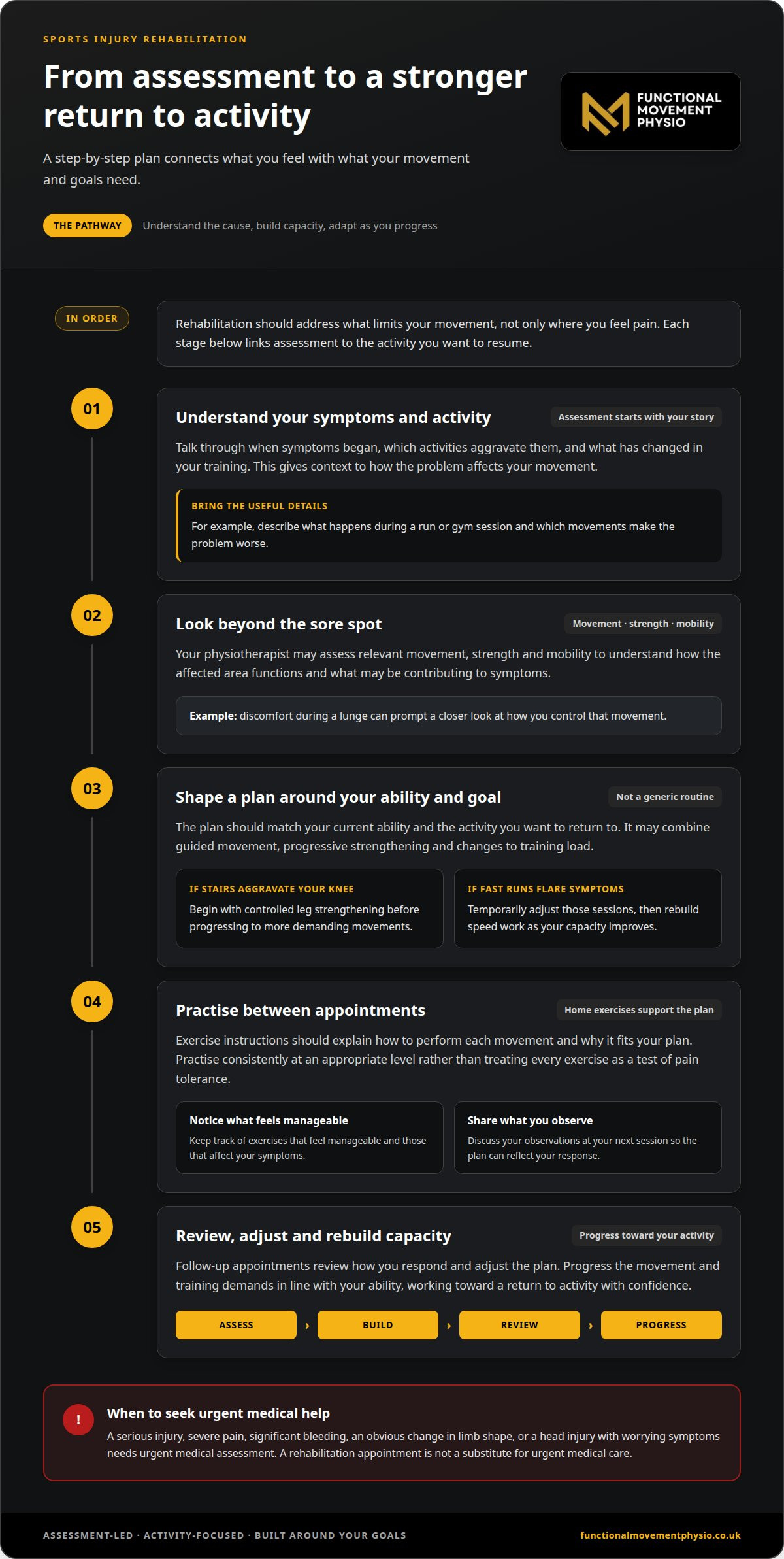
Rehabilitation works best when it addresses what limits your movement, not just where you feel pain. An assessment connects your symptoms with the demands of your activity and helps shape a practical route back to training.
Sports Injury Assessment
A problem that shows up during one movement may have several contributing factors. Your physiotherapist will ask when symptoms began, which activities aggravate them and what has changed in your training. They may assess relevant movement, strength and mobility to understand how the affected area functions. For example, discomfort during a lunge can prompt a closer look at how you control the movement.
Choose an NHS GP for broader health concerns or when you need NHS care. A sports injury clinic is suited to activity-related problems when you want focused assessment and rehabilitation. If you’re using private health insurance, check your policy and the clinic’s accepted insurers before booking.
Non-Surgical Treatment
The root cause approach links treatment to the factors identified during assessment. Non-surgical rehabilitation may include guided movement, progressive strengthening and changes to training load. For instance, a runner whose symptoms flare during fast sessions might temporarily adjust that training, then rebuild speed work as their capacity improves.
Treatment should have a clear purpose, such as improving movement or rebuilding strength for a specific activity. Hands-on care or sports massage can support a broader plan, but easing symptoms alone may not address why pain returns. Your plan should explain how each element relates to your assessment and goals.
Personalised Rehabilitation Plans
A personalised plan matches exercises to your current ability and the activity you want to resume. If stairs aggravate your knee, your physiotherapist might begin with controlled leg strengthening before progressing to more demanding movements. The range and effort should reflect your movement and symptoms, rather than follow a generic routine.
Home exercises help you practise between appointments. Instructions should explain how to perform each movement and how it fits your plan. Note which exercises feel manageable and which affect your symptoms, then discuss your observations at your next session. Consistent, appropriate practice helps build capacity without turning every exercise into a test of pain tolerance.
Urgent Injury Treatment
Some injuries need urgent medical assessment rather than a routine sports clinic appointment. Seek urgent help for a serious injury, severe pain, significant bleeding, an obvious change in limb shape, or a head injury with worrying symptoms. A rehabilitation appointment is not a substitute for urgent medical care.
For a less severe injury, arrange an assessment if symptoms persist, return during activity or restrict normal movement. Until then, stop movements that sharply worsen the problem and avoid repeatedly testing the injured area. A clinician can assess what is limiting you and guide a suitable next step towards purposeful movement.
Appointment booking and consultation pathway
For sports injury care, look for a physiotherapist or sports therapist experienced in assessing activity-related injuries. A useful consultation should explain the assessment, the next steps and how they relate to your goals.
Booking routes and opening times depend on the service. Same-day appointments depend on available capacity and the type of assessment required.
Booking Appointments
To book a private consultation, use the clinic’s appointment route and provide a clear summary of your injury. Include when symptoms began, which movements aggravate them and how they affect activities such as running or gym training. This helps your physiotherapist prepare for your initial assessment.
At a university sports injuries clinic, the process may involve Athletic Union membership. Athletic Union members must provide their membership card or Athletic Union number when booking. Members must also show an up-to-date membership card to physiotherapists before their session.
Student Health and university sports injury services may have separate booking pathways. Follow the route provided by the relevant student service, and have your student or Athletic Union details ready if required. For any appointment, note the location and time so you can arrive prepared.
An initial appointment usually centres on your injury history, movement and goals. Follow-up appointments review your response and adjust the plan. Appointment length depends on the assessment and treatment needed, so allow enough time to describe how the injury affects your activity.
Opening Hours and Same-Day Appointments
Some university sports injury clinic access is limited to term time. Athletic Union and club members can access the clinic from 5.15pm to 8pm on Mondays, Tuesdays and Thursdays once the clinic is busy enough. These hours apply to that service, not every Liverpool clinic.
There is no single opening schedule across Liverpool and Merseyside. Private clinics and student services set their own appointment times, while same-day slots depend on scheduling capacity and the assessment required. A routine consultation and an urgent medical concern follow different pathways.
Before booking, identify whether you need a sports injury assessment, a review or another type of therapy. Then use the relevant clinic’s booking process and share the main details, such as a painful muscle during a run or restricted movement after training. This helps match the appointment to your concern.
If you’re ready to discuss an injury affecting exercise, you can book an initial consultation and outline what you need help with.
Clinic locations across Liverpool and Merseyside
Clinic location affects how easily you can attend an assessment and continue treatment. In Liverpool and Merseyside, compare the appointment address with your usual route, work or study location, and travel needs.
North and South Liverpool
North and South Liverpool are useful broad search areas, but they don’t identify a specific clinic address. Start with the exact address provided for your appointment, then consider whether travelling from home, work or university is practical. A convenient location can make follow-up visits easier to fit around training and daily routines.
For example, if you live in North Liverpool but work in the south, an appointment near your workplace may reduce a separate journey. If you train at a local sports club, consider whether the clinic is convenient before or after sessions. The best location is one you can reach consistently, not simply the one with the nearest-sounding area name.
Mossley Hill and nearby areas
Mossley Hill is a named Liverpool area to consider when planning travel for sports injury care. Use the appointment’s precise address rather than assuming a clinic is close to a landmark or main road in the district. Even within the same area, the journey depends on your starting point and transport.
If you’re travelling with a painful shoulder or difficulty walking, consider the route from your transport stop or parking place to the building entrance. This can affect how manageable the visit feels. Allow time to find the correct entrance and reach the treatment room without rushing.
Planning your journey
Before travelling, use the address in your appointment details to plan a route from a familiar starting point, such as home, work or university. Check the journey for the time of day you expect to travel, and account for transfers or walking between stops. These practical details can help you arrive ready to discuss your treatment plan.
Across Merseyside, travel time can influence your choice of location, especially when rehabilitation includes follow-up visits. Consider the full return journey, not only the outward trip. If you rely on someone else for transport, coordinate appointment timing and collection arrangements in advance.
Location alone doesn’t show whether a clinician specialises in sports injuries. Match the appointment’s purpose to your needs, such as returning to running, managing recurring gym-related pain or addressing restricted movement. Athletes may want a location that fits their training schedule, while someone with a shoulder injury may prioritise an accessible entrance and comfortable travel.
For a clear comparison, write down the clinic area, full appointment address, route from your usual starting point and travel method. This simple check helps distinguish North Liverpool, South Liverpool and Mossley Hill options without relying on broad area labels alone.
Sports injury assessment and diagnosis
A useful assessment connects your symptoms with the movements and demands that bring them on. For example, a runner with ankle pain may need their running history, walking comfort and ankle movement considered together. This gives your physiotherapist a clearer picture than the painful spot alone and helps shape a tailored next step.
The initial session usually begins with questions about when symptoms started, what aggravates them and how they affect daily activity. Mention recent changes, such as longer runs, heavier gym sessions or returning after a break. Explain whether pain appears during exercise, afterwards or at rest. These details help identify patterns and guide the physical assessment.
Your physiotherapist may then observe relevant movements and assess strength, mobility and control. For knee pain during squats, this could include looking at how you bend, balance and load each leg. Findings are considered alongside your reported symptoms, not treated as a diagnosis based on one movement. You should leave understanding what the assessment suggests and what remains uncertain.
Sports injury assessments can address movement-related problems such as muscle strains, joint pain and recurring symptoms during training. A tailored assessment considers the activity involved: a swimmer’s shoulder pain may have different triggers from discomfort during lifting. The aim is to identify factors that may contribute to symptoms and decide whether rehabilitation, further medical assessment or another pathway is appropriate.
Concussion needs particular care. If symptoms follow a blow to the head or a fall, seek urgent medical advice rather than relying on a routine sports injury appointment. A musculoskeletal assessment is not a substitute for medical evaluation of a possible head injury. Once urgent concerns have been addressed, suitable rehabilitation can be discussed as part of the wider recovery plan.
Bring practical details to your appointment: the sport you do, movements that trigger symptoms, recent training changes and any previous injury in the same area. For example, noting that calf pain starts during faster running gives your physiotherapist a specific activity to discuss. You don’t need to arrive with a diagnosis. Clear examples help connect your symptoms, movement and goals.
At the end of the assessment, ask for a plain-language explanation of the findings and proposed next step. A sound plan should link treatment to your activity, whether that means modifying training, beginning exercises or arranging follow-up. If symptoms change or the plan doesn’t address your main concern, raise this at review so the approach can be reassessed.
Booking and clinic contact details
Before booking a sports injury appointment, identify the main problem you want assessed. For example, note whether knee pain starts during a run, after training or when climbing stairs. A brief, accurate summary helps the clinic understand the reason for your visit and direct your enquiry appropriately.
Use the clinic’s booking route, then check your appointment confirmation for the date, time and address. Keep the confirmation available on your phone or in your email. If you need to change your appointment, follow the contact instructions in the message rather than relying on an old booking link.
Give useful details when booking: the affected area, when symptoms began, the activity that triggers them and any previous treatment. If you’re recovering after surgery, mention the operation and any rehabilitation instructions you’ve received. This context helps your physiotherapist prepare for a session that reflects your current needs.
Clinician credentials matter. When booking physiotherapy, ask whether the practitioner is registered and experienced in assessing sports-related injuries. You can also ask how the initial assessment will address your symptoms and activity goals. A clear explanation helps you understand what the appointment is designed to cover.
Use the first appointment to explain what you want to return to, such as running, lifting or playing for a local team. Be specific about the movements you currently avoid. For example, say whether you can walk comfortably but struggle to jog. This gives your physiotherapist practical information to discuss assessment and recovery priorities.
Keep communication focused if you contact the clinic with a question. Include your appointment details, the affected area and the issue you need resolved. For instance, say that your confirmation shows one date but you need to discuss a different time. Clear details make it easier to respond to your booking query.
After an appointment, follow the agreed next step and note changes in your symptoms or activity. If an exercise affects your recovery, record which movement caused the change and when it occurred. This gives your physiotherapist a concrete example to discuss at follow-up, instead of relying on a general impression.
Choose a consultation when pain or restricted movement is affecting the activities you want to resume. If you have a new injury that needs urgent medical attention, use an urgent care route rather than waiting for a routine appointment. For ongoing concerns, a planned assessment can connect your symptoms with a practical path back to activity.
Functional Movement Physio: Clinical Pilates 1:1
Functional Movement Physio offers Clinical Pilates 1:1 to support controlled movement and strength as you work towards returning to activity. It may suit you if an injury has disrupted your confidence with everyday movement or training, and you want guided exercise as part of a broader recovery plan.
Clinical Pilates is not a substitute for assessing the cause of persistent pain. An Initial Physiotherapy Consultation can help establish what may be contributing to your symptoms and whether one-to-one Clinical Pilates fits your needs. Follow-up Physiotherapy Treatment can support continued progress and adjustments as your movement changes.
If you’re unsure which next step suits your injury and goals, book an Initial Physiotherapy Consultation with Functional Movement Physio in Liverpool.
Take the next step towards confident movement
Choosing a sports injury clinic in Liverpool is a starting point, not the whole recovery process. Act on what you’ve learned about your symptoms and choose support that helps you understand what may be driving them. A clear plan can keep your return to exercise connected to your goals, whether that means running comfortably or rebuilding strength after time away.
Functional Movement Physio offers an Initial Physiotherapy Consultation, Follow-up Physiotherapy Treatment and Sports Massage (30 Minutes). These options can support assessment and continued care, with the right approach shaped around your needs and activity.
You don’t need to have every answer before seeking support. Start with the movement or activity you want to regain, then discuss a practical way forward.
Small, purposeful steps can help you move towards the activities that matter to you.
Frequently Asked Questions
Which sports injury clinics are in Liverpool, UK?
Functional Movement Physio is a Liverpool city centre clinic providing sports injury assessment and rehabilitation for active people. If you’re looking for a sports injury clinic in Liverpool, consider whether its services match your needs, such as recurring running pain, a training-related strain or post-operative recovery. The clinic offers physiotherapy and sports injury rehabilitation to help you work towards returning to the activities you value.
What sports injury treatments do Liverpool clinics offer?
Sports injury care can include physiotherapy, rehabilitation exercises, sports massage and other treatments suited to the assessment findings. At Functional Movement Physio, available services include Shockwave Therapy, Clinical Pilates 1:1, Runner’s Assessment and Post-Operative Rehabilitation, alongside physiotherapy and sports massage. For example, a runner with recurring symptoms may benefit from an assessment that considers running demands, while post-surgery care needs to account for the operation and recovery stage.
Do I need a referral to visit a sports injury clinic in Liverpool?
No, you don’t need a GP referral to book directly with Functional Movement Physio. You can arrange an Initial Physiotherapy Consultation and describe the issue affecting your activity. If you’ve already received medical advice, bring relevant instructions or details about previous treatment. A referral isn’t a substitute for urgent medical care, so seek prompt help for serious symptoms rather than waiting for a routine appointment.
What should I expect at a first sports injury clinic appointment?
Expect to discuss your injury, health history and what you want to get back to doing. Your physiotherapist may assess relevant movement and consider how symptoms relate to activities such as lifting, running or changing direction. Wear clothing that allows the affected area to be assessed comfortably. You can also bring a list of medicines or previous treatment details, and ask how the proposed next steps relate to your goals.
Which Liverpool sports injury clinics have the best patient reviews?
Review ratings can change, so compare recent feedback rather than relying on a single score. Look for comments relevant to your needs, such as clear explanations, sports injury assessment or rehabilitation support. Functional Movement Physio has patient reviews available online. Consider whether reviewers describe the type of care you’re seeking, alongside practical factors such as treatment focus and appointment location.
Do Liverpool sports injury clinics accept private health insurance?
Insurance arrangements vary between clinics and policies, so check whether your appointment is covered before booking. Functional Movement Physio can provide details on insurance compatibility and receipts needed for your provider claims.

Article by
Stuart Goldfinch
HCPC PH112156
Specialist MSK Physiotherapist
Ex UK SAS Trainer
Graduate Sports Rehabilitator


