

Persistent tendon pain doesn’t automatically mean surgery is next. Shockwave therapy in Liverpool uses targeted acoustic waves and may help with ongoing tendon pain, plantar fasciitis and other chronic pain. It is a non-surgical treatment that can form part of physiotherapy to support your return to purposeful movement.
When pain keeps returning, it’s understandable to want more than temporary relief. Shockwave therapy is not suitable for every problem, so it helps to understand how it works and where it fits in a wider recovery plan.
This guide covers what to expect during treatment, how physiotherapy can address factors contributing to persistent pain, and which conditions may be considered. You’ll also learn how an assessment at our Liverpool clinic can help determine whether shockwave therapy is appropriate for you.
Key Takeaways
- Shockwave therapy uses targeted acoustic waves and may be considered for persistent pain, including plantar fasciitis and tennis elbow.
- It’s a non-surgical approach, but suitability depends on the injury and your health circumstances.
- Physiotherapy can pair treatment with targeted exercises to address the factors affecting your recovery.
- Learn what an assessment considers when deciding whether shockwave therapy fits your recovery plan in Liverpool.
- Use the guidance in this article to understand what to expect and how to take a considered next step.
What is Shock Wave Therapy?
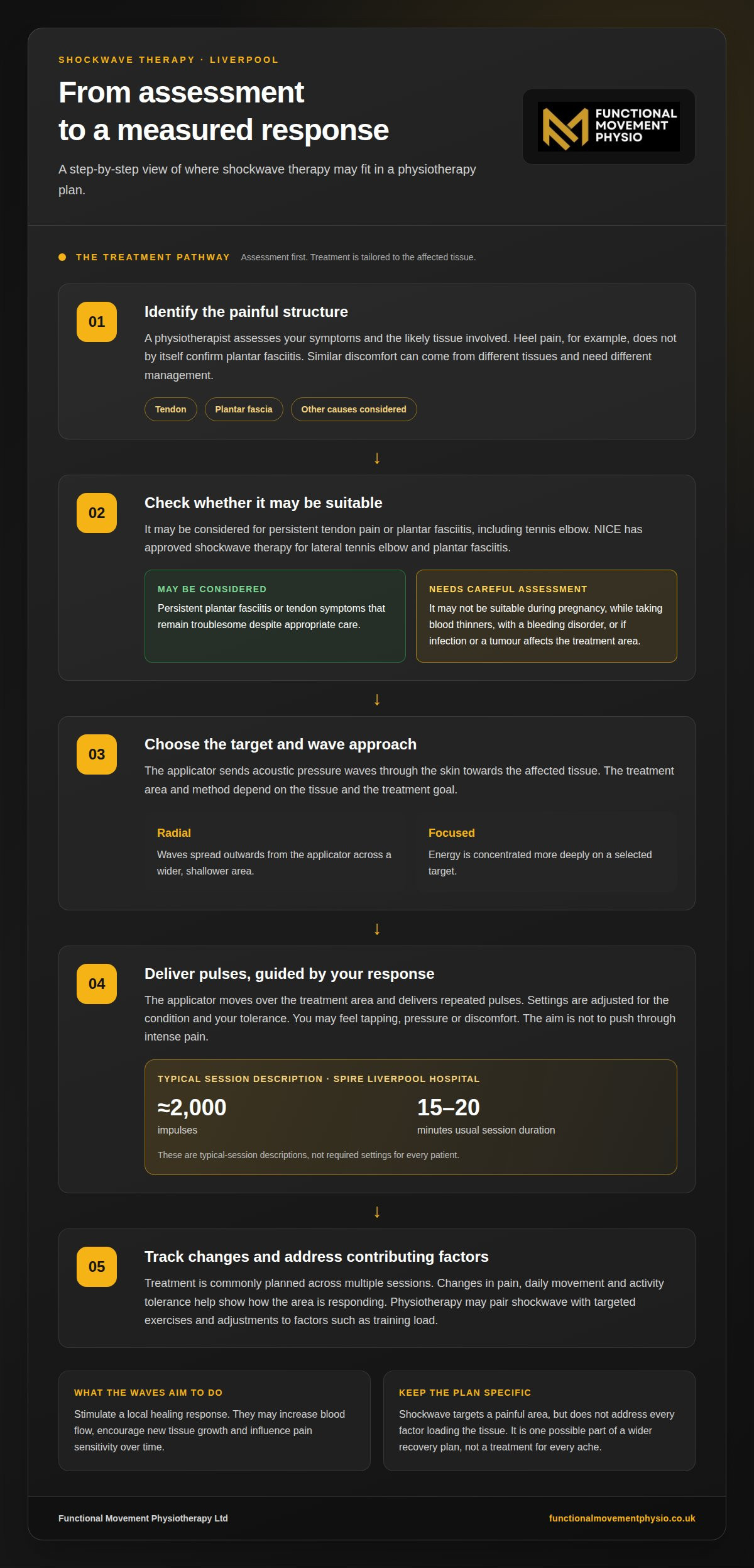
Shockwave therapy is a non-surgical treatment that sends focused acoustic waves into a painful area. The device delivers energy through the skin, targeting tissue such as a tendon or the plantar fascia beneath the foot. It is non-invasive, so it does not involve an incision or anaesthesia. NICE has approved shockwave therapy for lateral tennis elbow and plantar fasciitis, two conditions that can make everyday movement uncomfortable.
Who may be suitable for shockwave therapy, and who should avoid it? It may be considered for persistent tendon pain or plantar fasciitis, including tennis elbow. It may not be suitable during pregnancy, while taking blood thinners, with a bleeding disorder, or if an infection or tumour affects the treatment area.
Plantar fasciitis affects the band of tissue supporting the foot’s arch and can cause heel pain when walking or standing. Shockwave therapy may be considered when symptoms persist, rather than as a first response to every sore foot. A physiotherapist assesses the painful structure and checks whether the symptoms fit plantar fasciitis before treatment. Heel pain can have other causes, so the symptom alone does not establish suitability.
Tendinopathy is a problem involving a tendon, the strong tissue connecting muscle to bone. Examples include Achilles tendon pain that limits running and elbow tendon pain known as tennis elbow. Shockwave therapy may be considered when tendon symptoms remain troublesome despite appropriate care. It targets the affected area, but does not address every factor that may be loading the tendon.
This distinction matters for runners and gym-goers. Persistent heel pain in a runner may involve the plantar fascia, while pain at the back of the ankle may involve the Achilles tendon. Outer elbow pain in a gym-goer may be tennis elbow, particularly if gripping or lifting aggravates it. Each case needs assessment because similar discomfort can come from different tissues and require different management.
Shockwave therapy is not a general treatment for every ache, recent strain or unexplained pain. A physiotherapist assesses your symptoms, identifies the likely tissue involved and decides whether acoustic-wave treatment belongs in your plan. For example, persistent plantar fasciitis may be approached differently from heel pain that has only just begun.
In Liverpool, shockwave therapy may be worth discussing when persistent plantar fasciitis or tendon pain limits work, walking or training. It is non-surgical, but does not replace finding out why the area remains painful. A considered plan matches treatment to the affected tissue and the demands placed on it, helping you work towards purposeful movement.
How shockwave therapy works
Shockwave therapy delivers acoustic pressure waves through an applicator placed on the skin. “Extracorporeal” means the waves are generated outside the body and directed towards the affected tissue. The treatment is intended to stimulate a local healing response, not to remove or repair tissue surgically. It may increase blood flow and encourage new tissue growth. For example, the applicator can target a painful section of tendon rather than the whole limb.
The applicator moves over the treatment area, delivering repeated pulses. These pulses mechanically stimulate the tissue, which may support repair and influence pain sensitivity. The aim is not to numb the area during the session, but to provide a stimulus to which the body responds over time. Changes in pain and movement help track your progress.
Extracorporeal shockwave therapy (ESWT) is a broad name for this treatment approach. Radial shockwave therapy is one form: its waves spread outwards from the applicator, delivering energy across a wider, shallower area. A focused approach concentrates energy more deeply on a selected target. The method depends on the tissue and treatment goal, not the name alone.
For a shoulder tendon problem, for example, the physiotherapist identifies the painful structure and applies the device to the relevant area. Your shoulder position and response help guide treatment. Pain near a joint does not automatically mean the joint itself is the source. Identifying the affected tissue is essential before choosing where to apply the waves.
A session is not simply a fixed set of pulses applied at the same intensity to everyone. The practitioner selects the treatment area and adjusts delivery according to the condition and your tolerance. Spire Liverpool Hospital describes a typical ESWT session as involving approximately 2,000 impulses. It also gives a usual session duration of 15-20 minutes. These are descriptions of a typical session, not a required setting for every patient.
You may feel tapping, pressure or discomfort as the applicator delivers pulses. The sensation depends on the area treated and the settings used. Your feedback helps the physiotherapist keep treatment tolerable while targeting the affected tissue. The aim is to encourage a healing response, not to push through intense pain.
Shockwave therapy is commonly planned across multiple sessions, allowing the response to develop between appointments. A single session does not show the whole recovery picture. Changes in pain, daily movement and activity tolerance help indicate how the area is responding. If you’re considering treatment, book an appointment to discuss your symptoms and recovery goals.
Combining shockwave therapy with physiotherapy
Shockwave therapy can be one part of a wider physiotherapy plan. It targets a painful area, while physiotherapy assesses what may be keeping it irritated. For example, a runner with persistent Achilles tendon pain may need targeted treatment alongside adjustments to training load. Treating only the painful spot may leave other factors affecting recovery unchanged.
How does shockwave therapy compare with physiotherapy or injections? Each has a different role, so there is no single ranking for every injury. Shockwave therapy provides a targeted stimulus, physiotherapy builds movement and capacity, and injections are a separate invasive treatment option.
A physiotherapy assessment examines your symptoms, movement and relevant activity demands. If heel pain affects walking and running, the physiotherapist considers the painful area as well as how your foot and leg move. At FM Physio, treatment includes assessing the problem and applying shockwaves to the affected area when appropriate. This connects the intervention to the tissue involved rather than treating pain as an isolated symptom.
After identifying the relevant factors, your physiotherapist can shape an integrated plan. Shockwave therapy may be paired with rehabilitation exercises and a structured programme over several sessions. This matters because chronic tendon pain can affect strength, confidence and training tolerance. A plan can combine targeted treatment with progressive exercises to reload the tendon and support recovery.
Exercise is a key part of recovery. It gives you a practical way to rebuild the capacity needed for daily activities or sport. For example, someone with Achilles pain may work on calf strength before gradually increasing running demands. Exercises should reflect your symptoms and goals, not follow a generic routine. Monitor how the area responds and use that information to guide progression.
A treatment approach may involve 3-6 shockwave sessions over a two-week period, combined with exercise. This is one possible schedule, not a universal plan. The affected tissue, symptoms and response to loading shape the programme. Review appointments can track changes in pain and activity tolerance, then adjust exercise or treatment as needed. The focus stays on restoring useful movement, not simply reducing discomfort during a session.
If persistent pain is limiting your training or everyday movement, an assessment can help clarify the likely cause and suitable options. Book an appointment to discuss your symptoms and movement goals.
Potential benefits for persistent pain and slow-healing injuries
Persistent pain can make everyday movement feel unpredictable. Shockwave therapy is used for some musculoskeletal problems when symptoms have lasted at least 3 months. This timing can help distinguish a long-standing issue from a recent flare-up. It does not mean every injury lasting that long needs shockwave treatment; the affected tissue and symptoms still matter.
For tendon problems, shockwave therapy aims to stimulate tissue repair and reduce pain sensitivity. These are potential effects of treatment. Reduced sensitivity may make movement more manageable, while tissue repair is relevant when a tendon has struggled to settle. Treatment does not remove the need to understand what keeps loading the area.
Consider Achilles tendon pain that continues to interfere with running after months of symptoms. A useful plan takes account of the tendon, your training demands and how the pain behaves during activity. Shockwave therapy may target the affected tissue, while rehabilitation addresses strength and loading. Easing discomfort alone does not necessarily restore the capacity needed for running.
Soft-tissue pain can also affect confidence and routine. Persistent plantar fascia pain, for example, may make your first step in the morning or a longer walk difficult. Targeted treatment may support recovery, but progress is also measured through practical changes. Track walking tolerance, morning discomfort or your ability to complete planned exercise. These details show whether daily function is changing, not just how the area feels immediately after treatment.
Results do not follow a fixed timetable. Some people notice improvement after their first session, while changes may continue over the weeks and months after treatment ends. A single appointment is not the only useful point of review. Tracking symptoms and activity throughout treatment gives a clearer picture of your response.
Rehabilitation for chronic tendon problems should reflect what the tissue can currently tolerate. A runner returning to hills, for instance, may need to build distance and intensity gradually instead of immediately resuming their previous training load. A gym-goer with elbow tendon pain may need to adjust gripping or lifting while rebuilding strength. These steps address the demands contributing to the problem alongside treatment for the sore area.
Shockwave therapy is one tool within a broader recovery plan. Its potential benefits include stimulating tissue repair and reducing pain sensitivity, but the meaningful outcome is improved function. For persistent musculoskeletal problems, assess movement, daily tasks and exercise tolerance as well as pain. This keeps the focus on recovery and a sustainable return to purposeful activity.
Shockwave therapy availability in Liverpool
Functional Movement Physio provides shockwave therapy in Liverpool’s Baltic Triangle. We begin by understanding your symptoms and movement needs, so treatment has a clear purpose within your recovery.
Local Treatment Availability
At Functional Movement Physio, shockwave therapy is available as part of physiotherapy care in Liverpool. The clinic is at 27 Norfolk Street in the Baltic Triangle, giving local residents and active people a city-centre option for assessment and treatment.
Your appointment focuses on the problem affecting you, whether pain limits work, walking or training. A runner struggling to return to regular sessions, for example, needs a plan that considers more than the painful area. The aim is to connect treatment with the movement you want to regain.
Choosing a Reputable Clinic
How do you choose a shockwave therapy clinic in Liverpool? At Functional Movement Physio, your care starts with a physiotherapy assessment of your symptoms, movement and activity goals before we plan treatment.
You can explain what aggravates the problem and what you have already tried. Your physiotherapist uses that information to identify the issue and discuss how shockwave therapy fits into your care. You should leave understanding the purpose of the approach and how progress relates to your everyday movement.
If heel pain interrupts your usual walks, for instance, describe when it starts and what eases it. If elbow discomfort affects lifting at the gym, explain which movements are difficult. These details help shape an assessment around your real activities rather than a general description of pain. They also give you practical goals to revisit during follow-up care.
At Functional Movement Physio, we focus on factors contributing to your symptoms, not just temporary changes in discomfort. Your physiotherapist considers whether shockwave therapy belongs in a broader recovery plan. This keeps the next step relevant to your needs, whether your priority is returning to running, lifting confidently or moving more comfortably through the day.
If pain is restricting your routine, book an appointment to discuss your situation and goals. A clear conversation about your movement gives your care a practical starting point.
Functional Movement Physio: Initial Physiotherapy Consultation
At your Initial Physiotherapy Consultation with Functional Movement Physio, you can discuss persistent pain, movement difficulties and recovery goals. Your physiotherapist assesses the affected area, considers what may be contributing to your symptoms and explains whether shockwave therapy could fit your plan.
If you continue with care, Follow-up Physiotherapy Treatment reviews how your symptoms and activity are responding. This keeps the focus on underlying factors and rebuilding movement, rather than treating discomfort alone. You can discuss the activities you want to return to, from running and training to everyday tasks.
For an assessment and guidance on your next steps, visit functionalmovementphysio.co.uk.
Take the Next Step Towards Confident Movement
Choosing shockwave therapy in Liverpool is one part of planning your recovery. The next step is to set a clear, personal direction: identify which movements challenge you, what you want to return to and how progress will be assessed. This gives treatment a purpose beyond managing symptoms and keeps your focus on meaningful activity.
Functional Movement Physio offers an Initial Physiotherapy Consultation and Follow-up Physiotherapy Treatment to support assessment and ongoing care. Sports Massage (30 Minutes) is also available as a separate service. The right starting point depends on what you need help with, whether that’s persistent pain, returning to training or moving more comfortably day to day.
A considered plan helps you make informed choices without rushing into treatment. Start with the movement goal that matters most to you, then work towards it with practical guidance and steady progress.
With the right support, you can take purposeful steps back towards the activities that matter.
Frequently Asked Questions
Can I carry on with my normal routine?
Plan your routine around how the treated area responds, rather than assuming you must stop all activity. Note which tasks feel manageable and which increase discomfort, such as standing at work or climbing stairs. Share this pattern with your physiotherapist at review. It can guide practical adjustments to your day while keeping your longer-term movement goals in view.
How many shockwave sessions will I need?
The number of appointments depends on the problem and how your symptoms change during care. Your physiotherapist can review whether treatment is helping you work towards a specific goal, such as completing a workday or returning to your usual training routine. If progress stalls, reassess the plan rather than continuing the same approach without considering what has changed.
What Are the Benefits?
The value of treatment is not just a change in how the painful area feels. It may help you work towards an activity pain has disrupted, such as walking comfortably or taking part in sport. Set a clear goal before starting and consider how the problem affects your routine. This gives you a practical way to assess whether the overall care plan is useful.
What Does Treatment Feel Like?
Your experience may differ from someone else’s, so describe what you feel during the appointment instead of comparing it with another person’s account. Tell your physiotherapist if the sensation becomes difficult to tolerate. Your feedback can inform how treatment is delivered. Afterward, note any changes affecting your usual tasks and share them at your next appointment.
What's the advantage of ESWT?
ESWT directs treatment towards a selected area without an operation. Its role differs from the work of rebuilding strength and movement, so consider how it fits your wider recovery goals. A useful discussion focuses on the problem being treated, the activity you want to regain and how progress will be reviewed, rather than treating the device as a complete plan.
When Will I See Results?
There is no single timetable for everyone. Rather than judging progress after one day, compare your ability to manage relevant tasks over time. Note whether a work shift, walk or training session feels different from your usual baseline. Bring these observations to follow-up so your physiotherapist can consider them alongside your symptoms and decide whether the plan remains appropriate.
What is shockwave therapy and what conditions does it treat?
Shockwave therapy is a non-surgical treatment that applies acoustic waves to a targeted area. It is used for selected problems such as plantar fasciitis and tendon pain, including tennis elbow. Similar symptoms can arise from different tissues, so treatment should follow an assessment rather than rely on the symptom name alone. Tell your physiotherapist when the pain began and which movements bring it on.
Where can I get shockwave therapy in Liverpool?
Functional Movement Physio provides shockwave therapy in Liverpool. To discuss whether treatment may suit you, book an initial physiotherapy appointment and explain which activities are affected and what you want to achieve. This helps connect treatment to your individual needs. Contact the clinic to arrange your assessment and describe how the problem affects your daily routine.
Article by
Stuart Goldfinch
HCPC PH112156
Specialist MSK Physiotherapist
Ex UK SAS Trainer
Graduate Sports Rehabilitator


