

Why is it that many people consider a successful recovery to be simply walking without a limp, when your body is capable of so much more? You might feel stuck following a generic leaflet that focuses on the bare minimum, leaving you fearful of dislocation and confused by conflicting advice. It's frustrating to feel like a patient when you want to feel like an athlete again. To truly bridge the gap between surgery and peak performance, you need a structured program of post-hip replacement physio exercises that looks beyond the joint itself and focuses on how your entire body moves.
I understand that the journey back to the gym or the running track feels daunting after major surgery. You want more than just a temporary fix; you want to understand the mechanics of your new hip and regain the confidence to move with power. In this article, we'll explore a root cause approach to your rehabilitation. I'll show you how to move past basic mobility and implement a biomechanical strategy that restores purposeful movement and ensures you're building a foundation for long-term physical capacity.
Key Takeaways
- Learn why generic hospital leaflets often fall short of your lifestyle goals and how a root cause approach addresses compensations in your pelvis and spine.
- Discover how early activation techniques like gluteal squeezes wake up your primary stabilisers to build a solid foundation for movement.
- Master functional post-hip replacement physio exercises designed to improve your lateral stability and eliminate your limp during weight-bearing activities.
- Explore the transition from basic rehabilitation to high-performance activities like running and gym work using clinical Pilates and advanced strength training.
The Problem: Why Generic Post-Hip Replacement Exercises Often Fail
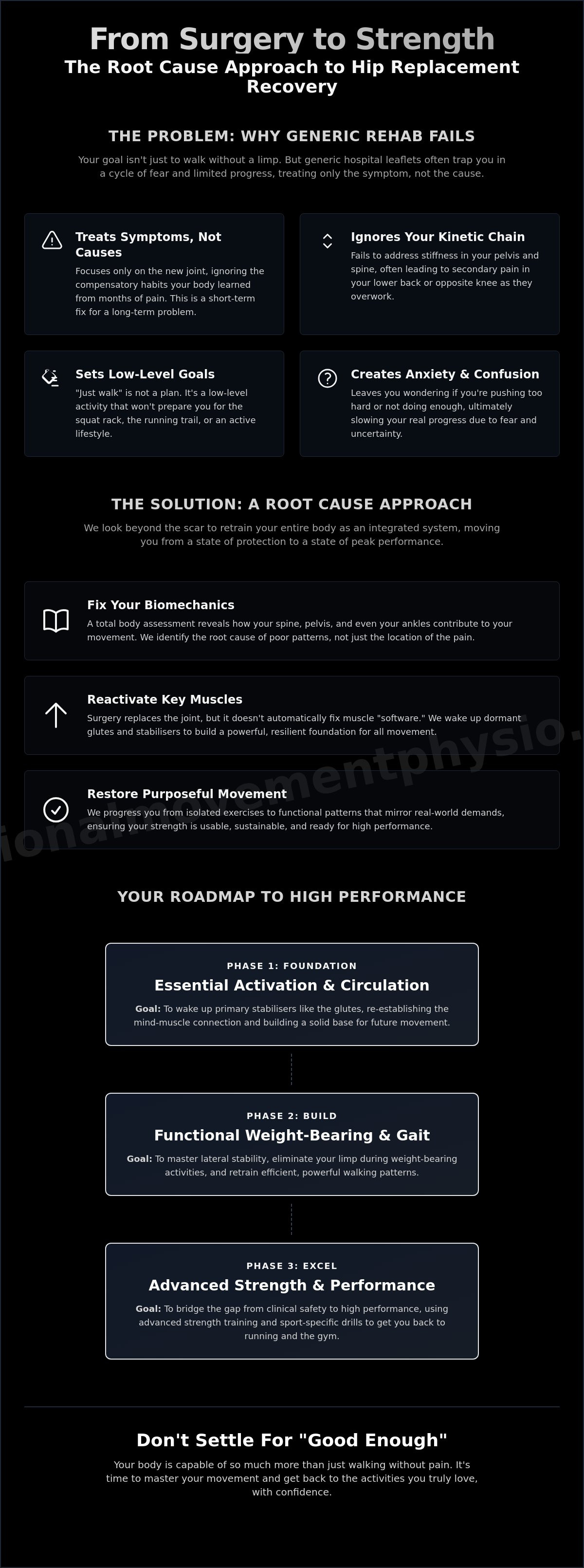
Most patients leave the hospital with a photocopied sheet of basic movements and a set of "hip precautions" to follow. While these instructions are vital for the initial safety of your new joint, they are rarely designed with your long-term athletic goals in mind. If you are a runner or a dedicated gym-goer, you probably find that generic hospital leaflets do not account for your specific lifestyle. These standard programs focus almost exclusively on the joint itself rather than the complex network of muscles that support it.
The reality is that you likely spent months or years managing pain before finally undergoing a hip replacement procedure. During that time, your body became an expert at compensating. You limped, shifted your weight, and changed how you climbed stairs to avoid agony. A successful recovery requires more than just a new joint; it requires unlearning those deep-seated habits. Standard post-hip replacement physio exercises often fail because they don't address these compensatory patterns. Ignoring these underlying issues doesn't just slow your progress; it often leads to secondary pain in the lower back or the opposite knee as those areas continue to overwork.
Relatable Frustrations in Post-Surgical Rehab
You might feel stuck performing basic repetitions that don't feel like real progress. It's frustrating to be told to "just walk" when your goal is to return to the squat rack or the trail. This often creates a cycle of anxiety. You don't know if you are pushing too hard or if you are not doing enough to regain your strength. Walking is a fundamental skill, but it is a low-level activity that does not challenge your lateral stability or your ability to handle impact. To restore full physical capacity, your rehabilitation must bridge the gap between clinical safety and high-performance movement.
The Risk of Symptom-Based Treatment
Treating only the surgical pain ignores the fundamental reason why you might still be moving poorly. Your brain has spent a long time protecting your hip, and it won't stop just because the hardware has been replaced. It continues to overwork other muscle groups to shield the area. A root cause approach looks beyond the surgical scar to see how your entire body is responding to the new joint. We must move your focus from protection to performance. This involves identifying stiffness in the pelvis and spine that could be sabotaging your gait. Without this level of specificity, you are simply managing symptoms rather than mastering your movement.
The Root Cause Approach: Fixing Movement Patterns After Surgery
Recovery is more than just healing tissue; it's a process of recalibrating your entire kinetic chain. We look beyond the surgical scar to identify how your whole body is responding to the change. Often, the stiffness you feel isn't just about the hip joint. It frequently stems from issues in the pelvis and spine that were present long before your surgery. By identifying these root causes, we can create a more effective path toward full function. Retraining the gait cycle is essential for sustainable long-term results. We don't just want you to walk; we want you to walk with the efficiency and power you had before the pain took over.
Our goal is to help you master your own physical capabilities through expert guidance. While a standard Total Hip Replacement Exercise Guide provides a solid baseline for safety, it often stops short of the biomechanical retraining needed for high-performance goals. We bridge that gap by focusing on how your body moves as a single, integrated unit.
Biomechanics and Your New Hip
Your new hip is a precision instrument. It requires a precision approach to movement. Surgery replaces the damaged joint, but it doesn't automatically fix the muscle weaknesses or the "software" errors in your brain's movement patterns. The glutes play a massive role in stabilising the pelvis during movement. If these muscles remain dormant, your lower back or knees will inevitably pay the price. This is why your Initial Physiotherapy Consultation starts with a total body assessment. We need to see how your spine, pelvis, and even your ankles are contributing to your movement quality.
Restoring Purposeful Movement
We focus on moving away from isolated exercises toward functional patterns. It isn't enough to simply lift your leg while lying on a bed. You need to be able to control that movement while standing, turning, and stepping. During your sessions, we identify movement "leaks" that slow down your recovery. A movement leak is anywhere your body loses stability or wastes energy due to poor control. By plugging these leaks, your post-hip replacement physio exercises become significantly more effective. This shift toward optimization rather than just symptom management is what allows you to return to the activities you love with total confidence. If you feel ready to move beyond basic rehab, a tailored movement assessment can help you identify exactly where to focus your efforts for the best results.
Early Recovery Phase: Essential Activation and Circulation Exercises
The first 24 hours following your surgery are a critical window for your recovery. While you might feel the urge to stay perfectly still, modern evidence suggests that starting post-hip replacement physio exercises and early mobilization within this timeframe significantly reduces the risk of complications. This phase isn't about building muscle mass or testing your limits; it's about re-establishing the neurological connection between your brain and your muscles while managing the physical aftermath of the procedure.
- Ankle Pumps: These are vital for maintaining circulation. By rhythmically flexing your feet up and down, you engage the calf muscles to pump blood back toward the heart, which is essential for preventing post-surgical blood clots.
- Gluteal Squeezes: This is the first step in waking up your primary hip stabilisers. You've likely spent months underusing these muscles due to pre-operative pain, and this simple contraction begins the process of pelvic stabilization.
- Quadriceps Sets: Tightening the muscles on the front of your thigh helps maintain knee stability. A strong knee is the silent partner of a healthy hip, providing the support you need for your first steps.
- Bed-Supported Knee Bends: Gently sliding your heel toward your buttocks restores range of motion. This allows the joint to move in a controlled environment without the added stress of gravity or weight-bearing.
Building the Foundation of Strength
Quality of contraction always trumps the number of repetitions. During these early days, short and impactful sessions are far better than long, exhausting workouts that leave you drained. You're training your nervous system to fire muscles that have been dormant or guarded. This approach follows the post-operative clinical practice guideline, which highlights the importance of a phased, criteria-based progression. These "boring" movements are the non-negotiable foundation of your return to high-level activity.
Managing Pain Through Movement
Movement is often the most effective tool for reducing post-operative swelling and discomfort. Gentle activation helps clear inflammatory byproducts from the surgical site, which can actually lower your pain levels over time. It's important to learn the difference between "good" muscle ache, which feels like a deep fatigue from work, and "bad" surgical pain, which is usually sharp or stabbing. Using these movements to regain confidence in your body's resilience is a vital part of the psychological recovery process. If you're unsure how to balance rest with activity, a post-operative rehabilitation assessment can provide the clarity you need to progress safely.
Functional Mobility: Progressing to Weight-Bearing and Gait Exercises
Moving from the safety of the bed to standing movements marks a significant milestone in your recovery. This is where your post-hip replacement physio exercises start to look and feel like real life again. Functional mobility isn't just about moving the joint; it's about teaching your body to support and propel your weight through a new, artificial structure. We shift the focus from simple activation to controlled loading, ensuring your body can handle the demands of gravity and movement.
- Standing Hip Abduction: This is essential for lateral stability. It targets the gluteus medius, which is the muscle responsible for keeping your pelvis level when you walk. Without this strength, your hip will drop, leading to a persistent limp.
- Mini Squats: These train the hip and knee to work together in a functional pattern. We focus on proper alignment to ensure the new joint is loaded evenly, building the foundation for more advanced gym work.
- Step-Ups: These build the strength required for daily activities like climbing stairs. They challenge your balance while forcing the surgical leg to take your full body weight in a controlled manner.
- Gait Retraining: We focus on a deliberate heel-to-toe strike and equal weight distribution. Many patients develop a "guarded" walk after surgery; retraining the gait ensures you aren't favouring one side.
Transitioning to Sustainable Movement
Safely introducing weight-bearing exercises requires a careful balance of challenge and protection. It isn't just about the hip; your core stability plays a massive role in protecting the new joint by controlling the position of your pelvis. This is why Post-Operative Rehabilitation is a partnership between you and your physio. We monitor your form closely to ensure you are building strength without creating new compensations that could lead to back or knee pain later on.
Mastering the Gait Cycle
One of the most common issues after surgery is the "Trendelenburg gait," or a noticeable hip drop. This happens when the muscles on the side of your hip aren't strong enough to hold your pelvis steady. We use video analysis to show you exactly how you are moving in real time. By applying the principles from Finding the Root Cause of My Running Pain, we can identify these movement leaks early. This allows us to fix the underlying mechanics of your walk before they become permanent habits. If you want to ensure your walking pattern is helping rather than hindering your recovery, you can book a Post-Operative Rehabilitation assessment to get a professional gait analysis.
Mastering Your Movement: Long-Term Strategies for Peak Physical Capacity
A common mistake in recovery is stopping your rehabilitation once you can walk without a limp. While reaching that milestone is significant, it doesn't mean your body has fully adapted to the demands of high-level activity. To achieve peak physical capacity, you must move beyond basic post-hip replacement physio exercises and transition into advanced strength and conditioning. This phase is where you shift from being a patient to becoming a high-performance individual who is resilient against future injury.
Returning to higher impact activities like jogging, tennis, or racquet sports requires a deliberate and phased approach. Your new joint can handle these stresses, but only if the surrounding muscles are strong enough to absorb the impact. We focus on building explosive power and multi-directional stability so you can change direction and accelerate with total confidence. For readers in other regions seeking similar expert support, specialized programs such as cours de pilates versoix can provide the necessary focus on core and pelvic stability. Regular check-ups play a vital role here, allowing us to monitor your progress and catch any minor movement compensations before they turn into chronic issues.
Unlocking Your Physical Potential
We often recommend Clinical Pilates Liverpool as a cornerstone for long-term hip health. Unlike generic gym workouts, clinical Pilates focuses on the deep stabilising muscles of the core and pelvis. It addresses the root cause of movement dysfunction by improving your body's "software" and how it controls the new joint. By developing a personalized strength plan tailored to your specific goals, we ensure that your recovery isn't just about healing, but about optimization. You deserve a body that doesn't just function but excels in the activities you love most.
Your Actionable Path Forward
Sustainable results require a proactive health management philosophy. Instead of performing ad-hoc exercises when you feel stiff, commit to a structured programme that prioritises gradual progression and expert feedback. Trusting the process means acknowledging that peak performance takes time and precision. If you are ready to stop settling for a "good enough" recovery and want to unlock your full physical potential, we are here to guide you. The first step is a thorough evaluation of your current movement patterns and a clear plan for the future. Book your Initial Physiotherapy Consultation today to start your targeted recovery in Liverpool and regain the purposeful movement you've been missing.
Take Control of Your Recovery and Return to Peak Performance
Your journey back to an active life shouldn't be limited by generic advice or the fear of moving. By focusing on how your entire body integrates with your new joint, you can unlearn old compensations and build a foundation of true strength. We've explored how a structured progression of post-hip replacement physio exercises moves you from basic circulation to the dynamic movements required for the gym or the track. This biomechanical approach ensures you aren't just healing, but optimizing your physical capacity for the long term.
Achieving this level of physical freedom allows you to return to the activities you love or even explore entirely new hobbies; for instance, once your recovery is complete, you might check out Fun Flying Aviation Ltd to discover the thrill of microlight flight training.
Our Specialist Post-Operative Rehabilitation programmes use expert root cause analysis to ensure your results are sustainable and meaningful. Based in the heart of Liverpool since 2018, we provide the mentorship you need to transition from patient to high-performance individual. Don't settle for a recovery that stops at walking. It's time to regain your confidence and move with purpose once again. Book your Initial Physiotherapy Consultation at our Liverpool clinic and let's start your targeted recovery today.
Frequently Asked Questions
How soon after hip replacement can I start physio exercises?
You should begin basic movements within 24 hours of your surgery. Early mobilization is a clinical priority to reduce the risk of blood clots and jumpstart the healing process. While you will start with simple ankle pumps in the hospital, your structured program of post-hip replacement physio exercises should begin as soon as you are medically cleared. This immediate start prevents joint stiffness and helps your brain maintain its connection to your leg muscles.
What exercises should I avoid after a total hip replacement?
You must avoid movements that violate your specific hip precautions, such as bending your hip past 90 degrees, crossing your legs, or twisting your leg inward. High-impact activities and heavy lifting are also restricted during the initial 6 to 12 weeks to allow the prosthesis to integrate with your bone. It is vital to follow these restrictions strictly to prevent dislocation while the surrounding soft tissues and surgical site are still healing.
Is it normal to have knee pain after a hip replacement?
It is very common to experience knee pain after hip surgery. This often happens because your body is adapting to a new alignment and may be overworking the knee to compensate for temporary hip weakness. Additionally, the surgical process involves manipulating the leg, which can cause transient discomfort in the surrounding joints. We address this by looking at your entire kinetic chain to ensure your knee isn't bearing an unfair load.
How many times a day should I perform my rehab exercises?
You should typically perform your prescribed movements two to three times a day. Consistency is more important than the total number of repetitions, as short and frequent sessions keep the joint mobile without causing excessive fatigue. If you notice increased swelling or sharp pain that lasts more than two hours after a session, you may need to reduce the intensity. We focus on the quality of each contraction to ensure maximum benefit.
Can I return to running after a hip replacement?
Many individuals successfully return to running, but it requires a meticulous, phased approach to impact loading. You shouldn't attempt to run until your strength and stability have been fully restored and verified through clinical testing. We use a root cause approach to ensure your running mechanics are optimized, protecting your new joint from unnecessary stress. Your surgeon's specific advice regarding your prosthesis type will also guide this transition.
How do I know if I am pushing my hip recovery too hard?
You will know you're pushing too hard if you experience a significant increase in swelling or sharp, stabbing pain during or after exercise. While some muscle aching is expected, pain that prevents you from sleeping or lasts well into the next day is a sign to scale back. Your body needs a balance of stimulus and rest to heal. If you're unsure, we can help you fine-tune your activity levels.
Why is my balance so poor after hip surgery?
Your balance is temporarily affected because surgery disrupts the sensory receptors in your hip that tell your brain where your leg is in space. This is combined with the muscle weakness that naturally occurs after a period of inactivity and surgical trauma. Improving balance requires specific post-hip replacement physio exercises that retrain these receptors and strengthen the stabilising muscles of your pelvis, such as the gluteus medius.
What is the most important exercise for hip replacement recovery?
There isn't one single exercise that guarantees success, but restoring pelvic stability is perhaps the most critical factor. Movements that target the glutes, such as standing hip abductions, are essential for preventing a limp and ensuring your pelvis remains level during walking. However, the most effective exercise is actually the consistent practice of a proper gait cycle. This ensures every step you take contributes to your long-term recovery and joint health.

Article by
Stuart Goldfinch
HCPC PH112156
Specialist MSK Physiotherapist
Ex UK SAS Trainer
Graduate Sports Rehabilitator


